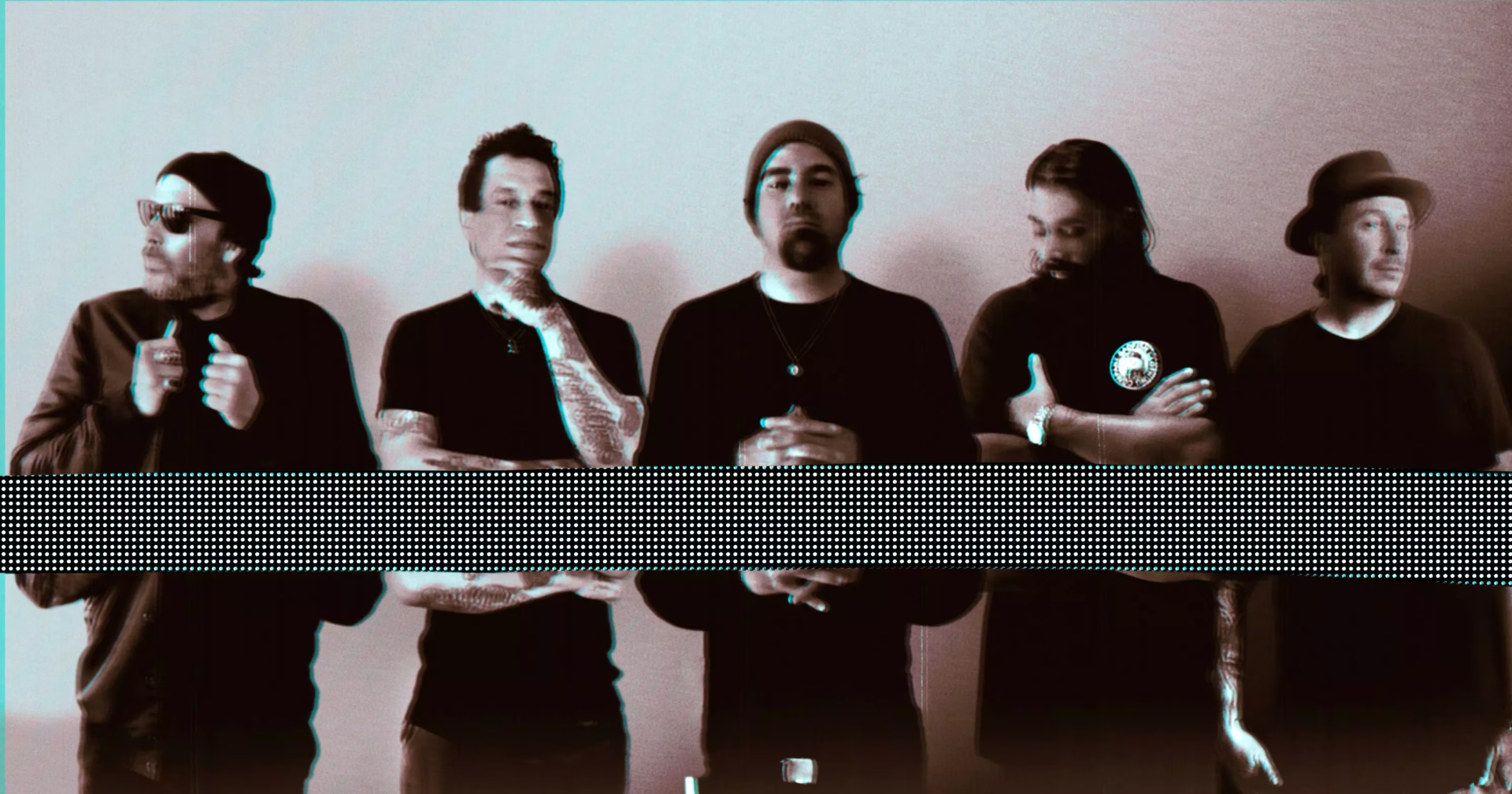
The year 2000 feels like a lifetime ago for Chino Moreno, frontman of Deftones. The year that birthed the Sacramento alt-metal luminaries' most commercially successful album, White Pony, no doubt is a long time ago, but 2020's pandemic—combined with hurricanes, wildfires, racial reckonings, a heated presidential election (just to name a few)—makes the new millennium feel like more like a century ago. Looking back on the band's third album, Moreno is reflective regarding their sound's longevity. "It's a trip, man," he says on the phone from Portland, Oregon. "It seems like forever ago, and I guess it kind of was in a way, but it's awesome that that record still carries so much weight to it."
A band that formed in the late '80s, Deftones have developed a catalog that blends nu-metal, hard rock and synth sounds with anything else that tickles their fancy. They are experts at crafting a soundscape that introduces hard and heavy guitar and drums to softened undertones. It's all married by Moreno's vocals, which can go from croon to shriek. And they're still standing the test of time. This year, 20 years after White Pony's release, Deftones find themselves days away from releasing their ninth studio album, Ohms, out Sept. 25.
<style>.embed-container { position: relative; padding-bottom: 56.25%; height: 0; overflow: hidden; max-width: 100%; } .embed-container iframe, .embed-container object, .embed-container embed { position: absolute; top: 0; left: 0; width: 100%; height: 100%; }</style><div class='embed-container'><iframe src='https://www.youtube.com/embed/KUDbj0oeAj0' frameborder='0' allowfullscreen></iframe></div>
At a time where every day takes us even more into the unknown, Ohms, packed with the familiar heaviness (in both sound and lyricism) will come as a comfort to fans. But this time, their music won't serve as escapism; it's more grounding than ever.
Despite the familiarity, Moreno finds himself in new territory. He is more open, more vulnerable than ever, he explains: "Usually, I steer away from [vulnerability] a little bit. I think it was just like the music itself. I connected with it in a way where it was calling for that."
Moreno recently spoke with GRAMMY.com about opening up on Ohms, going into isolation during the making of the album and how he feels about isolation now. He also covers painting with words via songwriting, connecting to his Latinx fans, taking a risk with White Pony and more
You're releasing your first album in four years. How are you feeling?
Pretty excited. I mean, obviously it's a little different than what we're used to, usually at this time we'd be on tour, out ready to support the record itself. Yeah, it's a little different, but actually it's been good for us to have something to focus on in these times of uncertainty. It makes you feel a little normal, just being able to put the finishing touches on it and put it out there and hopefully have people enjoy it.
The album has a very familiar sound, but it hits different right now with everything going on. It makes you feel present instead of trying to escape reality. Do you mind that?
No, not really. Music has always kind of been about escape for me in a way, but I feel like lately, and probably, like you said, a little bit more with this record, it kind of feels a little more present. I sort of opened up a little bit more on the record. There's still some anonymity there. It's still doesn't feel like it's just this direct message. I let some more of my, I don't know, just my personal vibes into it. Usually, I steer away from that a little bit. I think it was just the music itself really. I just connected with it in a way where it was kind of calling for that. I think the songs kind of had this tension to them that brought that out of my lyrics and my vocal performances.
Is it freeing for you being able to do that on this album?
I don't know if it's freeing. It's still a little scary. Honestly, it's not the most comfortable thing. I always had a hard time writing lyrics and communicating and being direct. It's just with a lot of the records that I even like, too, I usually gravitate towards things that are a little bit more obscure. So when I'm making music, I tend to lean that way. But even with this, it still has that kind of obscurity to it, whatever. But I think certain things bleed through a little bit more. And it's weird because a lot of the record itself was actually written and recorded mostly before everything that's been going on in the last six months or so. But it's weird and ironic how it's very... it sort of mirrors kind of what's going on. Not the whole thing, obviously in general, but I feel like a lot of things that [are] reoccurring in the record are very bearing to current times.
<style>.embed-container { position: relative; padding-bottom: 56.25%; height: 0; overflow: hidden; max-width: 100%; } .embed-container iframe, .embed-container object, .embed-container embed { position: absolute; top: 0; left: 0; width: 100%; height: 100%; }</style><div class='embed-container'><iframe src='https://www.youtube.com/embed//fbp0bET06wc' frameborder='0' allowfullscreen></iframe></div>
"Ohms" means a unit of electrical resistance. After hearing you talk about how were able to open up a little bit more, I'm wondering if you're resisting something else on the album?
No. I think it's also about connection.
I think that really rears its head a lot in a lot of the words of the record. For me personally, I was dealing with a lot of feelings of isolation and working through all that stuff. And that was like a physical thing of me just sort of being away from everybody for a long time. I'd spent about five or six years living out in the country, away from all my friends and all the people that I've made music with. Before that, I was living in Los Angeles. I was always around music or my friends who make music and I was constantly always filling that creative void. When I went on my own, I was like, "Okay, well, I'm just going to sit here and I'm going to make a bunch of music and I didn't make any music." I literally just—I'd go out to the mountains by myself and I'd hang out, and I liked it at first. But there was no balance there. At some point, I started to long for connection and conversations and just being a part of society again.
And so a lot of that stuff made its way into the lyrical content of the record. And like I said, the songs themselves kind of had that feeling to them. So with the title, it's obviously hard to title, to have one thing [encompass it all] because the record is not a concept record in any way. So it's hard to just think of a name that's going to blanket the whole... There's no statement there, or anything like that. I just felt like it really made sense. I mean, there's obviously this resistance and creating energy amongst the five of us as well. We were all sort of polarized in the way that we work. Everybody comes from a different place and I think that's what makes Deftones. It's kind of a beautiful thing in a way because if we all came from the same place, I think our music would suffer from being too one-dimensional. As to where there's a lot of push and pull involved in the songs themselves, so I think that's kind of always been one of our strong points.
Your title track was inspired by the environment. Tell us how.
Basically the state of the environment now. It was kind of literal when it came out, but then I realized that whether the song could be adapted obviously to a relationship, or whatever, where you are today is pretty much because of all the choices you've made coming through. So like I said, the very first adolescent mind in me just said, oh, this is definitely—and I never really write songs specifically about one thing—I like to keep it open-ended like that. But when a lot of people were, you know, because everybody has a different—it means something different to them. So I left it open-ended enough as it is.
But yeah, to answer the question, when they asked me like, "What did you write the song about?" That was, honestly, the first thing that clicked in my head. But then it very much opened up to a much broader spectrum.
I want to get into the lyrics a little bit. You write, "Through the haunted maze in your eyes, right through where I'll remain for all time." This could be in a poetry book. Are you inspired by any poets or writers at all?
You know what? When I was younger, like maybe a teenager, I think all teenagers get into this romantic phase. I used to try [to write poetry], but it used to always come out pretty hokey. My vocabulary is not that huge. I only have a high school education. But my favorite class that I did have in high school was creative writing, so I've always liked to kind of paint with words. And I feel like I've done that in a lot of our records, some more than others, but I don't really read books of poetry. I'm not really... I love music and I love when artists, when they paint pictures with their vocals. There's a vibe that's kind of given off and then the words fill in these gaps and it's not just like such a literal thing. Then, like I said earlier, you make your own interpretation of it and it kind of makes it special to you.
Your music puts together very heavy sounds with these subdued, rich undertones. Did you always set out to do that with your music?
I don't think it was something that was intentional or preconceived in any way. I think it was just what we grew up listening to individually and collectively. I've never felt comfortable with fitting in any one box, even from when I was young. In high school I hung out with everybody. I hung out with the goth kids. I was a skater, but I hung out with the preppy kids who listened to Pink Floyd and just everything. Some of the rap kids, everything. I listened to everything growing up and I never felt comfortable just having to pick a music that I was going to make, or at least that I was going to like even at that time. But especially when we're making music, We all continue on with that thought. I mean, yes, I think we are a rock band, you know what I mean? And the majority of it does have these heavy undertones, but to just box ourselves into that, I have never felt comfortable. So I feel like we've always drawn from influences from all the stuff that we grew up liking and loving.
Some of your fans like to really geek out on your synths on Reddit. How are you incorporating those sounds on this album?
I'm a big fan of a lot of synth music—from my childhood until now. When Frank [Delgado] first came into the fold, he didn't have any instruments and he didn't play any instruments, he was a DJ. So when he started using his turntable, we brought him in to bring in some kind of soundscape and more sample stuff. It wasn't about scratching or to add a hip-hop element at all to the music, he sort of blended. Our idea was to have him blend in where you almost don't know he's there. I feel like with now, even with the synths, although there are more, since he started getting more into instruments and bringing synthesizers into it, I still think that we try to keep that [idea of] mentality it not being [there]. If you hear the first song on the record "Genesis," there are synths present obviously on the intro, but throughout the song as well. Throughout the song when you hear them, they're there but I think we're very cautious of not making them overbearing as well because there's one thing that's important, that is as much as I love synth, they, along with guitar, don't blend well. They do, but if you turn the synth up too much, it takes away from the attack of the guitar. So then it can soften where a song should be heavy, it was written heavy, the synth can take that away from it. So the blend of it has to be right. And so that's kind of the task sometimes. We work hard on that because it's something that we love, but like anything you don't want to overdo it, you want to make it so it sounds organic and not like we shoved it in there just for the sake of doing it.
This is your ninth album. How reflective is it of where you are as a band?
I feel like it's pretty damn reflective. All our records are sort of a snapshot of that time. And obviously some times are better than other times, as far as us and the way that we work together. We've been through some tough times here and there. And I think those records kind of mirror that as well. This record, to me, it sounds very solid to me. If I had to compare it to a lot of our other recordings, I feel like it's a very solid recording. I feel like we spent a good quality of time on it, so I feel like the quality in general is there. Us as a band and as friends, more than anything, we're very engaged and having a really fun time making it. Although it's not like a party record in any way, there were a lot of laughs and a lot of good times making it. I feel like that reflects definitely when you hear the record in its entirety and hear that it's a solid piece of work and not something that was just slapped together at all.
You worked with Terry Date on this and you hadn't worked with him for a minute. How did he help you bring your vision for this album to life?
He's a really great sixth member of the band. We have a very close working relationship with him since the mid '90s when we did our first record with him up through our fourth. And then our sixth record we started with him and we didn't finish it. That was when our bass player was in a car accident, so at that point, we cut the record. We weren't finished with it, but we stopped working on it. When we continued again, we sought out a different producer, not because we didn't want to work with Terry but just because we wanted to start something brand-new from scratch. We felt like that might be the way to go as far as getting us in a whole different city and in a different studio with a different person.
So we did a few records with Nick Raskulinecz, which were great. But I think during that time, we all missed working with Terry just because, like I said, our friendship and our working... what's a good word? The way that we work with him, basically, it's very comfortable in a good way, where it's almost like you can try anything and it's just like there's no getting to know each other and figuring things out. He really is open, he's patient, and gives us space to sort of find our own way through making our songs as opposed to like trying to dictate where things should go. He is the best person I think that brings everything out of... lets everybody be themselves, lets everybody shine, I guess, in the best way, and captures it.
I grew up in L.A. and I remember listening to Deftones on KROQ thinking like, damn, this is such awesome music. And then I found out your name was Chino Moreno, not knowing what you looked like at all, but thinking like, damn, that's dope. That's a name that sounds like mine. Do you ever think about how much something like that might mean to your Latinx fans?
Yeah, I see it. When we travel. I notice we have a big Latin following and it's awesome to see faces, familiar faces, that you don't know, but they look like my brothers and sisters, my cousins, it's awesome. There's this connection that's there, that's just sort of unspoken. But we can go, especially through Texas, it's wild. You can go through there and you see so many just familiar faces and people and you just see just the love that's just like, and the passion really. You know what I mean? From these fans, it's really, it's a beautiful thing.
You recently celebrated 20 years of White Pony. How is it looking back at that album all these years later?
It's a trip, man. It seems like forever ago, and I guess it kind of was in a way, but it's awesome that that record still carries so much weight to it. When we made it, we obviously were taking a chance doing something that was a little different from where contemporary music was, you know? What was being played on the radio or MTV at the time. In our minds, we didn't know that anybody would even like the record. But we definitely were really into what we were doing and we didn't look back. And when it came out, it was sort of a lukewarm response. I mean, a lot of our fans liked it, but a lot of our fans didn't like it. What was crazy is that because they were used to just Deftones [being] in your face 90% of the time, 10% trippy shit. But this was like kind of maybe 50% trippy shit, maybe 50% in your face. So I think they just wanted more aggression from us, and I think we were just in a different place. Some of our fans, I don't think... It grew on them. But some of them just like, yeah, they did not get it.
What was cool is that we gained a bunch of different new fans that just only knew us from that and liked us for [that]. It was their first introduction to us. It's probably our most commercially successful record, and we're very proud of it. I'm happy that it's stood the test of time and people still react to it and are moved by it.
Is there musically something that you haven't done but want to do?
Nothing in particular. I definitely want to continue making music. Like I was saying earlier, I was, for a few years, maybe like six or seven years ago. I was really, really prolific. I was doing a lot of projects, like tons of side projects, along with Deftones, everything. And I was loving it. It was really, really fun, but it was when I lived in L.A. and I was surrounded by all my friends and musicians all the time. It was like it was just a natural thing. Then I stopped I stopped making music for awhile. I did one Deftones record, and that's about it really, in the last four years or so besides this Deftones record. So I'm looking forward to start doing more projects, collaborating with different people. That's really fun for me. And that's kind of one of the best ways I like making music is collaborating as opposed to just making music by myself. I love reacting to what someone else is playing and going back and forth, to me that's really, really fun. So I look forward to doing more of that.
Earlier you mentioned during the process of making some of these songs, you went off to the country and you felt isolated. How have you been doing with the isolation the pandemic has brought?
It's tough. I have two older sons who are in their 20s who I haven't seen. They live in Sacramento. I live in Oregon right now, in Portland. I was with them maybe two weeks before the shutdown happened. I went down there and stayed for like a week. My mom and my dad both live down there too, so all my brothers and sisters. I was seeing my whole family. Since the shutdown, I haven't gone, I haven't been able to see them. I get in like these little—and I'm sure a lot of people deal with this so I'm not saying "poor me" because I know everybody's in the same boat now—but yeah, I miss them and I want to spend time with them. But everything's very delicate still, so it's a difficult thing to do, but I plan on, in the next couple of weeks, doing that. So I have something to look forward to. I just try to keep optimistic and positive about it.
Doves On Their First Album In A Decade & Why They’re Still Trying To Stay Patient