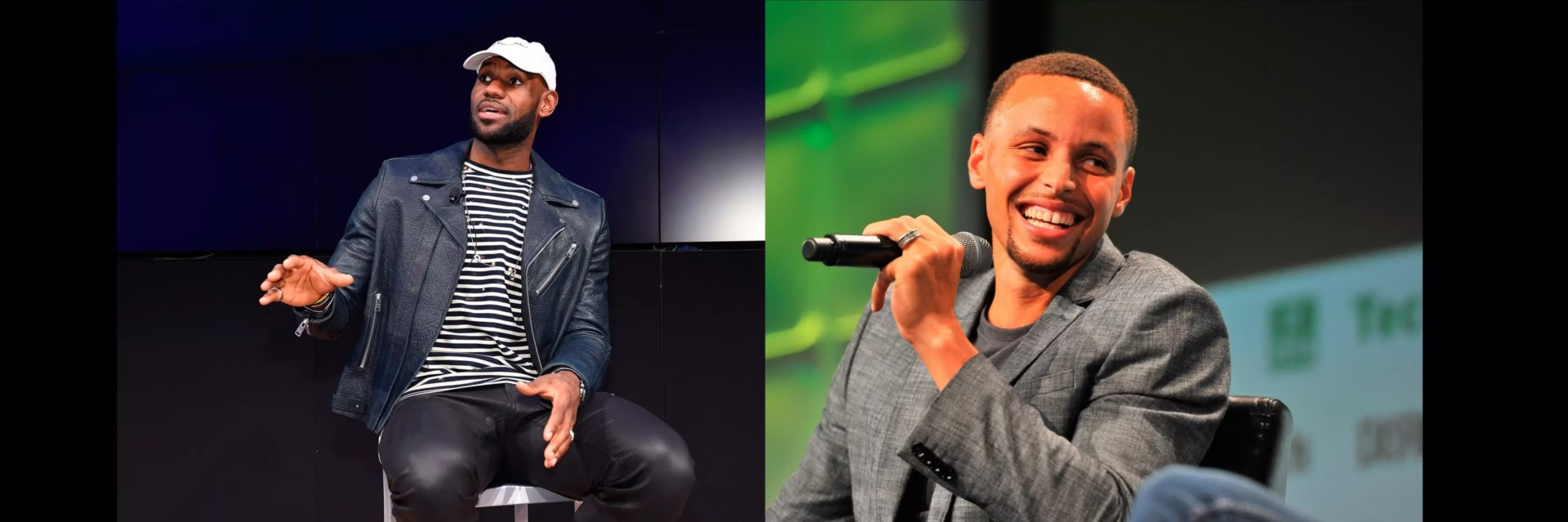
Basketball excellence will be on the primetime stage as Stephen Curry and the Golden State Warriors and LeBron James and the Cleveland Cavaliers lock horns for the third consecutive year in the 2017 NBA Finals, tipping off on June 1.
Excellence in primetime is no stranger to The Recording Academy. For nearly 60 years, The Academy has celebrated music excellence via the GRAMMY Awards, currently crowning recipients in 84 categories.
On the surface, dribbling a basketball and record production or strumming a guitar couldn't be farther apart. But those looking to transform themselves into a world-class athlete or virtuoso musician can find common ground in the science and methodology of achieving mastery. Indeed, the consummate musician is always in search of knowledge, and one can look to NBA all-stars and hall of fame coaches for a sea of inspiration and ideas.
Take Curry, the reigning NBA MVP for two consecutive seasons, who is lauded as the game's best shooter. Though talent is unquestionably part of the equation, it's serious dedication to his craft that has lifted Curry above the rim. A big believer in repetition, Curry — who reportedly once hit 77 three-pointers in a row in practice — puts up 1,000 shots in practice every week and he goes through an intense 90-minute warm-up routine before each game.
James, a four-time NBA MVP, is noted for spending endless hours working on different shots, including hook shots, layups and jumpers. As outlined in Jennifer Etnier's book, Bring Your "A" Game: A Young Athlete's Guide To Mental Toughness, James repeats shots over and over, noting nuances such as his body position, footwork and release points. In game play, James focuses as the plays unfold and reacts naturally, letting his instincts and subconscious take over as informed by the repetition in his practice.
Just like Curry and James, for musicians looking to up their A-game, the development of an effective practice regimen is seen by many professional musicians as crucial. Rather than noodling incessantly, a musician will benefit from a focused, strategic practice schedule in alignment with their personal music goals.
Within that regimen, whether drilling a new scale or working on a difficult solo passage, the right kind of repetition is key. As outlined by SonicBids, the "mindful" musician uses repetition in a slow, thoughtful and precise manner. For example, when practicing a passage, the "mindless" musician will repeat it until it sounds like all the notes are correct, while the mindful musician spends time repeating the opening phrase to ensure it's letter perfect, and then rinses and repeats. When it comes to performance, the music will flow more naturally from the mindful musician, just like a patented Curry three-pointer.
Similar to the relationship between a music student and music teacher, an NBA coach can provide leadership, insight and directorial guidance to help shape a player. But it's the superlative coach who can take a group of players and usher them from the first-round of the playoffs to the Finals.
Music education: 2018 Music Educator Award quarterfinalists announced
Pat Riley, a Naismith Memorial Basketball Hall of Fame inductee, was renowned as a master motivator in presiding over NBA titles with both the Los Angeles Lakers and Miami Heat. While Riley identified skills as of obvious importance, his coaching code placed a focus on attitude.
"The difference between people who are skillful and merely successful and the ones who win is in attitude," states Riley. "The attitude a person develops is the most important ingredient in determining the level of success. … If you can find people who really want to be a part of a great team, of something significant, to do something for others, for their teammates … then you've got yourself people who are special."
Applying Riley's thoughts to music, a successful band can be seen as a team activity, and a team with the winning attitude is one that will likely rise to the top. Writing for LinkedIn, John Sadler identified how a winning attitude informed by virtues such as respect is the crucial element to a band's success. Some of his helpful tips for instilling positive attitudes among bandmates include showing up on time, coming to rehearsals prepared, listening effectively, and discussing and outlining goals together as a group.
Also a hall of fame coach, Phil Jackson won 11 NBA titles with the Chicago Bulls and Los Angeles Lakers. While stars such as Michael Jordan and Kobe Bryant made outstanding individual contributions, it was Jackson's unique approach to coaching that helped him manage star personalities and ultimately put his teams over the top.
A big proponent of mindfulness and mental strength, Jackson — who earned the nickname the Zen Master — used coaching tactics such as inviting players to meditate, practice in the dark and practice yoga.
"As much as we pump iron and we run to build our strength up, we need to build our mental strength up," Jackson told Oprah Winfrey. "We need to build our mental strength so we can focus, get one point at attention and so we can be in concert with one another in times of need."
Inspired by Jackson's philosophies, future hall of famer Bryant worked with mindfulness expert George Mumford throughout his career. Mumford, who also instructed Jordan, helped instill in Bryant the Zen Master-approved mechanism of meditation to cope with the intense pressure of elite athletic competition.
"I meditate every day," the now-retired Bryant told Winfrey in 2015. "I do it in the mornings and I do it for about 10 or 15 minutes. I think it's important because it sets me up for the rest of the day. … If I don't do it, I feel like I'm constantly chasing the day."
Many articles have outlined how meditation can benefit musicians. Writing for The Guardian, pianist/composer Rolf Hind explained how meditation helped him find new purpose as a musician.
"For me, the practise of meditating … has brought an enormous amount to my life and music-making," wrote Hind. "[I have] a sense of clarity and control, less neurosis about ambitions and 'career,' greater efficiency, awareness and body sense as a pianist. As a composer, I'm more in touch with the sources of my own creativity."
As the saying attributed to the great painter Pablo Picasso goes, "Good artists copy; great artists steal." In the context of music this is not meant to be taken literally, but musicians who borrow ideas and strategies from successful people — in this case, all-star basketball players and hall of fame coaches — will surely take their game to an MVP level.