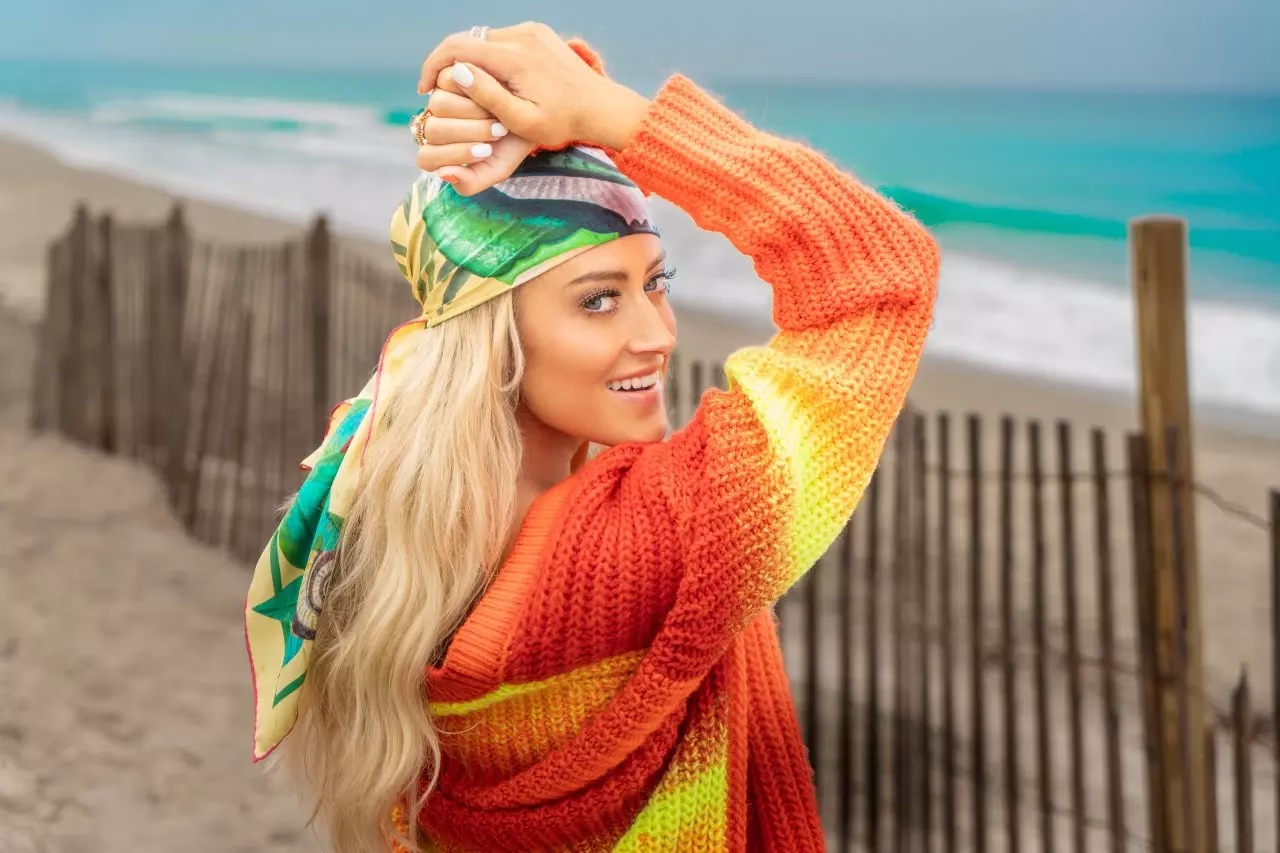
Brooke Eden once stared down the barrel of a heart-wrenching decision: Her livelihood or the love of her life. The singer/songwriter's chosen mode of expression was country music, a genre stuggling with LGBTQ+ inclusivity. And the love of her life, radio promoter Hilary Hoover, happened to be of the same sex. As somebody in Eden's circle informed her, she couldn't have both.
"I don't like to [name them] because I don't even want to give them the time of day for that," Eden tells GRAMMY.com over Zoom with an edge to her voice, "but it was a member of my team who's no longer on my team. He straight-up, to our faces, said, 'If you want to have a career, you have to keep your relationship a secret.'" This quandary stressed out the singer so badly that her physical health declined and she developed ulcers. Then, she threw up her hands and announced she's "Got No Choice."
<style>.embed-container { position: relative; padding-bottom: 56.25%; height: 0; overflow: hidden; max-width: 100%; } .embed-container iframe, .embed-container object, .embed-container embed { position: absolute; top: 0; left: 0; width: 100%; height: 100%; }</style><div class='embed-container'><iframe src='https://www.youtube.com/embed//r-nct1tFavw' frameborder='0' allowfullscreen></iframe></div>
That's the title—and part of the ascendant hook—of Eden's latest single, which acts as a rebuttal to that bad-faith imperative. In the video, Eden jet-sets around with Hoover by her side, accompanied by the infectious tune. "But the sound of my name rollin' off your tongue/ Couldn't sound sweeter from anyone," goes the pre-chorus. "This heart wants no one else and I can't help myself."
"I realized if I was ever going to put out music again, I would need to be completely authentic and myself in order to do it right," Eden says of the period leading up to "Got No Choice." Now, with perhaps her signature song under her belt and a full itinerary as gigs fire up again, Eden has proven this unnamed naysayer wrong—and shown how sweet it is to have it both ways.
Read on for an interview with Eden about increasing LGBTQ+ representation in country music, how external pressures tested her relationship and why recent strides are just the beginning for a fairer, more equitable Nashville.
<style>.embed-container { position: relative; padding-bottom: 56.25%; height: 0; overflow: hidden; max-width: 100%; } .embed-container iframe, .embed-container object, .embed-container embed { position: absolute; top: 0; left: 0; width: 100%; height: 100%; }</style><div class='embed-container'><iframe src='https://www.youtube.com/embed//NS3xNWuEDuQ' frameborder='0' allowfullscreen></iframe></div>
This interview has been edited and condensed for clarity.
What can you tell me about the intersection of the LGBTQ+ community and country music, historically speaking?
Historically speaking, there's not much [chuckles]. There's not much of an intersection. Now, things are changing. This whole genre of music is changing right now. It's so cool to be part of that change and watch it happen as we're living in it. Inclusivity for not only the LGBTQ community—me and T.J. Osborne, for example—but also different cultures and colors of skin.
Mickey Guyton is one of my best friends and she's finally getting the recognition she deserves. The only thing that was holding her back was that she was a Black woman.
What's up with the ingrained homophobia and racism in Nashville?
I think that there's ingrained homophobia and racism in our country as a whole. I think so much of that has to do with organized religion and the ways they've talked about homosexual behavior. I think it's very sad that people hide their homophobia and bigotry behind the Bible. It's so backward.
But I think so much of it—especially in the country music genre—is that so many people that are listening to country music are from very small towns and sometimes have never left that small town. It's not a city or even a suburb where you can live your life and be who you are. It's sometimes very closed-minded, just because they haven't ever seen representation and visibility of great people and artists who just so happen to be in the LGBTQ community.
I just think that the more representation and visibility we have marking the pop culture of America, the more of these small-town listeners will realize that our love looks like their love and that you should never judge someone by the color of their skin. That's still so mind-boggling to me.
Can you talk about some of the challenges you've faced due to your sexual orientation?
Some of the challenges are just that I'm a female in general. For a long time, it was hard to be played on country radio just being a girl, which is so crazy because, in the '90s, I grew up singing along to Shania Twain and Faith Hill and Martina McBride and the Chicks. All of these incredible female artists.
And then, for 10 years, we've pretty much had Taylor Swift, Carrie Underwood and Miranda Lambert. And if you were a female other than those three trying to knock on the door, you just weren't going to get answered. You weren't going to get let in. But that's also changing.
Basically, it started at the beginning of our relationship, when Hilary and I met five and a half years ago. We immediately faced pushback and them saying, "Basically, you can have a career in country music or you can be in a relationship, but you can't have both."
That's one of the reasons I wrote "Got No Choice," because I, first of all, thought that was a made-up rule. Who made up that rule? Second of all, I knew that not loving her was not a choice for me. That was my person and I was going to continue to be in a relationship no matter what the rest of my life looked like.
Brooke Eden. Photo: Ford Fairchild
Was this something you heard abstractly, as though you were taking the temperature of the culture? Or did someone literally tell you that?
They told me. I don't like to [name them], because I don't even want to give them the time of day for that, but it was a member of my team who's no longer on my team. He straight-up, to our faces, said, "If you want to have a career, you have to keep your relationship a secret." There were no ifs, ands or buts about that.
Did you ever have a moment of doubt where you thought "He must be right"?
Oh, yeah. For sure. There were definitely times that I was like, "How are these two parts of me ever going to coexist?" I didn't know if it would ever happen. There were years and years of figuring out how to navigate this, knowing that Hilary was my person and also knowing that I had spent my whole entire life working toward this career, toward being an artist. It was very difficult.
It was so unhealthy to continue to live my life disingenuously. I had no authenticity. I had no integrity. I was living two completely different lives—one at home in our close circle of friends and family and one on the road where I never spoke of the love of my life. It's just a very unhealthy way to live.
At some point, I was going through so much mental and emotional turmoil that I got ulcers from bottling things up and not dealing with my situation. My doctor made me get off the road because of how unhealthy my body was. That was a big wake-up call for me.
It was this moment where I realized if I was ever going to put out music again, I would need to be completely authentic and myself in order to do it right.
I want to get Hilary's read on this. How did she feel throughout this ordeal?
I think she's just so grateful that we're finally on the other side of this. There were so many times when we were going through the hard parts of this that we just held each other and sobbed. We were like, "Are we ruining each other's lives?"
Hilary was out when I met her, I put her back into the closet and then she's being told every single day that she's ruining my career. We were so happy and so in love, but the outside world was putting so much pressure on our relationship. I think we've been through so much that just being on this side is so wonderful.
She's the best human on the planet if you ask me, and she always has wanted to be a voice for the LGBTQ+ community. She's so supportive and such a big part of everything.
It seems like LGBTQ+ representation in country music will be a continuous process without a clear finish line. That said, what's the next step, in your mind?
I think it's just at the beginning. We've just cracked the surface. T.J. Osborne coming out was awesome because he's already at such a level of success. [But] they're still not playing Mickey Guyton on the radio. Still. After her GRAMMY nomination, they're still not playing Mickey on the radio. [Editor's note: In March 2021, Billboard reported Guyton's "Black Like Me" was sent to Adult Contemporary stations. after her GRAMMY performance.]
None of my songs have gone to radio yet, as we're just getting started. But hopefully [we'll experience] the inclusion of everybody on country radio—and not just white dudes singing about white girls.
