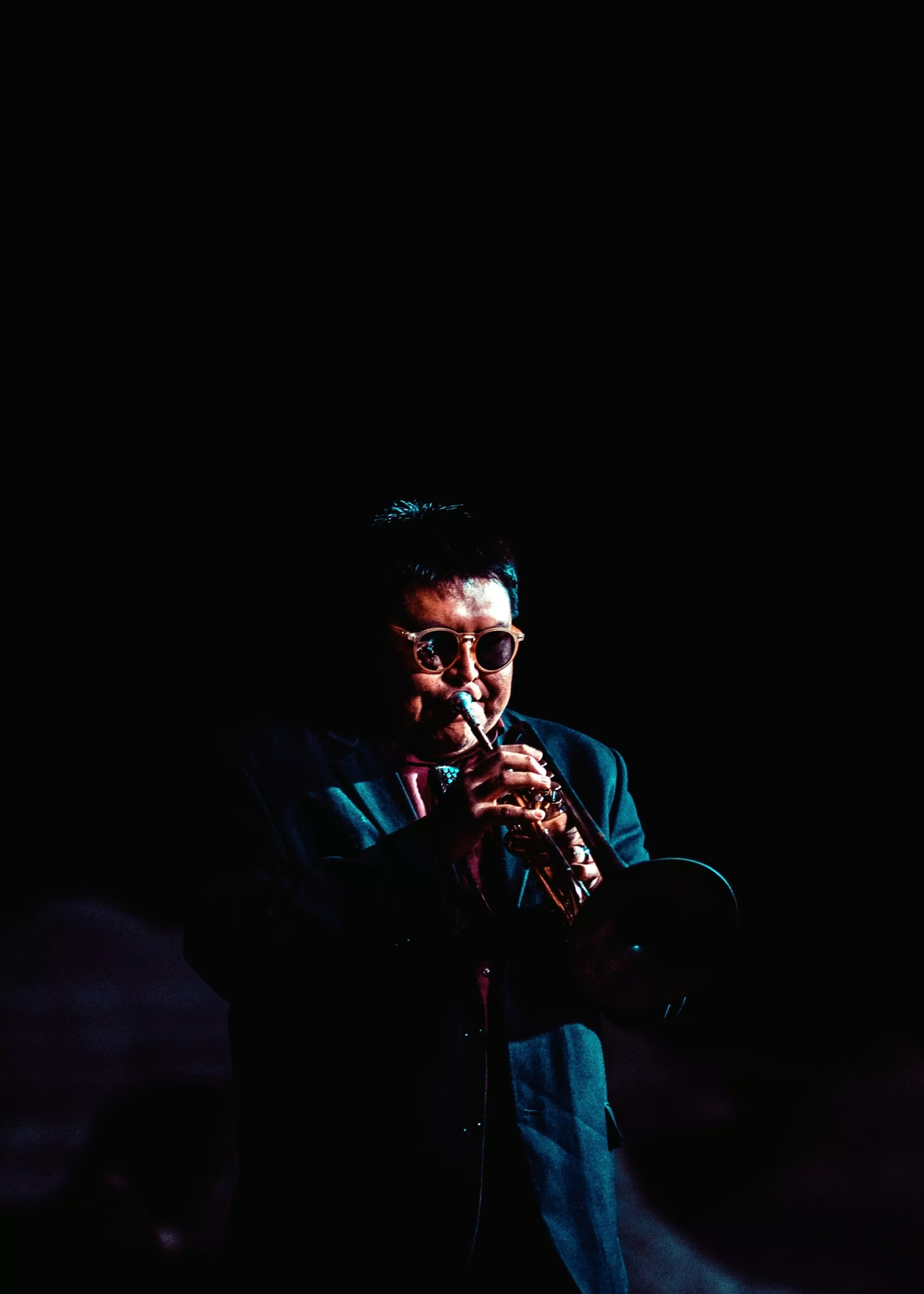
The universe of Native American heritage contains a fount of traditional melodies. There's just one problem: Hardly anyone remembers them.
When New Mexico trumpeter Delbert Anderson needed new inspiration for his jazz trio, he rolled out to an Aztec library and looked for Indigenous music. As a man of Navajo descent himself, he wanted to dig deeper into his ancestry. What Anderson found was a tape of “spinning songs”—essentially, songs dictating social interaction—chanted by Navajo chiefs. "It was really hard to pick out a melody," Anderson admits to GRAMMY.com. "The melodies that caught my ear were what I focused on."
Needing to know more, Anderson, a faculty member at San Juan College in Farmington, New Mexico, consulted traditional Native families, but their memories were hazy. What they could hum from memory, despite not knowing the origin, he connected to the Navajo spinning songs and learned two things. One: They were mostly in pentatonic, or specifically, minor pentatonic. Two: They were sticky and memorable enough to create stellar jazz tunes—ones that respectfully approach Native American musical tradition while also fostering an accessible experience for listeners.
<style>.embed-container { position: relative; padding-bottom: 56.25%; height: 0; overflow: hidden; max-width: 100%; } .embed-container iframe, .embed-container object, .embed-container embed { position: absolute; top: 0; left: 0; width: 100%; height: 100%; }</style><div class='embed-container'><iframe src='https://www.youtube.com/embed//nJwhcoeFA64' frameborder='0' allowfullscreen></iframe></div>
Thus, Anderson has staked his claim on an almost-untouched corner of music: Native American jazz. Along with bassist Mike McCluhan and drummer Nick Lucero, joined by a succession of hip-hop MCs, he skillfully braids Indigenous melodies and syncopated grooves in a way that can appeal to purists in either camp. This is evident on his albums like Manitou (2014) as well as his 2021 virtual concert series throughout New Mexico and Colorado, which earned a $30,000 grant from the Doris Duke Charitable Foundation.
GRAMMY.com gave Delbert Anderson a ring about his straight-ahead jazz beginnings, how he began communing more closely with his Navajo roots and how he mourns the melodies lost to time that double as a fertile source of mystery.
<style>.embed-container { position: relative; padding-bottom: 56.25%; height: 0; overflow: hidden; max-width: 100%; } .embed-container iframe, .embed-container object, .embed-container embed { position: absolute; top: 0; left: 0; width: 100%; height: 100%; }</style><div class='embed-container'><iframe src='https://www.youtube.com/embed//94FH2QtxX-Y' frameborder='0' allowfullscreen></iframe></div>
This interview has been edited and condensed for clarity.
I'm amazed by the melodic strength and integrity of some of these Native American tunes you transmuted into jazz. Where did they come from?
We started out playing jazz standards, and we weren't getting anywhere. We sounded like every jazz combo in the world! [Laughs.] So, we decided to dig a little deeper into everyone's culture. Mike [McCluhan], the bass player, obviously, is white. [Drummer] Nick [Lucero] is Hispanic, and actually comes from Peruvian culture. At the same time, both of them were urging me, "We need to do something Native American, with that kind of influence."
So, I went to this Aztec library that's 12 miles from where I live right now. I found this tape of Navajo spinning songs. At that time, I didn't really know what spinning songs were. I knew of them. But after doing a lot more research and speaking with some of the elders that are still on the reservation today, [I learned] they were basically social songs that taught their children or outsiders manners or how to operate. It's really neat that they used music to teach those things.
Just an example: When the song starts, it's the male who would have to ask politely for the lady to dance. There was a certain gesture they would make. They would dance, and that was a time they would get in a conversation. They had a very specific dance. It seemed pretty intense. It wasn't like today, [where you're] both dancing however you feel like. There were certain structures to it. It was really well-disciplined.
They had songs for everything. They had songs for love, songs for war, ceremonial healing-type songs, but there were also just spinning songs. The Navajo spinning songs that I started to be influenced by were those social ones. The reason why I chose those songs was that I didn't want to be playing ceremonial, sacred music and then get in trouble by someone who says that it's too sacred to share. [Laughs.] We ran into a lot of that stuff all the way through.
The melodies that caught my ear were what I focused on. We paid attention to how we mixed those together with the Latin [melodies] that Nick brings and the jam-band that Mike brings. We found out the hard way that when we create really heavy Navajo melodies, we lose the audience a bit. We lose certain people because it becomes a little too native; we fall into a hard, general category of being just Native American music.
We paid close attention to fusing those songs together to where it blends better or has a more palatable sound to everyone versus a particular demographic.
I feel like the average American may be aware of Native American history, but not be able to subdivide it. I'd like to place these melodies at a specific point in history. In the context of Navajo people, at which point did these tunes spring up?
This is something that's always been a little weird for me. Because, to tell you the truth, I didn't really grow up 100% traditional.
The only traditional music I know probably comes from my grandparents when they were traditional. Actually, both sides of my grandparents [converted] to Christianity at a later time in their lives. However, they used to be traditional, and they made this decision to follow a Christian faith instead of their traditional spiritual faith that most Native Americans follow right now.
I was still a baby when they were traditional. I would say when I was 14 or 15, that's when they decided to [convert] to Christianity. They never allowed me to go to ceremonies or put that on me to go and learn them. However, when I started, in 2013, I started to do research. I went to some of the more traditional families and asked, "What is the earliest melody you guys can remember?" A lot of them couldn't recall, but they did some humming for me and I recorded it on my phone.
My paternal grandfather was really heavy [into] tradition and still remembered his great-grandfather's melodies. One of those—we haven't released it yet or anything—but he did the same thing. He hummed it out and said he had no idea where it came from. It's just something that his great-grandfather would sing around.
However, when I paired that melody with the research I found on the tapes from the 1920s [era], it was a bunch of chiefs singing chants. There were no words. It was just pure chants. I found some similarities. One was that everything was pentatonic. Most of the time, they were in minor pentatonic. In that tape from the 1920s—who knows when it came from—it was really hard to pick out a melody.
I honestly don't know how long these songs have gone back. There are a lot of musicologists, and even Native American musicologists, that say they've been way, way early. Like, as back to as far as we can trace. The thing that I found out is that everyone has a different story. Everyone believes it came about differently. It's hard to say when or where.
There are historians that have really hard dates. But even then, to figure out the music portion is very complicated. Nothing was written down. Nothing was preserved.
Delbert Anderson. Photo: Maurice Johnson
When you think of the knowledge that might be lost forever, do you process that in a grieving way or as a mystery to explore?
It's a little bit of both. I wish I could know straight out what a certain era sounded like. But the thing that keeps me going is that whole mystery aspect, too. I don't even know if I'm going to find anything else, more, but I'm starting to listen to these earlier tapes I found a little more closely. I'm trying to figure out, "Is there anything I'm missing?" That stuff is really encouraging; it keeps me going.
I am somewhat sad that there isn't a recording or a piece of paper that says what happened back then. I tend to stay more on the mystery side of things—figuring it out maybe later down the road.
I've also been looking into number sequences. The number four is really important to Diné culture as well as a lot of other cultures. I was trying to listen to the music and find a significance for [the number] four in their piece.
More in-depth research like that is what I've been clinging to. I'm still writing my own tunes, but [they’re] inspired by what I'm finding in the earliest recording I can find. That's as deep as I'm going. I don't know if it would make sense to visit some more places or talk to more elders. I've only been able to get, maybe, two generations back.
Anything like three or four [generations back], it's really hard. Everyone at that point is like, "I don't remember," or "I have no idea. I was too small." We never had historians. We kind of go on a telephone system.
I don't want people to walk away from this article—and this subject—simply saying, "Oh, that's cool." How can people interface with Native American jazz and support it?
I honestly never thought of it. One thing I try to do, especially when filling out grants or anything like that, is that I want to get to the core of the healing process of music. I think Native Americans share a lot of similar history with African Americans.
I think one thing is that our African American ancestors were able to get through the worst time ever in U.S. history. Not "get through it"; I know some were lost. But for the majority, a lot of African American ancestors got through that period of time, and they did it with music; they did it with self-expression. In fact, a lot of people now aren't calling it jazz. They're calling it "Black liberation music."
Liberation music itself is what I really wanted to focus on because I think there are similarities. The Native American tribes, we have the history of genocide and all that stuff. But there are people that got through it, and I'm wondering if any of those used these songs. Obviously, there are healing songs in our ceremonies and stuff like that, but I wanted to find the core reason for it.
It's a very tough question. We're kind of the only ones doing it, you know? There's not a lot of people that are trying to preserve this music. That's what I would say: We really want to highlight the healing components of this Indigenous music to everyone. I think the support would be to these areas of research of how liberation works, or how music really heals people.
People say it's good for the soul and it makes you happy, but there has to be more than that. If somebody wanted to support it, I would go with historian research, and almost like medical research, on this type of Indigenous music.