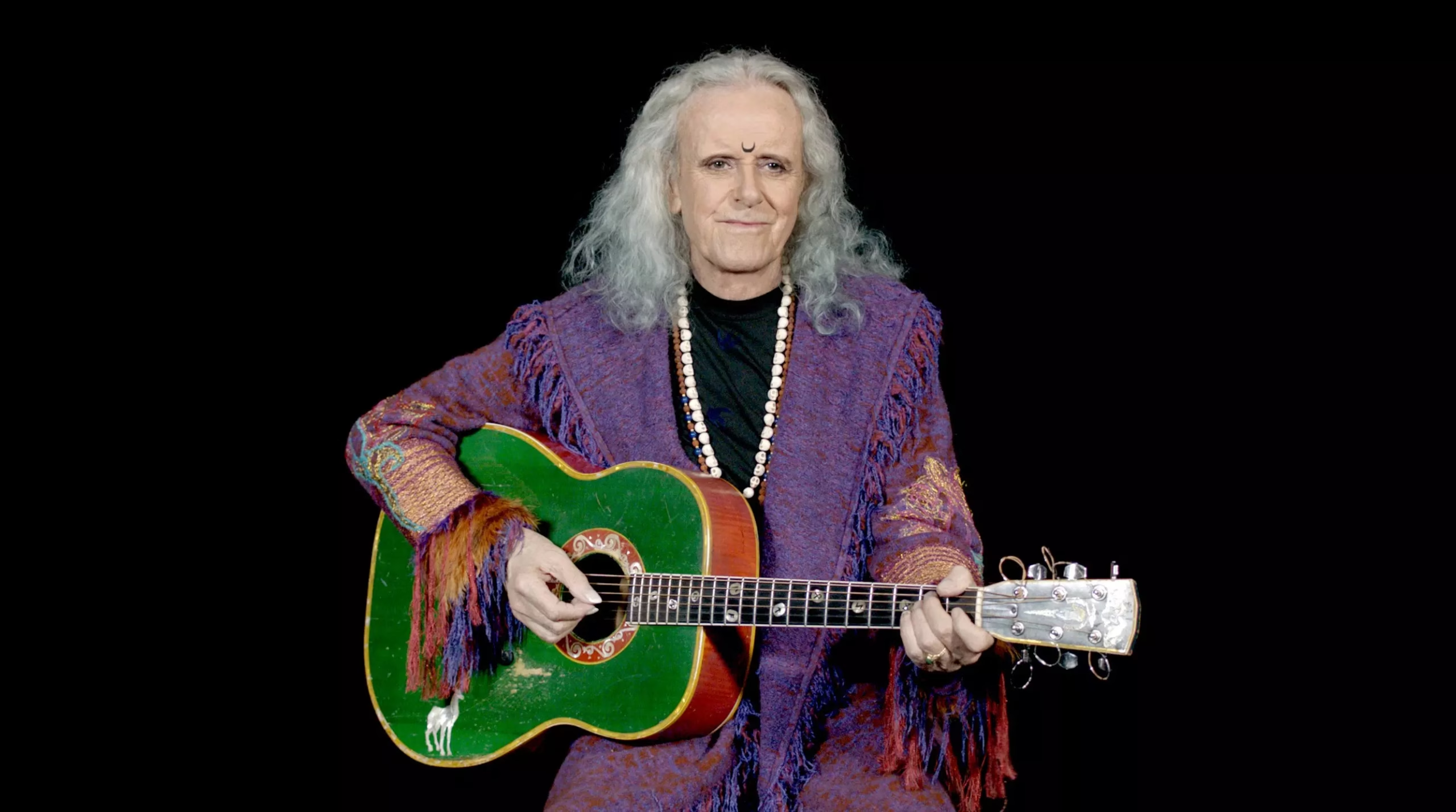
Fifty-five years after Clive Davis signed Donovan, the trailblazing A&R man and singer/songwriter sat down for an interview and performance at Davis' 2021 GRAMMYs celebration on May 15. For reasons one can probably guess, they weren't in the same room.
"The main problem was, what guitar should I use?" Donovan recalls thinking before his performance. "It's very bad sound through these Zoom microphones." After the 1960s star grabbed a classical guitar and beamed in his performance, the pair got to chatting about their epic history together, which predates the Summer of Love.
"Clive and I opened a new way ahead for music in 1966—he in a new way as a record label leader, me in a new way forward for music," Donovan tells GRAMMY.com, referring to his pivotal, Davis-facilitated 1966 album Sunshine Superman. "The new way was established. The effect would begin to influence bands to come. My shamanic mission for that time [was] accomplished."
<style>.embed-container { position: relative; padding-bottom: 56.25%; height: 0; overflow: hidden; max-width: 100%; } .embed-container iframe, .embed-container object, .embed-container embed { position: absolute; top: 0; left: 0; width: 100%; height: 100%; }</style><div class='embed-container'><iframe src='https://www.youtube.com/embed//V5i98tfyGac' frameborder='0' allowfullscreen></iframe></div>
Donovan's new single, "I Am the Shaman," and upcoming children's series, "Tales of Aluna," for which he and his wife, Linda Lawrence, have completed 26 episodes, speak to his ability to transform the world heart by heart. (The single is available on limited physical formats on his website; the show’s release date remains TBD.) The former, produced and with visuals by David Lynch, casts a purple-clothed Donovan as the titular healer. The latter teaches youngsters to steward a battered Earth.
Over Zoom, with his long, gray locks tucked beneath a hood, Donovan comes across not only as an ageless wizard of yore but a happy, vital artist in the now. "I had to be reminded I made four albums in two-and-a-half years," he says with a laugh. Two of those were 2019’s Joolz Juke, a bluesy collaboration with his step-grandson (and Brian Jones’ grandson) Joolz Jones, and 2021’s Lunarian, a mystical tribute to Lawrence.
GRAMMY.com caught up with the psychedelic-folk troubadour about his recent rendezvous with Clive Davis, the wild renaissance of his 1966 song "Season of the Witch" and his memories of his wholehearted 1965 debut album, What's Bin Did and What's Bin Hid.
This interview has been edited and condensed for clarity.
What does the word "shaman" connote to you, and what role does the spiritual realm hold in your daily life?
People who go online think of a shaman up in the freezing north of the world, dressed in ceremonial costumes. A very important role to play in the tribe. I've always known that there are shamans in all countries. My shaman's role is always, I've realized, to assure us that we're heroes of our own adventure. You see, the shaman has got a song, usually. That song is very helpful to the tribe, and, in my case, to a huge audience in the world.
Because the song of the shaman allows us to rise above our fears and doubts. We identify with the story in the song. Because we're doing this for the GRAMMYs, which is about music and song, I want to explain to you that one can see clearly when a modern song appeals to millions. Even though the language of the lyric is English, the song is understood in every language.
We identify with the story and the characters. They overcome their trials. So we need these shamans—the male and the female—to be guides on the journey of life. When you look at the old idea of a shaman, that's exactly the role he plays. [For] anybody in difficulty—and it's usually a psychological difficulty—the shaman is there to move that person into their place of healing. You know, [like I say in] the line in my song, "I Am the Shaman": "She guides us on our way/When hearts, they go astray."
This GRAMMY motto—MusiCares—expresses it quite clearly. The care, of course, can be physical. To help music-makers get the real healing is the invisible sound of music, which releases the obscure emotions of the heart. And that line in the song: "Who'll dry your pretty eyes?" I was committed to [being a shaman] very early. When a shaman is young, usually, that shaman gathers people around them; has some kind of skill, usually in music; and more often than not, has a childhood illness, which I had, which separates one from the others and makes you different.
Donovan in 1966. Photo courtesy of the artist.
What was it like collaborating with David Lynch for the visuals?
Well, it wasn't a planned session. It was obvious that at one point, we would run into each other. Before David became a huge promoter of [Transcendental Meditation] and created the David Lynch Foundation to bring TM essentially to schools and young people—now, it's quite wide, the range—Linda and I, and the Beatles, of course, were into TM. It was obvious I would run into David at one point.
So, when we did finally meet, it was in his studio. There, I had my guitar, of course. We got on really well. In the studio, he became interested in my process. He said, "Sit in front of the microphone, Don, with your guitar." So I sat, and he'd already said, "Bring a song in that is just emerging. Absolutely not even begun to be a song." I did, and he said, "OK, can you just play and write a song, sitting there? Just there?" I said, "Sure I can."
I started "The Shaman," and he said, "That's great. OK, let's roll tape." I started doing the song in a very special way that I do sometimes. Extempo. I was making it up as I went along. I only had a couple of structures, and the structures came out just right. This is a way that a skilled songwriter like I can just be open to the possibility. Maybe like a skilled artist who lets the pen play on the paper and sees the images come forth. Then, in the next few days, David put on his magic—I didn't know he was a record producer, really—and we created "I Am the Shaman."
What can you tell me about "Tales of Aluna," the show you're working on with your wife?
If you can imagine a long incubation period of 50 years, Linda and I, having met in '65—she was my sunshine supergirl—we met again after the turbulent '60s was over. We met; we married. We lived in Windsor. At one point, we traveled to Ireland. I started getting out my writings and she was looking at them and we thought, "Let's move out of music. The '60s [are] over. Let's try and move into the world of audio/visual."
We spoke of how difficult it had been to do anything in the late '60s, early '70s, about ecology. Nobody really wanted to talk about it. The government certainly didn't know anything [about] what to do and never mentioned it. Anybody that mentioned it was considered back-to-nature, a hippie, a bohemian. But Linda and I were also surprised that none of my contemporaries were writing [any] green songs. I'd already started.
But when we looked at the green songs I had, it was important that the message can't just go to teenagers and adults, because they're quite conditioned as well. So what I thought would be better, and so did Linda: "Why don't we make a tale for the very young before the conditioning grabs them?"
When we started to make "Aluna," it was very difficult. Animation was expensive and it was very hard to get into, but the story continued! We went to animation meetings and my publisher, peermusic, encouraged it all. And it went on and it was off and it was on and it was off. [laughs] And then, finally, out of Australia came this wonderful company called Three's a Company, and we created it.
Down there in Australia, 26 episodes have been produced. It's odd. Things have to come in their own time. But we never gave up the project. Now it's here, "Tales of Aluna." The girl [character] is very much based on Linda and her interests. There's a character that's based on me. But really, they're stories that I wrote 50 years ago, so it's taken a while.
How did the Clive Davis performance go? What's your history with Clive?
Of course, it was known by him and I that when he took over Columbia and created Epic, I was his first signing. But it didn't all become—what should we say—historic until later. He got so busy, I got so busy, and in 1966, he signed me, and the album was Sunshine Superman.
What we see now is it was quite a new door that he'd opened. He would be creating a new kind of record company and development of talent, similar to what happened in earlier decades when artists were encouraged seriously to be found and promoted. At the time Clive was in the driving seat of Columbia, a lot of pop music had gone down already. But he was sort of a visionary. He wanted to develop and find new talent.
Now, looking back, I realize Sunshine Superman kind of opened a door one year before Sgt. Pepper—opened a door to a fusion. This door was wide open now. Clive developed that with me and he developed all of my albums in the '60s. Then, it came around that I ran into Richard Barone on the phone again. We've known each other for years. We talked about various things and he was working [with] the GRAMMYs. He said, "Why don't you and Clive get together and talk about those days?" He arranged the gala and I was very, very pleased. It was probably my first Zoom. When Clive and I got together, I found myself feeling rather touched. Him, too.
It was very moving [of Clive to] place me at the end of the gala, honoring me. And I honored him during the interview. It was quite historic, really. It was a piece of history that people don't point to very much, but the doors have to be opened wide by somebody.
I'd never thought of it that way, that Sunshine Superman paved the way for Pepper.
Well, most of the bands up until '66 were quite formatted. Four guys, same suits, of course, long hair. Blues had arrived and was tearing things apart a bit, but nobody was thinking to fuse all forms of classical, Indian, folk music, poetry, jazz, and rock—"Season of the Witch."
I didn't plan it. I didn't sit down and say, "I'm going to do this." It just happened, and my sense of avant-garde—if you look at what the avant-garde is described as on Wiki—it is pushing boundaries. At first, [it was] quite unacceptable. But of course, I had "Sunshine Superman." That was the song that [producer] Mickie [Most] knew would go whizzing up the charts, and it did. Opening doors with that album was a great pleasure to me.
You brought up "Season of the Witch." Any time I see anything mildly haunting on TV or film, that song almost invariably plays—yours or someone else's version. How does it feel to have that song permeate the public consciousness again?
It's crazy! It's not mellow. It's not "Superman." It's not "Jennifer [Juniper]." It's "Season of the Witch" that has risen. The plays on Spotify, for instance, are extraordinary. It is an angst-based song. And Donovan, the soft, gentle singer, why is he singing so dark? David Lynch and I would smile because he gets the same: "Here you are promoting peace with meditation and you have these dark forces in your movie!"
I said to him, "Yeah, so what did they say to Picasso when he painted Guernica? Did they say, 'Why are you painting terrible, visionary, dark forces, when really, you should be supporting peace and brotherhood?'" You have to show the dark because out of the darkness of this modern age, we must come out. That darkness has to be plumbed. It seems like I did it with "Season of the Witch."
Donovan with his friend David "Gypsy Dave" Mills in 1966. Photo: Daily Mirror/Mirrorpix via Getty Images
Your first album, What's Bin Did and What's Bin Hid, rang in its 55th anniversary last year. That album's really important to me. Any memories you can share of that one?
I'm interested. Without going into detail, how old were you when you first heard it, would you say?
I was probably 13 or 14.
I think what you were experiencing was what I was experiencing on the album. I was growing into myself and wondering where I was going. I'd already left home and hitchhiked with Gypsy Dave and been the Ramblin' Boy and all that. At your point in life, maybe that feeling was what you felt most.
In those days, in the recording world, I knew I was going to the folk world; I knew I was going out of the folk clubs and pubs. I wasn't headed for the folk labels. The mission with Gypsy and I was, "Why don't we make a real record for the real charts, and we'll be part of the flow of the invasion of popular culture by folk music, blues, poetry, and jazz?" But more folk, more poetry from my end, at first, and I wanted to make a record. What you're listening to on that album was a kid who'd just begun to record. That was me. Those recordings [that comprise] What's Bin Did and What's Bin Hid, I had the zeal and the power and the energy to want to sing of civil rights and protest songs. But at the same time, my guitar picking had developed very fast, and it was even before I went to Tin Pan Alley. I was a publishing signing first.
I made most of those in the basement at Denmark Street in London. Now, those albums are re-released on vinyl via BMG, which is great. There's two of them: What's Bin Did and What's Bin Hid and Fairytale. That's 1965. You are not alone. 1965 recordings of Donovan are now way in the forefront, leaving "Superman" behind in interest by the younger and even younger and your age, as well.