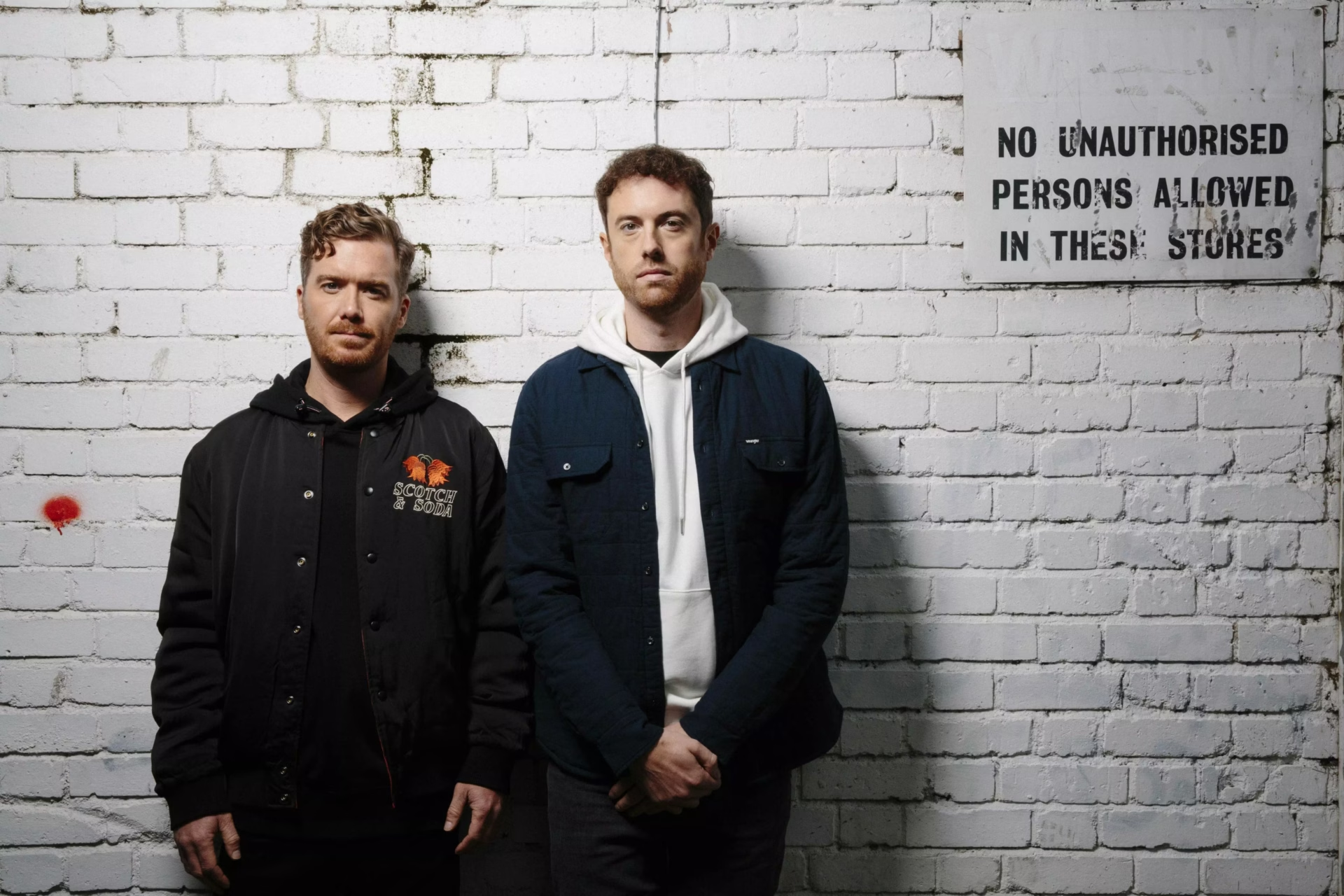
Just over eight years ago, U.K. DJ/producer duo Gorgon City (consisting of Kye Gibbon and Matt Robson-Scott) dropped "Real," an infectious, buoyant dance pop track that would set the tone for what was to come. Featuring singer/songwriter Yasmin, it was their first hit together (and as solo producers) and even got played on U.K. radio, encouraging them to stretch their songwriting skills and bring in more singer/songwriters into the studio.
It's a good thing they did, because that resulted in "Ready For Your Love" with MNEK a year later, an exuberant, affirming dance floor bop that reverberated around the world, solidifying their fanbase across the pond in the U.S. and beyond.
Now, nine and a half years after putting out their first EP, Gorgon City is back with their third full-length album, Olympia, an 18-track journey through moody club instrumentals and more collaborative dance pop-leaning gems.
Read on as the dynamic duo dive deep into the new album, their love of collabing with up-and-coming vocalists, their rapid rise and more.
<style>.embed-container { position: relative; padding-bottom: 56.25%; height: 0; overflow: hidden; max-width: 100%; } .embed-container iframe, .embed-container object, .embed-container embed { position: absolute; top: 0; left: 0; width: 100%; height: 100%; }</style><div class='embed-container'><iframe src='https://open.spotify.com/embed/album/3r4dG6bUfL4jasKeo50kLE'frameborder='0' allowtransparency='true' allow='encrypted-media'></iframe></div>
Can you paint the picture of Olympia for me? What were your sonic and visual references and inspirations for this project?
Gibbon: It's definitely a wide-ranging, sort of all-encompassing album. The pandemic definitely had a big effect and inspiration on the album. I mean, a lot of the songwriting Matt and I did together before the pandemic, but then over the last year and a half, we added more songs, a lot of which we did remotely. So, we were firing the projects back and forth over the ocean while we were in lockdown. That was definitely something different for us, a different way of working.
And I think emotionally, [the pandemic] affected some of our songs, especially some of the less song-based ones, the more instrumental tracks. They have a bit of a melancholy, yearning feeling to them. And I think that was reflective of how we were feeling at the time, going through those emotional roller coasters that everyone was experiencing during the pandemic. I think that had a big effect on some of the music that's in the album.
Robson-Scott: Yeah, and even some of the more vocal tracks as well, the way we worked on them and the emotions that we put into them when we were finishing them off was during the lockdown. I think they might've sounded a bit different if lockdown hadn't happened — if we hadn't been in that zone. I feel like a lot of the tracks were kind of finished at the beginning of the pandemic, when me and Kye both had our home studios. I was in London, Kye was in Chicago, and we were throwing the projects back and forth. I feel like we had a lot of time and space at home to do that, to work on those tunes.
I definitely feel like the emotions were quite intense at that time because no one knew what was going on. The whole world was kind of falling apart and it was a weird, weird time. I think it gave us a lot of energy in kind of a different way. But we're really happy with the way the album turned out.
But yeah, it's been a mad year and a half, really.
When did you start working on it and then when did you finish it?
Gibbon: About two and a half years ago now. As we were saying, a lot of the songwriting was done before the pandemic, so we managed to be in the studio together for most of that. And then it was originally going to be probably a 12-track album and we had it pretty much ready to go, but we just didn't feel right releasing it yet. So, we kind of sat on it, and I think while we were sat on it, we had a lot of time to produce.
We ended up creating about six more tracks for the album and it felt right to include them on it, even though it's quite non-standard to have 18 tracks on an album. But we felt like we wanted to because we've got a lot of music, we've got a lot to say for ourselves, so we wanted to include it all in there.
And it sort of feels like perfect timing. A lot of it was serendipity that the album happens to be coming out while everything's reopening. And we're really excited, especially because a lot of the tracks have this sort of big room club feel. So that was one of the reasons why we waited so long, we wanted to wait until at least there were hints of the world reopening.
And a lot of being in lockdown gave us time to finally reflect on the last almost 10 years of touring because in all that time, we've never really sat down for more than about two weeks. So, to be finally taken away from it for a year and a half, really gave us time to reflect on our careers and just be like, wow, we've done some crazy stuff in our time.
And that kind of influenced us to make these big-sounding club records because we were so excited and so inspired by everything we've done in our career to get back out there and do it again. It definitely gave us the energy to create this album.
You finally had that moment of reflection. What was the biggest thing you learned in that downtime and the time off the road?
Robson-Scott: Oh, god. I realized that we've been taking it all for granted in a way. When you're touring and you never stop, you just...
Gibbon: It becomes normalized, doesn't it?
Robson-Scott: Yeah. And the energy and the adrenaline and the kind of madness that you get from the crazy shows and the crowds and everything is just this big whirlwind, a hurricane of traveling and DJing and hotels and airports. And you just get used to it.
Gibbon: You almost become numb to it. It's just like another day in the office. And I remember quite a few times over this lockdown period, I've gone back in my phone looking at the photos and videos of all the crowds we've played to from the last few years. I was blown away by it like, wow, I can't believe we did that. Before, I'd never go back and look at a video from a year ago because it just seemed so normal.
And having this break from it, you look back on it and you're like, wow, we were so lucky to be able to do this stuff. And it kind of makes you feel quite emotional, with all of the stuff we've managed to do. I think when we hopefully get back to it and go back to normal, I think we'll never take it for granted again. [Both chuckle.]
Robson-Scott: Yeah, when you're in it you're like, "Oh, I hate airports. I haven't slept in weeks. I haven't eaten a proper meal with a knife and fork for two weeks." And that's all you think about. About six months into being in lockdown, I was like, "All I want to do is be on an airplane again." Because you miss those little things about seeing other DJs on the road, seeing other people that you know in the industry, seeing friends. We're so used to bumping into people all the time and sharing our experiences with other DJs and other people that have been a big part of our journey as artists and losing all those parts of touring was tough.
I think everyone's gone through it and everyone's feeling that. Everyone wants to see each other again on the road, to be backstage telling jokes and sharing stories about road madness. And everyone wants to complain to each other about planes getting delayed and to have a little moan, you know what I mean?
It's going to be mad when everyone gets back together again in those festival backstage moments. It's going to be so much fun and everyone's going to be so hyped. And everyone's going to smash it because everyone's got so much new music. And everyone's going to be unleashing all these bangers and everyone's just going to be losing it. It's going to be great. I can't wait for that first big festival, family vibe where everyone's there DJing and just loving it.
<style>.embed-container { position: relative; padding-bottom: 56.25%; height: 0; overflow: hidden; max-width: 100%; } .embed-container iframe, .embed-container object, .embed-container embed { position: absolute; top: 0; left: 0; width: 100%; height: 100%; }</style><div class='embed-container'><iframe src='https://www.youtube.com/embed/MegEII8icnc' frameborder='0' allowfullscreen></iframe></div>
And speaking of being on the road, you guys have your Olympia tour planned with some pretty big dance music venues, closing it out at Printworks in London, which is on my bucket list to check out. What are your top three cities to play in?
Gibbon: Yeah, the number one venue in the world for me is Printworks. We've only played it twice, but both times it's literally taken my breath away. And I don't really have that in other venues, maybe Red Rocks in Colorado where, when you're actually on stage, your breath is literally taken away by the sight of it and the vibes there. So yeah, to finish the tour at Printworks is just like the cherry on top of the cake for us. That's kind of the bucket list venue for us as well.
Robson-Scott: Yeah, for sure. We always have amazing crowds in L.A., and San Diego has always been a massive city for us. We're not really sure why, but it's sort of developed from the first live tour that we did of the States with the band. We had this incredible show at the House of Blues in San Diego and the energy and vibe were so electric. Since then, it's always been this amazing place for us. The crowd always goes absolutely insane. And then there's CRSSD Festival that's there [in San Diego] that we've played a few times and we're hopefully going to be going back there. For me, CRSSD is one of the best spaces to play as well.
Gibbon: Yeah, definitely.
Robson-Scott: CRSSD is up there in the top three. I would say Ibiza is the third place that is one of our spiritual homes. We've spent a lot of hours DJing there over the years and sort of half of our year is based there. Hopefully, it will come back soon as soon as possible. Ibiza is definitely an amazing place to play every year.
Where have you played in Ibiza?
Gibbon: Yeah, our first residency was at Space. Space was definitely one of my favorite clubs in the world, so that was amazing to be able to have a residency there. And then we moved to Amnesia, also one of my favorite clubs in the world. And most recently we had a residency — well we still do — with Defected, which is at Eden. When Ibiza comes back, we'll carry on our residency with Defected. Those guys are like family to us, we really love everything they do, so it's been amazing to have a residency with them. We're playing for their festival in Croatia as well this year.
<style>.embed-container { position: relative; padding-bottom: 56.25%; height: 0; overflow: hidden; max-width: 100%; } .embed-container iframe, .embed-container object, .embed-container embed { position: absolute; top: 0; left: 0; width: 100%; height: 100%; }</style><div class='embed-container'><iframe src='https://www.youtube.com/embed//gomqmTMvTAU' frameborder='0' allowfullscreen></iframe></div>
I want to circle back to the album. I really love "You've Done Enough" with DRAMA. I was curious how that track came together?
Gibbon: That track started off actually a long time ago. Matt was in the studio with this guy, Motez, and they came up with the chord progression.
Robson-Scott: I don't even know how long ago that was. Three years ago?
Gibbon: Yeah, it must've been. We sat on that chord progression for a while and then we sent it to DRAMA. This was before I moved to Chicago [where DRAMA is based]. We completely changed the production after we got what they recorded on it, we went in and made the production clubbier, and a bit darker because we felt like the song needed it. It was sort of an upbeat, positive, instrumental before that.
We turned it into this big bassline club track. And we made the other track with DRAMA ["Nobody"] after I moved to Chicago, so we wrote that in the studio together. It was really amazing to see how they work; their songwriting process is different from anything we've ever seen before. They are really talented and unique as artists, so we're really lucky that we got to have two tracks with them on the album.
Keep Dancing: Cakes Da Killa's New 'Muvaland 2' EP Is A Joyride Back To '90s Ballroom
Across the album, you have a bunch of different collaborators, which is not uncommon for you guys, but I was wondering: How did you choose to bring everyone into the project? Did you work on the songs first and think about who would be good on it, or how did the collabs all come together?
Robson-Scott: It was mainly just the way that we've always kind of done it. We just get in the studio with a certain artist or songwriter and then we make the track with them then and there. So, most of the tracks develop sort of organically.
Gibbon: Yeah, we kind of work in the opposite way to most dance music producers. Instead of writing a track and sending it to a vocalist to write over, we like to start with the songwriting and then produce the track afterward. We normally sit in the studio, write the song from scratch together and then afterward produce it.
Robson-Scott: We've been working on it for quite a long time, we were doing sessions all over the world. We were doing sessions together in L.A. and London, and Kye was doing them in Chicago. We were sending stuff back and forth. It's quite an amalgamation of all different types of songwriting, in a way, because it's a body of work that was in a work in progress for two and a half years.
Gibbon: Yeah, and the way we found these vocalists is completely varied as well. There are people like Josh Barry, who we've worked with for years and who's part of our live band. And there're other vocalists that are friends of friends, like Jem Cooke, she's part of our wider group of friends.
And then there's Cami [Izquierdo], who we worked on with on "Body Language." We were on Instagram one day and she sent us a clip of her covering our old song, "Imagination." And we were so impressed with our voice, we actually just DMed her and were like, "Do you fancy writing a song together?" I think that was a first for us, actually finding someone who's just covered songs on Instagram. That was kind of cool to be able to do that, working with someone who's really fresh.
Robson-Scott: There are a few artists on there that are really fresh and really new and interesting. And quite a few of the artists on there are actually people who we got put in contact with through friends, just randomly, really. Like, "Oh yeah, I know this girl's got a really nice voice. She'd love to do a session" — a literally unheard-of artist who is building their project and then we've been blown away by the quality of it. We always love finding brand new unique sounding singers, whether it's someone from Instagram or whether it's a friend of a friend or whoever.
It can be anyone, they don't need to be in the industry for years, or a really high-end songwriter or a big pop top-liner or something. We don't really care about that. We're not like, "Oh, we need that person who writes hits." We're more into just doing what feels right for the record and what feels right on the day sonically and stuff. We've got some really cool singers on there.
You talked a bit about how this album is a bit more melancholic. I do feel that, but to me, there's just something about the Gorgon City sound, there's always an element of euphoria. Even if the lyrics are about heartbreak or whatever, I can see it in a gay club or any kind of setting that's joyful. Is that intentional?
Gibbon: I definitely agree with that. We are really proud that it does that to people and we love seeing people singing and, yeah, that sort of contrast between the lyrical content and how it makes people feel. It's always quite amusing to us, being at a club and all these people with massive smiles on their faces dancing around, singing about how much they hate someone, or some really serious dark heartbreak situation. They have smiles on their faces. It's always quite satisfying to watch that.
Robson-Scott: We get such a mix of the way people react to the music. Quite early on in Gorgon City, when "Ready For Your Love" was a massive tune, especially in the U.K., I think we were in Glasgow and there was literally a mosh pit of all these lads singing along "I'm ready for your love." They were smashing each other. [Laughs.] It was hilarious. They're singing really happy lyrics but they're moshing.
Gibbon: To the most sweet, innocent lyrics. [Laughs.]
Robson-Scott: We also get such a juxtaposition of emotions when we play it, it's interesting. But it's such an amazing feeling having people singing along to your music. Especially with the new DRAMA one, "You've Done Enough," the reactions that we're getting to that song have just been out of this world. But that's probably the best reaction we've had to a song ever — just on Spotify alone — even more than "Ready For Your Love." It's just been mind-blowing the kind of reactions we're getting to it.
<style>.embed-container { position: relative; padding-bottom: 56.25%; height: 0; overflow: hidden; max-width: 100%; } .embed-container iframe, .embed-container object, .embed-container embed { position: absolute; top: 0; left: 0; width: 100%; height: 100%; }</style><div class='embed-container'><iframe src='https://www.youtube.com/embed/LtHxT0gndjU' frameborder='0' allowfullscreen></iframe></div>
How would you guys describe the Gorgon City sound?
Gibbon: It's a big combination of everything we've picked up over the years. I mean, me and Matt both have a similar musical upbringing, from our teens where we were both heavily into drum & bass and jungle. And that was the quite dark, underground movement of the mid- to late-'90s. For me, that was pretty much all I listened to when I was a teenager. For both of our production styles, that's where the deep basslines and the big sub-bass comes from and the darker elements. How we produce our basslines definitely comes from us listening to drum & bass and jungle.
And just through us DJing and touring over the years, we've got to see so many different styles of dance music at all these different festivals we've played at. Whenever we're at festivals, we always take the time to walk around different stages, soaking it all in. So we've definitely picked up a lot of techno and deep house influences over the years and that's always sort of seeping into our production techniques.
Robson-Scott: Yeah. I think also lyrically, it's always about being sort of powerful and deep and emotional, but at the same time, dance floor-friendly. That's what our sound has developed into. I think when we first started working with singers, I don't know, we always knew that we were going to make it very subby and very bassy and the bassline was the prominent part of the track. But I think it definitely developed and became its own thing organically. We didn't really even plan it. It just sort of happened over a space of time, that we started making all these tunes. It was really weird.
And then now we're at this stage where we're three albums deep and the energy is still the same. It's still kind of, like you said, party-friendly, and crosses all boundaries and hopefully crosses all cultures. And, like you said, you could hear at a festival, you could hear it at an underground gay club in Detroit or Chicago or London. We try and make music that does cross those barriers and it's an amazing thing [when it does].
I think we always wanted the vocals to not be generic and cheesy. That was one of our main aims with the lyrics and the vocal side of things. We always wanted it to sound unique and sort of meaningful, not just random, generic bollocks on top of a house beat.
Gibbon: Generic bollocks. [Both laugh.]
Gorgon City is not generic bollocks.
Gibbon: That's the best compliment anyone's said to us.
When you think about the roots of dance music, disco, there was a whole band, and the lyrics were dope, with vocalists like Diana Ross and people who were sometimes bigger than the band or the producer. But you had to be able to dance to it. I definitely see that thread in your music. It's funny, I love music with lyrics, but I never really know the lyrics. For me, it's like about how the rhythm and how it makes me feel.
Robson-Scott: Yeah, that's the weird thing about dance music, it doesn't really matter about lyrics that much. You don't want it to be rubbish lyrics, but a lot of the time people don't care. They just want to have the vibe and the energy, you know? And if it sounds good, it doesn't really matter what they're saying some of the time.
Gibbon: Yeah, and I think whenever we're in songwriting sessions with people, we always love to explain the fact that we really love lyrics that are a bit, I don't know, ambiguous. And I think when you keep lyrics fairly ambiguous, people can take whatever meaning they want from the song. They can make their own version of what the lyrics mean to them, and it makes it so much more personable when the lyrics aren't so direct.
Robson-Scott: Yeah, definitely. [The collaborator] will say a line and we'll be like, "Why don't you change that one word so it completely transforms the meaning of that sentence?" We try and do that quite a lot, to make it more interesting.
On "You've Done Enough," there's that one line she says where Via Rosa sings, "It takes time to love yourself. " That's a mantra right there. It gives me chills listening to it.
Robson-Scott: I know, sometimes it takes a while to get those bits and to really listen to them properly. But when I first heard that, I was like, "Wow, that's deep. That's some deep sh*t right there." She's amazing. She's got an amazing quality to her voice and her lyrics are just amazing, really cool.
In your opinion, what do you think are the essential elements of a great dance track?
Gibbon: Again, for us, it's all about the bassline. We're just bassline addicts.
Robson-Scott: And the drums have to be strong, obviously.
Gibbon: Yeah, and I've always said, whether it's the actual writing of a track or performing a DJ set, I think with dance music it's all about suspense and release. And always keeping something back and not throwing everything at them at once; I think that's the reason why with house and techno, you can dance all night and all day long to it. It's because you're keeping something back and sort of teasing it in, and with techno music, you have this huge build-up. And then after about two minutes, it just suddenly drops back into the groove. We try and bring that into our production as well, keeping stuff fairly restrained.
What have you guys learned as artists since back in 2014, when you put out Sirens?
Gibbon: I think we've definitely developed as songwriters because the whole Sirens album was our first venture into actual songwriting, writing full songs rather than just instrumental club tracks. So back then, we were experimenting and learning. I think we've come a long way since then, and that has allowed us to experiment more with the structures of tracks.
And I think we've kind of demonstrated that on this album, it's not so straightforward in our structures. We've taken time with the tracks and a lot of the songs on the album are longer than our previous albums because we've enjoyed the production process and putting in a few more techniques that we've drawn from the years we've been playing in the clubs and soaking in house and techno. We've put a lot more of those influences on this album.
Robson-Scott: I think we've also developed when it comes to collaborating with other people as well. We feel a little bit more comfortable in the studio when it comes to being in that sort of scary moment when you first start writing with someone that you've never met before. When everyone's a little bit, not nervous, but getting thrown into a session with someone you never met before, and you've got pressure to create something good.
It's like, "Nice to meet you..."
Gibbon: "Now, tell us your deepest, darkest secrets."
Robson-Scott: "How are you feeling at the moment? How's your relationship?" It can get quite deep really quickly. Literally, you just shook someone's hand, maybe had a cup of tea, and then within 10 minutes...
Gibbon: "When was the last time when someone broke your heart?"
Robson-Scott: And they're like, "Well, it's actually happening right now." And then everyone starts having this deep and meaningful conversation, and then you start writing a song about it. Or you come up with an idea that is quite intense and everyone gives their own opinion and you can create songs like that.
I think we've become more experienced with that side of it. Because at first, it was a bit like, oh my God, how do we do this? We had literally never done it before, and suddenly we're in a studio with all these random people. It was tough at first, but we definitely feel more comfortable now. And it's nice because we know more about how to get the best out of who we're working with. Whereas at first, we probably didn't really understand what we were doing, we were just sort of experimenting.
