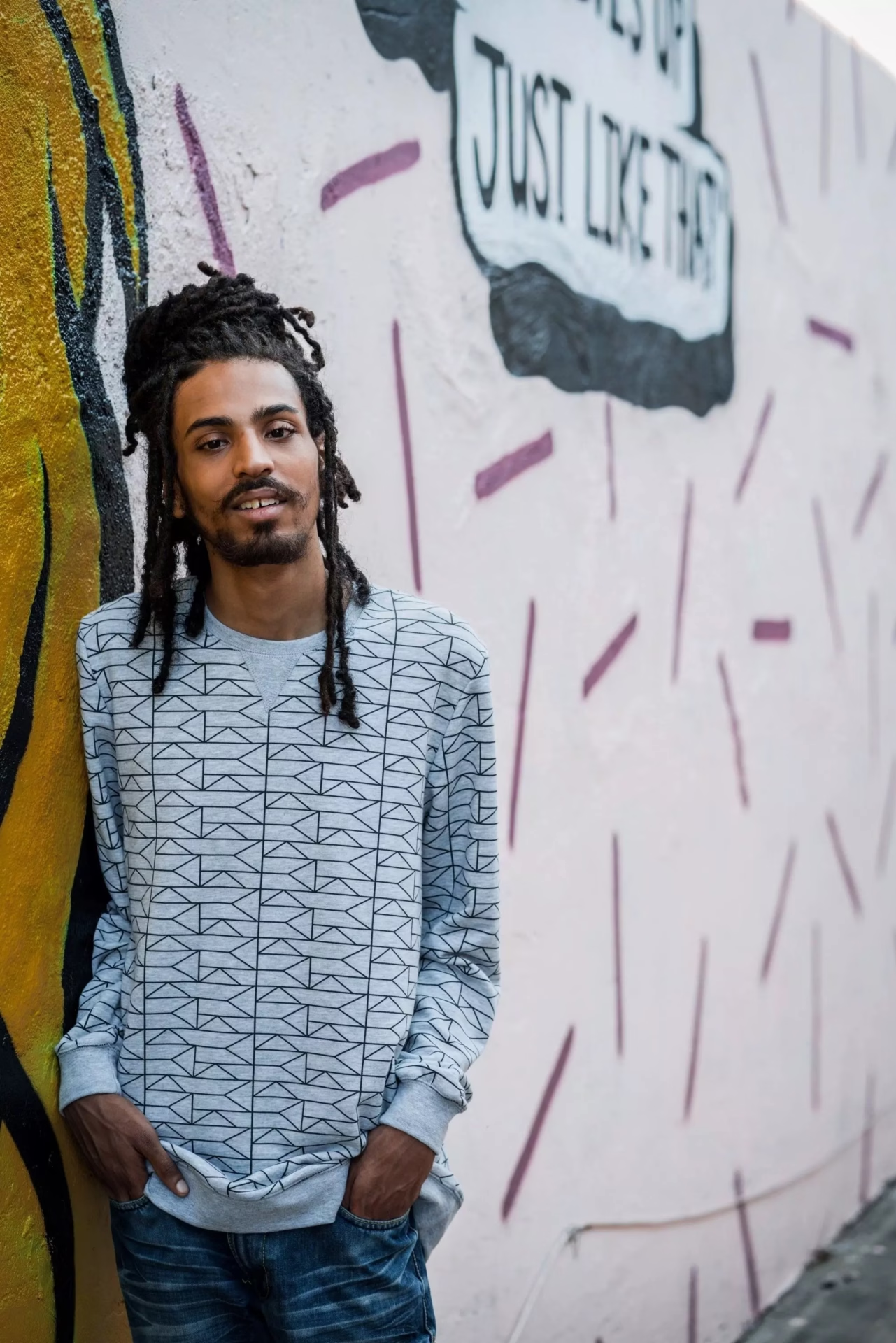
Is blindness an obstacle? In one sense, it's indisputably true. To not be able to engage with the physical world in all its aesthetic vibrance is an incalculable loss. That said, is it only an obstacle? It doesn't have to be—and it only takes a quick Zoom call with Question to realize that sightlessness has opened up new channels of intuition and perception for him.
Despite being just 23, the rapper/producer born Isaac Malik Wilson possesses acute self-awareness. On being blind in a mostly sighted world: "Until you encounter something in the world, it's kind of hard to have knowledge on it," he tells GRAMMY.com. "I don't really fault people for that." He's been making waves in the accessibility sphere, designing audio games for the blind. To this end, he's "making the world more aware that there is a market for this type of accessibility."
<style>.embed-container { position: relative; padding-bottom: 56.25%; height: 0; overflow: hidden; max-width: 100%; } .embed-container iframe, .embed-container object, .embed-container embed { position: absolute; top: 0; left: 0; width: 100%; height: 100%; }</style><div class='embed-container'><iframe src='https://www.youtube.com/embed//OLU7dctfB-Y' frameborder='0' allowfullscreen></iframe></div>
But above all, Question doesn't want to be thought of as encumbered, but a musician, full stop. And he hopes his upcoming debut album—title and run date TBD—will speak for itself without the blindness tag. "A lot of times, people with disabilities can be put into a certain category," Question adds. "But we would just like a chance to communicate on the same playing field and platform equally with everybody else, and have our message received."
To lead up to National Disability Employment Awareness Month in October, GRAMMY.com caught up with Question about his experience of being blind from birth, how he mastered audio technology without the aid of vision, and what he hopes his debut album will impart to the world.
Question. Photo: Jahi Gilkey
This conversation has been lightly edited and condensed for clarity.
Can you talk about your experiences as an artist with accessibility needs?
I have been blind since birth, and I've also been in love with music since birth. Basically, sound being the medium that I receive most of my information through, I just grew up having an affinity for music and things around me. So, pretty much from the time I was learning to talk and interact with my environment, I started making music then.
I used to learn on little toy keyboards to copy melodies off TV. I don't know if you're familiar with the See 'n Say [toy], with the little pictures of animals and things? I used to take that and DJ and make it into an instrument. So, I started with music as early as I could. By the time I was six years old, I was already freestyle rapping. By the time I was 12, I was making beats on my school laptop.
Are you currently promoting new music?
Right now, I'm in the process of getting some new music together. I'm in a transition period where I officially, finally got a team behind me. [My manager] David [Jackson] has been helping me so much with everything. So, right now, we're kind of in between me making a lot of music for people in my hometown and the fanbase I've acquired. We're getting ready for a commercial release on all platforms.
Congratulations! That must feel really great!
Yes! I can't lie—it feels awesome and gives me a lot of anxiety because I'm just so ready. I'm very curious to see how everybody reacts. I'm curious to see what the results are. I'm just so excited, so there's a lot of pent-up hyper-ness inside me because I've wanted this for literally my entire life. I've never pictured myself doing anything else. This has always been my dream and my aspiration.
What can you tell me about the project you're working on?
This album is an introduction to me. It's basically trying to let people into my life through the first glimpse into my story. Letting people know how it is coming up in Atlanta as a blind person and as a young kid through rap, you know? Giving as many different iterations through hip-hop as possible.
I study a lot of different music. I'm a big fan of several different genres. Being a music producer as well, I try to mold those together and pay homage to a lot of people who have inspired my sound and allowed me to create. So, this album is really about trying to launch me and introduce people to my sound while, at the same time, giving back to everything that's allowed me to be where I'm at.
You must have grown up loving words, then, if hip-hop has always been one of your primary vehicles.
Absolutely. English was definitely my favorite subject in school. I used to dislike math, but then, as I got deeper into music and music engineering, I found a love for math as well, because there's a way to check your work. Numbers don't lie. You can see the truth in formulas. But English was definitely the first subject I had an affinity for.
What challenges have you faced as a blind person in music?
I guess the most daunting challenge that I faced early on was accessibility, which basically means that a lot of things weren't available to me independently. I had to have people use the computer for me to work certain programs, or set certain things up in the studio.
So, it took me a little bit to figure my way around these things, but as I got used to using the computer and learning more about the world and everything, I was able to find accessible software. There's things called screen readers which actually speak aloud all the words on the screen. That enabled me to use vastly more music programs.
Even though some of them have graphical interfaces—I'm not sure if you make music as well—but you may know from some music programs that sometimes there's a lot of waves on the screen, and sometimes, you have to draw things in. Some of those weren't as easy for me to use, so that was the first big hurdle I had to get over—to find my own way to manipulate the software.
In which ways do we still have a long way to go in providing accessibility to artists?
I think the technology has definitely reached certain heights where many things can be made accessible. The information is out there. The ability is out there. Now, it's just about making the world more aware that there is a market for this type of accessibility. There are a lot of people out there with something to say. I guess the inclusion factor comes to mind.
For example, when Apple makes their iPhones, they come with something called VoiceOver, which is an accessibility assistant. They come with that right out of the box. You can hold down Siri and say, "Turn on VoiceOver," and then a blind person will be able to use your phone. I would just love to see more corporations and technology conglomerates factor blind people into what they're doing in that kind of way.
Question. Photo: Jahi Gilkey
Do you consider yourself part of a community that shares your experience?
Yes, I definitely consider myself part of the blind community as well as the technological community.
I've actually had a hand in making a few different audio games for blind people. A lot of us like to game and chill out and have pastimes like everybody else, but we're not able to play some of the mainstream games like Call of Duty or Grand Theft Auto, so we make our own adapted versions. So, there's definitely a lot of people who are knowledgeable about increasing accessibility and working on these things.
A lot of people whose senses are intact might not think about it, but they should think about it.
Yeah, it can be overlooked. Until you encounter something in the world, it's kind of hard to have knowledge on it.
I don't really fault people for that. I just hope people can be more open-minded when encountering someone with a disability, whether it be blindness or anything. I would love to also be a catalyst for allowing people to ask more questions and realize that we are willing and quite happy to have conversations on this subject, educate people and talk to people, just as someone else would.
It might also be helpful not to treat it as an obstacle, full stop. You're obviously a bright and intuitive guy. Blindness seems to have opened up parts of your mind that many sighted people don't have access to.
I'm passionate! Unfortunately, there is a quite significant unemployment rate in the blind community. I think that's largely because many people haven't been shown a pathway or opportunity to make something work for themselves. Sometimes, it's a confidence thing, but [other] times, it's a matter of not having a template to look at. I definitely want to show people that they can make things happen for themselves.
How can we interface with and support the blind musical community?
There are a few [organizations] I know of. [The] Andrea Bocelli [Foundation]. There are a few that are active. But also, it's just a matter of being willing to look at us as regular musicians who have something to say. A lot of times, people with disabilities can be put into a certain category. Like, "That's the blind rapper."
But we would just like a chance to communicate on the same playing field and platform equally with everybody else, and have our message received. Because we do have a lot more in common than our differences. Everyone loves to laugh. Everybody has a favorite food. Everybody enjoys a conversation. Everyone's passionate about something. That's the goal here.
How The Music Industry Must Work To Close The Accessibility Gap: 4 Eye-Opening Takeaways