The Onion once ran an article headlined "Pitchfork Gives Music 6.8." It's a gag, but it raises a compelling question: Thousands of years into its existence, after an astronomical number of permutations, is music still weirdly underrated?
While many simply hear it as a "soundtrack to our lives," others see it as a lifestyle unto itself. And for her part, the jazz singer Nnenna Freelon takes it a step further: Songs are like living, breathing people you meet, fall in love with, fight and grow old with. And like trusted friends, they can guide people through unimaginable sorrow.
"People have relationships with them. It’s this co-communication," the five-time GRAMMY nominee tells GRAMMY.com. "This mysterious, magical thing that happens when you enter into the circle of a song. It's kind of something you can't exactly describe, and in the world of grief, I think there's great untapped potential for healing around music."
How does Freelon know this to be true? She's lived it. After her husband died of the degenerative, cureless disease ALS in 2019, Freelon turned to songs—endlessly covered ones, like "Moon River," "Time After Time" and "Come Rain or Come Shine," that nonetheless revealed fresh meaning.
She mixed those with originals and reimaginings of '70s hits by artists like Marvin Gaye and Jim Croce to make Time Traveler, an inventory of Freelon's memory bank that came out May 21. (This summer, Freelon also launched her "Great Grief" podcast, a compendium of music and stories about grief and loss.)
Freelon sees Time Traveler as a portal for the listener’s memories—especially of those no longer on the planet. "I would say to just enter the space with the idea of time traveling in your head," Freelon says. "The title allows you to go where you will." In other words: Come as you are, clear your head and behold music's still-undersung facility for psychic transportation and emotional restoration.
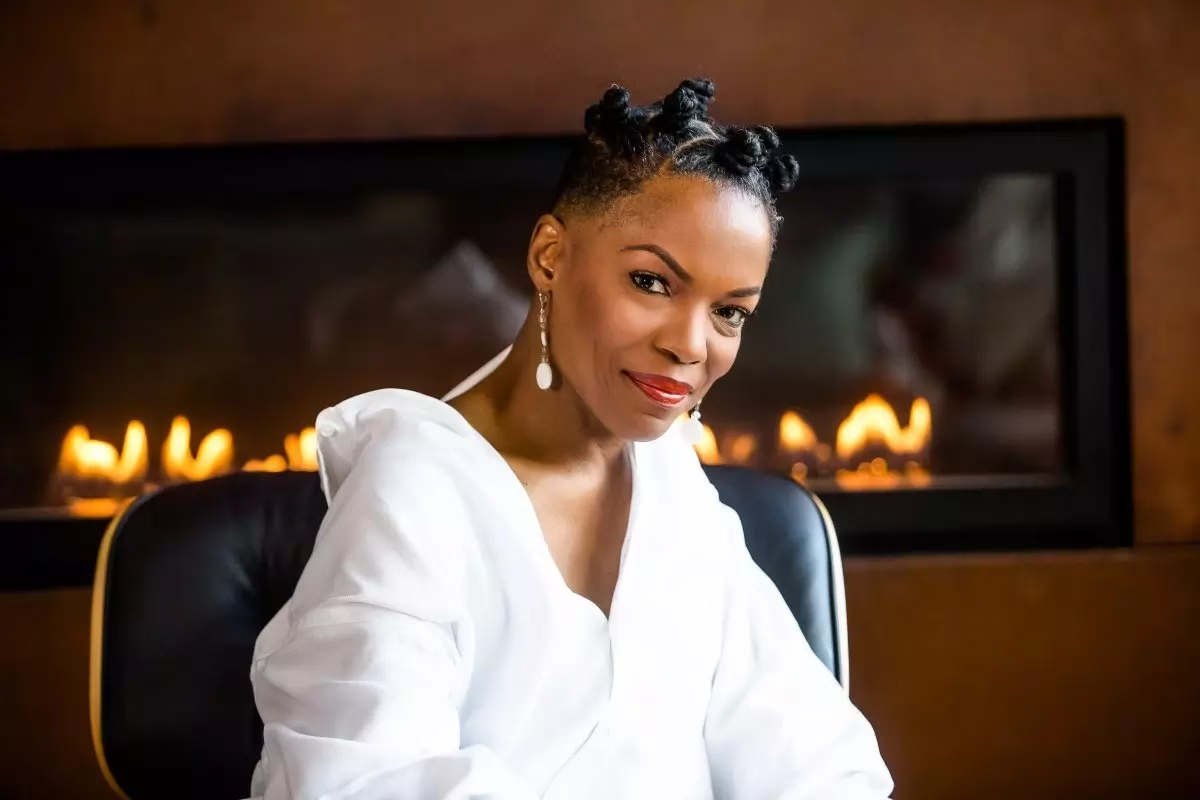
Nnenna Freelon gave GRAMMY.com a Zoom call to discuss the making of Time Traveler, why songs have the integrity of human beings and how reckoning with sorrow is like repotting and propagating houseplants.
This interview has been edited and condensed for clarity.
I think one underdiscussed thing about grief is the musical relationships you build with your loved ones and how you can manifest them into the world. Can you talk about that at all?
I think you're right. I think we're sleeping on music in terms of its power to transport us. It actually can take us back to the place where we first heard it—where there's an emotional memory—because the body keeps the score. That's the truth. All your trauma, all your joy, all your living—your body records it and it becomes your music. It becomes your composition.
We as musicians relate to the world with our ears and our heart. We hear you before we see you. We hear you coming! Sometimes, people even sort of project their vibration, musically—the good and the not-so-good. You know, I think songs themselves have spirits. I'm a jazz singer, right? So, I'm delving into the American Songbook, right? These are not songs that I wrote. They're not songs that even necessarily belong to my time. They were written in the '40s, written in the '30s.
My philosophy is that when you meet a song, you learn it. That's the honest and humble thing to do. You learn it as it was written. And then you ask for permission to change it. And if it says "No," you'd better leave it alone! You'd better sing it straight! And the songs themselves also have a world that they've created in the culture because others have sung them before you got there.
So, people have relationships with them. And I know this is true because people come to me and spill out all this story around a song I sang that is not even anything I did. It's this co-communication, this mysterious, magical thing that happens when you enter into the circle of a song. It's kind of something you can't exactly describe, and in the world of grief, I think there's great untapped potential for healing around music.
Even when I hear a standard I've heard a million times, it's doing its spiritual work in the present. My relationship with it is still developing.
It's an ongoing, real-time evolution. And then there are songs that appear for a certain time and they disappear and never reappear. "Whatever happened to... blank?" And sometimes, they only appear for you. They're your personal [entity] and everybody else is like, "No, I've never heard of that. I don't know that one." So, I think right there in that observation is the possibility of tapping into it in a real, intentional way for connection with each other.
Certain songs are elastic as far as time, space and perception go. Plus, they can bring people together.
Honestly, this yickety-yak, everybody a talking head, "This is what I think! That's not true!" and all that? No. Sing a song. Sing a damn song. Because music gets into our spirit in a whole different way—and I don't mean a political song either. If you sing something of beauty, who can resist beauty? Who can resist "I love you, and there's nothing you can do about it?" Who can resist that?
We need to move in those directions that allow us to explore: What is it we can agree about? What is it that we can come together on? I think there's a much wider landscape of that kind of thing than there is this divisive stuff, and there are elements in our society that really want us to be at each other's throats. We're looking at a dichotomy. It's either/or, when the question to ask is "What else is possible?"
This is what I'm screaming: The song can be a bridge. I don't have to agree with you to treat you with respect! Where did this thing come from where, if I don't agree with you, you're the enemy? What is that? It's terrible! What happened to honest discourse and agreeing to disagree?
When you call someone an enemy, you're actually looking in a mirror. That's a hard concept to deal with because you're like, "Damn, that thing is ugly." That's you, bro! That's you, sister!
I don't think pandemic-era albums will age well, but I believe yours will be an exception. You're responding to the broader sense of quietude, and you picked songs that have perennial value.
I was like: Let me do what I was put on this earth to do. Let me do what my assignment is at this moment, which is to put this baby out in the world and walk away. It's none of my business what happens to this record. I was obedient, even though it hurt. Even though it was painful. Even though it made me face some things about myself that I didn't like. Even though it made me face my loneliness.
I was thinking of going track-by-track and exploring each song through the lens of your grief. But by the same token, I'm thinking "Maybe all the information is embedded in the music. You either get it or you don't." Where does your thinking fall on that?
I would say to just enter the space with the idea of time traveling in your head. That's all. The title allows you to go where you will. If it doesn't pull you into the space of memory, then fine. You go on to the next track. Of course, I came from the world of LPs where the order of the songs was an attempt to tell a story within the project. I still have that in my mind, but it's the backstory. And it's my backstory.
I've done lots of "concept records" in my time. A tribute to a composer. A tribute to an artist. All the songs were written by blah-blah-blah. In this project, I'm wanting to sort of put that down. Put down that idea of it being so rigid and just letting the traveling through time be the concept, if there is one.
Like, "Moon River." You couldn't think of a more standard repertoire piece in the American songbook. There isn't one that has been more recorded. It's the standard of standards. But every time I hear that song, it takes me to someplace that only I can go. I don't know if anyone else can go there.
"Two drifters off to see the world:" that's my husband and me. "There's such a lot of world to see / We're after the same rainbow's end, waiting 'round the bend:" Everybody gets to die. Everybody. If there can be one unifying fact, that's it. "Waiting 'round the bend / My huckleberry friend." He was a friend; he was a lover; he was a confidante. He was my everything. Forty years! My god.
Even though I loved the song before, I'm in bed with the song now, because it's a comfort to me. I don't care that everybody else in the world did it. It's now mine. I claim it as my anthem love song to my spirit, to my situation, and it brings me joy. That's the only reason.
I don't think you or anyone else is the official spokesperson for grief or mental health. That said, what are your coping strategies?
One thing I'm trying to position myself as with my podcast is the anti-therapist. I don't want to be the therapist. I don't want to be the one who gives you advice. Frankly, I'm still figuring this thing out myself, so I can't really tell you what will work. I can only tell you what I'm doing, and that's that I am container gardening. That's finding containers large, small, medium-sized, decorative, plain, to put your grief in. Spaces that allow you to honor it and honor your beloved.
The small things you do to honor the space this grief is occupying is really important. It could be something as simple as baking a cake intentionally with your loved one in mind and thinking about, when you add the sugar, how sweet they were and how wonderful it was for them to be in your life. Adding the salt for the tears, the baking powder… if you're into cooking, you'll know what I'm talking about.
I can't boil water without starting a house fire, but as you can see over Zoom, I'm into succulents. I've noticed that when you leave them in the little plastic container from the store, they stall out and look sad, but if you repot them, it doesn't take them long to thrive.
This is what I've figured out, and I haven't even figured it all the way out: When you tend to your grief as in a succulent, after some time, you may need an even bigger pot. Because guess what? Seeds of joy, seeds of expansion, seeds of curiosity start to blossom in that space, and it can no longer be contained.