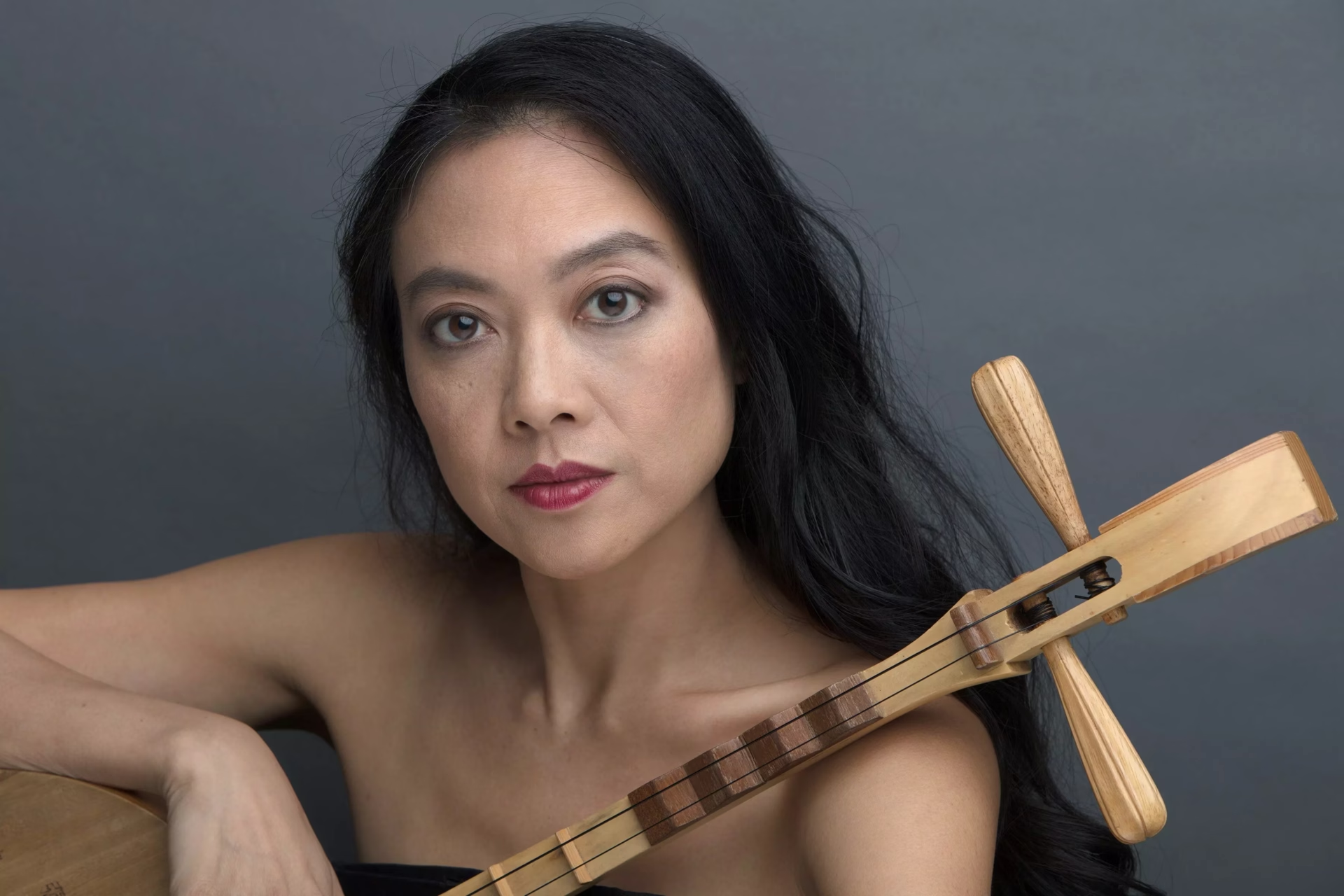
It’s a fact: Asian people face discrimination in America. And as composer and multi-Instrumentalist Jen Shyu points out, it happens everywhere—including the conservatories and concert halls on the coasts.
The comments and microaggressions in those spaces come fast and hard. At an upstate artist's residency, she was called "an Asian Meredith Monk." The vocalist/composer is frequently mistaken for various musicians of Asian descent—and vice versa. One time, a composer approached her and complimented her bass playing—and Shyu replied that she wasn't Linda Oh.
"He scurried away like a rat!" Shyu tells GRAMMY.com with a sharp laugh. "And I just wish I could remember his name!"
<style>.embed-container { position: relative; padding-bottom: 56.25%; height: 0; overflow: hidden; max-width: 100%; } .embed-container iframe, .embed-container object, .embed-container embed { position: absolute; top: 0; left: 0; width: 100%; height: 100%; }</style><div class='embed-container'><iframe src='https://www.youtube.com/embed//YgjY_87IJIM' frameborder='0' allowfullscreen></iframe></div>
Shyu takes these instances in stride and files them away in her memory bank. This is apparent on her new album, Zero Grasses: Ritual for the Losses, which came out on Pi Recordings on April 12. A harrowing-yet-beautiful grief journey, the album braids the shock of Shyu's father's death with memories of racism and sexism from throughout her life.
On tunes like "Lament for Breonna Taylor," "When I Have Power" and "Father Slipped Into Eternal Dream," personal and global sorrow pool into one. "I just think these themes are interlinked," she explains, in the context of a deadly pandemic and continuing police violence. "You kind of see how differently that manifests for people, depending on your privilege." But by examining both micro and macro grief through the same lens, Shyu sees both with more clarity—and by communing with Zero Grasses, listeners can too.
GRAMMY.com caught up with Jen Shyu over Zoom to discuss the traumatic experiences that informed Zero Grasses: Ritual for the Losses and how she continues to rise above daily challenges in her field.
<style>.embed-container { position: relative; padding-bottom: 56.25%; height: 0; overflow: hidden; max-width: 100%; } .embed-container iframe, .embed-container object, .embed-container embed { position: absolute; top: 0; left: 0; width: 100%; height: 100%; }</style><div class='embed-container'><iframe src='https://www.youtube.com/embed//6mFKwf17ST0' frameborder='0' allowfullscreen></iframe></div>
This interview has been edited and condensed for clarity.
This album is about grief in various forms. The pandemic and police killings add new dimensions to global sorrow.
I just think these themes are interlinked. You kind of see how differently that manifests for people, depending on your privilege. Now we're seeing it with Daunte Wright. It's frightening and can be paralyzing. You see no justice being served. It's hard to fight through that and carry on.
When my friend Joko [Raharjo and his family were] killed in a car crash, his mother and I were texting and she wrote, "I've cried all the tears." This is all in Indonesian. "I don't have any more tears left. But we still have an obligation in this life. Those of us who are still alive still have an obligation in this world." That has really stayed with me.
The word for "obligation" is wajib in Indonesian. So, indeed. That is the effort to carry on and inspire and comfort.
I can connect the dots as to how a family dying in a car wreck would compel you to express yourself in an unvarnished way. Loss makes it incumbent to tell people the things you always meant to tell them because they might not be around tomorrow.
Yeah, absolutely. It comes from life experience. I think this will always be part of my artistic output—immediacy. Wanting, being hungry for that rawness. When I created "When I Have Power"—where I talk about the young boy calling me a ch**k—that was written in August or September of 2019. That was before the pandemic. And the text was from when I was 15; it was from my diary.
So, it's like: "Oh, that's always been there." It just happened that this is coming out when there have been incidents of violence [reported] in the media. These instances of violence have finally been shown. That feeling of anti-Asian racism has always been there. All these things—if they stay hidden and remain unspoken, nothing's going to be done. Nothing's going to change.
Just to speak these things out: First, it makes people aware, and second, if it's visible, then OK, we can do something.
Jen Shyu. Photo © Marco Giugliarelli for Civitella Ranieri Foundation, 2019.
I'm curious as to where this album fits into your larger body of work.
This is my eighth finished recording. The first featured standards done in an unusual way. I did a couple, then, that were just digital. You can find these on Bandcamp. But then, when I started working with Pi, the first album was a duo with [bassist] Mark Dresser, who's amazing.
After that, I went to Indonesia right away! I got my Fulbright. That was 2011. I became a dual citizen of East Timor since my mom is from there. I came back and did [2015's] Sounds and Cries of the World. It was personal, song-to-song, which I recorded after producing my first solo theatrical work called Solo Rites: Seven Breaths that involved a lot of that music. It was autobiographical in the sense that it was about a woman on this journey to, first, her homeland, and then to all different areas and what she discovers. Very abstract, though.
That was the first time I connected the theatrical and the dramatic with the musical aspects of my vision. Definitely, an early influence on that would be Meredith Monk, whom I got to meet when I was at Stanford. She was kind of the first example of that for me.
Now, funny story! [sharp laugh] This is evidence of what one goes through as an Asian artist. There was this residency I was doing and this very famed composer—more in the classical world—he was at that same residency. I think this may have been at Yaddo, which is an artist residency upstate in Saratoga Springs.
We often do these presentations for each other. It's all voluntary ... So, I presented something and this composer came up to me after. He was like, "Oh, Jen, that was amazing. Your voice is so incredible. You're like an Asian Meredith Monk!"
And I was like, "Oh, thank you! Yeah, she's great!" Because he clearly meant it as a compliment. And then I thought about it: "Oh, I don't know about that!" So, yeah, that was pretty interesting.
<style>.embed-container { position: relative; padding-bottom: 56.25%; height: 0; overflow: hidden; max-width: 100%; } .embed-container iframe, .embed-container object, .embed-container embed { position: absolute; top: 0; left: 0; width: 100%; height: 100%; }</style><div class='embed-container'><iframe src='https://www.youtube.com/embed//EKPkJNXxgjI' frameborder='0' allowfullscreen></iframe></div>
Do you get patronizing comments like that often?
All the time. Oh my god! All the time. In different forms. There was a manager who's a veteran. I won't mention her name. She had told me, "Oh, yes, I looked at your work. Ostensibly, you'd be a perfect client for me, but I just signed a koto virtuoso and I think there might be some overlap there."
Noooooo!
[loud laugh] I looked her up and she's not a singer. She's not a composer. She just plays koto, and she does some interesting projects. She's great! But not the same, you know? The only thing we had in common was "Asian woman." Alright.
There are so many examples. First of all, I always get mistaken for Linda Oh, and she gets mistaken for me. Susie Ibarra. We get mistaken for each other. There are so few of us, perhaps. That's a big thing. It's the white male gaze. That's nothing against you personally. A lot of the gaze is from that perspective.
[Being mistaken for Linda Oh], that was at a Henry Threadgill concert.
An academic, learned crowd.
[This guy] introduced himself to me and said, "I'm so-and-so. I'm a musician. I just wanted to say: You are an amazing bassist." I was like, "I'm so sorry, I'm not Linda Oh." And he literally ran away. He scurried away like a rat! And I just wish I could remember his name! It's too bad.
It's even from friends. Recently, a friend just sent me a link to a video that an amazing gayageum player made. She's come to a lot of my shows. She's from Korea; she went to New England Conservatory. Amazing player, and I love her. She made this beautifully edited video that had her singing and playing.
This friend of mine sent me this video and said, "Hey, have you seen this yet? It reminds me a lot of you and your work." It kind of makes sense. She's been following me and she said I've been influencing her. But I kind of just told him, "You know, I've often been told this." People say, "Oh, I saw Bora Yoon and I thought of you!" She's a friend of mine also! But very different! So different!
It's this grouping together that's frustrating. People can't see the difference. It's like, "All Asian people look alike." This is what we're up against. Not only are we grouped and stereotyped, but if that's already what people can or cannot see, then how is our music going to even be appreciated?
I’m an artist who really embraces my ancestry. I go deep into it. That’s my path. But I know how frustrating it must be for other Asian artists who people might expect that of them. They just want to make music, you know? It’s just being the other. I’ve never let it stop me because I’m so hard-headed. I just go forward.
Inescapable Progression: 10 Jazz Labels You Need To Know In 2021
