
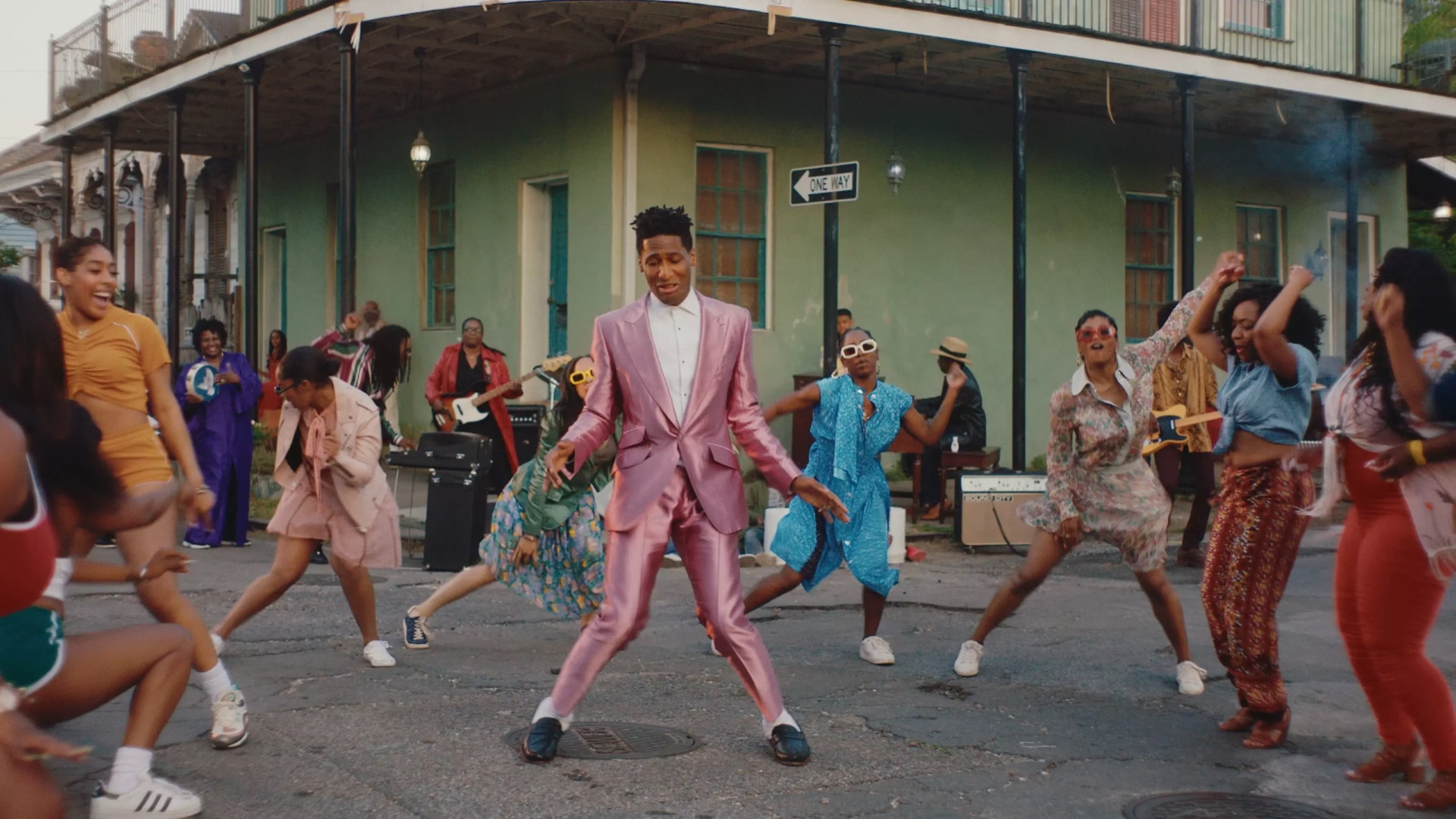
What has Jon Batiste been up to since his last album, 2018's Hollywood Africans? That's like asking an entire town, "What have you been up to for three years?"
For Batiste, even summing up three days is rather impossible. In that timespan, he's had an incalculable number of irons in the fire—his symphonic premiere at Carnegie Hall, leading his band Stay Human on "The Late Show With Stephen Colbert," a collaborative song with Diane Warren, and scores of other things. Still, he's found a 15-minute window for a Zoom call. Therein, the 34-year-old dynamo lovingly deems his life "a madhouse."
"It's hard to even encapsulate in one presentation of a thought," the three-time GRAMMY nominee admits to GRAMMY.com. "I'm also in the process of, while doing these things, developing other things."
This Möbius strip of a life—projects and projects and projects, blurring on a continuum—speaks to Batiste's boundless drive and work ethic. In a pandemic year, when so many lost motivation and momentum, he sped up. Not only that, he's showing the uncategorizable nature of his artistry.
Just as he can't be summed up as a bandleader, music consultant or TV personality, on his new album WE ARE, which was released March 29, Batiste combines half a dozen styles in fresh, unhackneyed ways.
"I don't even think genre exists," he declares later in the interview. "Self-curation and the free exchange of information and content creates a lack of genre adherence. That kind of diversity and access changes listening habits and changes the way people perceive music."
This paradigm, he says, exposes and deconstructs notions of genre, which, Batiste asserts, stems from race-centric marketing prevalent in the early music business. Read on as he holds forth on that subject, his Oscar-winning work on the 2020 Pixar flick Soul and what he has in store as live performances return.
This interview has been lightly edited and condensed for clarity.
What's been going on in your life since Hollywood Africans, up to and including the daily grind of TV and working on Soul?
I'm involved in so many different types of things that so much of my life is balancing the amount of things I have going on and maintaining artistic integrity and keeping my values intact. It's hard to even encapsulate in one presentation of a thought.
Looking at my day-to-day: I just finished working on a score last night. The day before, when I was working on that score, I did a symphonic composition for an NBA Playoffs ad, which is their official ad that's out now. We did that in a matter of three days and recorded an entire symphony orchestra. Then, before that, I was working on a song in collaboration with Diane Warren. Today, I was hosting "CBS This Morning," and I wasn't even playing music. I was the host [with] Gayle King.
Today, I'm doing "The Late Show." And then tonight, after that, I'm going to work on some things for a foundation I'm part of. This is just in the last three days, which is a microcosm of the type of madhouse that my life is and the variety and range of different things I'm part of, that I care about deeply.
This is [about] focusing on a few things that are offered to me that I care about the most in a moment. That's maybe five out of 500 opportunities to do things or be part of things. It really becomes a question of what matters most to me and what I want to put on everybody's plate at this time, and how much time I have to do it.
I'm also in the process of, while doing these things, developing other things. Developing shows and developing a symphony that I'm premiering at Carnegie Hall in May of next year that's called American Symphony. It will be my largest work to date. It's a 40-minute, four-movement symphony, and it has not only the orchestra, but a choir and marching band and guest musicians. It's a very expansive work.
I've got to mention Soul, because I really got the impression that It wasn't a writer's room guessing what that world is like. It seemed like jazz musicians were deeply involved with the film.
Oh, absolutely. You've got one of the greatest living jazz musicians being a consultant on the film—Herbie Hancock—a consultation that was from the beginning of the film. And you have Terri Lyne Carrington, one of the greatest musicians living, who also consulted on the film. I consulted on the film as well as working on the score with Trent Reznor and Atticus Ross.
You have real jazz musicians at the helm of this thing. Roy Haynes played the drums with me on the score. I put together another multigenerational band there with real jazz musicians. Roy Haynes and Harvey Mason, Sr. on the drums, and Marcus Gilmore as well, who is Roy's grandson. Then, you have Linda Oh and Tia Fuller on the bass and saxophone, respectively.
I think it's really amazing when they have these opportunities—for whatever it is—to have a big studio use their megaphone to speak to something that is more countercultural and less mainstream. This is a great example of the power of a big studio—one of the biggest studios in the world, Disney-Pixar—to use their megaphone and speak to something. It can have a lasting impact.
All That Jazz: Meet The First-Time GRAMMY Nominee: Tia Fuller On Growth, Artistic Vision & Leading By Example
That was a big win for the jazz community.
Yeah. Anyone who says otherwise, I think, missed the big picture. I think it's hard to look at that and not see it as a win for jazz and for culture. In particular, when I'm thinking about culture, I'm thinking about the ways that American identity and Black culture have been at odds in cinema. This movie was allowed to come through the cracks of a very marginalized history, when it comes to jazz in film.
As a journalist, I have to reckon with the word "jazz" and the periodic need to obliterate it. WE ARE has many of those elements, but when I listen to it, the word never crosses my mind. Do you even consider genre when you write?
I don't even think genre exists. I think it's a construct. The construct of genre was really created in order to help sell and organize music and to train the public to think about music in that way, in order to market it easier.
I think that's what it was from the beginning, and then, even earlier than our modern era of genre organization, what it was was all those things and race, which created these different forms of segregation. Segregated radio stations even had colored records versus non-colored records, and all kinds of crazy shenanigans. People would have songs that were done, and there would be a white version and a Black version. As you know, the history of all the stuff we've dealt with.
Then, you'd have R&B records and rock 'n' roll, and that became a way of segregating music. You have Chuck Berry and Little Richard, and then you have Elvis and the Stones, and all these different blues musicians. Blues and R&B were really the origin of what had become known as rock 'n' roll, but because it was Black people doing it, they didn't want to call it rock 'n' roll.
It's very interesting to see the evolution of that. That's a whole other story. But it's always been a construct. We've just always accepted it. And I think the more that we look at the way things have unfolded with streaming in the early 2000s, we see how the genie popped out of the bottle when people started to pirate, stream and download music and curate it for themselves, even though that's not even what it was called back then.
Self-curation and the free exchange of information and content creates a lack of genre adherence. That kind of diversity and access changes listening habits and changes the way people perceive music. It changes the taste of what they want from artists. We're just [now] starting to see the impact of that as the generation who grew up with streaming.
You know, my generation was the last generation in that when we were 11 and 12 years old, we didn't have it. By the time we were 13 and 14, it was taken over. It's the generation after us that grew up where that was the only thing they had. That's how they understood music consumption. There are pros and cons to it all, but it definitely was part of what is more and more exposed about genre, which is rooted in marketing and race.
When you crash together hip-hop, jazz, blues, R&B and soul, it exposes that they're all made of the same DNA.
What's totally interesting is that the more time that the construct of genre has persisted, it's created different approaches to these genres that are identifiable. You have artists that have created music to fit into a system that is a construct. And even with that being the case, the music is still not able to be separated.
I'll give you the perfect example. If you listen to what's known as smooth jazz and then listen to something from the '70s, like Grover Washington or Stanley Turrentine or post-bop music like Horace Silver or Bobby Timmons or something like that, the only thing that separates that music—besides the actual musicians—stylistically is the production concept.
Some beats, where you hear something Art Blakey might play, that could be a hip-hop beat if it was an 808 or it was sampled. It could be jazz—vice versa—if it was played on two-inch tape and recorded at Van Gelder Studios. A lot of stuff that separates genre now is largely sonic production approaches.
I feel like that's the new innovation in music. I see a lot of people trying to break genres in how they blend sonic and production approaches.
Julian Lage Talks His Blue Note Debut 'Squint,' Eyeing Tradition From A New Vantage Point
