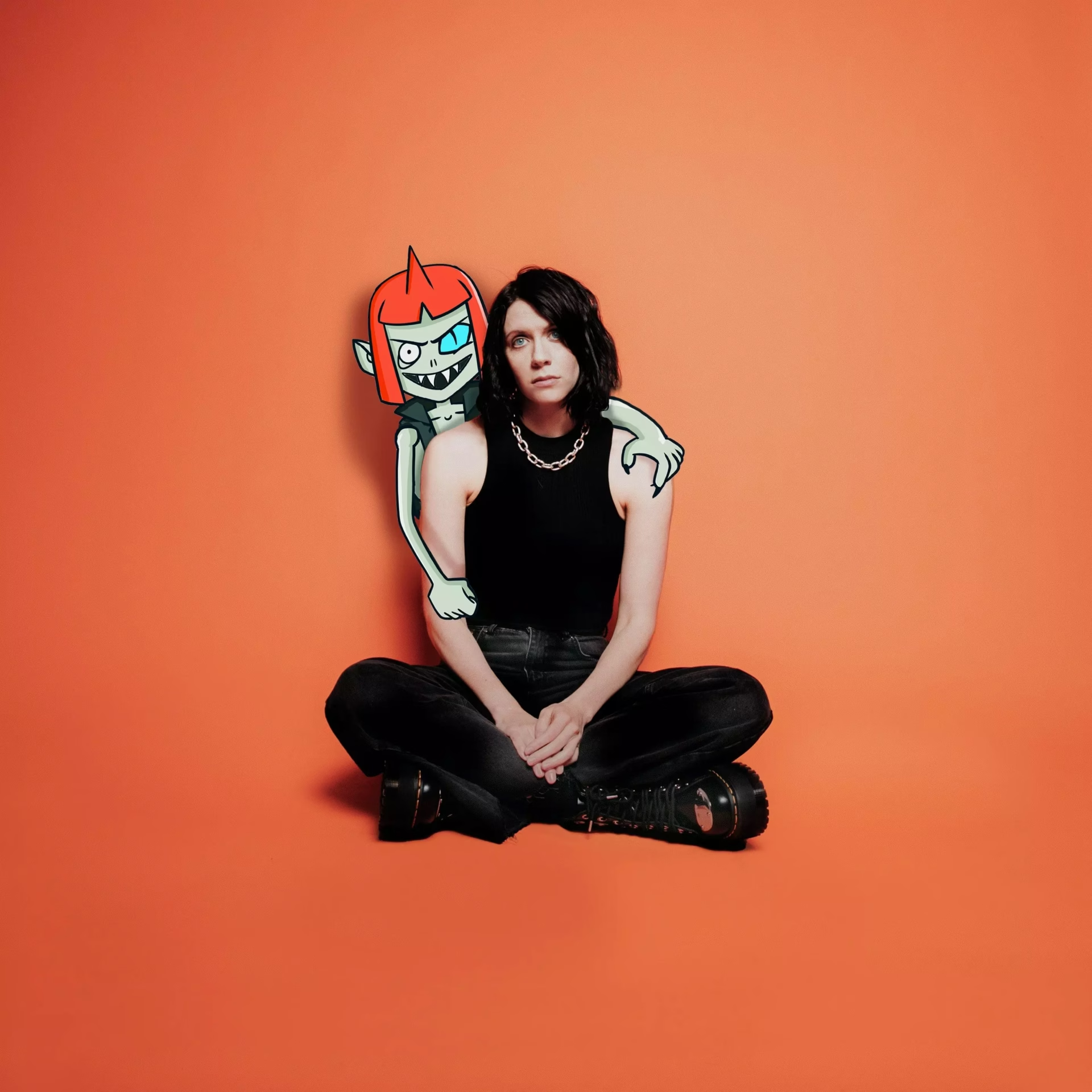
Kristine Flaherty's name is not Katherine. This is a bizarre phenomenon. Over the better part of a decade, she's been misnamed and misidentified all over the planet for mysterious reasons. "So, Katherine? Katherine, right?" she tells GRAMMY.com, mimicking a terminally underprepared European interviewer. Rather than leave it alone as a pet peeve, the singer/songwriter turned it into a declaration of self: "My Name Isn't Katherine."
"It started as a joke, but then it became this meditation on 'What does it feel like to be named? What is that experience like?'" she continues. "Your name is the accumulation of hopes and dreams and fears and the context of your parents and forebears. What does it feel like to be called by the wrong name and not seen and sort of misidentified?"
This age-old question—"What's in a name?"—not only applies to the pronouns-in-bio era, but the artist known as K.Flay herself. Within this persona, the easygoing, polite and articulate artist is free to be a flippant, extroverted provocateur. Her new EP, Inside Voices, which released June 11, contains the K.Flay persona in all her multitudes. It all wraps up with "My Name Isn't Katherine," sealing its central theme of identity.
Being flippant and absurd doesn't quite jibe with social media, where declarative statements by artists are parsed like court records. K.Flay is deeply aware of this paradigm but views art as a porous place to have difficult discussions. "It's no surprise that people seek out comedy and music and literature and visual art and all these things as a salve for the harshness of the world," she says. "They're not able to, on a daily basis, have that catharsis or sublimation or expression.
GRAMMY.com had an in-depth Zoom conversation with K.Flay about the genesis of Inside Voices, working with Rage Against the Machine's Tom Morello on the EP and how unfiltered self-expression T-bones with social media.
This interview has been edited and condensed for clarity.
I like how extroverted and full of melodies and attitude your music is. You're not holding back with anything. Is that an intentional approach?
I think, at first, it was not intentional. But then, once it became apparent, I leaned the f*** into it. I started working on my next project of music right before quarantine, so many of these songs began in their infancy in a pre-quarantine world and then developed and were produced and recorded and became themselves during the pandemic.
In many ways, this has been a time when I have fleshed out the essence of the difference between Kristine and K.Flay. In interviews, people are often like, "Is there a difference?" and I'm like "No." But actually, there's a huge difference. I don't know why I was saying that. There's a giant difference and it's basically what I talk about in "Four Letter Words."
Which is, I'm usually nice. I'm polite and try to be on time and respectful of others and never yell. I sort of fear confrontation in many ways. As K.Flay, I don't. I'm very expressive. I'm often fairly profane. This is where I'm able to be this; it's my alter-ego. But of course, it's a part of me. My psychological process on this EP and new music is a full embracing of that.
It's not a gratuitous celebration, but, I think, a justified celebration of: Hey, that's a part of me too. That's great, and I'm going to channel it through music and hopefully be self-aware and have enough of a sense of humor that people understand what I'm saying—that I'm in on the joke and know what I'm saying.
In many ways, this is the most confrontational music I've made. At first, that was uncomfortable. I think we all have these boundaries that feel like, "If I stay inside this space, I'm not really ruffling any feathers but I can still be edgy, or I'm still pushing the envelope a little bit." With this EP, I did feel like I was going out of my comfort zone, which is usually when you're on to something.
Is it just me, or are we living through the most humorless, self-serious era of the last several centuries?
Oh, my god. Yeah.
When I was very young and my parents were going through this very acrimonious split, my mom and I had this vagabond period for a year, kind of roaming around. We had this horrible night and we were going to a friend's house. We were both crying and [it was] raining. My mom was like, "We're going to laugh about this someday." And the minute she said that, it broke the spell. We both started laughing.
It is not always possible, in the moment, to see the humor in things. Certainly, there are things that are just not funny. However, many things in life, whether it's due to absurdity, whether it's due to its physical humor, have that element of humor.
It's been important to me throughout my career to have that sensibility and to embrace it and acknowledge that it doesn't make what I'm doing less tough or less serious. In fact, I would say, for me, it kind of deepens it.
This moment hasn't been so conducive to that sense of release—of grappling with unknowns and reckoning with the things we're all thinking but can't say. Still, certain songwriters such as yourself aren't afraid to potentially piss people off.
Yeah, I think that's the role of somebody who makes art or music or comedy or whatever for a living.
I think about this frequently. My brother and sister, for instance, have normal jobs. They work within an institution. My sister works for the government. So she can't just go spouting off and say, "I'm usually nice, but f*** you!" She can't say that at work. And she can't say, "The world is run by lunatics, so who gives a f***? Let's light it up!" [Lyrics from "TGIF."] She definitely can't say that.
I think as a person—and particularly as a songwriter and musician—your job is to say the things other people are thinking and feeling, because you have some immunity there. Your work isn't in peril when you express yourself. In fact, your work is at its best when you express yourself.
To me, it's no surprise that people seek out comedy and music and literature and visual art and all these things as a salve for the harshness of the world—because they're not able to, on a daily basis, have that catharsis or sublimation or expression.
How'd you end up working with Tom Morello on Inside Voices?
I've known Tom for about four years. He actually cold-emailed me four years ago. He said, "Hey, I got your email address. I heard your song on the radio with my kids. I was driving them to school and I thought it was cool. Do you want to talk on the phone?" I was like, "What the f***?"
Anyhow, we ended up having a great conversation. I collaborated with him on his solo record called Atlas Underground. We did a song called "Lucky One." I loved that experience, and Tom and I got the chance to actually get to know each other and spend time together. I really appreciate his intellect and creativity. And, perhaps most significantly, his openness to music.
So, I just texted Tom: "Hey, I'm working on this song. This is what it sounds like. Would you possibly be down to play guitar? I think it'd be a perfect fit. Also, I already mentioned Rage Against the Machine in the song, so it seems like kismet.
Everyone's probably asked you about your favorite songs on Inside Voices. Instead, what are your favorite moments?
[One of] my favorite moments on the EP is In "TGIF," when the first drop hits. The producers I worked on this—who are two of my best friends—we were texting about this this morning. Man, we layered so much s***. What I was saying to them is: This song has to feel demented. Gnarly, weird and sort of dissonant. You don't know what instrument it is. It just sounds like a guttural thing.
I think the moment when we layered saxophone, me screaming, drop C guitar, some weird mellotrons that were put through [processing]—all of this noise, but following the riff. The first time I heard that I was like, "OK. I feel this, and I feel that this song is giving me power." It went from an idea that was cool to something that felt bigger than the sum of its parts.
There's also a moment in "My Name Isn't Katherine," which is the last song on the EP, where two-thirds into the song, it goes into this super-heavy sub-breakdown section where it feels like the song is considering its own weight, or whatever.
That song started out as a joke because people have been consistently, incorrectly calling me Katherine for about eight years now.
Oof.
I don't know why, but it's everywhere. All over the world. Doing interviews in Germany, Russia, they're like, "So, Katherine? Katherine, right?" I don't know where the miscommunication is happening, because I'm very open about my name.
So it started as a joke, but then it became this meditation on "What does it feel like to be named? What is that experience like?" Because of course, your name is the accumulation of hopes and dreams and fears and the context of your parents and forebears. What does it feel like to be called by the wrong name and not seen and sort of misidentified?
I think people feel that with their name. I think people feel that with their gender. Often with their ethnic or racial identity. There are many ways in which people are misidentified and misunderstood.
When we were trying to make this song, we finally got to that point and I was like, "I think this is a song and it should go on this." But it didn't make sense to me until we reached that really heavy section.
I feel like the central question of this moment is "Who am I?"
It's super interesting. I think at the heart of putting your pronouns on Instagram and being front-facing with some of these identifiers is an effort to preempt that misunderstanding, because the misunderstanding feels very upsetting.
I'm sure there's a whole psychology to it depending on the nature of the misunderstanding, but perhaps in a world where arguably any human being can be more known than ever—everyone's at an all-time high of knowability—it's also, strangely, because of maybe the wide spectrum of identifiers, the apex of being totally unknown and misunderstood.
That strikes me as a pretty interesting juxtaposition. I don't know if I have any insight about it other than that's the case.
