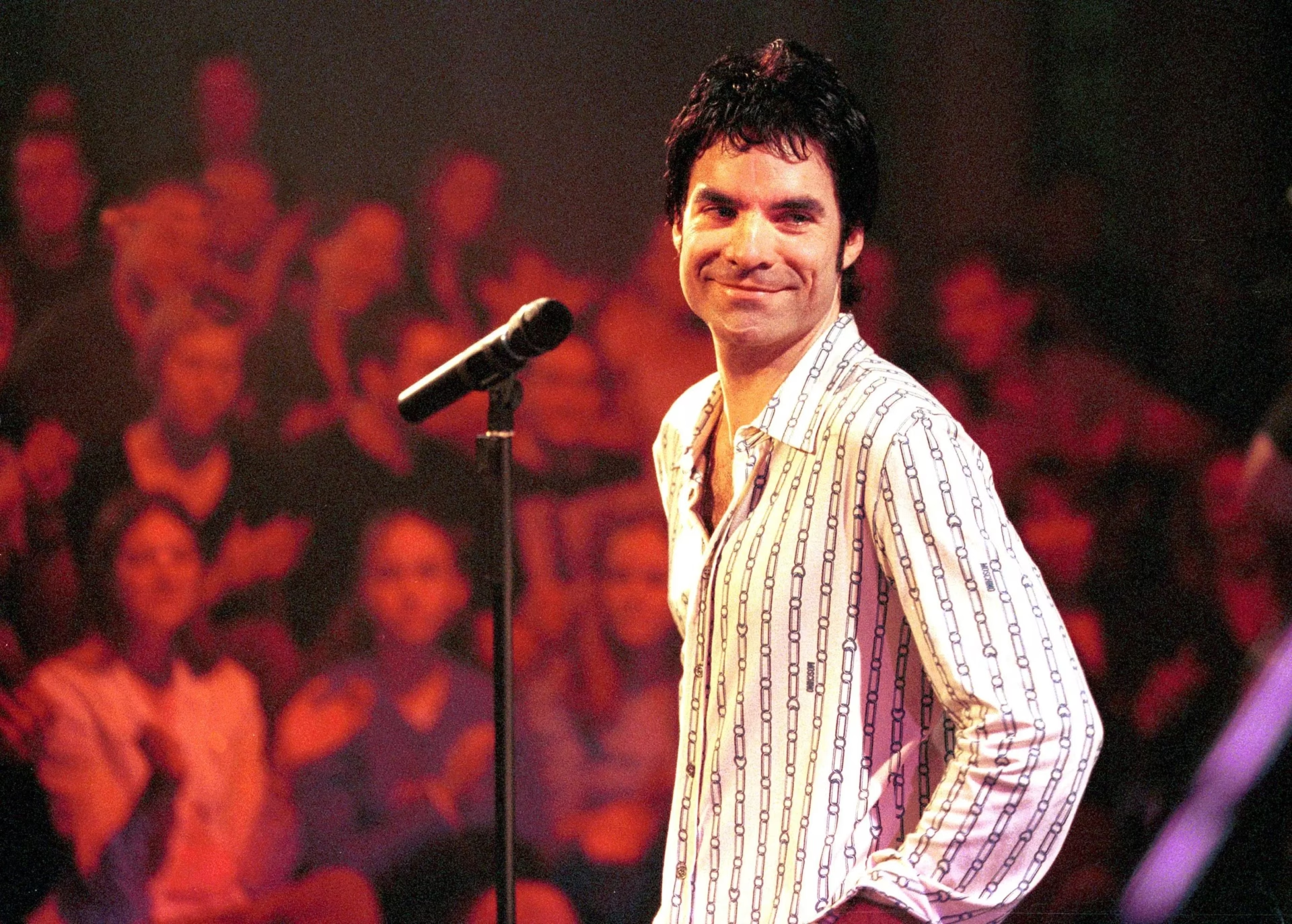
What do the Rolling Stones' session pianist Chuck Leavell and Leonard Cohen's string orchestrator Paul Buckmaster have in common? They both appeared on Train's "Drops of Jupiter."
While the song may conjure the Y2K adult-contemporary boom more than those vintage artists, the two studio veterans' presence speaks volumes. No matter which way your tastes flicker, "Drops of Jupiter" is a classy tune. Not that Train singer, Pat Monahan, was thinking about that at the time. A married father in his late twenties touring the world on their early hit "Meet Virginia," Monahan felt destabilized by sudden fame, struggling to square his his tour life with his home life.
Sure, he might have commanded a stage in front of adoring fans, but that didn't mean much while crying on a payphone near the venue afterward. Why? At the time, his mother was terminally ill—and her eventual passing is what inspired "Drops of Jupiter," released on their album of the same name 20 years ago on March 27, 2001. In the hit song, Monahan wonders where his mother might be: "But tell me, did you sail across the sun?/ Did you make it to the Milky Way/ To see the lights all faded/ And that heaven is overrated? " he asks.
"I wrote that song in 15 minutes," Monahan tells GRAMMY.com over Zoom. "I fell asleep and woke up and it was like my mom tapped on the shoulder, and she was like, 'Let's go. I've got it for you. Let's go write this.' And it was a story about her telling me what the afterlife was."
While Monahan admits the title track—which was nominated for Record Of The Year and Best Rock Performance By A Duo Or Group With Vocal at the 2002 GRAMMY Awards show— "consumed" the album, other tunes like "I Wish You Would," "Hopeless" and "Something More" provide further breadcrumbs as to his state of mind.
<style>.embed-container { position: relative; padding-bottom: 56.25%; height: 0; overflow: hidden; max-width: 100%; } .embed-container iframe, .embed-container object, .embed-container embed { position: absolute; top: 0; left: 0; width: 100%; height: 100%; }</style><div class='embed-container'><iframe src='https://www.youtube.com/embed//7Xf-Lesrkuc' frameborder='0' allowfullscreen></iframe></div>
As for the rest of the album? Monahan, now the only sole founding member in the band, mostly stands by it, even if he admits he was miserable at the time. GRAMMY.com spoke with Monahan about memories behind every song on Drops of Jupiter, how Leavell and Buckmaster got involved, and why he's happy never to return to this well of sorrow.
Does it feel like Drops of Jupiter came out two decades ago?
I never really think about that, but yeah. I suppose it does. A lot has happened in 20 years. I'm a lot happier than I was back then. I think that whole album is based on a lot of sadness and questions and really not having faith in the future, but now, it's a different life that I live. So, it's pretty cool to look back at that.
What was going on in your emotional life at the time?
Well, I was in a bad relationship, and I was traveling so much and I had children. It was after the first album that had "Meet Virginia" on it. It was still a time [when] there was no real money. We sold a million albums but it didn't mean that I was living in any type of luxury at all. The only thing I was able to do at that point was to pay off my credit card debt.
We were traveling the U.S. and Canada. We may have even gone to Australia with it, but we never really went to Europe or anything. There wasn't a big push in Europe for "Meet Virginia," so writing the second record was, I would say, more pressure than I've ever felt in my life.
We knew [we needed to write] some type of song that people would care about or the chances of making another record were going to be slim.
<style>.embed-container { position: relative; padding-bottom: 56.25%; height: 0; overflow: hidden; max-width: 100%; } .embed-container iframe, .embed-container object, .embed-container embed { position: absolute; top: 0; left: 0; width: 100%; height: 100%; }</style><div class='embed-container'><iframe src='https://www.youtube.com/embed//4R40p6ZG8Uo' frameborder='0' allowfullscreen></iframe></div>
Tell me about "She's On Fire."
"She's On Fire" was a fantasy. There were moments on that first tour that I met a lot of people, and I was seeing so many beautiful faces and meeting boys and girls and everything you could think of. But I was married, so there was no anything I could do about any kind of attraction I might have had. So, I had to write songs instead. "She's On Fire," I think, was a fantasy of, like, "Man. This is the magic of what a relationship should feel like."
We thought that was an obvious first single. We just thought that was the coolest song ever. When we listen now, it's obvious that it's not. But nobody else thought it was a first single, and we were really surprised. So everything obvious in my career is never the single. I should never judge what a single sounds like because it's the weird ones that make it to the forefront of radio and peoples' brains.
What about it struck you guys as the obvious first single?
It had tempo. We thought [sings hook] "She's on fiiiiiire!" would appeal to whether you liked pop radio or country radio or whatever. That sat there in a great American way. Americana, I should say.
I'm looking at the chart position. It did respectably.
It did OK. Not like we imagined. And I think it came from the fact that "Drops of Jupiter" was so big that it still had some momentum, even though the second single was supposed to be a song called "Something More." But it got dumped because of 9/11. We shot a music video for it [where] I was climbing up a sky-rise building and 9/11 happened and everything changed.
So, we went to "She's On Fire," but it was years—It seemed like two years after "Drops of Jupiter." Sometimes, a song can be so big that it can consume the entire album, and that's kind of what happened.
<style>.embed-container { position: relative; padding-bottom: 56.25%; height: 0; overflow: hidden; max-width: 100%; } .embed-container iframe, .embed-container object, .embed-container embed { position: absolute; top: 0; left: 0; width: 100%; height: 100%; }</style><div class='embed-container'><iframe src='https://www.youtube.com/embed//EbrkOPM2Ejs' frameborder='0' allowfullscreen></iframe></div>
Tell me about "I Wish You Would."
That was more about a fantasy of what I had always hoped to go home to. Being on the road for months and months and months and coming home, my fantasy was to come home to someone who was as excited to see me come home as I was excited to be home. That kind of thing. That's what that song's about.
That entire album is either me apologizing for shit or hoping for things, and it continued into the next album, with "Calling All Angels." That was the end of that period for me.
From what you've described regarding the first few tunes, it seems like there was a tension between home life and tour life.
Of course! I mean, I was 28, 29. My son was born when I was 23, and I was sober. I had been sober for a long time because I knew what it was going to take for a guy from Erie, Pennsylvania, to try to be successful to be in a potentially dangerous industry. Everyone around me was partying and having multiple fun relationships and I was just working.
Now, we get to the big one. Obviously, a product of grief. A really personal one and also the biggest hit.
Yep. You know, somebody asked me the other day about that, because I had lost my mother that year and we were writing and it was hard to be inspired by anything when a boy loses his mom. It was very tragic.
But somebody asked me, "How do you feel that potentially the biggest song of your career means so much to you?" I was like, "Wow, I've never really thought about that." It wasn't a fluke. It wasn't like, "Oh yeah, we just came up with [mimics guitar riff] 'Doo-dow-now-now!' or whatever." It's a really heartfelt moment for me, so I guess I should be more appreciative. I've never really thought about that.
I wrote that song in 15 minutes, man. I fell asleep and woke up and it was like my mom tapped on the shoulder, and she was like, "Let's go. I've got it for you. Let's go write this." And it was a story about her telling me what the afterlife was. "I can swim through the planets if I want to. I can do whatever I want."
One thing about "Drops of Jupiter" that a lot of people don't talk about is that it had two veterans on it—Paul Buckmaster and Chuck Leavell.
Chuck Leavell, man. He made that song as magical as it could have been because he gave it that bounce. [mimics piano-and-drums groove] I think he played it three times and we were like, "That's good. You're good. Thank you!" He's that special?
Was that the label's push, to get a pro on there?
No, actually. That was Brendan O'Brien. We recorded that record in Atlanta, and we did not have "Drops of Jupiter." I wasn't a Pearl Jam fan, but there's a song called "Better Man" that was on the radio, so I asked if I could look into that producer, and it was Brendan O'Brien.
When I asked if I could get Brendan O'Brien, they laughed at me: "Dude, you're not a big enough band." He was about to record the Limp Bizkit album, and something happened where it was postponed or whatever and Fred Durst backed out, or something. So, Brendan, all of a sudden, was open and he took the project.
Chuck Leavell is also a Georgian, and he owns a tree farm in Georgia. He called Chuck because Chuck was an hour away and he came and did it, and it was that easy.
How about Paul Buckmaster? His string arrangement is gorgeous.
That was actually [music executive] Donnie Ienner's idea. When we didn't have a single, we also had an agreement in the band that we weren't to write outside the band. Which really put shackles on us, but we weren't aware of it at the time. You protect things that you end up breaking.
I was being asked to meet Donnie Ienner in New York, and he was about to say, "You have to write outside the band. It's time." Because we didn't have the hit he wanted. It was two days before that meeting when I dreamt "Drops of Jupiter."
So, I went to New York to have that meeting with him and I had a demo of it in my pocket. That's when I played it for him. At the time, Almost Famous was the biggest movie in the country and Elton John's songs were all over it. So as soon as Donnie heard the song, he was like, "Paul Buckmaster has to do the strings." He was so fired up about this whole thing.
<style>.embed-container { position: relative; padding-bottom: 56.25%; height: 0; overflow: hidden; max-width: 100%; } .embed-container iframe, .embed-container object, .embed-container embed { position: absolute; top: 0; left: 0; width: 100%; height: 100%; }</style><div class='embed-container'><iframe src='https://www.youtube.com/embed//mZbr78Hwt0M' frameborder='0' allowfullscreen></iframe></div>
Before I knew I would be doing this interview, I learned Leavell and Buckmaster were involved from a Rick Beato deconstruction on YouTube. Have you seen that?
Yeah, I have. It's pretty interesting!
Did it teach you anything about your own song, in a way?
You know what it taught me? Humans will overthink anything! Why did he throw that ball that way? Well, I'll tell you why! Because in fifth grade, he met a girl called Sheila! Who knows what anything is, you know?
<style>.embed-container { position: relative; padding-bottom: 56.25%; height: 0; overflow: hidden; max-width: 100%; } .embed-container iframe, .embed-container object, .embed-container embed { position: absolute; top: 0; left: 0; width: 100%; height: 100%; }</style><div class='embed-container'><iframe src='https://www.youtube.com/embed//ZbFqrv-oHi8' frameborder='0' allowfullscreen></iframe></div>
The next tune is "It's About You."
That was an attempt to write a hit song. This is what you get stuck doing sometimes.
Let's say you're making a sad album. Today would be different than it was when I was trying to become something. Today, you could go make a sad album and then 15 minutes later go make a different album. And you have a computer, so you can make three albums in a week, or whatever.
But when you have one chance to make an album and it potentially costs a couple of hundred thousand dollars, you start to want to feed the machine that's going to feed you. That was a song that we thought, "Man, it's got tempo and this cool drum bit and whatever."
We played it for years live and people seemed to like it because we needed that type of song, but it didn't make a huge impression on people.
I'm a songwriter myself, and I think we all have material that feels like juvenilia. It's not us anymore. Can you still inhabit the self that made this album?
Of course. It's like looking at—I wouldn't say a lesser me, but a part of me that needed to do this to be better at certain things.
My manager and I talked the other day and he was like, "Man, we're listening to these songs you wrote that didn't make the album. There's a handful of them. Your melodies are so much more complex and thought-through and better." When I think of "It's About You," I just think of [mimics goofy cadence]. There's no melody there. It's just a guy trying to rap who can't.
It's funny in some regard, but in another way, I needed to be a young guy trying to figure stuff out.
<style>.embed-container { position: relative; padding-bottom: 56.25%; height: 0; overflow: hidden; max-width: 100%; } .embed-container iframe, .embed-container object, .embed-container embed { position: absolute; top: 0; left: 0; width: 100%; height: 100%; }</style><div class='embed-container'><iframe src='https://www.youtube.com/embed//4_WaNpz8lfA' frameborder='0' allowfullscreen></iframe></div>
How about "Hopeless"?
That was a pretty important song to me.
Tell me about it.
When I was [touring], "Hopeless" was, like, I was hopeless. I felt hopeless all the time. It's a wild trip. The importance of love in a human body, that need for love and affection and somebody to look at you with love, is so necessary. I was writing songs just like, "Man, I'm writing as a voyeur. I'm writing somebody else's life, but it's just like a reflection of my own."
<style>.embed-container { position: relative; padding-bottom: 56.25%; height: 0; overflow: hidden; max-width: 100%; } .embed-container iframe, .embed-container object, .embed-container embed { position: absolute; top: 0; left: 0; width: 100%; height: 100%; }</style><div class='embed-container'><iframe src='https://www.youtube.com/embed//FC601nWwR-c' frameborder='0' allowfullscreen></iframe></div>
How about "Respect"?
That was a very particular song about a guy that I went to grade school who I and my friends didn't treat properly. We're friends today and I love him a lot. He's a wonderful guy. But I have a lot of regret about a certain couple of years of my young childhood life.
Not beating people up or anything. It wasn't like that. But it was "bully" enough that it excluded him. And that exclusion made us, the others, feel closer. That's what happens when kids are not kind. I really regretted that and still do, and that's what that song is about. Everybody needs respect, and now I know that, so I'm sorry.
How did he react to the song?
You know, he's such the kind of fella—he's a bodybuilder and could beat me up 1,000 times a day if he wanted.
His lesson during that wasn't to hold a grudge, thankfully. His lesson was "I've just got to get through this," and he did. And he became a big, tough, strong guy so he wouldn't have to deal with guys like me and other people anymore. We all learned what we were supposed to, I suppose.
<style>.embed-container { position: relative; padding-bottom: 56.25%; height: 0; overflow: hidden; max-width: 100%; } .embed-container iframe, .embed-container object, .embed-container embed { position: absolute; top: 0; left: 0; width: 100%; height: 100%; }</style><div class='embed-container'><iframe src='https://www.youtube.com/embed//AshW0KKFoWg' frameborder='0' allowfullscreen></iframe></div>
"Let It Roll."
That was the biggest song about my mom. That was the heartbreaking "I'm lost now." I was on tour during the "Meet Virginia" days with no cellphone, no Internet, no connection to anybody.
The way I found out my mother was terminally ill was [through] my sister. [She] said, "Hey, so-and-so's coming to your concert tonight." She came and left me a card and the card said, "Your mom's really sick. You need to call her."
So after the show, I went outside the venue to a payphone and just cried on the phone with my mom for an hour, with her telling me that she was going to be sick for what we hoped was going to be a long time, but it wasn't. She was gone quickly, but that's what that song is about: "I don't know how to let this thing roll, but I've just got to remember you'll be in me forever."
That's so rough, dude.
It's so f**king hardcore, dude. You don't want to have that moment ever.
<style>.embed-container { position: relative; padding-bottom: 56.25%; height: 0; overflow: hidden; max-width: 100%; } .embed-container iframe, .embed-container object, .embed-container embed { position: absolute; top: 0; left: 0; width: 100%; height: 100%; }</style><div class='embed-container'><iframe src='https://www.youtube.com/embed//bWIrE6vYYKg' frameborder='0' allowfullscreen></iframe></div>
"Something More."
It wasn't the magic that "Drops of Jupiter" was, but we thought it at the time. That was my speaking out against the life I was living: "I'll get through this and I'll be something more." You think you're something more right now, that you're above this, but it's going to flip.
It was at a weird time because as I said before, we were trying to write only within the band. Our drummer at the time, his name is Scott. He wasn't writing anything, so I was like, "Dude, learn how to write. We all have to write within this project. Go do it."
So he got the keyboard and wrote the [mimics vamp] because he was a novice writer. He was writing whatever he felt in those weird minor keys and stuff. Nobody else was really writing that, so it became a fun little project to jump-start somebody's writing style.
Before we hit the last three songs, tell me what it was like to be frightened and on tour and newly famous during that boom for the music industry. I guess it was a boom, right? In the early 2000s? That high of being on stage versus sobbing on the payphone with your mom, that's such a crash to Earth.
It never really felt like a boom. It just never did. Because there's a thing that happened where "Meet Virginia," it was an underground [success]. When people find a new band, it's like ownership. I found them, I turned you on to them, you like them because of me—it's ownership. A feeling of "I just found my jam."
"Drops of Jupiter" was so big on pop radio that we almost had to transition from real fans to now pop fans. And pop fans are fickle. They deteriorate. They move on to the next thing. So, it wasn't a boom. It was a transition, and we had to figure out how to get used to it.
Like, did we just lose all the people we gained by touring for three years with a little old song that's like a cool car? And now we're in a Bentley and they're like, 'You've changed'? We had to figure out how to navigate that.
<style>.embed-container { position: relative; padding-bottom: 56.25%; height: 0; overflow: hidden; max-width: 100%; } .embed-container iframe, .embed-container object, .embed-container embed { position: absolute; top: 0; left: 0; width: 100%; height: 100%; }</style><div class='embed-container'><iframe src='https://www.youtube.com/embed//Uf7yuRyYhx8' frameborder='0' allowfullscreen></iframe></div>
We've got four minutes left. "Whipping Boy."
Yeah, that was me just being me. We were listening to records that were, like, Sparklehorse. At the time, Whiskeytown, when Ryan Adams just started that project, and his guitar tone. We were trying to emulate some of those vibes. That was the darker side of what we loved musically.
<style>.embed-container { position: relative; padding-bottom: 56.25%; height: 0; overflow: hidden; max-width: 100%; } .embed-container iframe, .embed-container object, .embed-container embed { position: absolute; top: 0; left: 0; width: 100%; height: 100%; }</style><div class='embed-container'><iframe src='https://www.youtube.com/embed//zCqE2jUXNHE' frameborder='0' allowfullscreen></iframe></div>
How about "Getaway"?
That was my jam at the time because I got to play the vibraphone on it. It just felt "jazz" to me, and I grew up listening to jazz. That was a song kind of about my parents' relationship.
<style>.embed-container { position: relative; padding-bottom: 56.25%; height: 0; overflow: hidden; max-width: 100%; } .embed-container iframe, .embed-container object, .embed-container embed { position: absolute; top: 0; left: 0; width: 100%; height: 100%; }</style><div class='embed-container'><iframe src='https://www.youtube.com/embed//uMjS1xzySps' frameborder='0' allowfullscreen></iframe></div>
Lastly, we've got "Mississippi."
That was the sleeper. That was everybody's favorite song on the album.
Whoa.
It was "vibe." You know, nowadays—and I think it's really cool; I like where music's at—we listen to vibes. Instead of "Hey, check out this album," it's more of a playlist of things that have whatever in common. That was our vibe song. I'd like to make a record of vibe songs like "Mississippi" someday.
I've got one last question. Where did the muse—or whatever you want to call it—lead you from Drops of Jupiter?
Well, it went from "Somebody please come and help me" to finding real love. True love from somebody I'm supposed to be with.
So then, when I wrote "Hey, Soul Sister" and "If It's Love" and the happier songs, this was also a transition because people were like, "Well, that's not the same sad guy that I remember, so I'm not sure if this is for me." And I'm like, "Well, that's good because I'm going to stay here. I don't want to go back to that other thing! Your joy is coming from real misery from me, and I've got to move on, too."
How Coldplay's 'Parachutes' Ushered In A New Wave Of Mild-Mannered Guitar Bands