Can an artist of one race pay homage to the art of another? On one side of the debate is disrespectful appropriation—on another, racial essentialism. On her new album of songs—many of them important to Black communities—from the 20th-century pantheon, American Quilt, Paula Cole walks the middle course with dignity and respect.
Among its mélange of Americana staples, like "Shenandoah" and "Wayfaring Stranger," American Quilt, which arrives May 21, does contain one original—"Hidden in Plain Sight (I Dream)," which premieres exclusively below via GRAMMY.com. That song illuminates the role of quilts as coded guides for fleeing slaves during the Underground Railroad. As a white woman, Cole is fully aware that she's not the representative for this subject. But unlike politicians, artists can swim between these boundaries at will.
<style>.embed-container { position: relative; padding-bottom: 56.25%; height: 0; overflow: hidden; max-width: 100%; } .embed-container iframe, .embed-container object, .embed-container embed { position: absolute; top: 0; left: 0; width: 100%; height: 100%; }</style><div class='embed-container'><iframe src='https://www.youtube.com/embed//4Yc-vckYgcE' frameborder='0' allowfullscreen></iframe></div>
"I just felt that even though it's not necessarily my story to tell, being a white person, it's important that we remember," the GRAMMY winner and seven-time nominee most famous for 1996's smash hit "I Don't Want to Wait" tells GRAMMY.com. "I created the song to reflect that because there isn't very much out there, and a lot of people don't know about them. They're mind-bogglingly ingenious." That last description could just as easily apply to Bessie Smith, Louis Armstrong, Miles Davis and John Coltrane—Black innovators that Cole highlights on American Quilt and enthusiastically praises through the course of the interview.
GRAMMY.com caught up with Cole over the phone from Massachusetts about her all-over-the-place cultural roots, what compelled her to make this patchwork of American tunes and why music can help bridge the gaps between races and cultures.
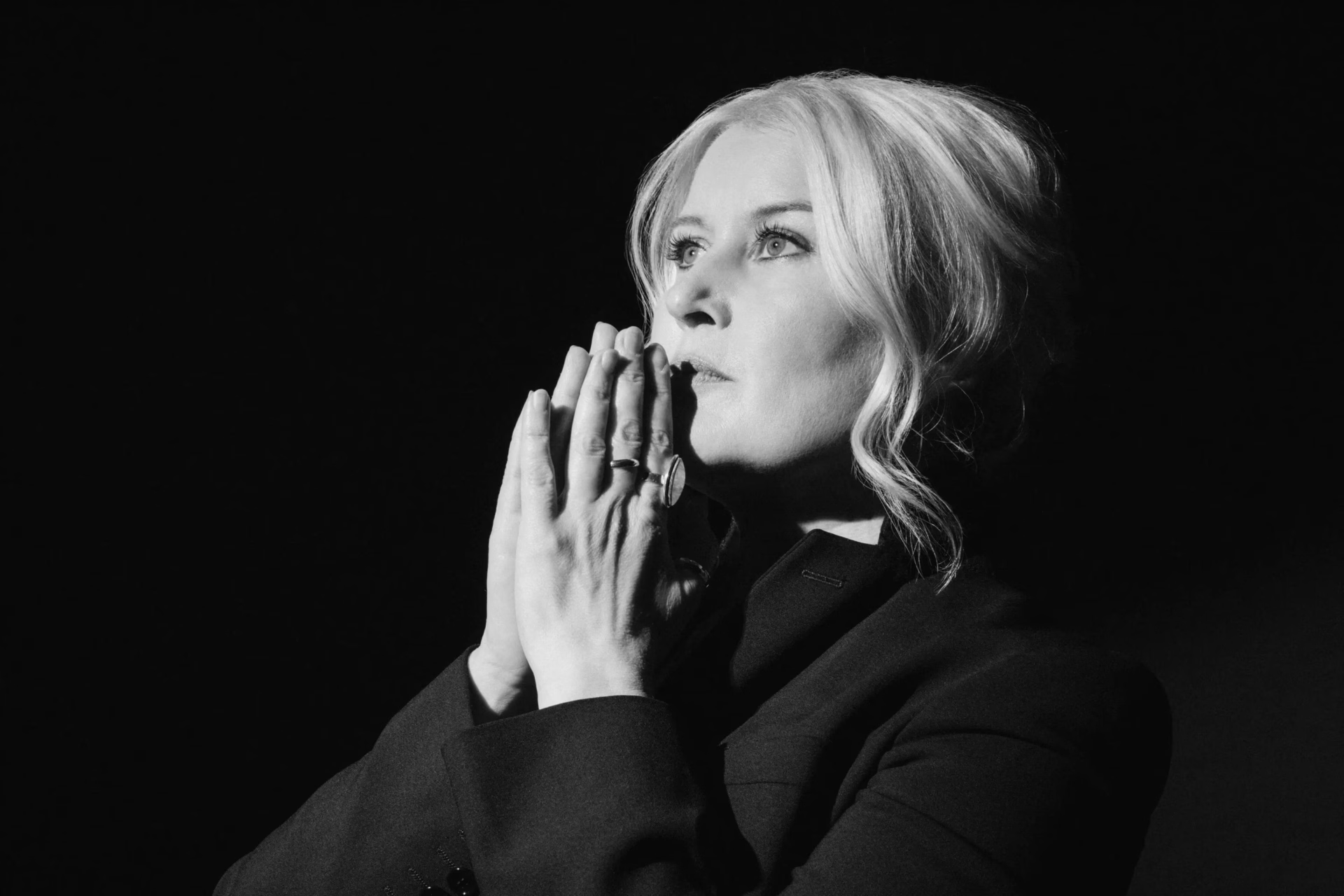
Paula Cole. Photo: Ebru Yildiz
This interview has been edited and condensed for clarity.
Nice to meet you, Paula. Where are you located?
At the moment, I'm in Rockport, Massachusetts. I'm visiting my parents quickly, so I'm conducting the interview from my childhood home, which is pretty interesting for me.
How does that feel?
It feels great. I love my parents so much. I had decided to move back to the North Shore of Massachusetts to raise my daughter nearer, so she could know them and the generations would be unified. That was more important to me than other things, like living in an industry city.
Is your childhood bedroom just how you remember it?
[laughs] No, it's different now. They changed it. We grew up in a Georgian house that was built in the 1600s. We're talking about a colonial New England house. George as in King George, you know? It's very small and poky and yet beautiful and historic.
What compelled you to see the American experience as a patchwork quilt?
It was accidental. The music informed the process. Having recorded 31 jazz standards in five days for my Balladsalbum—I should requalify that. They weren't all jazz standards. "God's Gonna Cut You Down" was actually recorded in 2016 in the Ballads sessions.
I was so pent-up as a lover of these standards that we recorded so much music. I released a double album, Ballads, and yet all these wonderful tracks were remaining and I had to shape them up. But I wanted to honor my roots and my roots are so diverse. Genetically, I'm so mixed, and musically, I'm so mixed.
I grew up with a father who was a professional bass player on weekends when I was a small child. He could play Duke Ellington songs on the piano and then folk songs on the guitar or harmonica and upright bass. We listened to country music records and everything. There was no classification or boxing-in of genre. It was meant to be self-made and fun.
Non-musicians were the ones who classified the music, and they usually did so by gender and race and age. Which still happens to this day, based on algorithms through platforms on which we listen to music. We're classifying and dividing music for all the wrong reasons. And here I am, a mixture. I'm such a mixture. Loving all music. It's a patchwork.
My mom's a visual artist. She's a quilter, too. It just came to me that it was a quilt. That's when I needed to go back into the studio, and I recorded some more folksy Americana songs which reflect all of who I am. That's when I had the "A-ha!" moment that it's a quilt.
I needed to represent the sad parts of history and the honest part of our history. We wouldn't be who we are without the African experience. Slave quilts were these ingenious creations helping slaves flee to the Underground Railroad, to find the clues in the quilts.
The more I researched slave quilts, the more I realized that people didn't know about them. There isn't very much out there about them. Certainly, there was no music, no song I could sing to reflect them, even though there are Christian spirituals that double as protest songs, like "Steal Away." There wasn't anything about the quilts, so I wrote something into that vacancy to reflect a more full and diverse experience of America and our history.
We are a patchwork. We're all part of this diverse culture. Whether our music comes from Scotland or Africa or the cities or the mountains, it's all this American melting pot. That's our strength. [The album] coalesced intuitively. I didn't go about trying to make a concept album. It made itself.
Tell me more about "Hidden in Plain Sight."
That's the one original song I wrote for the album. "Hidden in Plain Sight" is all about the quilts. It's the cautionary tale and the advice from the quilter to the traveler. Each verse of "Hidden in Plain Sight" is a quilting square.
For instance, flying geese is a quilting square. It's a pattern used in quilts to this day. Flying geese in the context of slave quilts meant "Follow geese in spring. They lead north." Or a bear trail, which is a quilting pattern, means to the follower, "Follow the tracks of animals. They take you to water. They take you to safe places to hide."
So on and so forth. Each verse is advice to the traveler from the slave quilt. I created the song to reflect that because there isn't very much out there, and a lot of people don't know about them. They're mind-bogglingly ingenious. I just felt that even though it's not necessarily my story to tell, being a white person, it's important that we remember.
I'd like to explore your connections with all these traditional songs, too.
Sure. Sometimes, it's just because I like them!
That's as good an answer as any! That being said, what attracted you to "You Don't Know What Love Is"?
Oh, that's mostly my love for John Coltrane. I listened to so much from his Ballads album and I really feel the band channeled Coltrane on that recording. The form is the same. How it moves into double-time for the solo. The piano player, Consuelo Candelaria, just branches out so beautifully in her jazz solo. Then, we bring it back down to this very moody, almost spiritual, solemn feeling.
I just wanted to honor him. He was such a gentle giant and spiritual being.
He could play the hell out of a ballad, too.
[chuckles] Yeah. He's a hero to so many.
Paula Cole performing at Lilith Fair in 1997. Photo: Bob Berg/Getty Images
How about "Wayfaring Stranger"?
See, I'm bowing to the masters here. I'm bowing to Coltrane and I'm bowing to Emmylou Harris, who I think is one of the great American voices. We shouldn't forget her. We should be talking about Emmylou Harris more. I learned "Wayfaring Stranger" from her Roses in the Snow album.
Emmylou is very dear to me. We sang on each other's sets when we were both at Lilith Fair. When I was taking my hiatus from the music business—totally disenchanted with the music business, hating the music business and wanting to leave the music business—it was Emmylou who told me in a very motherly way, "You can't. It just happened too fast."
For me, she said I'm lucky. That I've had a nice, long plateau of a career. It's true; that's the healthier way. That's the way of the proverbial tortoise, and she helped me see that. I love her so much for giving me the right spiritual advice when I wanted to leave the music business.
I'm honoring that traditional song. Life being hard for early settlers. Life being hard and thinking about death as a place that can be beautiful, where you meet your loved ones again. People would sing these songs to console themselves, to pass time.
And they span hundreds of years! It's so amazing! But I'm also honoring Emmylou Harris because I associate that song with her.
What made you want to quit the biz once and for all?
Like she said, it happened too fast for me. I'm very much a live performer and a catalog, legacy artist. That's how I see myself. I don't see myself as a hit-pop-song artist. My hits were so huge and there was so much attention. I was terribly introverted, so I didn't deal with it very well, and I just felt I was overexposed. I wasn't being known for what I actually was.
I wanted to have a reset and have my personal life back. I wanted to have a child and I wanted to live a sincere life and make great art. So, I just needed to shed an ill-fitting skin. It ended up, then, that I wasn't going to leave the business. I was just going to reinvent myself, reset and embark upon a more authentic second career.
How does "God's Gonna Cut You Down" speak to you?
I heard that from Odetta and from Johnny Cash. I don't have much to say about it other than it's a traditional song and it's a morality tale. It's nice to have a morality tale right now, especially told from a woman's point of view.
And how about "Shenandoah"?
It lives somewhere in our collective unconscious, right? That one's really profound because it has a lot of American history in it. From fur traders heading west to the Oneida tribal chief. These lonely fur traders going up and down the St. Louis River. Very often, they would marry Native American women and blend with tribes. And, again, people are singing these songs to keep themselves company, going up and down rivers and across oceans. So, the song lives on in an oral history, preserving this culture. The singer is singing to the Oneida chieftain about loving his daughter and wanting to marry her.
I love the melody. It's so haunting and so beautiful. I was kind of possessed by it. I made this very long arrangement that includes the journey of the song. It goes across the ocean in clipper ships to the U.K. by including the pennywhistle, coming back to American soil, and by including the voices of the gospel churches.
That's Darcel Wilson singing with me and also Peter Eldridge. They're both such brilliant artists in their own rights. When Darcel sings at the end, I'm completely transfixed and the hair stands up on my arms. It is so moving to me what she does in her performance. She takes over from the lead singer. It feels prescient. The Black voice taking over the white voice.
What can you tell me about "Black Mountain Blues"?
"Black Mountain Blues," I heard from worshipping at the altar of Bessie Smith. I love her lyrics. Bessie Smith was Janis Joplin's favorite singer and also Billie Holiday's favorite singer. Bessie Smith is so influential to modern music. I don't think we quite understand that.
I like it because it's strong. It's not so much a woe-is-me blues; it's a fierce blues. It's a power-of-woman blues. I'm honoring those masters, like Janis and Bessie.
Have you read Angela Davis's book Blues Legacies and Black Feminism?
I have it on my shelf and I've poked around in it! I haven't read it cover-to-cover. But, yes, I know what you mean. The feminism in [the music of] Bessie Smith, Billie Holiday and Ma Rainey.
"Good Morning Heartache." What's your connection to that one?
That's in the book of standards. I literally have a book of standards on my piano that I go to as a place to grow, learn and relax. I always have. I love that song.
I just wanted it to sound spooky. I produced it in a way that was mournful and spooky. I layered my clarinets, and my clarinet is like my Alfred Hitchcock cameo appearance. I put it on every album I make, somewhere. I put an underwater reverb on it and it gave it a real mood to evoke that sadness.
"Nobody Knows You When You're Down And Out" is also Bessie, right?
Absolutely; that's where I learned it. Bessie. The queen. The Empress of the Blues.
What's the title mean to you?
When you're down and out, nobody gives you a break. Nobody wants to hear from you. Most people are fairweather friends. Fairweather fans. Fairweather business. Fairweather everybody. It's when you're down and out that you know the truth in people. That's why she says "Nobody can use you when you're down and out," because people are going to act truthfully when you're down and out.
What a weird part of human nature.
I know! When you're high and mighty and on your high horse and successful, everyone is obsequious. Everyone is trying to get your business and placate you and lie and be two-faced and be sweet and ingratiate so they can be associated with you. When you're nobody, they couldn't care less.
You're back to jazz with "Bye Bye Blackbird." Obviously, Miles had such a beautiful version.
Miles taught me so much about space and being a bandleader. Honoring the rhythm section to be part of your sound. I wanted to vocally improvise on something simple and keep it very sparse and honor Miles, too. And then, "What a Wonderful World." We think of Louis Armstrong, and he was a genius. I don't like to use that word, but there are a few in the world, and he was one. When you listen to all of his recordings, his vocal improvisations, his ears are just astounding. He unified Black and white audiences. He's a beautiful example of someone who was positive and loving and unified people. This song was written specifically for him, so it appeals to Black and white audiences.
Somehow, in my life, that has become part of my mission. To talk about race and to mix genres.