
Ever hear of the "sophomore slump" phenomenon ? As a rock band, it's a formidable boss to face down. Often, with the first breakthrough album, there's been years of thinking, woodshedding and commiserating involved. With the second, you might have 25% of the creative and production time you had for your debut, if that. And you've got to write something better in every conceivable way.
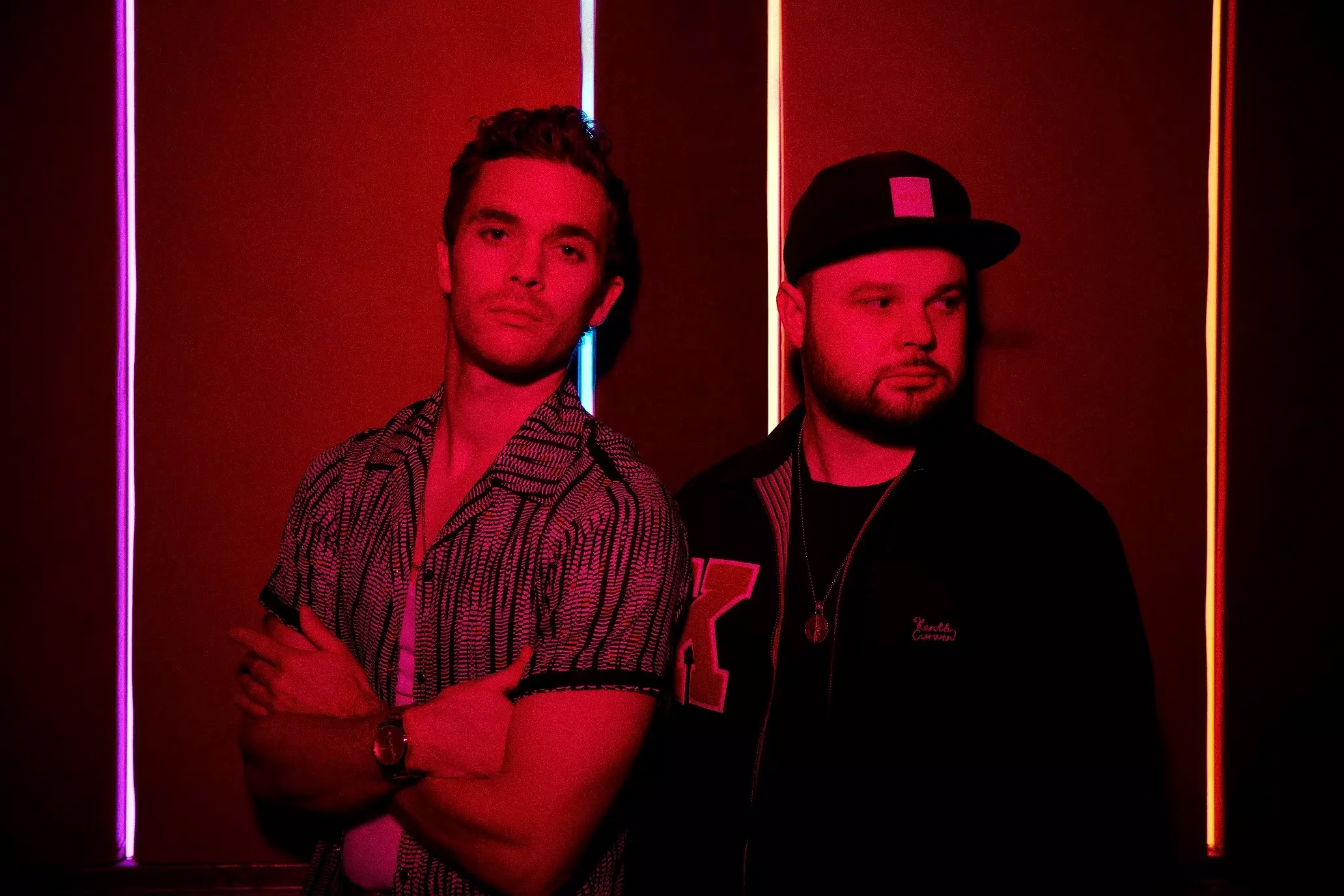
For the British rock duo Royal Blood, their second album, 2017's How Did We Get So Dark?, had the potential to fall into the sophomore slump trap. Fortunately, they swerved around it: The album reached similar commercial heights as their 2014 self-titled debut album. Still, singer/bassist Mike Kerr and drummer Ben Thatcher, who just put out their third album as Royal Blood, Typhoons, last month, recall the experience of recording its predecessor as anxious and self-conscious.
<style>.embed-container { position: relative; padding-bottom: 56.25%; height: 0; overflow: hidden; max-width: 100%; } .embed-container iframe, .embed-container object, .embed-container embed { position: absolute; top: 0; left: 0; width: 100%; height: 100%; }</style><div class='embed-container'><iframe src='https://www.youtube.com/embed//k9SQ2xfHEiM' frameborder='0' allowfullscreen></iframe></div>
"It was quite daunting," Thatcher tells GRAMMY.com over the phone from his Brighton bedroom. "We put all this pressure on ourselves to write something that's new, but still has what made Royal Blood, Royal Blood at the core of it."
So how did Royal Blood regroup afterward and make Typhoons, their most kinetic and self-assured album to date? For Thatcher and Kerr, concocting tunes like "Oblivion," "Million and One" and "Mad Visions" came down to clearing their heads, getting back to their original artistic thesis, and writing for themselves, not others. In the process, they uncovered some poignant advice for young bands who aren't sure how to outdo themselves in the studio and want to do so without driving themselves mad.
To mark the release of Typhoons, here's what Royal Blood did to make recording the album a pleasant, joyful experience, which, in turn, led to their most inviting and rewarding music to date.
<style>.embed-container { position: relative; padding-bottom: 56.25%; height: 0; overflow: hidden; max-width: 100%; } .embed-container iframe, .embed-container object, .embed-container embed { position: absolute; top: 0; left: 0; width: 100%; height: 100%; }</style><div class='embed-container'><iframe src='https://www.youtube.com/embed//FoDNFsQGDjE' frameborder='0' allowfullscreen></iframe></div>
They Cleared Their Heads
Everyone's relationship to sobriety is different, and Royal Blood offer no prescriptions for anyone's lifestyle. Regardless, Kerr feels he couldn't have had the wherewithal to co-create Typhoons if he hadn't given up drugs and alcohol beforehand.
"I went from one extreme to the other, really," Kerr admits to GRAMMY.com. "The first extreme being living that party lifestyle and doing that for eight years on the road without letting up at all. It was pretty consistent and it just got more and more intense."
In an effort to stop "letting chaos into my life," he, with Thatcher's support, made the decision to become completely clean and sober.
"Honestly, I didn't really know what was on the other side," he adds. "It was stepping out into the unknown. It took a long time, looking back, to find familiarity. Addiction starts with feelings and it ends with feelings. There were a lot of pieces to pick up and a lot of reflecting to do. I had to rebuild myself from scratch. I had to relearn life from scratch."
A little over half a year after cleaning up his act, "A great sense of clarity descended on me,” Kerr said, “and, suddenly, these songs were coming out of nowhere. I felt sharper and smarter than ever."
"The lyrics are all so personal and so revealing," Thatcher remarks. "They're quite dark, in a way. It was a big life change for Mike in the process of this record. As he came out the other side, he had a lot of things to write about. That crashing with the upbeat, euphoric music, I think it's a marriage that works really well."
"Life is hard when you're losin'/Nothin' easy's worth doing," Kerr sings in "Hold On." "Save yourself, don't throw in the towel."
<style>.embed-container { position: relative; padding-bottom: 56.25%; height: 0; overflow: hidden; max-width: 100%; } .embed-container iframe, .embed-container object, .embed-container embed { position: absolute; top: 0; left: 0; width: 100%; height: 100%; }</style><div class='embed-container'><iframe src='https://www.youtube.com/embed//_eSj5Ln8iMQ' frameborder='0' allowfullscreen></iframe></div>
They Returned To Basics
At its core, Royal Blood work with the simplest of palettes: bass and drums. This made their 2014 a relative breeze. But with limitations comes freedom. So, did How Did We Get So Dark? have too many chefs in the kitchen?
"No, I think we had the option of getting too many chefs in the kitchen," Thatcher says. "And we didn't know how to write a second album. I think it's got some great songs on it; I just remember the process was a lot harder than this one."
For Typhoons, on the other hand, "It kind of went back to how we wrote the first one," he notes.
The making of How Did We Get So Dark? was leaden with the knowledge that people would hear it; Typhoons, on the other hand, consisted of two guys trying to come up with parts the other would like.
And they only did this by sloughing off thoughts of how the public would perceive the results.
"You can't make music to please people," Thatcher says. "Nothing ever comes out well if you go in with that mindset. It's got to be a mix: You feel excited, and that's sort of how you can gauge it. Luckily for us, there's two of us in the band, so if something is rockin', we both connect to that and know instantly that we should pursue it. And vice versa: If one of us is not feeling it, then we leave it."
<style>.embed-container { position: relative; padding-bottom: 56.25%; height: 0; overflow: hidden; max-width: 100%; } .embed-container iframe, .embed-container object, .embed-container embed { position: absolute; top: 0; left: 0; width: 100%; height: 100%; }</style><div class='embed-container'><iframe src='https://www.youtube.com/embed//ZadJYsngKqI' frameborder='0' allowfullscreen></iframe></div>
They Wrote Without Fear
By blocking out the imaginary naysayers, Royal Blood made an album full of joyful, interpersonal moments. Thatcher particularly loves the ending of "Million and One" ("It's just brilliant when that synth comes in"), the hook in "Mad Visions" ("When the chorus drops on that, it's just brilliant"), and the transition from that tune into "Hold On" ("Such a sweet mistake").
As for Kerr, he's psyched about "the big, ascending riff section in 'Typhoons,'" likening the harmonies to the Beatles or Beach Boys and the backing to a "massive, AC/DC stadium-rock riff."
Typhoons emphasizes a four-on-the-floor disco feel, which both Thatcher and Kerr consider to be a natural, if unexpected, development. "Our unique spin on it is that we sped it up. We used the ethos of having the guitar as the karate chop over the straight beats, like Angus Young does on those four-to-the-floor beats," Kerr adds.
And if some fans don't follow them into this next phase, it doesn't matter, as long as Royal Blood are authentically themselves. "It's about being what we've been shooting for," Kerr says. "It's about being fearlessly ourselves. We haven't attempted to change direction. This is a direction we were always going in."
Thatcher agrees, and touches on the simplest yet most philosophically bulletproof reason to ever sing or pick up an instrument. "I think this record has been written out of the joy of creating music for us," he concludes.
