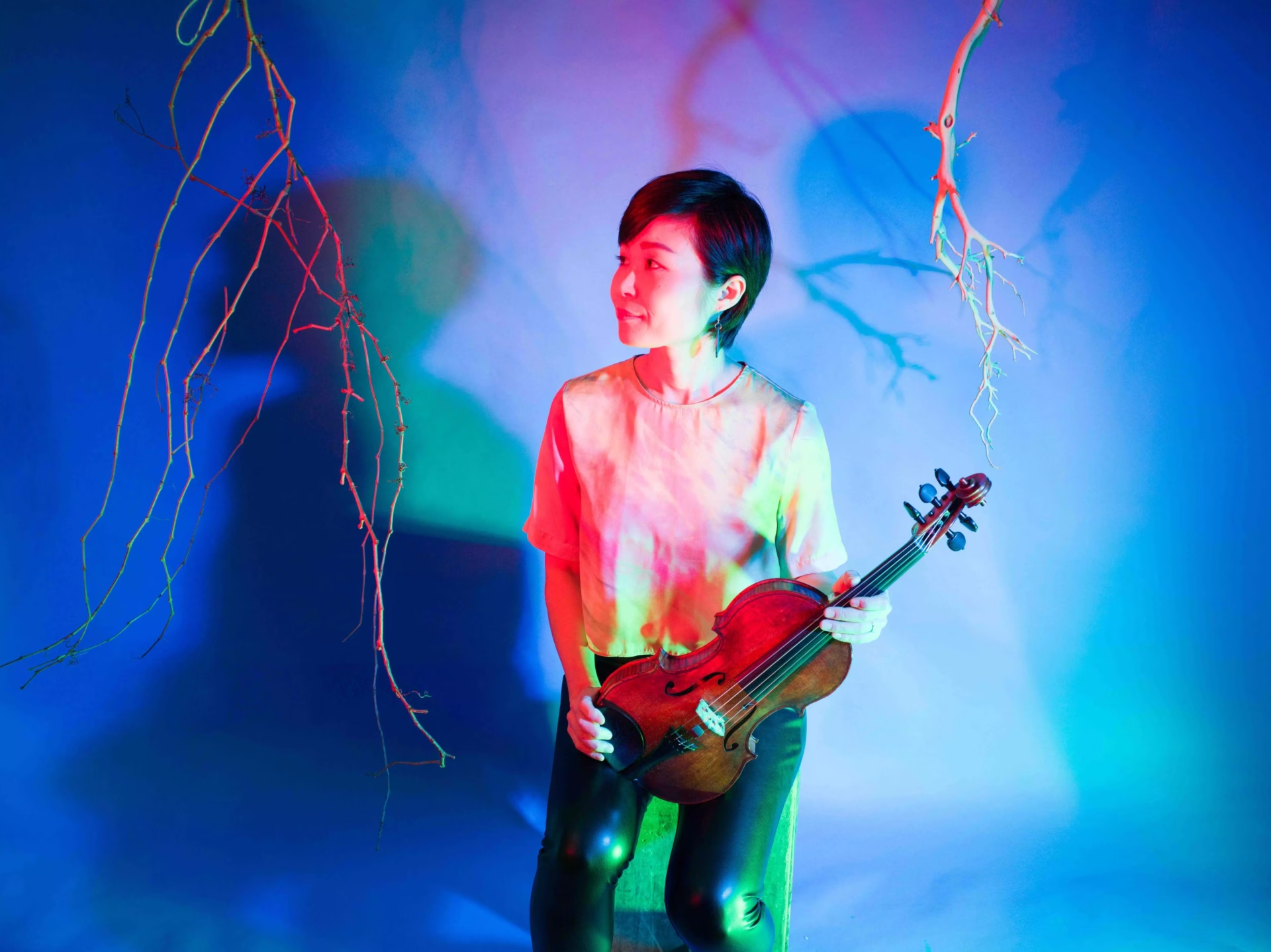
How can people bridge cultural gaps without obsessing over ethnic differences? Maybe the answer lies in feelings and stories as much as music or cuisine. Tomoko Omura, a violinist, composer and arranger, is aware of the role of the intangible in battling xenophobia. This potential for immaterial connection especially applies to Japanese folktales, which deal in the primary components of the human condition—love, death and mystery—in a way anyone can grasp.
"They're stories you can relate to, those folktales," Omura tells GRAMMY.com over Zoom. "They've been told for a long time for reasons, right? Because we're humans at the end. Those children's folk songs and folktales have lived so long because the messages are strong. I think it's a great way to connect us as humans. It's an easy way to communicate."
For instance, the folk song "Come Firefly" is about the magic of those starry insects. "To Ryan Se" conjures visions of irreversible loss. And "Bow's Dance" is a song of the dwindling Ainu people, an indigenous group from northern Japan. "The culture diminished and the people had to adapt to Japanese culture," Omura explains. "Not so many people know about them."
These three traditional songs appear on Omura's immersive new album, Branches Vol. 2, which arrives June 18 via Outside In Music. "Urashima Suite," one of the album’s three original tracks, premieres exclusively below, with illustrations by Noah MacNeil.
<style>.embed-container { position: relative; padding-bottom: 56.25%; height: 0; overflow: hidden; max-width: 100%; } .embed-container iframe, .embed-container object, .embed-container embed { position: absolute; top: 0; left: 0; width: 100%; height: 100%; }</style><div class='embed-container'><iframe src='https://www.youtube.com/embed//QvpbXHpVFnY' frameborder='0' allowfullscreen></iframe></div>
Featuring masterful performances by guitarist Jeff Miles, pianist Glenn Zaleski, bassist Pablo Menares and drummer Jay Sawyer, Branches Vol. 2 marks the latest installment in Omura's Roots series, which pays homage to her Japanese background. (Roots [2014] and Branches Vol. 1 [2020] precede it.) This elegant album braids jazz with the collective unconscious, using centuries-old melodies to travel from darkness to light.
GRAMMY.com caught up with Tomoko Omura to discuss the inspirations behind Branches Vol. 2, the Japanese traditional songs she used as both framework and springboard, and the role of the folk canon in fostering racial harmony.
Photo: Desmond White
This interview has been edited and condensed for clarity.
Tell me about your ongoing musical homage to Japan and your relationship with the country.
I moved here, to the States, in 2004. I went to Berklee College of Music in Boston. I [initially] went to university in Japan and started playing jazz over there at the college with my friends. Then, I really, really fell in love with jazz, and I decided to pursue it. I wanted to study more, so I decided to come to the States. Being at Berklee, I decided to do more.
Then, I ended up in New York in 2010. When I went to New York, everyone was doing their own music. I didn't know that was the thing, but then I realized everyone brings their different thing to create new music. That was the time when [I realized], "OK, I have to bring my own thing." That's when I [got in touch with] my Japanese roots.
I started writing a lot of arrangements of preexistent Japanese melodies—Japanese folk songs, Japanese popular music, TV songs—and I had a lot of fun, so I decided to continue with it. That's how I got here, and I have three albums dedicated to my Japanese roots.
What do the traditional songs on Branches Vol. 2 mean in Japanese culture?
"Come Firefly," the first track, is a Japanese folk song. I always liked this song. There are a lot of famous choir versions of the song. It's a song that everyone sings. In the early summer, you see fireflies everywhere, and it just lights up. That's how they communicate with each other, right? And I thought, "Wow, that's pretty sci-fi, communicating with lights." Humans don't do that, but they do.
I had a sci-fi image, so I combined this Japanese folk tale about the firefly into this sci-fi element.
How would you describe that "sci-fi element" in musical terms?
Well, the solo form is open. I use a lot of effects, and the instrumentation is a five-string violin with pedals and electric guitar. I have a keyboard in it also—keyboard, piano, bass and drums. It kind of goes into an electrifying, frayed, extreme, free zone. I told them to imagine a UFO coming above you to take you up. So, everyone was doing that sci-fi theme.
"To Ryan Se" is also a Japanese folk song. It's from that era. Children play the song as they sing. They hold their hands together to make a bridge, and at the end of the song, the bridge goes down and one of the kids gets trapped inside. The lyrics are very vague; it's kind of haunting.
If I had to explain it, it's like, “Passing through, passing through, I am on my way to the shrine in Japan, and it's easy to go there, but it's hard to get back.” But people have imagined in the past, "What does that mean? Does that mean that you might not come back, ever?"
It's very vague, you know what I mean? It's not very obvious. I wanted to have some sort of crazy adventure with the music.
Once again, how did you and your accompanists achieve that?
It's a fast-swinging version of that. Everyone plays in unison, instrumentation-wise. Everyone's playing the theme together, then it gets to a solo section and goes to the piano section. It opens up wide. It slows down, then it comes back to the fast. Then, it goes to a fusion-rock kind of section when the electric guitar takes over, and an epic end.
What can you tell me about "Bow's Dance"?
"Bow's Dance" is a Japanese folk song, but, I should say, an Ainu folk song. Ainu is a tribe in Hokkaido, somewhere in the northern part [of Japan]. They have their own language and culture. They have history on their own; it's sort of connected to Russian ones. But then, the Japanese, early on, took over their territory. There were small wars a long time ago.
The culture diminished and the people had to adapt to Japanese culture. It was almost like the Native Americans to American people. Not so many people know about them. My friend showed me this music of Ainu sung by Umeko Ando. I really loved the sound. It was very unique. It's not typical Japanese folk. I was intrigued, so I was listening to this CD a lot. Recently, I went back to it, listened to it and [thought], "Wow, I should make my version of it."
"Bow's Dance" is a direct translation. They literally danced with a bow. At the end, it gets sped up, sped up, sped up and people sing together. That's how my arrangement goes at the end. Many repetitions on the same melody.
I just looked up the Ainu. It looks like there are approximately 20,000 of them according to official estimates, but unofficial estimates say there could be many more.
Yeah, they had to adapt and live as mainland Japanese at one point. They were suffering poverty, too. The Japanese gave them a very bad deal after the leader of the Ainu got murdered. It's a sad history, and not so many people know about it anymore. I think it's good to remember, though.
Okinawa is a similar type. They have their own culture, their own language and their own musical instruments. They were in the southern part of Japan and the Ainu were in the northern part. Some historians believe that they are, in fact, derived from the same tribes of mainland Japan before they moved to the North and South, as a lot of people from Eurasia entered Japan and spread in the North and the South and occupied the land.
They had very similar cultures—their own musical instruments, like jaw harps and string instruments; a very similar type. It's a very interesting history.
<style>.embed-container { position: relative; padding-bottom: 56.25%; height: 0; overflow: hidden; max-width: 100%; } .embed-container iframe, .embed-container object, .embed-container embed { position: absolute; top: 0; left: 0; width: 100%; height: 100%; }</style><div class='embed-container'><iframe src='https://www.youtube.com/embed//thnS75JaR_k' frameborder='0' allowfullscreen></iframe></div>
Branches Vol. 2 gives me a sorrowful feeling—sorrow, but in a good way. Were you intentionally trying to convey that?
Interesting! I didn't intend it to be. "Urashima [Suite]," at the end of the album, gets kind of happy. I think it starts dark. I didn't want it to end dark, and that's why the end song is a little bit optimistic, musically. Vol. 2 is definitely sadder than the first one.
Obviously, right now, there's a conversation about xenophobia in America in the wake of violence against Asian-Americans. I've been thinking that by sharing folk songs from other traditions, their humanity and history can make people from other countries seem less like interlopers.
Definitely, music can be the savior for that. I think people can connect [that way]. I've performed these songs a lot, and I've often had to explain what the songs are about. They're Japanese folk tales, but people relate to the folk tales a lot! Especially people who are not Japanese. They were fascinated by the story and related to the story and felt, "That's funny," or "That's scary."
They're stories you can relate to, those folk tales. They've been told for a long time for reasons, right? Because we're humans at the end. Those children's folk songs and folk tales have lived so long because the messages are strong. I think it's a great way to connect us as humans.