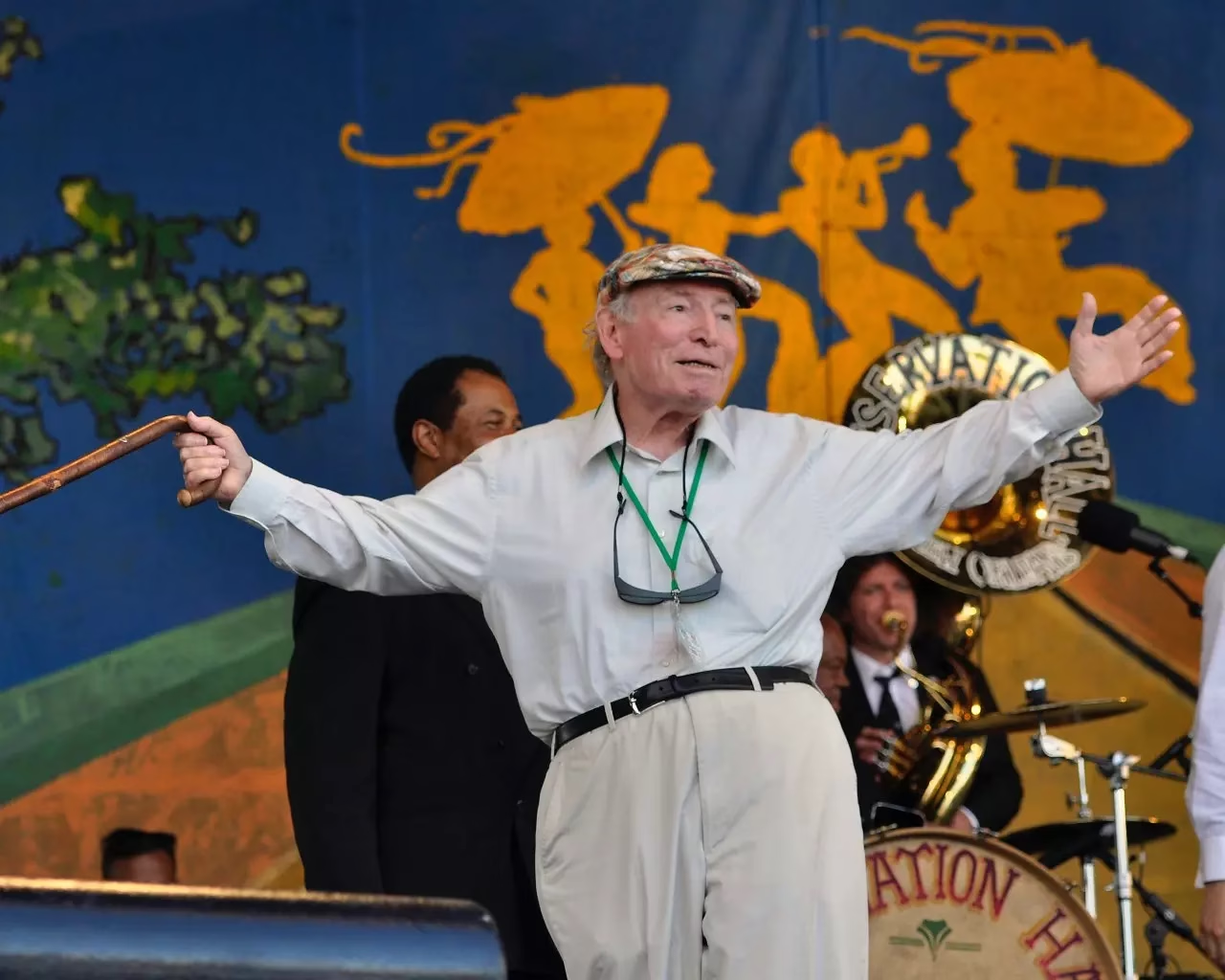
Despite being perhaps the most important concert producer to ever live, George Wein didn’t disappear behind a curtain like the Wizard of Oz. Anyone who’s been to Newport Jazz Fest probably remembers the suspenders-clad senior citizen zipping around the grounds in his golf cart, nicknamed “The Wein Machine.” The image seems to sum him up: Public-spirited, lovably avuncular and darn near universally beloved.
But as close compatriot Danny Melnick remembers, he wasn’t only zipping around looking for handshakes and hugs: Sometimes, Wein was on his way to yell at him about something.
“He would get driven backstage and go [Faux-screams] “Dannnyyy!” Melnick tells GRAMMY.com. “I would come over and he was like, ‘The goddamn craft vendors are too close.’ And I'm like, ‘What are you talking about?’ And he's like, "Go over there and look.’” Eventually, Melnick says, he would have to excuse himself and deal with the crowd-congestion issue.
But although Wein could be “a tough boss,” their conflicts were always constructive and familial, never malevolent. “He deserves all the accolades and all the love and all the credit, but, definitely, he was a human being,” Melnick continues. “And for those of us that were close with him, we've definitely had all of those human experiences.”
George Wein in 2019. Photo: Jack Vartoogian/Getty Images
Wein passed away suddenly in his Manhattan apartment on September 13, 2021, drawing to a close a seven-decade career. He was 95. The important information about Wein is out there, both in myriad obituaries and in his memoir with Nate Chinen, Myself Among Others: A Life in Music.
The pianist and concert producer wasn’t just at the ground floor of Newport Jazz Fest, Newport Folk Fest and the New Orleans Jazz & Heritage Fest; he arguably crafted the archetype of the modern music festival, both on a creative and structural level. His record on civil rights is unassailable. But what no Wikipedia rundown of accomplishments can elucidate is how he became himself: The raw intelligence, people skills, business acumen and adoration of music that enabled him to inhabit a once-in-a-generation role.
While it would take hundreds of interviews to get to the bottom of who Wein was and what he meant to multiple entire musical communities, GRAMMY.com rang up five musical figures with unique perspectives on him: Large-ensemble leader Darcy James Argue, trumpeter Gregory Davis, Preservation Hall creative director Ben Jaffe, jazz impresario Danny Melnick and the Recording Academy’s Senior Membership and Project Manager, Reid Wick.
Below are their heartfelt and sometimes surprising expressions about George Wein, whose likes we’ll never see again. All of them answered questions about the man through the same emotional lens: “How did he make you feel?”
These as-told-to quotes have been edited and condensed for clarity.
Darcy James Argue (bandleader, Secret Society)
Darcy James Argue & Secret Society at Newport Jazz Festival in 2019. Photo: Eva Hambach/AFP via Getty Images
He saw so much of the evolution of the music over the course of his life and presented so much of it and documented it and was a real curatorial force in a way that I don't think is truly possible for anyone to ever replicate.
Why was he the one to take on that role in the world? What made him the antenna to pick all this up?
I could not really say. Obviously, being a musician himself—a pianist—I think, gave him a perspective on the music. You know, there aren't a lot of presenters who could get up there on the stage and play a few choruses.
So, I think that aspect of George's love of the music, coming from a certain amount of lived experience as an actual player, is a big part of it. All I can really speak to is my own particular interactions with him.
But for me, the striking thing was when I first met him, when he came down to the old Jazz Gallery to hear Secret Society in person. This was a very small venue and audience. He might have been one of 40, 50 people in the room. Just the fact that he was still doing that. At that point, he was in his eighties and still getting out to hear new music.
At a time when most people would be more than happy to rest on their laurels after an entire career of presenting the highest possible musicians in jazz—Louis Armstrong, Miles Davis, Duke Ellington, Thelonious Monk and that same person who had such incredible long-term fruitful associations with those artists was also coming down to our little Jazz Gallery show.
Having that sort of insatiable curiosity and desire to hear things with his own ears, just blew my mind and blew the mind of everyone in the group.
It was just an incredibly special night. I don't even fully know how George even heard about the band, to be honest, but he heard about it from someone and wanted to come down and hear it for himself.
That is what you would want of anyone in that position, going so far above and beyond the call of duty. Just to still be in the trenches in your eighties and nineties, seeking out unfamiliar music and trying to contextualize it.
You think of all the music George heard over the course of his life and it was just such an honor that he felt that Secret Society was a worthy part of that lineage. It just meant the world.
You’ve mentioned it was hard to get people to listen to Secret Society, or get on board with them, at that time. How having George on your side meant so much to you.
I'm sure at this point he was seeing a lot of music. Just having him show up to the audience was already an incredible validation for the amount of toil and blood and sweat that had gone into this band.
Then, shortly after, we were speaking on the phone and he was inviting us to play Newport, which was completely crazy. Certainly, in that situation, maybe you daydream about that happening, but the fact that it then just happened was just incredible.
So, we played Newport in 2010 and have been back four times since then. He was just always so supportive of the group and I think had a sense of investment in the group because he was one of those people who heard us before, certainly before any other jazz presenters heard us.
Not to put words in his mouth, but with the kind of trajectory that we had, I'm sure at some level, there is a sense of pride in being able to take something that he found valuable and to be able to present it on the stage at Newport. And, to have that music resonate with the kind of people who have been going to that festival for years and years and years and never miss it.
I'm so enormously grateful to George and to his whole family of people involved in putting on the Newport festival. It really is kind of a family affair. There are people who have been part of the festival productions and their children are part of festival productions.
And there's a community around George as well. That was very special for me to get to know and connect to and to see what this festival means to people and what it means to everyone in that orbit.
How did it feel to be around George?
Well, he was always so generous with his time in addition to the invitations to Newport. I did have lunch with him a few times at his apartment. Just seeing the incredible collection of African art and memorabilia and everything there was an incredible experience.
George was just someone who had such a deep love of the music and wanted to connect me to his incredible past and the artists that he had seen in person and the knowledge that he had gained over so many years in the business.
He would offer me advice. He was always curious about how things were going. “Did I have a booking agent yet?” or “Was I still doing all of this on my own?” And “Where were we playing when we booked Europe?” and all of these kinds of things.
To answer your question, it felt very avuncular. He was personally invested in how I, as a young person, was navigating the jazz business with this impossible outfit—this financially ruinous way of making music with a big band. And he was always very genuinely curious and asking questions about how I was making it work and what was next for me and what I was writing.
I will say that one of the last opportunities for George to hear one of my projects was Ogresse with Cécile McLorin Salvant—the Jazz at Lincoln Center presentation of it. I really wanted George to see that. I made sure that we extended the invitation and that he knew how important it was to me that he be able to see that show if he was able to make it. And thankfully he was, and he was able to hear it.
I think it showcased my connection to the tradition of the music in a more concrete way than my music with Secret Society. And I hope that George enjoyed hearing that part of my musical interests kind of foregrounded.
Gregory Davis (trumpeter, Dirty Dozen Brass Band)
Gregory Davis performing at New Orleans Jazz and Heritage Festival in 2017. Photo: Douglas Mason/Fairimage via Getty Images
Of course, I met him as a promoter—a festival producer and all that stuff. But as I got to know him personally, I personally became more and more impressed with him just as a human being, beyond music.
I lived by myself. I was doing well, earning money here in New Orleans as a musician. And my wife, at that time, was teaching school, but we couldn't get approved for a loan to buy a house, because I was a musician. I was making three or four times what she was making, but primarily because I was a musician, we couldn't get approved.
George caught wind of it and he put me in touch with a banker, who made sure that I was able to get the loan to buy the land but then get the money to build a house. And although he did that as a human being, he never brought it up again. He never made me feel obligated. He never made a big deal about it.
And then even after that, I attempted to buy some rental property and I had problems again. And then I mentioned it to him. He said, "Hey, go see that same banker. He'll take care of it." He made it possible just for me to do things. Maybe those things would have happened later on, but he just stepped in.
Speaking with the woman who was his caretaker, I later found out that he had done similar things for other musicians that had a hard time paying medical bills or mortgages. That kind of stuff you're not going to find on the internet.
Hardly anybody has a bad word to say about the guy. His legacy spans the latter half of the 20th century and the first two decades of the 21st.
It's a rare occurrence that you would meet a person that just checks so many boxes on the humanitarian side. OK, yeah, he had an effect or played a part in furthering jazz just because of his involvement as a performer, producer, promoter, whatever.
But what we go through—what musicians go through on a personal level—affects what happens to them musically, whether or not they even sustain just playing music. He affected that greatly, and it's just rare in life that you meet a person that checks so many boxes.
There was no pretense about how much money he might've made or what he meant to the festival world, to the music world, whatever. For me, personally, that was the best quality about him—his humanism that he just exuded. That's the thing that I will always remember and cherish about him for the rest of my life.
Ben Jaffe (creative director, Preservation Hall Jazz Band)
Ben Jaffe and George Wein at New Orleans Jazz & Heritage Festival in 2012. Photo: Skip Bolen/WireImage via Getty Images
I feel very comfortable around older people and I've seen people go through the last chapter of their life dozens of times. Some people only get to see it with their grandparents or their parents, and I got to see it with a whole community.
It's a beautiful thing in New Orleans and I find comfort and solace in that, that death is not a sad transition. It's a beautiful transition because it leaves a torch and it leaves somebody's wisdom and knowledge behind. You start to be like: Oh. You start to find your own calling when there's these holes that are left.
There's a lot about George that isn't discussed. George and my dad [Preservation Hall co-founder Alan Jaffee] had a very, very close and special relationship. My dad was from a generation that was influenced and inspired by what George and Pete Seeger created with the folk festival and then later with the jazz festival.
My dad probably saw a piece of himself in George in the same way that he probably saw a little bit of himself in Bob Dylan. A young, Jewish kid attracted to regional folk music and spiritual music. Here are a bunch of East Coast Jews who are hung up on Mahalia Jackson and Bessie Smith and Louis Armstrong and want to celebrate that music.
I heard somebody speaking about this in terms of technology. Someone was speaking about the actual age and generation of Steve Jobs and all of the creators of that whole universe, and how they all came from a very similar reference place.
That was the reason why my dad and George connected. What my dad did is he came to New Orleans and created a lot of what George did at Newport in New Orleans by establishing Preservation Hall and celebrating music. That's what George did: He celebrated a music community.
Read More: The Preservation Hall's Historic Legacy
George never thought of it. My mom [Preservation Hall co-founder Sandra Jaffe] doesn't think of it that way. If you talk to her or my dad about it, they would say, “Oh, well, we just did this thing. Without a strategy, without a plan. Just a high principle.”
They were principled people. That's actually what drove them and that's what's so beautiful about it. That’s what was so special about it. It came so naturally and was so embedded in their moral DNA. It just happened.
What George admired about my dad and what my dad admired about George is that they never lost sight of it being a business. “Triple bottom line” is a popular term in business circles where there are principles for a for-profit corporation.
That was something that always existed with George and my father. There were always moral principles that drove their business. They just never articulated it that way. They never had to. Their work spoke for itself.
When you were around George, how did he make you feel?
As a business person, I often felt inadequate. I would show up at his apartment and he would be sitting at his desk. I would walk in and here's George looking at spreadsheets and profit and loss statements and on the phone with Chris McBride and Jay Sweet.
He’s yelling at people and screaming and asking me questions. He's like, "What's going on in the scene? I'm too old. I'm not out there. I'm not going to the clubs anymore. Who's doing what?"
I said, "George, have you heard of this guy, Kamasi Washington?" "No." I put the speaker up and played it for him and he was like, "Sounds like this other thing. Oh, it sounds a little bit like Miles Electric and this." He could immediately put it all together because he was a musician himself.
<style>.embed-container { position: relative; padding-bottom: 56.25%; height: 0; overflow: hidden; max-width: 100%; } .embed-container iframe, .embed-container object, .embed-container embed { position: absolute; top: 0; left: 0; width: 100%; height: 100%; }</style><div class='embed-container'><iframe src='https://www.youtube.com/embed//CXSylOgdkfk' frameborder='0' allowfullscreen></iframe></div>
Read More: Listen: Kamasi Washington Drops Alluring Cover Of Metallica's "My Friend of Misery"
He could culturally understand it. It's hard for me to keep up with stuff. For George to know who Kendrick Lamar is ... He relied on people like myself and Jay and others in his close circle to be that conduit to these next generations.
I found that beautiful. I love older people who want to know what's going on. They want to be on the scene. They want to know what's driving people. They want to know what's connecting with people.
George thought a lot of himself. He had a reason to. He climbed mountains and he achieved greatness. But I will say that he was also curious enough and humble enough to know and would acknowledge if he was wrong about something.
Give me an example of that.
I remember going to George and telling him after Katrina, I was like, “George, we're making an album. Tom Waits is singing on it. Steve Earle's singing on it. Richie Havens is going to be on it and the Blind Boys of Alabama and Mos Def.” And he just looked at me, and very sternly went, "That's not Preservation Hall."
Talk about just hitting you in the gut. It hit me in my gut. I said, "George, Preservation Hall hasn't been Preservation Hall since the first time you saw it—since George Lewis and Willie and Percy Humphrey passed away. That snapshot of Preservation Hall you had the first time you walked in the door—when that snapshot passed on, that period died with it."
In New Orleans, we pay homage to that better than anybody. We reflect on that. No matter where you're going—if you're the Neville Brothers, if you’re Jon Batiste, if you're Wynton Marsalis, Terence Blanchard, Donald Harrison, Harry Connick—if you're any of these people, you carry that with you for the rest of your life. You may not play every song, but it's in there. It's embedded in the soul of that.
I remember the record came out and we did some shows. And the next time I went to go see George, he said "You were right."
He calls me Benji. He goes, "Benji, you were right." That's how I know people who've known me my whole life. There's a small group of people who call me Benji. He said, "You were right. You reinvented this thing." That gave me so much confidence that I was doing the right thing.
People like George are so rare. They understand beyond the music what a person's doing. George understood what Bob Dylan was doing beyond his music. That's so valuable, to see beyond the notes, to see beyond the words that there's some energy connection between this artist and that artist.
This is a blessing, a gift that some of us have inherited. And we don't question why, but when you recognize it, it's all you can do in life. George appreciated that and understood that. He wasn't easily fooled. To play on George’s stage, you had to be the real deal.
Danny Melnick (Absolutely Live Entertainment founder, jazz impresario)
George Wein and Danny Melnick at Newport Jazz Festival in 2015. Photo: Douglas Mason/Getty Images
Well, George was a typical large personality and boss. He would encourage you and inspire you. And the work that we did was so exciting and so much fun, putting on these festivals and working with all of these amazing artists.
We would just be euphoric and excited about the conclusion of these things. Every concert and every festival and every tour, it was just like this unique moment in time. And then when they were done, it was just like, wow.
And for me, I just wanted more of it. I think a lot of us who worked with him and for him over the years, we wanted more of it. We wanted more live music.
But at the same time—as you probably know in your own life—he could be a real big pain in the ass also. He was a tough guy. George did not suffer fools. He did not accept mediocrity. He did not accept failure. Even though he failed a lot. A lot of festivals lost money or sponsors came and went.
I mean, his book talks so much about “This didn't make money. This failed. I got kicked out of Newport,” blah, blah, blah. When my mom read the book, she called me and she was like, “I don't understand. Everything was a failure.” I’m like, “Well, he took a lot of risks and some things failed. Things happen throughout life and through business. And when you're in business that long, this is what happens. Not everything can be fully successful all the time.”
But as an employee, he didn't take shit from us. And he shouldn't have, because he was paying us. Most of the time he was taking the risks on these events. He owned Festival Productions, Inc. for like 50 some-odd years on his own, by himself. And there were just so many times throughout my career with him where we were at it. Battling, yelling, arguing.
As much of a tough boss that he was, it never lasted. George did not hold a grudge against us. We couldn't hold grudges against him. We got through it. And a lot of the times those arguments and those battles were super passionate battles because we were dealing in a creative environment.
It's one thing if you're a stockbroker and you f*** up a deal and your boss just wants to rip you a new one because you lost a client $2 million, $20 million. But, for us, we were arguing about how we were advertising and marketing our shows and how the porta-johns were laid out at Newport—those types of things.
And we were all so passionate about the work and passionate about the music that we would get into it, but then we would move on. We always moved on. With George, he just didn't have time to hold a grudge.
He always used to say—and he said this a lot—”Focus on your friends; don't worry about your enemies.” And that also went to the staff. And so, all of us on the team, all of us that were working, producing these events—yeah, we would get into it and we'd have arguments. It was always politics.
But then, you turn around and you're like, “All right, we got to get this done.” Or “We have another one to do.” So it was this sort of duality of life with him, like almost with any other person in your life.
So he got a ton of accolades over the last week and all these beautiful posts on socials and all these amazing articles, but he was also a real tough guy. He could be really tough and really aggravating, but I had an incredible run with him.
Even though I had all these good and bad times with him, I have a tremendous amount of gratitude and a tremendous amount of happiness. And I have this life with him, and in that was able to affect his business and his work, and he clearly had a massive effect on me. So, this was sort of a two-way street.
From the way you characterize these arguments, it seems like they weren’t malevolent or vindictive, but ultimately constructive. Couples who love each other [can] fight all the time, and ideally, there’s a lesson unearthed in the conflict.
Totally. And I will tell you that George, he was married to Joyce for 46 or 47 years before she passed away and they never had children. We all refer to our experience as a festival family.
There are so many people who came and went over the years—assistants and stage managers and sound guys and back-line people and caterers and field-crew people, and then more of the executives like me and others who just were part of this. And we all, obviously looked at him as sort of like this fatherly, grandfatherly figure. And he definitely looked at us as his kids.
It was definitely that familial relationship in so many ways, and it wasn't a malicious thing. He never came to me and said “You're an asshole. I hate you. You don't know what you're doing,” blah, blah. It was never like that. It was always about the work.
George got to a point in his later years when he would—particularly at Newport—it's famous that they would drive him around in this golf cart. They called it the Wein Machine, and George would just get driven around. He could take pictures with the audience, say hello to people.
But he would see something. He would see a food booth in the wrong place or the craft vendors lined up too tight, so people couldn't move around the craft areas. And he would get driven backstage and go [Faux-screams] “Dannnyyy!”
I would come over and he was like, "The goddamn craft vendors are too close." And I'm like, "What are you talking about?" And he's like, "Go over there and look. Did you look?" And I'm like, "Ah, I don't know," and he was just, "Go look!" And then it would be a thing where I'd be like, "All right, I got to deal with this."
And that's the way he was. So, he deserves all the accolades and all the love and all the credit, but definitely he was a human being. And for those of us that were close with him, we've definitely had all of those human experiences.
<style>.embed-container { position: relative; padding-bottom: 56.25%; height: 0; overflow: hidden; max-width: 100%; } .embed-container iframe, .embed-container object, .embed-container embed { position: absolute; top: 0; left: 0; width: 100%; height: 100%; }</style><div class='embed-container'><iframe src='https://www.youtube.com/embed//VAJtbihsRLI' frameborder='0' allowfullscreen></iframe></div>
Reid Wick (Senior Membership & Project Manager, The Recording Academy)
First off, I didn’t really have the kind of relationship and didn’t interact with him on a regular basis like some of the people that you interviewed. I’m sure mine is far more tangential, so I kind of wanted to say that right off the bat. It may not be as important to the whole, raw story.
But I first met George many years ago. I worked at Loyola University College of Music here in New Orleans and was part of our team who started the music industry program in the mid-’90s. We put together advisory councils in New York and L.A. to start with and, through our local contacts, suggested we invite George to this meeting. It was at some lunch place by Lincoln Center.
We invited all these people and didn’t know who was going to show up. And George actually showed up with Danny Melnick! That’s when I met both of them together. And he was so gracious, but he was all about business. He showed up there: “Happy to meet you. OK, tell me what we’re doing here and what I need to do to help. How can I be involved? I love New Orleans.” For him, it was “Let’s get to work. Let’s cut through any bulls***.”
So, that was my main interaction with him early on. And then just over the years, it’s been more of an observing role of him interacting with other people I’ve met in the industry.
I think the most important thing that I know about George is that these guys just wanted to recreate a Newport thing down here [in New Orleans]. George said there was something so special about the culture of New Orleans and South Louisiana that it had to be more than just recreate what they did in Newport. You need to be able to find what the real strengths and gems are and make that the centerpiece of the festival.
I think that’s the biggest takeaway for the community here in New Orleans: All the people I know that really admire George and what he did know the festival needs to be uniquely New Orleans. He really sought to make that come to fruition.
Business dealings aside, how did George make you feel?
He made me feel like what we have in New Orleans is important.
We probably have the most unique cultural scene on the planet with regard to not just one thing. What’s so special about New Orleans is that we have it all. We’re known for certain things out in the world, but when you dig deeper, we have every style of music.
When it comes to jazz, we have the whole spectrum from early traditional jazz—still being performed by these young kids today who are kicking ass—but we have modern progressive jazz. We have all this “out” stuff that some cats totally [embrace]. That whole spectrum is still very vibrant today, but we have the gospel. We have a freakin’ death metal scene here. Every style of music is available here.
That’s so intertwined with other aspects of the culture, like the food and arts and crafts. Everything that New Orleans has as a culture—a true mix of Caribbean, African and European—is represented by the festival. From my perspective—and I know I share the same perspective with so many people in our cultural community—his main goal was to make sure that all aspects were highlighted.
For me, Jazz Fest is the best representation of our entire culture—whether it’s Mardi Gras Indians, whether it’s the Gospel Tent, whether it’s the Social Aid and Pleasure Clubs. Every genre of music, all the different food, all the different crafts. Just the focus on a 10-day period where everyone feels like they have the proper spotlight being shined on them.
All of it was George’s vision to make it happen. If the founding fathers would have had their way in the beginning, the vision was so tightly and narrowly focused that they didn’t really see the gems that they had.
I think that’s the biggest thing George gave New Orleans. He made us look at our entirety of culture and wanted to create a platform to celebrate it all.
The Revivalists Prep Jazz Fest Headlining Set: “It’s What the Good Stuff is Made Of”