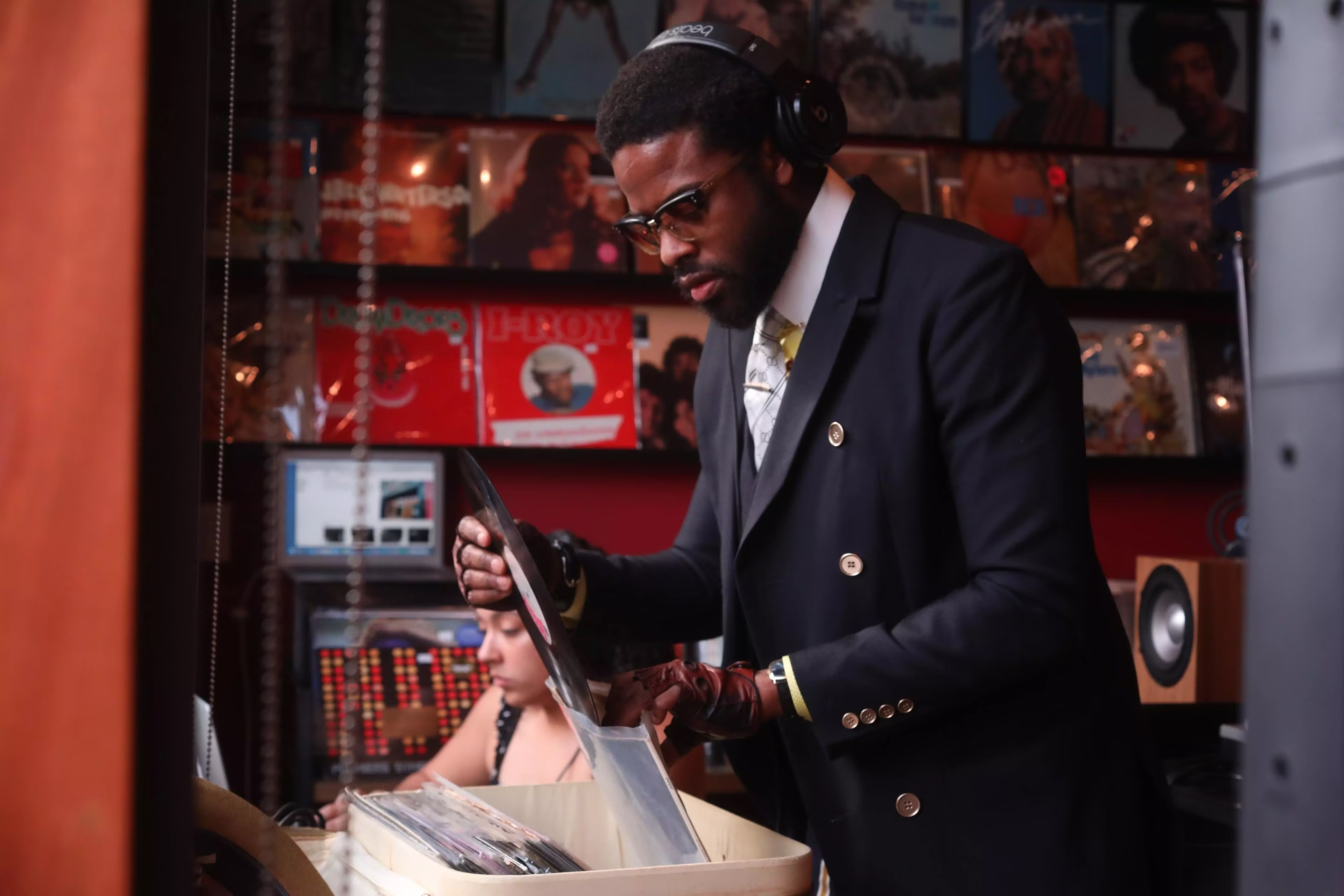
"Sadly, this album will never be out of date, but I know the universal language of sound will reverberate beyond my years. Listen closely. Raise your children to love like children; embrace humanity, regardless of hue."
With those words, Adrian Younge closes his latest album, The American Negro. The moving 26-track album, released Feb. 26, combines spoken word, classic soul and free jazz sensibilities.
Everything the Los Angeles-based multi-hyphenate (He's a multi-instrumentalist, composer, producer, singer, and label head) does pays tribute to his roots and is filled with heart and soul. Beyond using analog equipment to pay homage to golden era soul records of the '60s and '70s, he's composed T.V. and film scores for "Luke Cage," Black Dynamite and others. On his latest musical project, he crafts a haunting, powerful soundtrack of America and her racist past and present. With it, he shines a light on the harm this country has inflicted on Black people so we can enact change and move forward together.
<style>.embed-container { position: relative; padding-bottom: 56.25%; height: 0; overflow: hidden; max-width: 100%; } .embed-container iframe, .embed-container object, .embed-container embed { position: absolute; top: 0; left: 0; width: 100%; height: 100%; }</style><div class='embed-container'><iframe src='https://open.spotify.com/embed/album/1b3K1rvUIaDmRP2AsLahXw'frameborder='0' allowtransparency='true' allow='encrypted-media'></iframe></div>
Ahead of its release, GRAMMY.com caught up with Younge over Zoom to learn more about his vision for the project—which also includes a film and a podcast—and how Marvin Gaye and James Baldwin inspired it. The "Revolutionize" artist also explains the magic of analog recording and the power of spoken word.
Your powerful new album, The American Negro, is out now. What is your hope for this project once people get to hear it?
My hope for this project is that people receive the message. And the message about the evolution of racism in America. Most people don't realize how America pioneered the racism that has affected the entire world.
In America, we're a nation that is derivative from a slaveocracy. We didn't just have the enslaved, we're a nation that was formed around the concept of maintaining a slave system. So when our laws are being created, when our constitution is being drafted, when people are making money at the cost of Black lives, it's something that gets fermented into our system. It's become institutionalized and we still feel the vestige of that today.
And most people don't understand the connection to the past. A lot of people say, "Oh, there isn't slavery [anymore]," or "The civil rights laws were passed." But people don't understand that when an institution that you believe in is complacent towards certain people based on their skin color, it has a negative effect on posterity for all. With this album, I really want people to become better educated on what's going on and be able just to disseminate the message. That's what it's really about.
In what ways did James Baldwin and Marvin Gaye inspire the music and the message?
So with Marvin Gaye, he's one of my favorite artists of all time, if not my favorite. My two favorite albums by him are I Want You and What's Going On. I have to put What's Going On on top because it's more important than just my enjoyment of hearing the composition of the melodies.
Not only do I love the composition, the melodies and the recording, but the message resonates on such a higher frequency than everything else. The reason being that he's talking about life. He's not just talking about love and "let's have sex" and "let's get married." He's talking about life sh*t. He's talking about changing the future for our children. He's talking about real change ecologically. He's talking about change in regard to discrimination to how the people coming back from patriotically serving in the war are being perceived. He's talking about so much that resonates with people like myself who want to be as virtuous as possible.
So that, coupled with James Baldwin, who is such an intellectual scholar and poet, talking about the Black consciousness, talking about what it's like to live our lives, even though we're in a place that looks at us as the face of evil, in many cases. His work combined with Marvin Gaye's work is what inspired me to make this. Because I don't really see many musicians trying to create that kind of work at this moment. People talk about certain issues, but not many have invested themselves to this degree of making something for the purpose of change.
Listening to James Baldwin's words and Marvin Gaye's What's Going On, it is crazy, how much they could have been written last year or this year.
It could be coming out in two weeks. That's how relevant it is, right?
<style>.embed-container { position: relative; padding-bottom: 56.25%; height: 0; overflow: hidden; max-width: 100%; } .embed-container iframe, .embed-container object, .embed-container embed { position: absolute; top: 0; left: 0; width: 100%; height: 100%; }</style><div class='embed-container'><iframe src='https://www.youtube.com/embed/6iUMg88SBI4' frameborder='0' allowfullscreen></iframe></div>
On your "Black Lives Matter" track, you talk about how America is pretending to be blind. What do you think we, as a country, can do to finally stop pretending to be blind to this system of deeply embedded racial injustice?
There are so many things. First of all, just educate people. My seven-year-old daughter was talking to me last night about who she's learning about right now [in school.] She's learning about Abraham Lincoln. I'm like, "Oh, dope. What do you know? What are you learning?"
"Oh, he was the 16th president and he helped to free the slaves," [she said.] I was like, "Do you know where the slaves came from?" So I'm talking to her about that. I'm not ready to hit her with, well, did you know that Abraham Lincoln actually didn't really care about the disposition of Black people? And actually, him and Thomas Jefferson at various times were trying to figure out how to send [freed] Black [slaves] people back to Africa. It's not like that's something I want her to learn as she grows. But this is the kind of stuff that we did not learn in school.
I say this all to say that with The American Negro, I want to stimulate thought and help people that don't have malice to act in a way that's not racist. A lot of people that act racist aren't doing it intentionally. They're just following custom and don't realize certain things. It's up to America to help them.
You're right, it's difficult to summarize all the things we need to do. Which is why things like The New York Times' 1619 Project are so powerful because it draws direct links between way back then and, for example, our banking system now. American capitalism was founded on slavery.
Even moreover, American capitalism is based on white imperialism, which is supported under the doctrine of manifest destiny. These white males at the time felt that they had the God-given right and authority to expand their nations throughout the world. Expanding westward in America and killing all the [Native Americans] was manifest destiny. "We're making their life better. They can be civilized." It's a very paternalistic perspective. And this is still happening today.
Can you speak a little bit to your reasoning for using spoken word on the album?
I was a law professor for a few years, and in my teachings I loved to research Jim Crow laws, Black codes, slave codes. These were laws that were created to subjugate the Black person and edify the white male and female.
I wanted to create an album where I'm synthesizing music that speaks to Black excellence. Music that is run underground, but it's so opulent with rich textures and an orchestra that you have to take it seriously. But at the same time, you have somebody speaking to you in a poetic, yet professorial manner. I guess oral pontification is my way of delivering a message to some people that may not otherwise hear it unless they're digesting it with a sweetener, which is the music.
With The American Negro, I also have a film coming out in March on Amazon called T.A.N. and I have a podcast that I started a couple weeks ago on Amazon as well called Invisible Blackness. All these pieces put together really help to further explain the ideology of racism here in America and throughout the world.
"And my real message with all this stuff is that race is a social construct… But you have to realize that and stay in touch with your humanity so you can really live life to the fullest and allow others to live life in a way that they're not ensnared by all this nefarious bullsh*t that the institutions have been promulgating for centuries."
What's going on in the film T.A.N. and why was it important to you to create that visual counterpart to the project?
So T.A.N. is a film that is like watching the "Twilight Zone." It's a very psychedelic, very cinematic and thoughtful arthouse-type film that deals with a group of individuals in purgatory. They are discovering their own bigotry and really finding themselves through discussion. To me, these characters in the film represent so many types of people in America and around the world. I want people to watch the film and see if they could identify with some of the characteristics of these people. And if so, help them change some of their negative ways.
I've been moved by so many different songs, but there's something specific about spoken word. And I feel it on this album, where the songs are moving you and you feel it, but the spoken word, it feels like you're looking at me. It feels more direct.
It was something that was a real choice for me because I said, "All right, there's a substantive message that I want to get across. Then there's a musical message that I want to get across which is more important?" I said the substantive message is more important because I can make music any day, but I can't bring people in to listen to my thoughts every single day. I really want this to be a timeless piece that inspires people in a way that is not wholly musical, but contextual.
"I can make music any day, but I can't bring people in to listen to my thoughts every single day. I really want this to be a timeless piece that inspires people in a way that is not wholly musical, but contextual."
I've talked to a lot of different artists about the way that music is a medium to get powerful and radical messages across—look at Marvin Gaye's music. It will transcend his life, I think, for a long time.
Absolutely. What's Going On is the most important project he ever did. It's interesting because if you look at the periodicals of the time, in '71, Billboard said this is the greatest work Motown has ever done and it sounds like something derivative of Curtis Mayfield. Curtis Mayfield, in 1970, came out with his first solo album. Before that, he was doing stuff with The Impressions, but in the late-to-mid '60s his music with The Impressions was political. But it was not brazenly political. He had songs like, "If you had a choice of color, which one would you choose, my brother?" He was talking about Black consciousness in a very beautiful, non-offensive way.
And in 1970, Curtis Mayfield has a song called "If There's a Hell Below, We're All Going to To Go" where he's talking about Nixon, about ni****s, all that shi*. And then you have Marvin Gaye with What's Going On. And then in '72, you have Curtis Mayfield's Superfly and the Black Power movement is just getting bigger and bigger because we're going from the '60s where we're going from this non-violent protest to Black is Beautiful, Black Power. And it's something that is analogous to the concept of Black Lives Matter now because the white media saw Black consciousness as something that was violent and racist, and it's the same thing that's happening now.
My real message with all this stuff is that race is a social construct. Race is something that's a fallacy. We're actually all the same. And Black ain't better than white, white ain't better than Black. But you have to realize that and stay in touch with your humanity so you can really live life to the fullest and allow others to live life in a way that they're not ensnared by all this nefarious bullsh*t that the institutions have been promulgating for centuries.
You recorded the project fully analog, right?
Everything I do is analog. Everything.
What do you feel like you gain from using tape? Is there a spiritual element to using analog technology?
[Moves camera.] This is my reel-to-reel machine. Over there, there's a whole big live room and that's where I recorded the orchestra [on the album]. I record everything I do. The recording technique is very important to me because my golden era of sound is between '68 to '73. That's everything I'm about.
With this album, I really put myself to work as if I enslaved myself because I played every single instrument for the rhythm section. After that, I wrote for an orchestra and I brought them in. So, I'm playing everything from drums to flute to sax to bass to guitar to keys and then I'm ready for a full orchestra. I can't put myself in it any more than I am. I want people to feel my soul. I want them to feel how organic and real my message is. So sonically, it has to be right.
People make dope digital recordings. But for what I do, if you're trying to have that classic, timeless sound, you cannot do that with a computer. You can't do that by pressing the space bar. You have to have real instruments. And that's why I do that. It means a lot to me.
"I played every single instrument for the rhythm section. After that, I wrote for an orchestra and I brought them in…I can't put myself in it any more than I am. I want people to feel my soul. I want them to feel how organic and real my message is. So sonically, it has to be right."
Do you feel like there are specific textures that come across on tape that don't come across on digital?
Absolutely. With tape, I always explain it like this. When you record digitally, you're pouring water into a bucket with holes in it because digital recording just can't handle certain frequencies. The bass frequencies, all that, it just literally can't. The difference between analog is that you're pouring the same water into a bucket with no holes and it has a sweetener in it. You're getting something back and you're not losing frequency. Digital recording is the emulation of analog recording. So yeah, tape gives you a texture back to it. You can't copy tape.
<style>.embed-container { position: relative; padding-bottom: 56.25%; height: 0; overflow: hidden; max-width: 100%; } .embed-container iframe, .embed-container object, .embed-container embed { position: absolute; top: 0; left: 0; width: 100%; height: 100%; }</style><div class='embed-container'><iframe src='https://www.youtube.com/embed//NVoVgSkhIxs' frameborder='0' allowfullscreen></iframe></div>
I want to look a little bit more into the sonic elements on "Revolutionize." I really love how the sounds of it really dance with the repetition of "Black is beautiful."
In that song, I wanted to do something that was very chaotic and organized at the same time. I wanted to also give you the sense of Gil Scott-Heron's "The Revolution Will Not Be Televised." It's just a reminder that Black people deal with something called double consciousness where you see yourself in the mirror as you are, but you also see yourself through the vantage point of white America—that sees you as a criminal, as somebody that is feebleminded, as the problem of America. You have to synthesize these two perspectives in order to better understand who you are supposed to be. And this song [says], "Revolutionize the way you see yourself. Black is beautiful. You're beautiful."
And what instruments were on the song?
I'm playing drums, bass, piano, guitars, vibraphone, drums and various percussion. Then I wrote for a 30-piece orchestra, for strings and oboes and all that stuff.
For your parts, you had to obviously record them each separately?
Exactly. So I'll record drums first and then I'll record keys, then I'll record bass and guitar, and I just layer it.
Do you have the vision of what it's all going to sound like together or does it come together after?
I always know what the roadmap is. I'll sit there and say, "Okay, we'll make this change here, that change here. We're in this key here, I want this to be funkier, I want this one to be a little more chill. I want to have space so I can have more movement for bass here." I map it all out and I see it my head, and I just go in there and execute.
And did it feel different on this album doing most of the instrumentation yourself versus bringing in a band or collaborating with other people?
Well, it's interesting because most of the music I do I'm playing 90 to 95 percent of the instruments anyway. It's not really anything really new to me. My Midnight Hour album project with Ali Shaheed Muhammad [of A Tribe Called Quest], we both share in what we play, but everything outside of that is pretty much me playing all the instruments I know how to play. I really don't record with a band, per se.
Could talk about some of the specific people you honor on the album—James Mincey Jr., Margaret Garner, George Stinney Jr.? And one of your collaborators, Loren Oden, is related to James, correct?
Yeah, James Mincey Jr. was the uncle of my dear friend and collaborator, Loren Oden. James was somebody that was killed by the police unlawfully. He was choked to death, died by asphyxiation, like Eric Garner. And there was no judicial reprisal. Nothing happened to them.
Margaret Garner, she was enslaved and she ran away for freedom. When she was caught, she killed her child because she did not want them to be in perpetual bondage. America pioneered the concept of perpetual slavery, whereby your offspring is going to be the property of the enslaver in perpetuity.
George Stinney Jr. was the youngest person executed in America, a 14-year-old Black boy that was wrongfully accused of killing two young white girls. And he had a very speedy trial and he was murdered. So, this concept of vigilante justice has been plaguing people of color for centuries. I wanted to bring up certain names in order to inspire people to research the stories and find the connections between what happened back then and what is still happening now.
How Artist Jonathan “Chaka” Mahone Is Helping Black Residents During Tough Times In Austin