Even if you don't know Alice Coltrane's music or feel compelled to check out a "jazz" artist, there's an ambient tape floating around YouTube that will break your heart.
Turiya Sings, a droning 1982 cassette of chanted Sanskrit vocals, organ, synthesizer and orchestra, is not only a sad, haunted jewel but one of the most convincing available arguments for a higher power. But for Coltrane's son, Ravi, what sounds like a transmission from beyond was just a fact of life around the house.
"That's the sound I grew up hearing. That is the sound," the now-55-year-old saxophonist tells GRAMMY.com over Zoom. "I'd come home from school and she'd be at the organ, playing these songs, singing quietly to herself." This also extended to when he went to church—a.k.a. services at her Agoura Hills ashram—every Sunday, and Coltrane led the congregation in original devotionals like "Jagadishwar," "Krishna Krishna" and "Govinda Hari."
In both scenarios, Coltrane didn't have a rack of synthesizers nor an orchestra at her disposal, but a simple Wurlitzer. And that's the version of Turiya Sings that is finally getting a wide release, offering an alternative to the spectral tape rip hanging out on the internet. Kirtan: Turiya Sings, a fresh "reduction"—Ravi's word—of the original album, arrives July 16 on Impulse Records/UMe. Now, listeners worldwide—Hindu, Christian, agnostic, or atheist—can access the album's boundless spiritual riches.
Alice Coltrane is often discussed in the shadow of her towering husband, John. But the truth is, her marriage to the groundbreaking saxophonist only spanned a few years; her life and career stretched for years before and after him. When she and John met, the pianist was already a known quantity as a Detroit bebopper in vibraphonist Terry Gibbs' band. And by the time she replaced McCoy Tyner in his group in the final year of his life, she was a downright veteran.
Read More: 10 Essential Cuts From Jazz Piano Great McCoy Tyner
After John's 1967 death from liver cancer, she recorded a succession of albums for Impulse!, then Warner Bros. In the '70s, she moved out of the Long Island home she shared with John and headed out to California, establishing the Vedantic Center northwest of Los Angeles and adopting the name Turiyasangitananda. By the dawn of the '80s, she was through with the rat race of commercial music.
"By '81, she was just done with record contracts," Ravi says. "She felt that she had done everything she wanted to do in music and wanted to shift directions to a more spiritual life, so that's what she did."
Turiya Sings was her first functional rather than commercial work, serving as an offering for congregants rather than something meant for a wide release. Every Sunday, the group would sit on the floor, clad in white, for a kirtan service, shaking tambourines and bells as Coltrane sang and played. ("Kirtan" means "narrating, reciting, telling" in Sanskrit.)
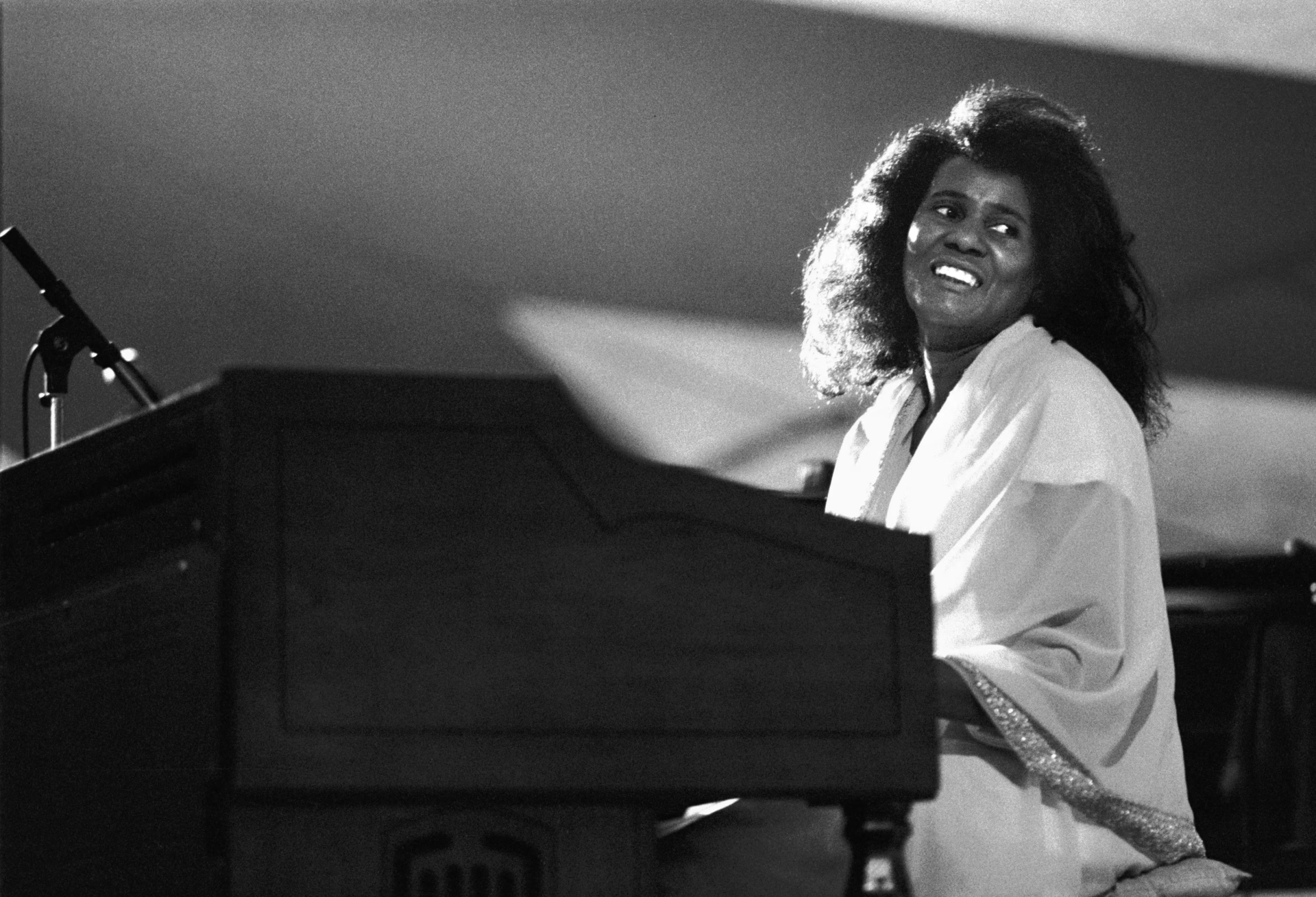
"My mother, who we would call 'swami'—I still called her 'mom'—would sit behind the Wurlitzer," Ravi recalls. "The very same Wurlitzer you hear on the recording."
Coltrane recorded the album in 1981—mostly in first takes—at a studio near the ashram. Then, she overdubbed synthesizers and a self-conducted orchestra, pressed a few hundred copies under the Avatar Book Institute imprint, and sold it in the ashram's bookstore. "This is celebratory music of the highest order," the rear sleeve attested, calling it the product of "a soul that has already traversed far."
Of this sumptuous sound-world, only various secondhand versions were available for years—at press time, even eBay doesn't turn up an original cassette copy. But when Ravi finally heard a stripped-down, Wurlitzer-and-voice mix in 2004, he felt the embellishment-free version was the most gripping and immediate. The only problem was that he couldn't find a 24-track master—until recently when he found it sitting in a closet for decades.
Photo: Courtesy of Impulse Records/UMe.
While the original subsumed listeners into its undertow, this bare-bones version bends the ear to its lyrics and melodies. And without the overdubbed atmosphere, you can hear more clearly the gospel-ish angles in the chords and click and clack of the Wurlitzer's pedals.
"As dynamic and bold as the original version is, hearing my mother sing and play in this stripped-down, intimate setting revealed the true heart and soul of these songs," Ravi wrote in a producer’s note. "In this form, I could hear every nuance and inflection in her vocal performance and feel the weight of her rock-solid pulse and timing and (dare I say it) groove on the Wurlitzer. And, most importantly, in this setting, I felt the greatest sense of her passion, devotion, and exaltation in singing these songs in praise of the Supreme."
"It's powerful in a different way," Ken Druker, the Vice President of Jazz Development at Verve Label Group, tells GRAMMY.com. "You can hear what she's doing on the organ. You can hear the gospel influence. As Ravi said, you can hear the Motown in her voice—things that weren't as apparent on the cassette where there were all these other layers going on."
Druker is quick to call Kirtan: Turiya Sings a "variation" of the album, not meant to supplant it. To that end, Ravi says the decision to release this unadorned music wasn't to insert his own agenda but to get at the essence of the work. "That's the primary motivation," he says. "It wasn't me trying to tinker with Alice's creative works. I'm a custodian of my mother's music, my father's music, and a guardian of this music."
As for the lyrics, you don't have to learn a foreign language to feel them—even as a Sanskrit-to-English translation in the booklet helps bridge that gap. "They're just praising the Supreme—the Highest," Ravi says. "They're songs to elevate the spirit, and I don't see this as religious music. I see this as devotional music. Music that is for everyone, from any religious background—or no religious background."
Indeed, Vedic Hinduism wasn't the end for Coltrane, but the means. Even as Kirtan: Turiya Sings is firmly hooked to that tradition, it's meant as a vehicle for universal God-consciousness.
"People have heard this music and not heard the translations nor the Sanskrit, but they can feel it," Ravi continues. "There's something compelling about these chants and these songs in a way that's not pushing one specific religion's doctrine, but promotes the universal in all divine music."
Despite being just one stop on the long continuum of Coltrane's music, nothing else in her discography quite sounds like it—and now that it's out for real, its influence and impact have the potential to be as borderless as its spirituality. Will Sheff, the GRAMMY-nominated leader of the long-running rock band Okkervil River, found himself bewitched by the original version of Turiya Sings years ago.
"I feel like she's going down to this depth, and the depth is heavy. You're sinking down and down and down and down into the darkness, but I don't think of that necessarily as bad," he tells GRAMMY.com. "That's where everything comes from and where everything goes, or something like that."
For Sheff, the quality of the music—coupled with the fact Coltrane didn't make it as a capitalist object—makes Turiya Sings an incredibly rare bird. "I don't want to get into some kind of weird, purist state of mind, but I guess I just feel like there's something so beautiful about hearing a musician do something where their soul is reaching out to God and they put it out to people who share the same faith as they do as a prayer aid," he says.
"At no point in that process does 'I want to be rich' or 'I want to be famous' or 'I want to be well-thought-of' come into that," Sheff adds. "That's very refreshing because those are the biggest prizes of our culture right now." This might hold true for the foreseeable future, as far as music is concerned.
But we'll always have Turiyasangitananda, praising the Most High softly, solemnly, as if singing to herself.
'Ptah, The El Daoud' At 50: How Alice Coltrane Straddled Heaven And Earth
