
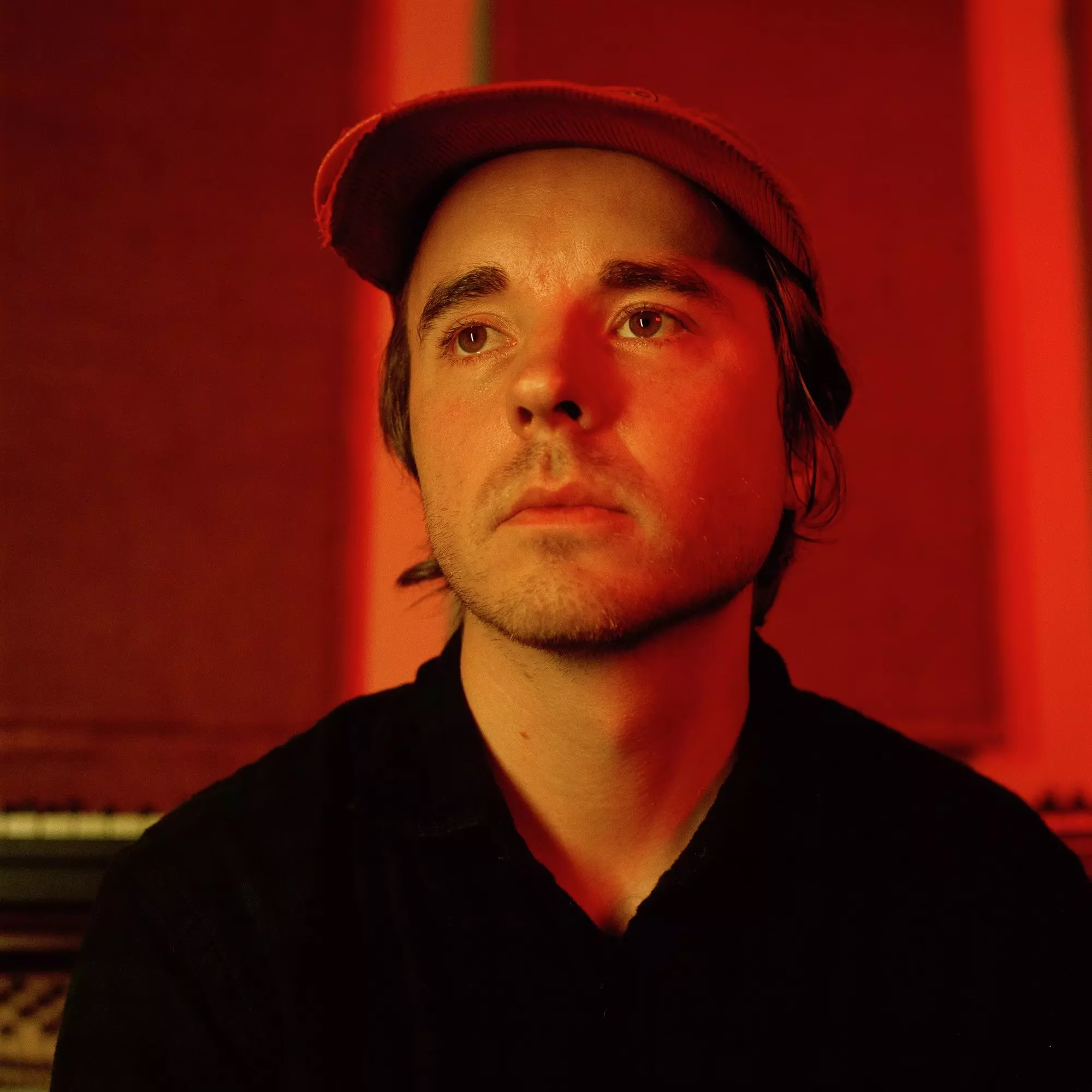
Andy Shauf is playing poker at Laguardia airport. He's currently at 2,300 chips, and if he gets to 5,000 then he'll have enough to win an actual bag of potato chips. It's a funny sight to try and visualize; this soft-spoken guy perched at an iPad in a bustling airport, surrounded by clunky musical gear, gambling for a petty snack while speaking on the phone with a journalist about the music that put him in that very situation. It's the sort of simultaneously banal and peculiar setting that Shauf could write an entire album about.
The 33-year-old Toronto via Saskatchewan singer/songwriter rose to international prominence with his 2016 record The Party, an album about the myriad happenings at a single house party. Part drama and part character study, the album bounced between the perspectives of various guests at the function to offer a deeper—and often darker—understanding of their intoxicated psyches. While cooing admirably concise lyrics over dazzling '70s pop-rock songs (which he wrote, arranged, performed, produced and recorded independently) Shauf nodded vividly to each genre of partygoer: the girl who shows up too early, the too-drunk spectacle, the callous boyfriend, the jealous best friend and the guy who dies alone out front while smoking a cigarette. You know, typical house party stuff.
The stories were intended to be fictional, but after reflecting on the lyrics throughout an intense press cycle, Shauf realized the album had more of himself in there than he expected.
"I think there was a point where I realized after I did The Party and [said], 'Oh, this is fictional, blah blah blah,' and then thinking about the lyrics and realizing it was a lot more about me than I thought," he says.
The Neon Skyline is his highly anticipated follow-up (out now via ANTI-), and it's another concept album about another single night in an alcohol-oriented setting. This time, however, the lyrics are remarkably verbose and novel-esque, and Shauf went into the writing knowing that it was based loosely on his own experiences. The record begins with the narrator meeting his friend at a bar called The Skyline (which is a real place that Shauf's a regular at), and what’s initially an incredibly ordinary night turns into a whirlwind of reminiscence when his ex arrives and memories start to rush back as the drinks go down.
"I don't even know if I know how to write a normal song anymore," Shauf says with a laugh. "They’re just all gonna be weird stories."
Fortunately for him, weird story songs are something he’s exceptionally good at. Shauf’s characters are astoundingly lifelike and the conversational tidbits he included on The Neon Skyline are hyper-realistic. In "Try Again," the narrator gets playfully called out for botching a fake British accent while holding open a door—the type of menial moment that a songwriter would typically cut in favor of some witty one-liner. Shauf's dialogue never relies on that sort of camp. He says he tried really hard to instill humor into this album, and he did so by purposefully making some of the jokes fall flat.
<style>.embed-container { position: relative; padding-bottom: 56.25%; height: 0; overflow: hidden; max-width: 100%; } .embed-container iframe, .embed-container object, .embed-container embed { position: absolute; top: 0; left: 0; width: 100%; height: 100%; }</style><div class='embed-container'><iframe src='https://www.youtube.com/embed/thiHFeIw_5U' frameborder='0' allowfullscreen></iframe></div>
For instance, in the song "The Moon," a character repeats a corny pun about "taking off" to a bar called The Moon, and the narrator cringes at his ex's chortle at a joke that he didn’t think "was that funny the first time around."
"There are a lot of jokes on this album that bomb," Shauf says. "There are some that intentionally are not funny and I left them in because nobody's jokes always fly."
We talked to Shauf about why he chose to center his album around this dive bar, how he developed the detailed plot and why he chose to end the record on an unceremonious note. Our conversation has been condensed for clarity.
<style>.embed-container { position: relative; padding-bottom: 56.25%; height: 0; overflow: hidden; max-width: 100%; } .embed-container iframe, .embed-container object, .embed-container embed { position: absolute; top: 0; left: 0; width: 100%; height: 100%; }</style><div class='embed-container'><iframe src='https://www.youtube.com/embed/ciVfmcrbkqU' frameborder='0' allowfullscreen></iframe></div>
Why did the setting of a dive bar strike you as the right place to tell these stories?
I think a lot of the writing that I've done as of late or on the past two records have been stories that are pretty close to what’s going on in my life. On The Party, I was [going] to a lot of parties and stuff and observing that kind of thing. This one, I had just moved to Toronto like three years ago. I was starting to work on this record three years ago and I found myself spending a lot of time at that bar and I made friends who were just kind of drinking buddy acquaintances, so that was what I was doing. That was my social life, that was it. So it was just kind of natural.
I don't know if you've ever been a bar fly or a regular at a bar, but you end up kind of meeting a lot of people but kind of not. You get little glimpses into their lives because everyone's drinking and a little more willing to give up information. I don't know, it's just an interesting bunch of characters.
In the past, the press has framed you as this very shy and socially anxious person. So I'm wondering what you find appealing about a dive bar, which is such an intimate setting that puts strangers in conversation with one another in closed quarters.
I feel like I've come out of my shell a little bit, maybe. I'm getting older and realizing nobody gives a sh*t how weird you are. When I moved to Toronto I knew very few people, so going to the bar and sitting at the bar, talking to the bartenders, was kind of one of the only social outlets that I had.
I get framed as a shy, socially awkward guy, quiet guy. But I have that desire for a social life and it was one of those things where I have no one to hang out with tonight because I don't know anyone, I'm gonna go to the bar and hang out with the bartenders. And they were really welcoming and they became good friends.
So you had the idea of the setting and sort of an idea for the story, but when did the actual plot start to come together?
It was really one song at a time. The first song kind of sums up a lot of what's going to happen. It mentions the ex, it has the drinking buddy Charlie, the setting The Skyline. It was just trying to figure out how to make that all work and how to make it into something.
Because essentially it's an album about nothing. These guys go to a bar and a girl shows up. It doesn't sound that interesting. [Laughs.] So it was a lot of trying to figure out how to make that interesting. What are the small things that would happen that would make it into a story? How many songs can you write about a couple of people sitting in a bar?
I like how there's not a real resolution to their relationship. They meet up, they reminisce about some stuff and the night ends. And sometimes the night just ends, and I feel like that ending felt really realistic.
Yeah, definitely. And I feel like that's how nights most often end, especially when you're drinking. Like, "Oh, we’re done I guess. Time to go to bed. I thought something exciting was gonna happen but it didn't." And that was something that I struggled with when writing this; there's no big moment. I've written a lot of songs where there is a big moment and someone dies or someone gets murdered or something. I was trying to keep the deaths out of this one. It's more subtle, it’s more kind of just a normal night out.
Your career really took off after The Party and a lot of people really began to take notice of your writing style. Did you feel any pressure to follow that album up with something as conceptually interesting?
You can't help but think along the way, "Are people going to like this? They liked my last one, this one's a little different." Most of my pressure comes from myself. I really just want to make something that’s better to me than the last thing that I made. This record was really difficult because I was trying to make something that was focused and narrative-driven and trying to make it so that it doesn’t just read like a musical theatre, or sound like musical theatre.
And I struggled with how to do that and how to make it better than The Party for myself, not necessarily for other people. In my mind, the people who listen to my music are probably like, "Why is he so fixated on making concept records? Like, can't he just write a normal song and be done with it?" But I like the challenge and it doesn't really matter to me. I mean it matters to me if people like it or not, I want people to like my music obviously. I'm on a little self-motivated tangent of trying to make these weird story albums for some reason.
Saves The Day's Chris Conley Talks 20 Years Of 'Through Being Cool'
