The blossoming of Tom DeLonge from pop-punk delinquent to dead-serious UFO researcher may seem dubious. Despite his whole-souled dedication to the field and the Pentagon (to a degree) backing up his claims, it may be difficult to accept that the guy who mewled "Dammit" and ran around nude in the "What's My Age Again" video could solve central questions of human existence.
But to say that these pursuits are disconnected—a thousand tired jokes about "Aliens Exist" aside—would be to fundamentally misunderstand DeLonge. His old band, Blink-182, was all about the id and failed romantic efforts. And Angels & Airwaves, the group he's led since 2005, is just as interested in human beings and their travails. He's just connecting them to a grander cosmic timeline.
<style>.embed-container { position: relative; padding-bottom: 56.25%; height: 0; overflow: hidden; max-width: 100%; } .embed-container iframe, .embed-container object, .embed-container embed { position: absolute; top: 0; left: 0; width: 100%; height: 100%; }</style><div class='embed-container'><iframe src='https://www.youtube.com/embed//S0kBp5O9rPw' frameborder='0' allowfullscreen></iframe></div>
Read More: Blink-182's 'Enema Of The State' Will Never Actually Turn 20
"I like the exploration of how we interact with the people around us and what we think life really is," DeLonge tells GRAMMY.com over Zoom alongside drummer Ilan Rubin—basically the Paul to his John in this band since he joined in 2014. "I'm really fascinated by the expansion and growth of self-awareness and who we are and where we're going as humanity. To me, this is a big study in that."
He's talking about Angels & Airwaves' new album Lifeforms, which was released Sept. 24. Restoring a tinge of punk angst to the band's atmospheric aesthetic, highlights like "Rebel Girl," "Euphoria" and "Restless Souls" illustrate how far DeLonge has come as a craftsman. He says it's the best album he's ever made. "If not, the top couple," he clarifies. "It's so challenging and unique and diverse."
Read on for an in-depth interview with DeLonge and Rubin about the making of Lifeforms, DeLonge's fascination with outer realms and their push-and-pull as collaborators. The blustery DeLonge holds forth at length with White Claw in hand; the mellow and measured Rubin mostly listens.
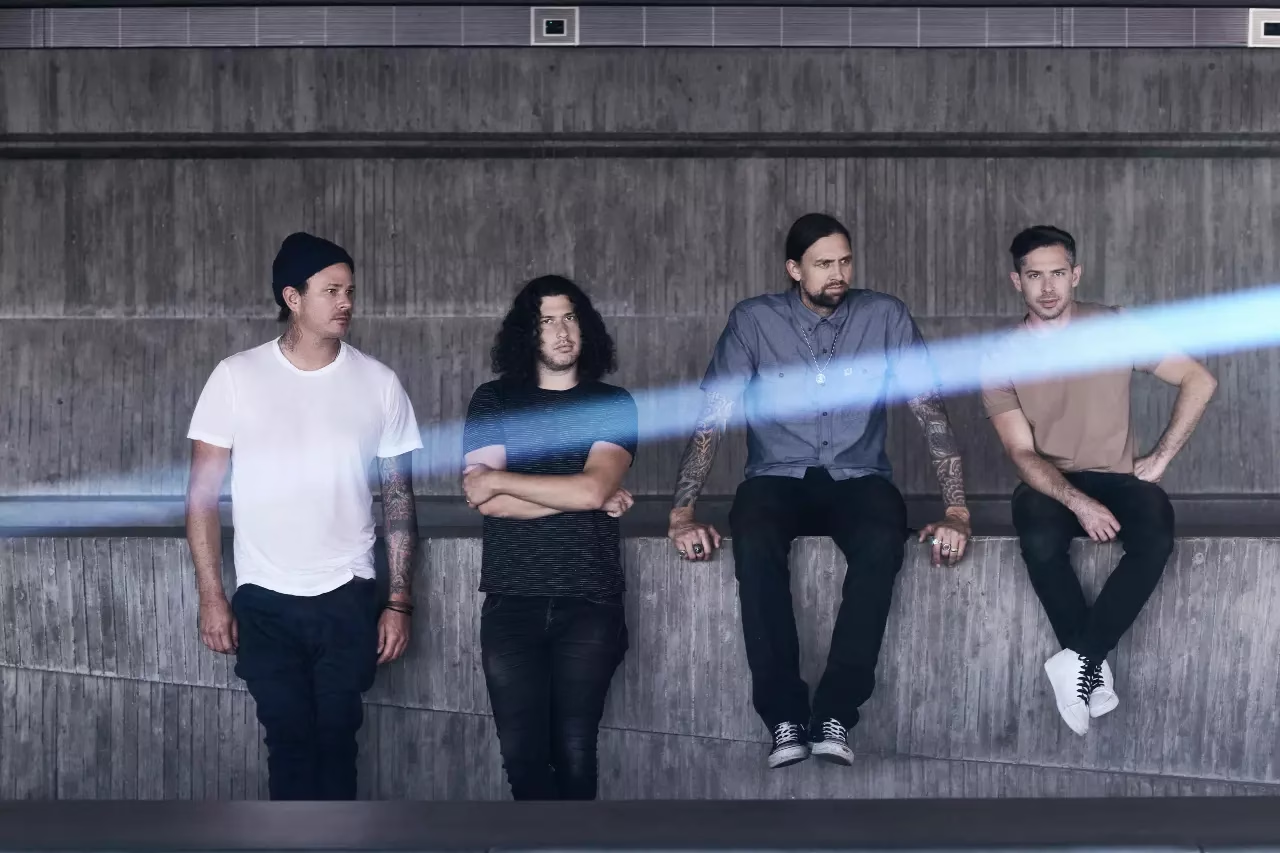
Angels & Airwaves. Photo: Ashley Osborn
This interview has been edited and condensed for clarity.
How are you guys feeling? Looks like a nice day over there.
DeLonge: It's a nice day. Ilan and I do a lot of meditation together. We like jogging, swimming, calisthenics, aerobics. We do all these things every day for 10 to 17 hours straight and then we do rehearsal.
What do you guys get out of that? These meditative, bodily experiences?
Rubin: Nothing physical. It's an emotional bonding.
DeLonge: It's an emotional affair between us. It's really emotional. Here's my White Claw. [Holds up can for a Zoom toast.] I do this as a joke where I literally pour out the White Claw and put Jack Daniel's in it. I just want people to think that I'm drinking White Claw.
Did you have any questions or was it just this?
It's just this. Later!
No, how did you develop the aesthetic for this record? There are synthetic elements, but with something very human underneath.
DeLonge: Well, we have a process that we've developed over the years between myself, Ilan and his brother, Aaron, who's our co-producer. Coming into it, one thing I was wanting to do was: A lot of punk bands start out really fast and aggressive, and where do you go from there? You slow down and get more intricate.
Over a decade ago, we started a little slower and more atmospheric. So, one of the things I wanted to do was have a little more angst—a little more edge. On this record, I wanted the songs to be really diverse—kind of a best-of album with a lot of things in my head I grew up with coming out. It was all about guitars and doing heavier elements, and you'll hear that on things like "Euphoria."
There are not as many songs on the album that represent what Angels used to be. We're just growing into a realm where, I think, Ilan's really added an element of musicality to what I do.
Because I'm more of a melody guy. I think of music in very simple ways, but it helps a lot to have someone like Ilan come in, expanding on some of those ideas. He understands all the music I grew up in and he's been part of that world, but he liked bands that had more than three chords, and I found that really interesting.
Because in punk, if you play more than three chords, it's like "They don't know what they're doing. They're hitting wrong notes. It's too many!"
<style>.embed-container { position: relative; padding-bottom: 56.25%; height: 0; overflow: hidden; max-width: 100%; } .embed-container iframe, .embed-container object, .embed-container embed { position: absolute; top: 0; left: 0; width: 100%; height: 100%; }</style><div class='embed-container'><iframe src='https://www.youtube.com/embed//ZUxCynz-1vk' frameborder='0' allowfullscreen></iframe></div>
Rubin: I think the intent in the music is clear, and I say that aside from my involvement. [2014's] The Dream Walker, which was the first album we did when I joined the band, seemed like a step in a different direction. And all these years later, this is a different direction from that.
But I do have to say that everything does start with what Tom is feeling the direction should be. He starts the ideas. He plants those seeds, lets the ideas grow, and then, at a certain point, I get sent the stuff and kind of play around with harmonies, different sounds and twisting some structures here and there.
We've sort of fallen into that pattern of working because we live in different cities now. He's still in San Diego; I'm in L.A. We've been able to utilize the internet and the wonders of technology. Tom starts with it, throws it over to me, I throw it back, and we do that quite a few times until the song ends up where it ends up. Before we know it, an album's done.
DeLonge: This is about us getting a GRAMMY, right? Is that what this is? We've won so many, it's hard to even discuss.
A whole room full of them, right?
DeLonge: I even tell people that I don't acknowledge that the GRAMMYs matter until I get one. Then they really matter.
Ilan, you mentioned that you build off of Tom's material. Any examples of how you do this?
Rubin: What I'm about to say is a good thing: Tom works from a simple place, usually, which would entail just the chords, the melody and the overall vibe he's going for. He relays the vibe, I do a little digging, a little research, and I help bring that to life.
Beyond that, once the feel of the song is established, it becomes a matter of "When I hear it, what comes to mind creatively?" And that could be harmonies, vocal arrangements, other sounds, potentially improving or replacing electronic stuff that was there—because we have different instruments where we are—and that, as I said, is a polite push-and-pull until we're done.
DeLonge: Just for clarity, too: A lot of bands will write a bunch of songs, then they pick the ones they like. I kind of feel like anybody can write songs—just like "Here's a bunch!" I don't know why, but I find it better—not all the time, but most of the time—to kind of have a goal: "Here's a song that's in this kind of box." Like, a direction I want to go in.
It worked well on this record, and that's why it's so diverse. Because we weren't just writing songs out of nowhere: I would sit with his brother and go, "Why don't we do something that's more electronic, that's more dance-focused but still has an edge, that reminds us of whatever band from the '80s?" or something. That gives us a target to follow.
And then once we identify what that is, Ilan really excels with all the electronics and synths. I mean, on every instrument, really, but it's cool to send up "Something like this," and he goes "Oh, you mean this?" I go, "Oh, f***, that's what I meant, but I don't even know that language!"
It works really well, the way we figured it out. I think. For us, at least.
Rubin: I will say that I stay out of the way until it's time for me to get involved. We've written songs together; we've obviously written songs for other people. As a songwriter, I understand that people like to get their ideas out first—myself included. In which case, Tom just kind of does his own thing until it's time for me to get involved and that collaborative process begins.
<style>.embed-container { position: relative; padding-bottom: 56.25%; height: 0; overflow: hidden; max-width: 100%; } .embed-container iframe, .embed-container object, .embed-container embed { position: absolute; top: 0; left: 0; width: 100%; height: 100%; }</style><div class='embed-container'><iframe src='https://www.youtube.com/embed//e95efluJ9yw' frameborder='0' allowfullscreen></iframe></div>
The press release states that the album is partly about how "Our interaction with other types of lifeforms will actually be what we evolve into caring about more in the near future." Can you expound on this a little bit? Do you mean terrestrial or extra-?
DeLonge: For me, writing the words—at least for these songs—it's always about relationships. In the past, with Blink, it was like "OK, you're breaking up with a girl or moving away to college and leaving behind your life, your family or friends, or whatever." Very simple things that a kid in the suburbs would understand.
But, really, where I'm at now—not being a kid anymore—I like the exploration of how we interact with the people around us and what we think life really is. If I argue with my chick about what movie we're going to watch, is that really all life is about—those kinds of interactions? Or is it something bigger than that?
It's tied into a lot of work I do with my company or the movie I worked on that's going to come out—Ilan and I, and his brother, are scoring that. That movie is more about paranormal lifeforms and what the universe really is, and consciousness.
All that time together [reinforced] the idea that lifeforms and our interactions with others are more than just arguing about a movie. It's really about lessons learned as a human being and as a soul. Interacting with love and loss and pain and heartache and all that kind of stuff.
It makes more sense to call this project Lifeforms once you see the movie, Monsters of California. You'll see a little more about my passions and what I'm doing with To The Stars.
I'm really fascinated by the expansion and growth of self-awareness and who we are and where we're going as humanity. To me, this is a big study in that. Any individual song, you could say this about love, loss and heartache, or something. But to me, the entire picture is about something different.
Ilan joined the band right after we did this sort of arthouse film called Love [from 2011]. It was an artistic, meditative film, and an album went with it. And that whole thing was the same thing: I was writing love songs or whatever, but it wasn't really about just falling in love. It was the idea of a unified mind and consciousness. Our interactions with each other are what this is all about.
So, this is another one of those things where I take deep dives into subjects that can be communicated in different ways. That's why I like the whole transmedia element of this. Rather than just being in a band and pumping out music every two years, I like this idea of being much more ambitious—including different elements and formats and mediums to play with.
It's going to make the show better. It's going to make the fans more tuned in to what we're trying to achieve and trying to say so they can get their own opinions of it or whatever. So, that's what makes me excited about it.
I think you're doing what great songwriters should do, which is juxtapose the microcosmic and macrocosmic. A petty fight or love affair can be connected to an eternal timeline, or expand infinitely outward in impact or meaning.
DeLonge: Because I believe in that—any guide you take into consciousness and how we work and how matter is affected by the way you think.
Things like telekinesis and telepathy—all that stuff's real. They're doing it in laboratories. They're trying to understand how it works or whatever, but at the end of the day, there's a reason why, when someone walks in a room and they're angry or weird, you feel their vibe. You're like "Man, that person's got a weird vibe. I feel weird around that person."
Well, that's the beginning of telepathy. People don't know that. I know this because I spent eight hours with one of the head genetics experts at Stanford—in the world! Up for the Nobel! I spent an entire day with him. He worked on a UFO program. All these things about consciousness I learned, and it's fascinating.
I feel like we know nothing, probably, about who we are and why we're here. So, that's something I'm always chasing—trying to understand that more.
<style>.embed-container { position: relative; padding-bottom: 56.25%; height: 0; overflow: hidden; max-width: 100%; } .embed-container iframe, .embed-container object, .embed-container embed { position: absolute; top: 0; left: 0; width: 100%; height: 100%; }</style><div class='embed-container'><iframe src='https://www.youtube.com/embed//04DFw52bmtM' frameborder='0' allowfullscreen></iframe></div>
Tom, I'm curious about what you read or heard or experienced or watched early on that initiated this awakening in your life, or made you aware of a grander context to the world.
DeLonge: Well, it's not one thing. It's a journey, right? Anybody who's fascinated by something and studies it for 20 years is going to have a perspective that's different than most. A lot of people go "OK, there he goes with UFOs!" or whatever, but that's like saying you're into agriculture. "I like gardening" or "I grow evergreen trees" or whatever it might be. It's kind of a blanket term.
But when you get more into that subject, you're reading about consciousness. You're reading about geopolitics or ancient texts and religions and all that kind of stuff. The journey takes you through all these things where you discover something along the way. You start to find patterns.
And by the time I was surrounded by all these government people, I was like [Taken-aback voice] "Oh my god." It all comes to a head.
But I've always been someone searching out why we're here, and I think artists are supposed to. They're supposed to guide us through the world and communicate it back in a way that somebody could get a new perspective, or at least resonate with it and not feel so alone.
I just think it's our job as artists. We're weirdos and we're supposed to show you what we see. And then, every once in a while, someone goes "Wow! That's an interesting perspective."
The press release also touches on childhood tumult. Is that autobiographical? Can you expound on this theme?
DeLonge: A little bit. I don't know about Ilan's childhood. I don't think either of our childhoods were very standard. They were very different`.
Music's gotten [to where] it's so easy to write a catchy song these days. What's the difference between this catchy song and another catchy song on the radio? Well, it's going to be the people saying it and why they're saying it. I like my musicians to have an edge and come from a weird upbringing or something wrong to where their perspective is warranted or embraced as a different point of view.
Wouldn't it suck if the guys in the Who [weren't like that]? If Pete Townshend sold insurance and was a totally normal guy? He wasn't breaking his speakers and going crazy? I like my bands to have a kind of messed-up childhood or something that's unorthodox.
What would they be if Pete didn't have a couple of screws loose? That's the heart of the band.
DeLonge: That's my point! That's why the songs are cool. A few fistfights and maybe some drugs and alcohol and growing up in a really hardcore blue-collar town and not having the best parents in the world gives them the perspective to write the songs they did. If they weren't like that, they wouldn't have the great hits that we love so much.
Tom DeLonge. Photo: Jonathan Weiner
It seems like you're trying to embrace a punk-ness with Lifeforms. Maybe one that connects your past in Blink-182 with your musical future.
DeLonge: Yeah! I think a lot of people that don't understand the punk scene might think it's about the music. That's something I originally thought as well, but it's really much more about a rebellion against the norm. I tend to find that a lot more around me in other places that you wouldn't expect.
Like, [Gestures to Ilan.] He plays in Nine Inch Nails, and Trent Reznor's f***in' got a pretty edgy past! A lot of f***in' angst. And that kid's more punk than most of the people I grew up with! But you can't say Nine Inch Nails sounds like the Ramones, you know? Or the Clash. But no one's going to argue the angst behind the music.
For me, it's that element within a rock band—or a rap band! One of the guys who used to tour manage Blink was at the Santa Monica Civic when the Clash played there for the very first time. There were riots and s***.
But, he goes, "The first time we heard N.W.A., we were s***ing our pants! We were talking about burning places down, but they were talking about killing cops! That's a whole other level! That was the most punk s*** any of us heard!"
So, I think it's more about coming from a place that isn't so perfect and is a little bit broken and busting out of that. Saying "I'm not going to stand for that. I need to change my environment. I need to change the world that I see," you know? And it happens in a lot of places besides the typical punk-rock music that people think owns this attitude. It's not true! It's just not.
Nobody's going to argue that Liam [Gallagher], who sings for Oasis, is some kind of mellow guy. He's not. He's probably in a fistfight somewhere. He's one of the most colorful dudes in rock, and I love that. That's what I'm searching for, I guess.
Anything on that, Ilan?
Rubin: I definitely agree that an attitude is brought to the table that can be brought to anything, regardless of the style of music. I completely agree with that. I will also say that attitude can be brought to the table regardless of upbringing or any kind of external influence, I think. Largely, people are wired the way they are, and music is a great medium to be you and your truest self.
For example, I may not be an aggressive individual on the outside, but when I play drums, it's almost a different version of me. But that version of me is as authentic—if not more—than anything else you might see.
DeLonge: That is a really wild thing, by the way. That is super true. He's, like, this mellow all day. Most drummers are hitting or shaking things; they have a lot of energy. I was making fun of him yesterday because he was like [Langurous voice.] "Oh, I'll stretch, let's play the show," and then it's like [Makes explosion noise.] He turns it on.
But that has to be in you. You can't fake that. It's just different sides of you. [Jokingly] I mean, when I make love, it's insane. People say...
Rubin: You'd never expect it.
DeLonge: You'd never expect that I know what I'm doing.
<style>.embed-container { position: relative; padding-bottom: 56.25%; height: 0; overflow: hidden; max-width: 100%; } .embed-container iframe, .embed-container object, .embed-container embed { position: absolute; top: 0; left: 0; width: 100%; height: 100%; }</style><div class='embed-container'><iframe src='https://www.youtube.com/embed//CTzcjnQAbsQ' frameborder='0' allowfullscreen></iframe></div>
"Restless Souls" is described in the press release as "A letter to God from humanity." Tom, can you talk about that?
DeLonge: I mean, for me—coming out of the pandemic and seeing all the racism and violence and infiltration of foreign territories into our democracy and the shutdowns and the propaganda that divided us so badly—lyrically, I was like, "What would God say?
If he was going to write a letter—"F*** it, I'm going to write a letter, because I want to be able to talk without you guys talking." You know how that happens in a relationship? "I wrote it down so you can't interrupt me."
God's like, "I don't even recognize you anymore. If you think you know how this is all supposed to work and you think you're doing it correctly, then take the reins. And if you're not going to take the reins, step aside and go for the life lessons you're supposed to go through." That's where the song was coming from.
The thing about it, too, is that it's probably the only song on the album that shows you what Angels was known for a little bit. It's inspirational; it's uptempo; it's kind of pop-punk in the foundation of it. But the musicality of it is very different from something we've done in the past.
I think it's going to be a popular song. It's not a single. We're not working on the radio. We're not making a music video for it. I think it's a wonderful song that Angels fans are really going to be appreciative of. It kind of maps out what the band is always trying to be, which is something a little more positive. More of a positive force.
But we're not scared to make d*** jokes and we're not scared to write a fast song once in a while. We had a super-fast punk song but it didn't really make it past the demo stage.
Rubin: It was too fast.
DeLonge: It was just too fast! So fast we thought it'd hurt somebody!
Is there anything about the essence of Lifeforms we didn't touch on?
DeLonge: Whatever you may or may not have thought Angels was, I think this album will honestly catch you by surprise. I think some people go, "Oh, that's the guy from Blink, so it must sound like Blink!" or "They have the guy from Nine Inch Nails in there, so maybe it's industrial."
I think people don't really understand what we do, but as a mainstream music lover, I don't have a problem in describing this record as a best-of tour of some of the great bands that I grew up with. You might hear a song that kind of reminds you of the Who, or Depeche Mode, or the Cure or the punk, new-wave kinds of things that happened in that era.
And every band does this, right? Every band's trying to say "How am I influenced by the greats?" I can put myself into our version, but I think we really achieved that. We're not chasing something that's happening right now. We're not chasing something that we've already done.
We're making music for us, really. And then, if people like it, that's bitchin'. But what happened here is we made a record that I think is the best album I've ever been part of—if not, the top couple. It's so challenging and unique and diverse.
I don't have anything where each song is f***ing good and so radically different. At least I think so. Now, if you hate what I do, it's easy to say "Each song is really bad!" On the whole, people don't say that. But different! But different! If it's really bad, at least it's different.