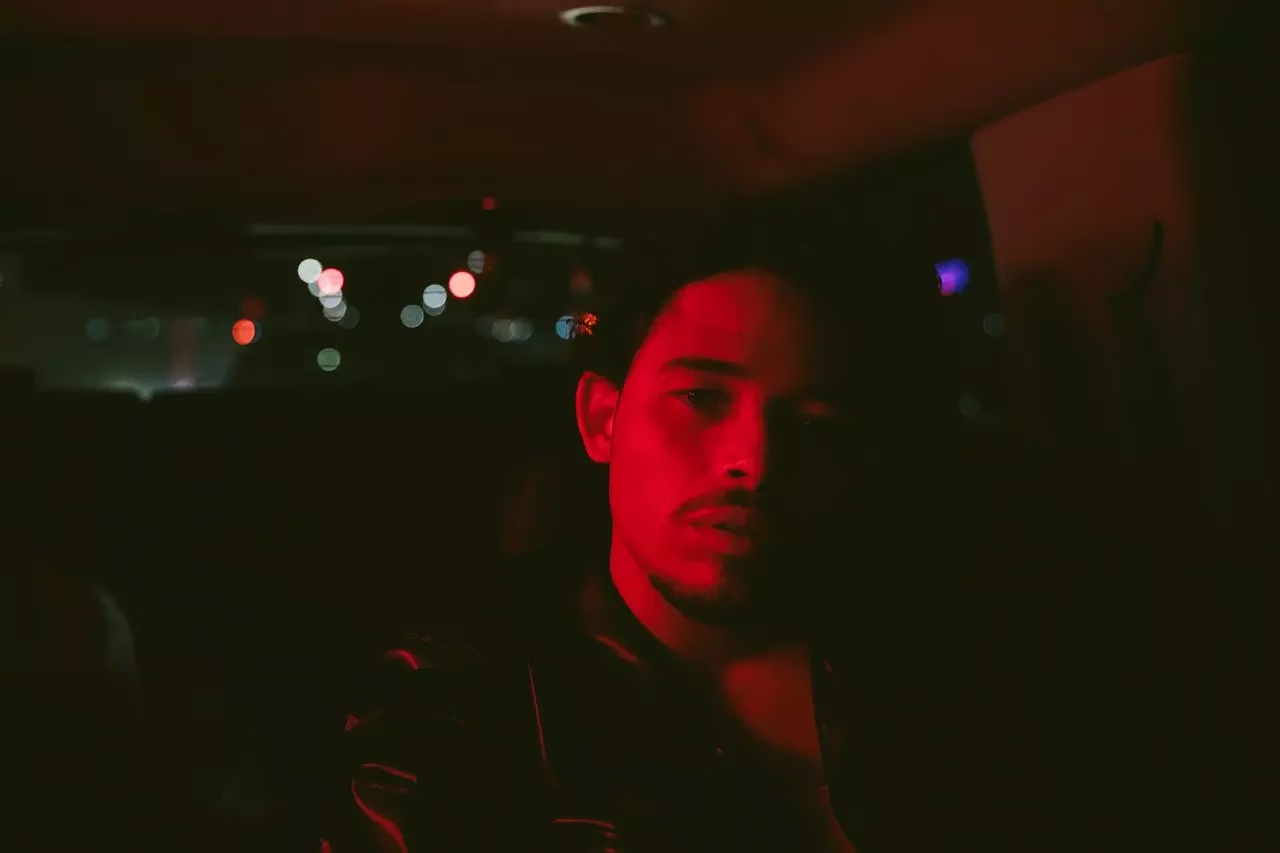
There's something about Anthony Ramos that makes you want to root for him. A star on screen — The actor was Usnavi in the film adaptation of In the Heights and Lady Gaga's best friend in A Star Is Born — Ramos has won many over through his characters. But now he’s ready to show people a different side to him via music.
A versatile talent who is quickly establishing himself in entertainment, Ramos is becoming one of the most visible Latinx multi-hyphenate artists. While he’s not new to music — his debut, The Good & The Bad, covered themes of family dynamics, situationships and mental health — Ramos says he now has a greater understanding of his musical identity. Evolution does not come without its struggles, but that hasn't scared Ramos out of making music that speaks to where he is at this moment.
<style>.embed-container { position: relative; padding-bottom: 56.25%; height: 0; overflow: hidden; max-width: 100%; } .embed-container iframe, .embed-container object, .embed-container embed { position: absolute; top: 0; left: 0; width: 100%; height: 100%; }</style><div class='embed-container'><iframe src='https://www.youtube.com/embed/tisEZ13SY24' frameborder='0' allowfullscreen></iframe></div>
Ramos' sophomore album, Love and Lies, eschews the darker, heavier themes of The Good & The Bad in favor of steamy R&B tracks about sexual healing. Love and Lies tucks Afro-beats and reggaeton influenced bangers that for many will evoke memories of denim stains on basement walls, transferred via contra-la-pared perreo between Ramos' pop layers.
In this conversation with GRAMMY.com, Ramos discusses the evolution of his sound, unreleased material, and how In the Heights impacted his growth as a recording artist.
Can Love and Lies be defined by a set of rhythms or a single sound?
The mood set the tone for what the sounds ended up being for this album. The title came up after the 12 songs were picked. I asked myself, “What are these songs telling us?” while searching for titles. Every song kept unintentionally pointing back to Love and Lies and what the title track is about.
"Say Less" replaced "Stop" as your lead single. Walk me through the decision to introduce listeners to this new body of work with "Say Less," a song reminiscent of The Weeknd's body of work, and eliminate "Stop"?
"Stop" is part of a different album that was ready to go, completely different from Love and Lies. We just had to mix the songs. After putting that song out and feeling out what was happening in the world [since it was released shortly after George Floyd's murder,] I felt like it wasn't the right time to put out an album. I went back to the drawing board and kept writing. I still have all those songs, and I still might put them all out. That might be the next album because I love those songs. "Stop" became a standalone song, but it was initially a part of a body of work.
On this record, you sound almost like you’re more carefree, having more fun in your life compared to your last one, The Good & The Bad. Was that an intention or a result?
This was on purpose because I wanted people to have fun while listening to this record. The Good & The Bad was in many ways autobiographical, and I had to let all of that out. It was my first album, and I was discovering what I wanted to say and how I wanted to say it. Working on a first album feels almost like speed dating because sometimes you write with many different writers and meet new producers. In early 2020, I did the speed dating thing again and went to L.A., and most of those songs from the record I still have in a Dropbox somewhere. I kept the group smaller for this album because I wanted to work with my friends and people closest to me on my team. I wanted to have a good time, especially after the year and a half, almost two years we’ve had locked up. People want to connect, dance, sweat all over each other, take shots together!
Who did you collaborate with?
Will Wells, who executive produced my first album, songwriter Castle, producers Andrés Torres and Mauricio Rengifo (Daddy Yankee, Luis Fonsi, Justin Bieber, Nicky Jam), and Jesse Shatkin (Rihanna, Sia). I also worked with David Stewart, Jessica Agombar, Kinetics and One Love, and Alex Sutton.
I'm from Puerto Rico, and "échale" is a very Puerto Rican way of telling someone they look sexy, but it has different meanings across Latin America. What's the story behind the song title?
My boy Castle came in and said he had a great concept and was like, "Échale, bro!" and started humming this melody [starts singing the chorus to Échale] and mumbling things in Spanish. I asked what if the only Spanish word was Échale. It would go so hard, be an anthem of sorts! Then Jesse, our producer, added the horns underneath. This song is going to be the song about you being whoever you want to be! Do you want to take a shot? Échale! Do you want to go dance with her? Échale! This sh* is going to smack! We wanted to incorporate the Latin vibe, so this ended up being one of those joints, so that was the inspiration for that song. We were having a good time at the studio, having a party [laughs], mad fun! Writing these lyrics was fun too: "Bottle after bottle, keep it poppin'/ You can pick your poison, ain't no problem, we got it."
Everything flowed so easily because we went into the studio with the mentality of just wanting to have a good time. If there's one thing I could add to my first album, it would be more songs with rhythm. I love dancing. That's what I listen to all the time. You look at my playlist and there's lots of reggaeton, reggae, Afro-beats, even pop songs. I love to have rhythm. The big thing for me with this album, even the ballad at the end, "I Can't Get By," still has the 808 underneath.
We're the sum of our experiences, and you're clearly someone who uses music to communicate with others. How did the experience of filming In the Heights and recording "Home All Summer" with Marc Anthony, Leslie Grace, and Lin-Manuel Miranda impact your evolution as a recording artist?
Marc Anthony was really influential in my youth, and musical theater changed my life forever. I identified with Usnavi when I first saw the musical on Broadway. A regional production of “In the Heights” was also how I got my Equity card. All of that served as both a learning experience and as a writing intensive.
Would you say this experience pushed you out of your comfort zone?
I felt like I was right in my comfort zone! When I’m in the studio, I’m the happiest, and sharing a track with Marc was one of my favorite things about the whole experience.
I've always appreciated the vulnerability in your music. To use your album title, Love and Lies, as inspiration, what relationships have been the most impactful in showing you a good example of what real love is?
The romantic relationship I’ve been in for the past six years has definitely affected how I move through life, write, and how I feel, so that has been the most impactful one. But I have teachers and mentors. Sara Steinweiss, my theater teacher from high school, has been the realest, and she’s one of my best friends. She’s someone I can say taught me about unconditional love and what that feels like—my mother and my aunt, too. I lived with my aunt for three years in high school. They taught me what unconditional love feels like. When you know what that feels like, it’s hard to ignore. It’s hard to brush it off because you know what that feels like. I think all of that helps me in my art because I feel their love. Even my grandmother, who passed away, watches over me. My relationships with them over time have really shaped who I am as a human being and definitely as an artist.
Poll: From Megan Thee Stallion To Olivia Rodrigo, What Will The 2021 Song Of The Summer Be?
