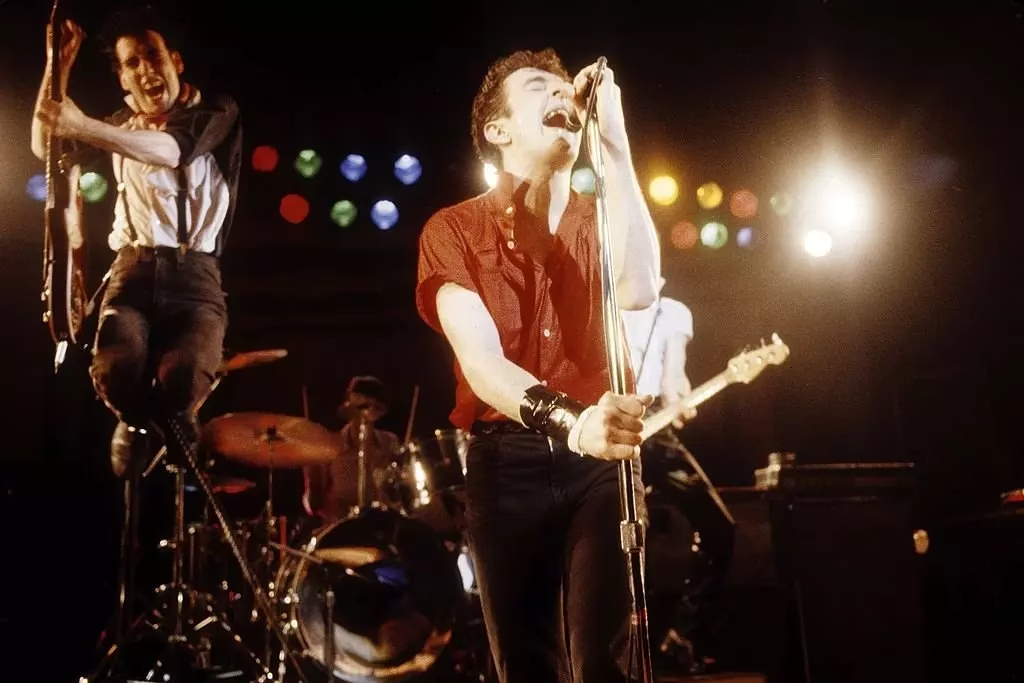
Few bands in the entire history of rock music have left as big of an impact on the wider pop canon as The Clash. Known for their tight songwriting, piercing guitar riffs, boundless sonic experimentation and sharp political lyrics and social commentary, The Clash command a powerful sound that spans multiple genres and has influenced generations of punks, poets and provocateurs. It's also what earned the U.K. group the epithet heard around the world: "The only band that matters."
As one of the progenitors of punk, The Clash are responsible for one of the most distinguished discographies in rock: a collection of six sonically diverse albums, recorded and released during the band's short nine-year stint. Standing at the epicenter of The Clash's legacy is London Calling, the group's third album and their undeniable magnum opus.
<style>.embed-container { position: relative; padding-bottom: 56.25%; height: 0; overflow: hidden; max-width: 100%; } .embed-container iframe, .embed-container object, .embed-container embed { position: absolute; top: 0; left: 0; width: 100%; height: 100%; }</style><div class='embed-container'><iframe src='https://www.youtube.com/embed//EfK-WX2pa8c' frameborder='0' allowfullscreen></iframe></div>
Released in the U.K. in December 1979 and in the U.S. in January 1980, London Calling is today hailed as one of the greatest albums of all time, with everyone from Rolling Stone and Entertainment Weekly singing its praises. It's a commercial success, too: London Calling reached the top 10 in the U.K. and achieved platinum status in the U.S. In 2007, London Calling was inducted into the GRAMMY Hall Of Fame. (At the 2003 GRAMMYs telecast, Bruce Springsteen, Steven Van Zandt, Elvis Costello, Dave Grohl of the Foo Fighters, No Doubt's Tony Kanal and others honored The Clash frontman and guitarist Joe Strummer, who died two months prior to the show, with a performance of the group's punk anthem, "London Calling," in what became the GRAMMY's first-ever "In Memoriam" tribute.)
At its core, London Calling is a sonically daring album from a band unafraid to push the limits of their own sound and that of the genre from which they originated. Across the album's 19 tracks, The Clash smash the punk playbook, transcending their punk roots and expanding their sound into everything from reggae ("The Guns Of Brixton") and ska ("Wrong 'Em Boyo") to rockabilly ("Brand New Cadillac") and post-punk ("Lost In The Supermarket").
"It's a punk record, a reggae record, a pop record, a rockabilly record, and it's accessible and influential on bands 40 years after its release," Jason Camacho, guitarist for California rock band Audio Karate, tells The Recording Academy. "The Clash, and London Calling in particular, is one place where people with vastly different musical tastes can intersect and agree."
Beyond its groundbreaking musical approach, London Calling is also one of The Clash's most politically and socially critical releases. Across the album, frontman Strummer, guitarist/lead vocalist Mick Jones and bassist Paul Simonon tackle heavy social issues like unemployment, racial conflict, drug addiction, war, consumerism and beyond via thought-provoking lyrics and unforgettable melodies. It's the pop-meets-politics paragon perfected by The Clash.
"London Calling serves as a blueprint, a document on how to fight fascism and bigotry [and how to] create community and find commonality in arduous times," Chris #2, bassist for Anti-Flag, tells The Recording Academy.
"London Calling taught me that anger, protest and raw energy could also be catchy," musician Nathan Gray adds. "Not just nihilistic reaction, but a cause to stand for, righteous anger instead of anger for anger's sake. I immediately knew that punk was my music and my lifestyle from there out."
To this day, both The Clash and London Calling continue to inspire generations of musicians and bands. In honor of the iconic album, which celebrates its 40th anniversary this month, The Recording Academy surveyed a handful of artists to discuss the ongoing influence and legacy of London Calling.
<style>.embed-container { position: relative; padding-bottom: 56.25%; height: 0; overflow: hidden; max-width: 100%; } .embed-container iframe, .embed-container object, .embed-container embed { position: absolute; top: 0; left: 0; width: 100%; height: 100%; }</style><div class='embed-container'><iframe src='https://www.youtube.com/embed//JcW8VNwYvL0' frameborder='0' allowfullscreen></iframe></div>
What was your first memory of London Calling?
Chris #2 (bassist for Anti-Flag): I actually didn't find London Calling for a while. I was probably 17 years old and playing some of my first shows in Anti-Flag. But growing up, I was so hungry for activist and empathetic music. I was politicized at a very early age by N.W.A and "F**k Tha Police." My childhood was one of dysfunction, the cops were always f**king with my siblings. This was the first place I was able to compartmentalize my anger and frustration. But when I found the songwriting, melody and succinct packaging of London Calling, I felt empowered. I felt like you can write a song and impact a person, and that person can spread empathy and impact the world. I'm forever grateful for this lesson from The Clash.
Jason Camacho (guitarist for Audio Karate): My first memory of London Calling is likely very similar to many people my age (37). I had an older brother [who was] into new wave and punk, and [The Clash's 1982 hit] "Rock The Casbah" was on the radio in pretty heavy rotation when I was a kid. My brother learned I liked the song and played London Calling for me [when I was] around age 5. The staccato opening guitars of the title track were burned into my brain forever. Artistically, The Clash have always stood out to me as one of those great punk bands who are a punk band by virtue of being punk rockers, but their music is so much more than three-chord punk rock. There is instrumentation and reggae and rockabilly and world music elements, and that has always left an impact. I mean, by the time one is done listening to "Jimmy Jazz," you really have no clue what the fourth track [on London Calling] might sound like because the first three are so different.
Nathan Gray (artist): It was 1985, I was 13 years old. I was living in Pensacola, Fla., and my mom and I were at a public library. I remember it vividly: walking into the music section and searching through to find something I'd never heard before. And there it was. That iconic and powerful cover, LONDON CALLING, with Paul Simonon hunched over about to slam his bass into the stage. The energy leap off the cover, and I knew I needed to hear it.
My mom let me check it out, and I still remember the excitement I felt that I had discovered something special... I had no idea how right I was. I put the tape in my boom box and sat back: The guitars came in, the bass, the drums. And then [the opening lyrics]: "London calling to the faraway towns." I was hooked. I just have listened to that album through at least 25 times before my parents insisted I shut it off and head to bed.
With every song, a new discovery, a fire in my veins and call to action! It was raw, desperate and important. Absolutely changed my life and my perspective on what a magical medium music was.
Andrew Pohl (guitarist for Tsunami Bomb): My first memories of London Calling are from when I was in high school, about 15-16 years old, with friends and I discovering more about punk and, specifically, the roots of the punk rock we were into at the time: Rancid, Green Day, Bad Religion, etc. We were learning about bands like Dead Kennedys, Minor Threat and, of course, The Clash. I had heard The Clash before when I was much younger from their videos on MTV, but didn't really think much of it, as I was more interested in " G.I. Joe" at the time [Laughs.] I loved the album and how all over the place it was stylistically. And man, starting off with the title track was a hell of a way to draw you in—such a powerhouse of a song.
Jason DeVore (frontman for Authority Zero): I would have to say I was probably 23-24 [years old]. A friend of mine brought it to my attention, and I really dug the vibe of it and how eclectic it was. It opened my eyes to different variations of pop and punk in a different way.
<style>.embed-container { position: relative; padding-bottom: 56.25%; height: 0; overflow: hidden; max-width: 100%; } .embed-container iframe, .embed-container object, .embed-container embed { position: absolute; top: 0; left: 0; width: 100%; height: 100%; }</style><div class='embed-container'><iframe src='https://www.youtube.com/embed//07mvTzbIZok' frameborder='0' allowfullscreen></iframe></div>
As an artist, what does London Calling mean to you?
Chris #2 (bassist for Anti-Flag): There isn't a record that I have dissected more. I've learned to play the entire thing, all of the instrumentation that's within my wheelhouse. We as a global society have only seen an acceleration of the warnings of London Calling. Globalization has left so many people behind and created the historic wealth gap we see today. The false populist movements we're seeing around the world are pitting people against their neighbors, refugees, immigrants, women, people of color, LGBTQ+ folks—those most vulnerable and marginalized are being scapegoated. London Calling serves as a blueprint, a document on how to fight fascism and bigotry [and how to] create community and find commonality in arduous times.
Nathan Gray (artist): London Calling taught me that anger, protest and raw energy could also be catchy. Those songs stuck in my head and I couldn't get them out! It spoke to everything I felt looking out at a world that seemed cold, dark and devoid of anything substantial to say. I remember thinking, "This is what I was hoping to hear from the Sex Pistols." Not just nihilistic reaction, but a cause to stand for, righteous anger instead of anger for anger's sake. I immediately knew that punk was my music and my lifestyle from there out.
Watch: Offspring's Noodles On Punk's Roots | "On Location: L.A."
Andrew Pohl (guitarist for Tsunami Bomb): London Calling is a testament to the fact that you as an artist has the ability to define and redefine yourself at your will. If you want to write a politically charged song, do it! If you want to write a ska-infused song, go for it! If you want to toss in some rockabilly for kicks, have at it! I love how free the album is and that The Clash took chances as songwriters. It's super inspiring.
Adam Masterson (artist): London Calling resonates with me because it forces you to think bigger. I love The Clash for their sense of place. They tell you to write about where you're from, and if you live in a big city and you're feeling lost in it and pulled down, it forces you to think bigger again and keep building it up until you have something that can't be denied and stands up to the forces that are pushing you down. They say that to me in the title track "London Calling" and "Lost In The Supermarket" and so many of the songs. It had a massive impact on me and [is] a lasting source of encouragement and inspiration.
<style>.embed-container { position: relative; padding-bottom: 56.25%; height: 0; overflow: hidden; max-width: 100%; } .embed-container iframe, .embed-container object, .embed-container embed { position: absolute; top: 0; left: 0; width: 100%; height: 100%; }</style><div class='embed-container'><iframe src='https://www.youtube.com/embed//_lt4O-EHNnw' frameborder='0' allowfullscreen></iframe></div>
What is it about London Calling that's allowed it to spread across so many generations throughout the decades?
Jason Camacho (guitarist for Audio Karate): The album has stood the test of time after 40 years because it is honest and urgent. You listen to [lead vocalist/rhythm guitarist Joe] Strummer singing and he has something to say. He is singing about concepts that will always be relevant. There is always going to be a generation of young men and women that are navigating racial conflict, unemployment and social disparity. London Calling will be relevant another 40 years from now.
Chris #2 (bassist for Anti-Flag): It's timeless in its messaging, sonically so diverse that it fits in perfectly in a world where art is genre-less. It changes moods as quickly as we do now, and it does so beautifully.
Nathan Gray (artist): Those hooks. Seriously. You can be as provocative as you like, but if you can't keep an audience's attention, you're lost. The Clash were the whole package. They were raw rebellion anthems that borrowed from pop, rock and reggae, and then put them in a punk blender for the disenfranchised. They were the perfect storm, exactly what we needed when we needed them.
Read: The Ramones' Pioneering Punk Rock
Andrew Pohl (guitarist for Tsunami Bomb): I think what has helped the album remain so vital is how honest it is. It's the album that really shows The Clash coming into their own as a band, both musically and as a force of nature. The songs are so well put together, and the way it is paced is incredible. There are so many awesome moments on the record that demonstrate the band having a lot of fun as well as taking bold steps with their writing. It's got a lot of soul, and I think people just resonate with how it takes from so many influences and not just punk.
How has London Calling influenced your own music and art?
Chris #2 (bassist for Anti-Flag): I've dissected [the album]. In doing so, it's unlocked melodies and chord progressions I never thought possible and [that] I carry with me into every Anti-Flag song we write. Because of London Calling and The Clash, we are endlessly on this mission to write a song that sticks with you melodically, in its energy, that you're humming or singing as you walk down the street, but at the same time, that song is about how we will fight them with every breath we take, dismantle systemic oppression and put power in the hands of the people.
Nathan Gray (artist): London Calling and The Clash taught me music was meant to be important. It was meant to convey a message and spit in the face of manufactured and sedate cookie-cutter pop, while still borrowing stylistically from the parts that grab your ear. When I have writer's block, London Calling is my battering ram to remind me why I write music.
Jason DeVore (frontman for Authority Zero): It inspired me with the open styles woven throughout [the album] and its groove as well. I've written quite a few songs based on or around some of the arrangements and riffs with my own band.
<style>.embed-container { position: relative; padding-bottom: 56.25%; height: 0; overflow: hidden; max-width: 100%; } .embed-container iframe, .embed-container object, .embed-container embed { position: absolute; top: 0; left: 0; width: 100%; height: 100%; }</style><div class='embed-container'><iframe src='https://www.youtube.com/embed//Ul0uJfhywW8' frameborder='0' allowfullscreen></iframe></div>
How would you explain the importance and legacy of London Calling to someone who's never heard it?
Jason Camacho (guitarist for Audio Karate): I'd say, in 1979, a working-class punk band from the U.K. wrote an era-defining album about race, consumerism, nuclear meltdown and concepts that no one else was really dealing with. It's a punk record, a reggae record, a pop record, a rockabilly record, and it's accessible and influential on bands 40 years after its release. The Clash, and London Calling in particular, is one place where people with vastly different musical tastes can intersect and agree.
Nathan Gray (artist): Funny enough, I don't know if I would try. I'd just play it, and either they would get it or they wouldn't. That's The Clash to me: an energy that only those who can tap into it fully get. Open your ears, your mind and your heart to what they have to offer, and if you don't get it, you were not meant to.
Chris #2 (bassist for Anti-Flag): There is this thing that happens, specifically with great art: the moment. All of it was a perfect cauldron for this album. The global crisis they faced, their own failures or losses as a band, having [drummer] Topper [Headon] being able to play everything and get out the sounds in their collective heads. The only description it needs is that it's a perfect record. They are the only band that mattered.
Adam Masterson (artist): Had London Calling not happened, The Clash would have still been a legendary band from the first album. But London Calling transcended them to something more than one of the glorious trailblazers of punk and turned them into one of the most influential bands in the history of popular music, who will no doubt continue to influence generations to come.
<style>.embed-container { position: relative; padding-bottom: 56.25%; height: 0; overflow: hidden; max-width: 100%; } .embed-container iframe, .embed-container object, .embed-container embed { position: absolute; top: 0; left: 0; width: 100%; height: 100%; }</style><div class='embed-container'><iframe src='https://www.youtube.com/embed//aUzBgeI5dpc' frameborder='0' allowfullscreen></iframe></div>
London Calling celebrates its 40th anniversary this month. In 40 years from today, when the album turns 80, do you think you'll still love it as much as you do now?
Nathan Gray (artist): That would be like asking if I'd still love my parents when they turn 80. Will I still love an album, a band and music that mentored me through my awkward preteen years? Will I still love an album that completely changed all I thought I knew about music? Hell yes! London Calling and The Clash will be mainstays in my music catalog until the day I die. The Clash were maybe total strangers from the U.K., but in my bedroom, when I needed them most, they became my best friends in the world and inspired me to push forward with music as my rebellion, my hope and my love.
Jason Camacho (guitarist for Audio Karate): In 40 years, I will be dead, but if I happen to survive, I will absolutely still want to crack a beer and nod and sing along to London Calling. The production isn't hokey or dated. It is truly a timeless rock 'n' roll album.
Watch: Sex Pistols' 'Never Mind The Bollocks …' | For The Record
Chris #2 (bassist for Anti-Flag): I will 100 percent still listen to it. I'm hopeful we will live in a far more egalitarian world, one with social, racial and economic equality and equity abound. The stories on the record will serve less as warnings, but more as a document of where they were and what they fought for, that there were four incredible humans that created art predicated upon empathy and gave a f**k about more than just themselves.
Andrew Pohl (guitarist for Tsunami Bomb): I think the album is timeless and easily one of the most important punk albums of all time. Having learned so much about the band between the time of my introduction to the album till now, I've gained an incredible amount of respect for what they accomplished with London Calling. It's made such an impact and helped to inspire so many other fantastic artists with their music and other forms of art.
Adam Masterson (artist): Yes, because great music never dies and only gets better with time.
Jason DeVore (frontman for Authority Zero): Absolutely! It's just one of those well-written and timeless records. I believe no matter what direction music goes, people will continue to appreciate it and use it in remixes and otherwise.