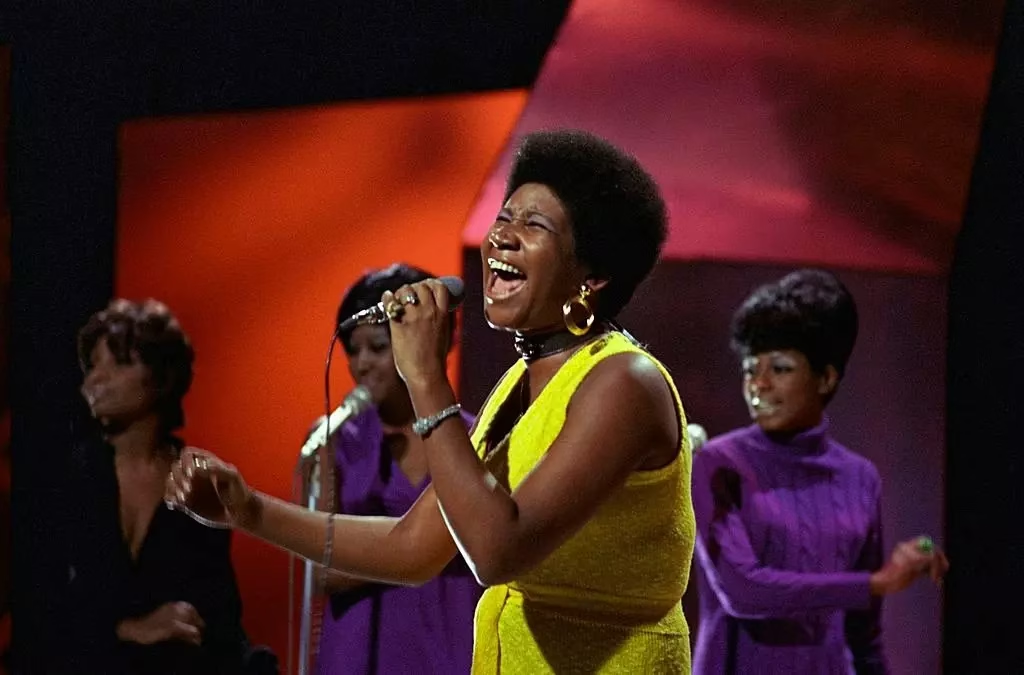
The year 2020, as difficult (and deadly) as its been for so many, has become a moment of reckoning. The nation is facing the shutdown and health crisis of coronavirus, pervasive acts of racist violence against unarmed Black people, and countless injustices for people of color, LGBTQI individuals and women and those within the intersectionality of these identifies. Today, in this climate of social unrest, powerful protest music of the past resonates once again.
As we stand in this pivotal moment, let's look back on some of the songs and moments that defined the civil rights movement and beyond, as Black artists and allies reflected the dire need for justice and inclusive representation, and protestors took their music to new heights.
Mahalia Jackson
Known as the Queen of Gospel, Mahalia Jackson is credited as one of the first artists to take gospel music out of the church. She used her powerful voice to record a massive catalog of religious music during her career, choosing to never dip her toes in secular music. Jackson befriended Martin Luther King Jr. at the 1956 National Baptist Convention and later performed before many of his speeches, in Selma, Montgomery and, most famously, immediately before his famous "I Have A Dream" speech at the March on Washington for Jobs and Freedom in 1963, which she directly inspired.
She was the final musical guest during at the March, singing "How I Got Over," a powerful gospel song, popularized by the Famous Ward Sisters, about overcoming racial injustice. Not only did the song have deep resonance with the Black audience members, it was Jackson herself who moved King to improvise the most famous "dream" passage of his speech. According to King's adviser Clarence Jones, Jackson shouted out; "Tell them about the dream, Martin! Tell them about the dream!" King pushed his notes to the side and Jones told the person next to him, "These people out there, they don't know it, but they're about ready to go to church."
Given its power, Jackson sang the song many times during her career, earning a GRAMMY for Best Soul Gospel Performance at the 1977 GRAMMYs for it.
Did You Know That Dr. Martin Luther King, Jr. Won A GRAMMY?
Aretha Franklin
<style>.embed-container { position: relative; padding-bottom: 56.25%; height: 0; overflow: hidden; max-width: 100%; } .embed-container iframe, .embed-container object, .embed-container embed { position: absolute; top: 0; left: 0; width: 100%; height: 100%; }</style><div class='embed-container'><iframe src='https://www.youtube.com/embed/9iayJ8u4Qew' frameborder='0' allowfullscreen></iframe></div>
18-time GRAMMY winner Aretha Franklin was one of the many successful soul and gospel singers inspired by Jackson and the path she paved, even performing at her funeral in 1972. The Queen of Soul got her start in music singing in her minister father's church. It was there where Franklin was introduced to civil rights activism. While many of her most beloved hits were covers, she had a unique power to reimagine a song all her own and resonate with so many. "Respect," originally recorded by Otis Redding in 1965, is one of these, which became her first No. 1 hit when she released it in 1967. A powerful anthem asking the listener for "a little respect," it became a protest song for both the feminist and civil rights movements of the time. As Pacific Standard states, "it captured a cultural moment Franklin had herself been fighting to achieve."
The outlet also notes that "Chain Of Fools," an original song, followed in 1967 as another feminist anthem, but found new meaning among Black U.S. soldiers fighting "a white man's war" in Vietnam. In 1972, Franklin recorded a rousing rendition of Nina Simone's 1969 civil rights anthem "Young, Gifted and Black," giving her album the same name, a powerful symbol of Black pride. That same year, Franklin later released live gospel album, Amazing Grace, including renditions of "How I Got Over" and "Amazing Grace." "Respect," "Chain Of Fools, "Young, Gifted and Black" and "Amazing Grace" all earned Franklin GRAMMY wins, evident of how deeply they resonated with America.
'Black Gold' At 50: How Nina Simone Refracted The Black Experience Through Reinterpreted Songs
Harry Belafonte
At 93, Jamaican-American actor, singer and activist Harry Belafonte has been a powerful force and barrier-breaker in U.S. culture since the '50s. Inspired by the emerging social justice-minded folk music of the turn of the century, he made it his life mission to "sing the song of anti-racism," as he said in 2017, to use his voice to highlight the music of the oppressed. Seeing Woody Guthrie perform lit this fire within the Harlem-born artist, inspiring him to visit the Library of Congress in Washington, D.C. to listen to Alan Lomax's field recordings.
His third album, 1956's Calypso, was led by one of his most beloved songs, "Banana Boat (Day-O)," a call-and-response Jamaican folk song sung by dock workers (he spent part of his childhood living with his grandmother there). His version took the U.S. by storm, hitting No. 5 and inspiring five other artists to cover it, who all earned Top 40 hits in 1957. The album, as its title suggests, was filled with upbeat calypso music, a genre with roots stemming from those enslaved by the 17th century Caribbean slave trade. At a time when Elvis Presley and other White rock artists ruled, Belafonte's Calypso outsold both of his records that year, spending thirty-one weeks on top of the Billboard 200.
Belafonte also became a pivotal member of the civil rights movement, as a close friend of King, performing at many of his events and offering financial support to fund voter-registration drives, Freedom Rides and even the March on Washington. "I was angry when I met [King]. Anger had helped protect me. Martin understood my anger and saw its value. But our cause showed me how to redirect it and to make it productive," Belafonte writes in his 2011 memoir.
Pete Seeger
"For Mr. Seeger, folk music and a sense of community were inseparable, and where he saw a community, he saw the possibility of political action," the New York Times wrote in Pete Seeger's obituary in 2014. "His agenda paralleled the concerns of the American left: He sang for the labor movement in the '40s and '50s, for civil rights marches and anti-Vietnam War rallies in the '60s, and for environmental and antiwar causes in the '70s and beyond."
In the '50s, the folk artist adapted "We Shall Overcome" with several other activist, including Zilphia Horton, who taught an updated version of the gospel spiritual "I'll Overcome" to union organizers. Seeger's version became an important rallying cry of the civil rights movement. Many other activist/artists of the time recorded and sang the powerful song at various events, including Jackson and folk acts Peter, Paul and Mary and Joan Baez, the latter who sang it during the March on Washington.
Seeger always used his music to speak up on the big issues of the time; in 1941 he wrote "Talking Union" with members of The Almanac Singers (both acts recorded it), "an almost literal guide to union-building," as Time put it. During Vietnam and the Cold War, respectively, he released anti-war anthems "Waist Deep in the Big Muddy" (1967) and "Where Have All The Flowers Gone" (1955). The latter has been covered many times over the years by Earth, Wind & Fire, Dolly Parton and more, with folk/pop act Kingston Trio's 1962 version first hitting the mainstream and reaching the Top 40.
Bob Dylan
"How many roads must a man walk down / Before you call him a man?" a 21-year-old Bob Dylan begins on his beloved 1963 song, "Blowin' In The Wind," another anthem of the civil rights movement. It is the opening track of his second album The Freewheelin' Bob Dylan, which also features "The Death of Emmitt Till," "Oxford Town," "Masters of War" and other explicitly political songs examining injustices of the time.
Like Belafonte, he was inspired by Guthrie's political brand of folk, but it was his then-girlfriend, Suze Rotolo (pictured on The Freewheelin' Bob Dylan album cover), who moved him towards activism and playing political rallies. He wrote "The Death of Emmitt Till" in 1962, about the Black teen that was brutally murdered by White men for alleged whistling at a White woman, shortly before singing it at a fundraiser for the Congress of Racial Equality, which Rotolo was involved with.
During the March on Washington the next year, Dylan performed several songs, including "Only a Pawn in Their Game," which he had recently written about the civil rights activist Medgar Evers killed just months earlier. He also performed the heart-breaking song at a voter registration rally for Black farmers in Mississippi later that year. In January 1964 he would release the track on his next album, another socially conscious project, this one earning a GRAMMY nomination, The Times They Are A-Changin'.
Bob Dylan Announces New Double Album 'Rough And Rowdy Ways,' Releases New Single "False Prophet"
James Brown
In August 1968, a year before Simone released "Young, Gifted & Black" and just four months after King was assassinated, the Godfather of Soul James Brown delivered the funky Black pride anthem "Say It Loud – I'm Black And I'm Proud." As UDiscoverMusic notes, "The tone of the civil-rights movement had so far been one of a request for equality. Brown, however, came out defiant and proud: he isn't asking politely for acceptance; he's totally comfortable in his own skin. The song went to No. 10 on the Billboard [Hot 100] chart and set the blueprint for funk. Like later Stevie Wonder classics of the '70s, it was a political song that also burned up the dancefloor; an unapologetic stormer that would influence generations."
In 2018, on 50 years after the song's release, Randall Kennedy, a Black law professor at Harvard, explained the power of the song in that moment, and today: "It was precisely because of widespread colorism that James Brown's anthem 'Say It Loud, I'm Black and I'm Proud' posed a challenge, felt so exhilarating, and resonated so powerfully. It still does. Much has changed over the past half century. But, alas, the need to defend blackness against derision continues."
The iconic song recently saw a massive boost in streaming numbers as part of Spotify's Black Lives Matter playlist.
N.W.A, Ice Cube & Dr. Dre
When N.W.A released "F*** Tha Police" in 1988, their hometown of Compton, in South Los Angeles, was rife with police brutality and racial profiling. One of the hardcore rap group's most controversial songs, it struck a chord with in their community, as well as with other Black people living in over-policed inner-cities around the country and frustrated youth of all colors. Directly denouncing the police's abuse of power, the song was largely condemned by the mainstream, causing the group to receive a cease-and-desist letter from FBI and to be arrested for playing it at a Detroit show in 1989, as shown in the Straight Outta Compton biopic.
"We had lyrics. That's what we used to combat all the forces that were pushing us from all angles: Whether it was money, gang-banging, crack, LAPD. Everything in the world came after this group," Ice Cube said in an interview. "We changed pop culture on all levels. Not just music. We changed it on TV. In movies. On radio. Everything. Everybody could be themselves. Before N.W.A … you had to pretend to be a good guy."
In 1992, Rodney King was brutally beaten by LAPD officers who were later acquitted, sparking the 1992 Los Angeles uprising. This not only highlighted the truth and urgency of N.W.A's lyrics, it further solidified it as a rallying cry against the daily violence and racism Black people across the country faced. That year, Ice Cube released his third solo album Predator, along with its biggest hit, the laidback "It Was A Good Day." As HuffPost notes, "he raps about how to cherish moments like chilling with your homies to enjoying your mom's food to NOT get harassed by the police." Dr. Dre followed with his 1debut solo album The Chronic in 1994, and on "Lil' Ghetto Boy" he and Snoop Dogg rap about the dark challenges faced by a formerly incarcerated Black man on parole, powerfully sampling Donny Hathaway's 1972 classic "Little Ghetto Boy."
"Fight The Power": 7 Facts Behind Public Enemy's Anthem | GRAMMY Hall Of Fame
Public Enemy
New York political hip-hop outfit Public Enemy originally recorded "Fight The Power" at the request of then-emerging filmmaker Spike Lee, for his 1989 film Do The Right Thing. It plays a prominent role in the poignant film that explores racial tensions in Brooklyn's Bedford-Sty neighborhood, as the only song character Radio Raheem plays from the boombox he proudly carries at all times. As HipHopDX writes, the song is "indisputably a call to action, [as] Chuck [D] commanded people to stand up against systematic oppression." "Elvis was a hero to most / But he never meant sh*t to me you see / Straight up racist that sucker was / Simple and plain. / Mother f*** him and John Wayne / 'Cause I'm Black and I'm proud," Chuck D raps with authority, both calling out White heroes and nodding to a Black hero, the Godfather Of Soul.
The powerful track finds inspiration from both Brown and the Isley Brothers, who released a song called "Fight The Power" in 1975, it also takes direct influence from them. According to Genius, it features around 20 samples, including Brown's "Say It Loud" and "Funky President (People It's Bad)," and interpolates The Isley Brothers' song. "I wanted to have sorta the same theme as the original 'Fight the Power' by the Isley Brothers and fill it in with some kind of modernist views of what our surroundings were at that particular time," Chuck D explained. The music video (watch above) begins with news footage from the March on Washington, followed by Public Enemy organizing their own march and rally in Brooklyn.
The song was released on the film soundtrack and on their 1990 album, Fear Of A Black Planet, on which they also called out racism in Hollywood and in the police on "Burn Hollywood Burn" (featuring Cube and Big Daddy Kane) and "911 Is A Joke," respectively. This summer, Public Enemy returned with the fiery "State Of The Union (STFU)," calling out the rampant racism of the current White House administration.
How Black Trans Artists Are Fighting To Achieve Racial Justice & Amplify Queer Voices