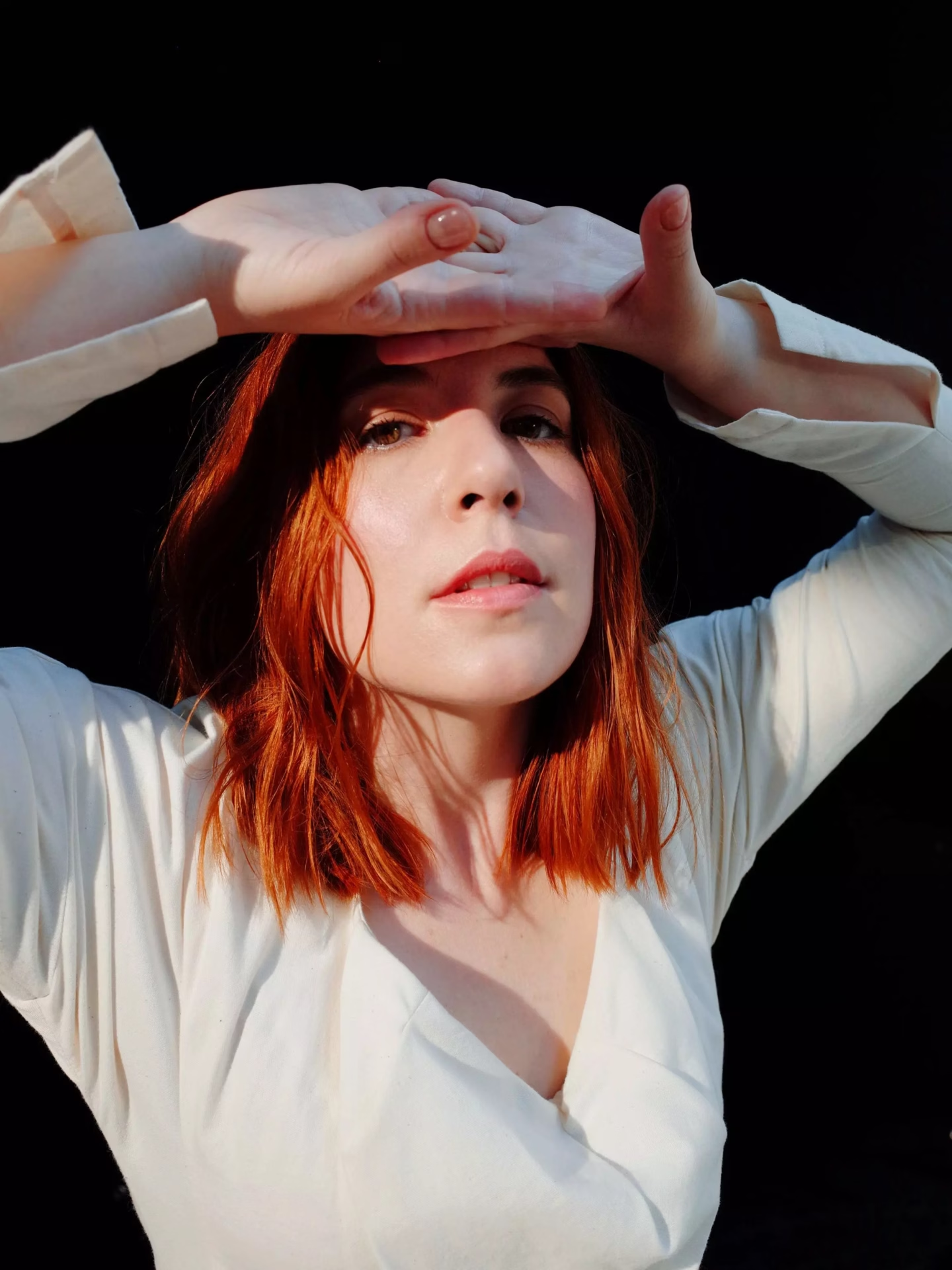
We like to think of memory as infallible, as if there's a video camera lodged behind our eyes with an ability to call it all back into frame and experience it again. But in reality, we absorb every memory within the context of a new moment—which in itself will pass and be recontextualized. Katie Stelmanis is experiencing that process in multiple concurrent ways when it comes to her new album as Austra. "We worked on the bio, and they had this whole thesis behind the record and all these ideas of what I would want to talk about. But none of that feels genuine in the context of what's happening right now," she says. "Do I just stick to the plan and pretend it's all the same, or do I just say 'f**k it' and talk about whatever?"
Stelmanis began writing songs for her fourth studio album, HiRUDiN, in 2017, processing a breakup she’d been dealing with at the time. Now, three years later, the album’s about to release (on May 1 via Domino) and she’s processing a fresh breakup—not to mention the resultant isolation and self-study that comes with life in a pandemic. The refractory meaning of the songs doesn’t stop there; Stelmanis is aware of the way in which each listener can take in and process the songs in their own frame. "Eventually, songs stop being so much about one specific incident," she says. "They exist on their own."
And while that process gives the album its own life, they possess a bit of Stelmanis' soul, a palpable sense of her emotional core. Fittingly, the album’s title is taken from a chemical found in the saliva of leeches, a substance that thickens blood prior to consumption. Though the memory and context of her own experience may have changed a dozen times in the intervening years, the record palpably pulsates with life and the feeling of it congealing in a moment of loss.
Stelmanis spoke with the Recording Academy about the vulnerability of happiness, discovering the power of collaboration and the constant creative recontextualization of HiRUDiN.
<style>.embed-container { position: relative; padding-bottom: 56.25%; height: 0; overflow: hidden; max-width: 100%; } .embed-container iframe, .embed-container object, .embed-container embed { position: absolute; top: 0; left: 0; width: 100%; height: 100%; }</style><div class='embed-container'><iframe src='https://www.youtube.com/embed/dlcqnZeO3bQ' frameborder='0' allowfullscreen></iframe></div>
It almost feels trivial to ask what people are up to these days.
Yep. I'm in quarantine like everybody else in the world. I'm in Toronto right now. I was living in London, doing a residency that got cut short, so I booked a flight back to Canada. I lived at my parents' house for two weeks while they were away with two friends that were also in London and decided to come quarantine together. It was nice to be with people and cook and calm each other down when we thought we had coronavirus. But now I'm alone and I'm in my apartment, facing the reality of the time.
Do your family and friends live close by?
My apartment is across the street from my parents' house, but before I came back to Toronto, I was in Berlin, Paris, London and a million airports. I feel like I'm such a high risk that I don't want to see them for a little while.
Your work is grounded in motion and movement, so the stark reality of being at home must be challenging to navigate. Does thinking about everyone else in the same boat bring some sense of calm?
I had been living in London with a partner, and we broke up in January, which was a shock. That added an extra layer of chaos and confusion to coming back home. I broke up with my partner in January and immediately had to start doing press for a record that I wrote with their help. That was really difficult. So I'm actually in part relieved that I have this time to actually process it and be by myself rather than have to rush into a year of touring, which was the plan.
How long have you been living with these songs?
I started writing this record in May, 2017. Actually, some of the songs are breakup songs about my previous relationship. It's funny because I wrote the record thinking that it had this narrative of self-discovery—you're in this toxic relationship and then you get over it and have this future ahead of you. Since then, I've realized that it's not a linear thing. It's a cyclical thing where you're constantly in this wheel of redevelopment.
The record has nothing to do with the current breakup, but the context of the songs has completely changed. In a way, I also feel a little psychic, because there were some songs that I wrote near the end of the writing period that are very much about a breakup but weren't necessarily based on my own experience. And I was like, "Where did this come from?" But now they make perfect sense in the context of what I'm going through. I pre-wrote a breakup album.
A newfound superpower?
It’s kind of perfect.
<style>.embed-container { position: relative; padding-bottom: 56.25%; height: 0; overflow: hidden; max-width: 100%; } .embed-container iframe, .embed-container object, .embed-container embed { position: absolute; top: 0; left: 0; width: 100%; height: 100%; }</style><div class='embed-container'><iframe src='https://www.youtube.com/embed/mx6VazPD8x0' frameborder='0' allowfullscreen></iframe></div>
Have you had much time to think about the album that you initially set out to make as opposed to what you’re experiencing now?
As with any record, it’s very reflective of a period of time that I was going through. But it's interesting in the cycle of the music industry where often by the time your music comes out, you will have finished a year ago. By the time you're promoting the record, you're like, "This is old news." It's just interesting how up in the air everything is. Theoretically I'll be on tour in the fall supporting this record, but also maybe not. Maybe I'll never be on tour supporting this record.
It's difficult to share a part of yourself that relates to a certain moment and then constantly relive those feelings.
We worked on the bio, and they had this whole thesis behind the record and all these ideas of what I would want to talk about. But none of that feels genuine in the context of what's happening right now--in my breakup or in coronavirus. Do I just stick to the plan and pretend it's all the same, or do I just say "f**k it" and talk about whatever? I feel like it would never make sense to just talk about the record as planned. And in the coronavirus, everyone's life has been upended and nothing is the same.
That reminds me of the song "How Did You Know?" on your new album, where you say, "I've moved six times in the last five years and I need rest."
I guess this is number seven. [Laughs.] Actually, it's been longer than five years. It's been seven years. Yeah … totally normal.
There is a fantasy and obsession with constant movement. Identity can be wrapped in that. Now that you're back, will remaining in one spot affect your creativity?
It's all so new. I literally live across the street from my parents, on the street I grew up on. So when I come back to Toronto, I am home. Undeniably home. Obviously I have mixed feelings about that. Part of me doesn’t want to be here. But then I'm also like, "Why don't I want to be here? Is it because I'd rather be somewhere else? Or is it because of everything that's going on? Or because I'm forced to be here?" Normally, whenever I come home, I love it. That's something I'm trying to figure out now: where I want to live, where I want to put down roots.
<style>.embed-container { position: relative; padding-bottom: 56.25%; height: 0; overflow: hidden; max-width: 100%; } .embed-container iframe, .embed-container object, .embed-container embed { position: absolute; top: 0; left: 0; width: 100%; height: 100%; }</style><div class='embed-container'><iframe src='https://www.youtube.com/embed/yCXiPlcqOL4' frameborder='0' allowfullscreen></iframe></div>
How does a song’s meaning evolve for you?
Eventually songs stop being so much about one specific incident, they have a life beyond that. The songs that I've been playing and performing for almost 10 years now, the songs for my first record, the meaning has changed so many times. They exist on their own. And so with these songs, I'm waiting for that to happen. It's so good that I'm able to have this space away from them, to not listen to them. And then maybe when I'm actually able to tour again, they'll have a different meaning and I'll be able to live with that.
Do you have any tendencies as a musician that you found yourself fighting against whilst making this record?
This record was unlike any other I had made before in that it's the first time I worked with outside collaborators. I worked with producers and a ton of different session players, a lot of whom I had never met before. That was a really new experience for me because I had always felt like I needed to self-produce everything. It seemed absurd to me to hire an outside producer. But now that I’ve done it for the first time, I realized that it doesn't mean that you're giving them control or relinquishing your creative identity. It means that you have somebody to bounce ideas off of, somebody to help you take the songs to a place that you might not have been able to take them on your own. I'm almost mad I didn't do it before.
It's so useful to learn how other people do things. When you're working by yourself, you can get into these habits where you do the same thing over and over again. As soon as you're working with other people, you have more tools and your music can go to many different places. Before I made this record, I felt like I had hit a wall in what I was able to do myself.
I did a bunch of sessions with Cecile Believe, who has spent a lot of time working with PC Music, Sophie and that group. She shared an insight into Ableton plugins like Kick 2 and Serum. Opening the door to future collaborations, to learn other ways of using these tools I’ve used in my own way, has made me realize that there are no walls. The possibilities are endless.
What were the sonic walls that were difficult to break out of?
I had approached music in a very insular way. I started making electronic music over 10 years ago, at a time where very few people were making computer music. I didn't come from this community of people that learned from each other. I'm always jealous of people that came of age in places like London, where people have been going to the clubs since they were 14. They're so lucky. But at the same time, I wouldn't trade my experience. I'm at this stage where I'm opening these doors that in some ways are just not available to people when they've been making music as long as I have.
You partly recorded the album in Spain. Does a new environment recontextualize personal material and give it space?
Being in rural Spain was never somewhere that I imagined myself. My partner at the time is from London and works in music, and took a sabbatical from her job to start a musicians artist residency in rural Spain. Her parents own a place in the middle of nowhere, in the mountains. It's not a place you'd ever go and visit, but they got the place to retire in. I probably spent a total of six months in Spain over the period of three years in this very isolated little town on a mountain. She ended up renting this weird bunker on a mountain and turned it into a studio space. I was able to do a ton of writing and recorded all my vocals there.
How do you interpret the link between love, pain and storytelling in music? Why was it important for you to tell your story and not coat it in metaphors?
My last record, Future Politics, was really intense to promote. There was a lot of theory behind it. I had just started learning and reading about capitalism and left-wing politics, and I had a lot of optimism. And then of course the day that record came out, Donald Trump came into power. So all of these ideas that I had dissolved. Everything was recontextualized. I was able to have so many conversations around that album, but as time went on, I felt like it wasn't really my place to be considered a reliable source or expert to talk about any of that. There are people who know so much more than I do, people who devote their lives to this way of thinking.
I started to think more about what an artist's purpose is. I have been thinking a lot about the importance of vulnerability and allowing yourself to experience happiness. As an artist, one of the most powerful things we can do is share our vulnerabilities, and in that sense connect people to their own humanity, to their own emotions, and to make them feel things. There's a real importance in that. Making this record, that was a real goal. I wanted people to feel this record very deeply in an emotional way.
<style>.embed-container { position: relative; padding-bottom: 56.25%; height: 0; overflow: hidden; max-width: 100%; } .embed-container iframe, .embed-container object, .embed-container embed { position: absolute; top: 0; left: 0; width: 100%; height: 100%; }</style><div class='embed-container'><iframe src='https://www.youtube.com/embed/AE9ePc0OTjs' frameborder='0' allowfullscreen></iframe></div>
You are still using your platform to speak openly, just in a different context. What are the things that matter to you most now in politics and the queer community?
My politics haven't changed from that record, but in terms of what we're going through, the most important thing that we can campaign for is universal basic income. I just believe in that so strongly. It's such a precarious time to be in any creative industry, whether you're a journalist or a musician. These industries are suffering. I think that if there was universal basic income, these mediums would still exist. People could actually freelance and survive. This is something that we desperately need to be campaigning for.
Do you have a daily practice, a place you are drawing your creative energy from?
I have been going to the studio in my basement a lot, but at the same time I'm giving myself permission to not have to do anything. I have very low expectations of what I can actually accomplish at this stage. And that's fine. Going through a breakup, going through a pandemic, I'm using the studio and I'm using music in a way that feels good, in a way that I want to. I'm definitely not putting any expectation on myself to write a pandemic album. I think the biggest challenge right now is to just stay sane and stay healthy, so I'm doing what needs to happen for that.
It's almost cliche, the classic millennial in quarantine is making sourdough and planting a garden, but at the same time these are all activities that we associate with survival and that we associate with having a home base and feeling like we're in control. The fact that we can make and grow our own food is giving back some control that most of us have lost. It's actually really healing for people and it's really satisfying. So, yeah, I'm trying to make sourdough. I haven't succeeded yet.
Streaming Is Down, Festivals Are Dark: How Music Is Coping With COVID-19