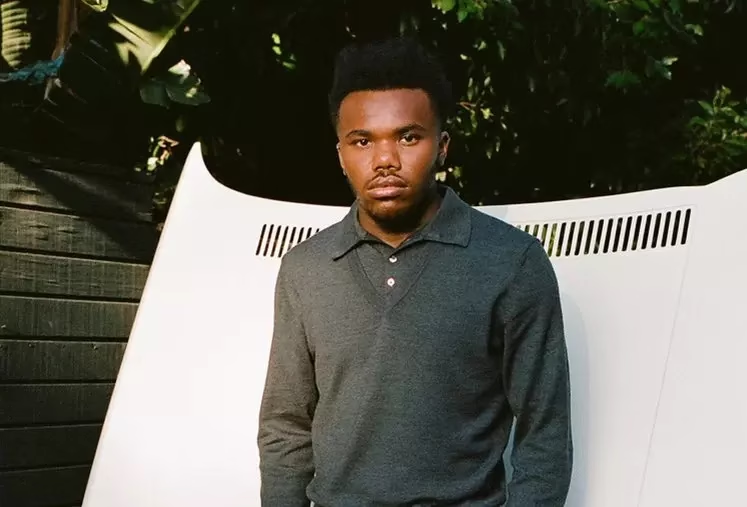
Baby Keem is different. That much was clear even before he collaborated with Travis Scott, before Kanye West recruited him for Donda, before Drake declared his 2019 mixtape the album of that year — oh, and before it was revealed that he really is Kendrick Lamar's cousin.
Early listeners of the Las Vegas native (born Hykeem Jamaal Carter Jr.) didn't need cosigns from four of rap's most powerful acts to know that Baby Keem could become an influential artist in his own right. Four GRAMMY nominations later, the 21-year-old rap provocateur seems poised to live up to that potential.
A mixed bag of diverse flows, disarming vocal deliveries, top-notch production, and no-way-he-just-said-that lyrics makes listening to Baby Keem a true exercise of being kept on your toes. His debut album, The Melodic Blue, is likely jarring for some, but exciting for many. Its push-pull experience of mosh-pit anthems like the Lamar-assisted "family ties," as well as moments of revelation like "scars," paint an accurate portrait of Keem as an artist — calculated, experimental and unabashedly polarizing.
His unpredictable style is clearly resonating: Not only did "family ties" earn Keem 2022 GRAMMY nominations for Best Rap Song and Best Rap Performance, but he also received a Best New Artist nod. (Additionally, his feature/co-write on Kanye West's Donda track "Praise God" scored Keem an Album Of The Year nomination.)
GRAMMY.com sat down with the rising rap star to discuss his "surreal" nominations, how producing his own music has impacted his sound, and how he hopes to influence rap's next generation.
Your debut album, The Melodic Blue, dropped Sep. 21st. Then two months later, you're nominated for four GRAMMYs. What was your reaction to the news?
Happy, surprised a little. Everything's kind of surreal when you're just in the moment, and I practice living in the moment. So I probably won't even know how exactly I felt until 15 years from [now]. You know what I mean? But just really surreal.
Two of the nominations come from "Family Ties," the track you did with your cousin, Kendrick Lamar. You two also collabed on "Range Brothers" and "Vent," as well as your work on the Black Panther soundtrack. So on a scale of 'never going to happen' to 'we could drop one tomorrow if we wanted,' how likely is a full Keem/Kendrick collab project in the future?
That's a good question. It's like it's 50-50. It could happen and it couldn't, I don't know. It just really depends on a lot of factors that I don't have control over. So, it's just what the world wants. The world wants it, then it can have it.
I'll speak for the world — the world definitely wants it. What's one message or practice from one of your early collabs that has stuck with you the most so far?
I would like to say everybody that's been on the project has been really easy to work with, especially Don [Toliver], Trav [Travis Scott], and then Brent [Faiyaz] — getting [him] on the project last minute, even though I was like, "we need you on it" like a week before it came out. He was really easy to work with, and all these guys are my friends. I'll remember that forever.
What's the collaboration that most people wouldn't think of that you would like to get done in the future?
Ah, man. Most people wouldn't think of, maybe, Frank Ocean.
You're nominated for Best New Artist, a category that a bunch of generational influencers have been nominated for: Kanye West, Frank Ocean, Drake, Lauryn Hill. What do you think a generation of artists influenced by you would sound like?
That's a crazy question. I don't know. I just want to inspire people to keep pushing the sound forward. Whether it may not be popular or whatever. Just keep doing different things to inspire each other, because that's really what it is. We all inspire each other.
I get excited when someone drops something that's really worth listening to — that excites me. Not even just for the person, for music in general. So I just hope that the next generation or the next Best New Artist can keep pushing that agenda.
What are some projects that have gotten you excited recently?
I find myself going back to a lot of old music. A lot of old Kanye and Outkast, obviously. But those are just songs — album-wise, I really go back and dig. Like I said before, Frank. Even my cousin's old albums. I think it's important to have your own individuality, but also be able to reference art from the past.
You have production credits on the Black Panther album, Jay Rock's Redemption, Schoolboy Q's Crash Talk, and of course, The Melodic Blue. How does your background as a producer factor into your work? And do you feel that's an underrated part of who you are as an artist?
For sure. It was, and then I think people found out when they realized I did, like, half of my own catalog. I feel like producer artists are like the best artists, just because you just know what you want. You see a vision. You're able to execute a vision from start to finish — unwavered.
That's probably the best thing I've ever learned, how to make beats. And it's probably one of my favorite things, for sure.
Since you are a talented producer in your own right, where do you stand as far as working with other producers?
I don't really care. It's just about the end product for me. I don't really care who's pushing the buttons, as long as we got the right chords going on.
I like to keep consistent faces around and slowly bring in new people as it may fit. But I don't just like switching the whole scene up. So the producers you see now would be with me for the long run, I'll make sure of that.
When I first heard your 2018 mixtape The Sound of Bad Habit, I thought the most interesting thing was the fact that I couldn't trace where you were from. How much do you think that the lack of an established Las Vegas sound for you to lean on contributed to the artist you are today?
I don't think it contributed anything. We live in a new era where everyone sounds like everyone. There's no typical sound. Of course you have the local underground sound of each city, which is cool. But you think of all the artists that have bigger platforms from their cities. They don't really sound like their cities. And I think that's something that's been lost over the years in terms of city influence when it comes to hip-hop.
Is that something you want to try to kind of bring back with Vegas?
It depends on what the next artists do — what the 13-year-old kid does in his bedroom right now, and who he wants to sound like. You ultimately have no control over it. You could just set the standard really and hope it formulates into something.
Your music videos have a real cinematic feel to them. On The Melodic Blue, I think it's at the end of "scapegoats," you have this female narrator. Every time I hear it, I think it's the woman from Pulp Fiction, like, Bruce Willis' girlfriend.
[Laughs.] Really? That's hard.
What's your connection to cinematography in that whole world? And how does that come into play with music for you?
That was actually my first thing that I wanted to do before I started making music. I wanted to act, and I have an eye for visuals that I really like.
Of course, my tastes have grown over the years. It's just keep moving forward, pushing the narrative. People don't expect artists to have these type of videos, so I just try to stay ahead and do that.
What's next for Baby Keem in terms of music?
Jeez. I'm just still working. Who knows until the music's done?