
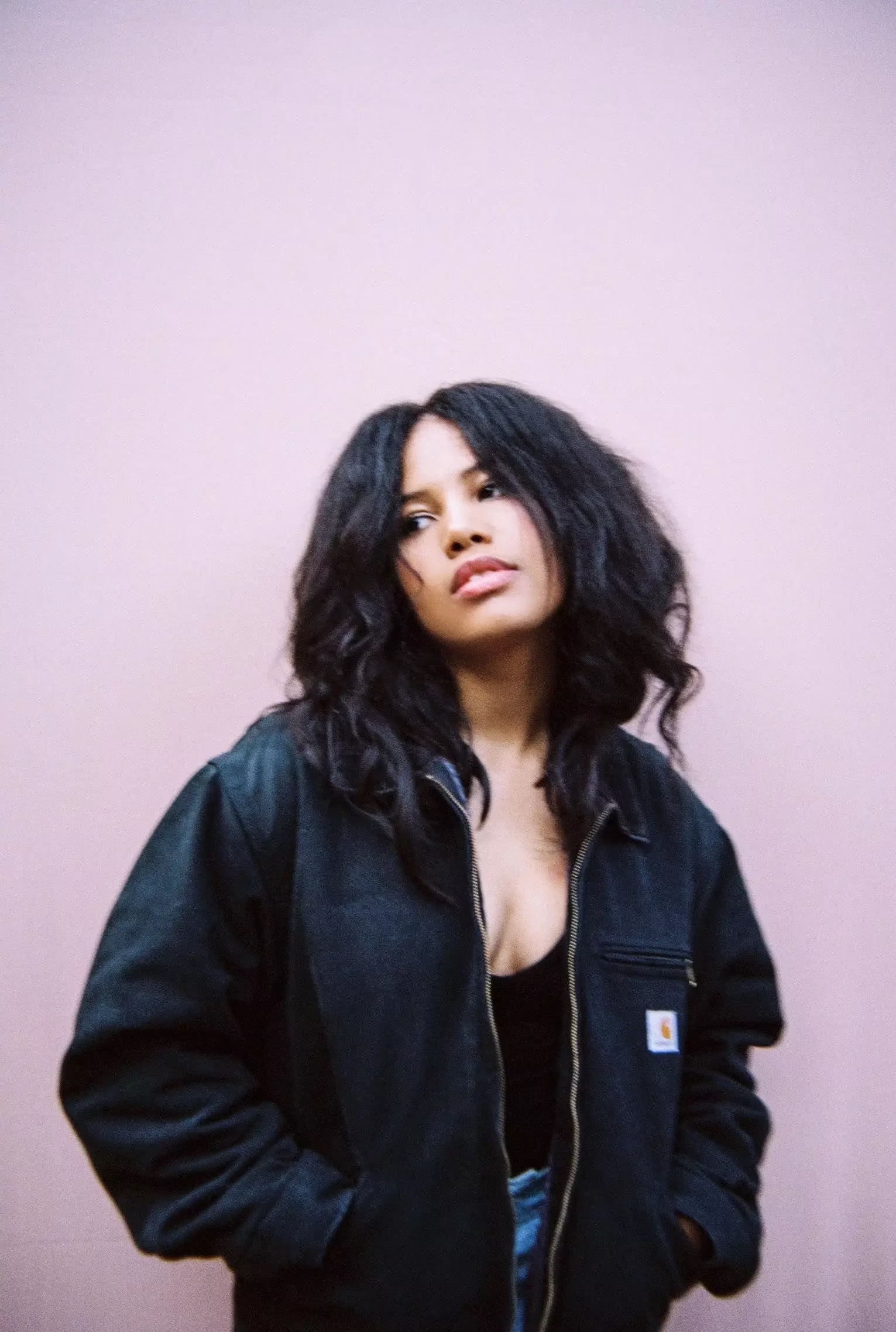
It's June 11, 2020, and Baby Rose is present. Not just in her apartment; not just on the phone with me; not just in her own skin. She’s present in the times that have bound the world during the COVID-19 pandemic. The public plundering of Black lives; the tears of crying souls taking shape as flames of burned businesses; the protests. Rose is present in it all by not letting her aching heart find shelter in ignorance and knowing she plays a part in the healing of the world.
“As a creator, I agree with Nina Simone who said, ‘An artist’s duty is to reflect the times,” Rose told GRAMMY.com.
When civil rights activist Medgar Evers was assassinated outside of his Mississippi home on June 12, 1963, and four Black girls were murdered by a racist bombing in Birmingham, Alabama three months later, Simone composed her first civil rights song, “Mississippi Goddamn,” in an hour. Yet, when I first spoke with Rose last month, and as late as a week and a half before our second chat on July 2, she hadn’t been in the studio let alone write a song. “You don’t feel encouraged to really create if you feel the whole system is against you. It’s like, what is the f**king point?” Rose asked rhetorically.
During both conversations, Rose spoke openly about how she’s been coping during the pandemic, the struggles with making protest music, and the balance she must maintain between being a Black woman and being an artist of the times.
“As an artist, I did face that type of ‘what is it worth’-type s**t,” Rose explained. “I understand people want things to go back to business as usual, but there’s another part of me that’s resilient and knows that I, as an artist, have a responsibility to express how I feel and speak to the times around it and not ignore it or make it business as usual; use my voice for a tool of change.”
<style>.embed-container { position: relative; padding-bottom: 56.25%; height: 0; overflow: hidden; max-width: 100%; } .embed-container iframe, .embed-container object, .embed-container embed { position: absolute; top: 0; left: 0; width: 100%; height: 100%; }</style><div class='embed-container'><iframe src='https://www.youtube.com/embed//UbaXUMNjHOs' frameborder='0' allowfullscreen></iframe></div>
In the course of one year, her unique voice went from obscure to in-demand. In 2019 alone, she was featured on the GRAMMY-nominated, platinum-selling Revenge of the Dreamers III compilation from J. Cole’s Dreamville label, toured with Ari Lennox and Snoh Aalegra, and dropped her critically acclaimed debut album To Myself, setting the stage for her to headline her own international tour in 2020. Now, she’s exalted as one of the leaders of the new era of neo-soul and has a growing fanbase eager to hear her thoughts on anything and everything.
But, if and when Rose addresses the current social upheaval, it won’t be new to her. Not at all.
In 2017, before she was selling out venues across America, Rose released a three-track playlist of songs over J. Dilla production. One of the songs on the set was “Victoria,” where Rose urgently shoots off the lyric, “Trying to turn my cheek like King but f**k it. Somebody gotta say something. Somebody gotta do something.” As with Simone’s “Mississippi Goddamn”, “Victoria” was more compulsory than calculated.
<iframe width="100%" height="300" scrolling="no" frameborder="no" allow="autoplay" src="https://w.soundcloud.com/player/?url=https%3A//api.soundcloud.com/playlists/306950762&color=%23ff5500&auto_play=false&hide_related=false&show_comments=true&show_user=true&show_reposts=false&show_teaser=true&visual=true"></iframe><div style="font-size: 10px; color: #cccccc;line-break: anywhere;word-break: normal;overflow: hidden;white-space: nowrap;text-overflow: ellipsis; font-family: Interstate,Lucida Grande,Lucida Sans Unicode,Lucida Sans,Garuda,Verdana,Tahoma,sans-serif;font-weight: 100;"><a href="https://soundcloud.com/babyrosemusic" title="Baby Rose" target="_blank" style="color: #cccccc; text-decoration: none;">Baby Rose</a> · <a href="https://soundcloud.com/babyrosemusic/sets/j-dilla-x-baby-rose" title="J Dilla X Baby Rose" target="_blank" style="color: #cccccc; text-decoration: none;">J Dilla X Baby Rose</a></div>
“That was the beginning of Trump’s presidency. That was when the Muslim ban happened. I was in awe like most people. It was like, ‘What the f**k is happening? What type of dystopian society are we in right now? Are y’all not seeing this?’,” Rose said, referring to the President's executive order restricting entry into the United States from citizens traveling from six predominantly Muslim countries.
These days, she’s been consuming music rather than making it. Simone’s Young, Gifted, and Black, Marvin Gaye’s What’s Going On, Kendrick Lamar’s To Pimp A Butterfly, and music from Gil Scott Heron have been her soundtrack. She’s been reading Black literature from Zadie Smith and Toni Morrison, as well as listening to these brilliant women speak, along with James Baldwin, speak [check out her full list of recommendations at the end of this article]. For Rose, “it’s like food to consume that,” because these present-day injustices are only new in execution, not in design.
“When I do come and speak, I’m coming with not only this present mindset but also with all the knowledge of generations prior that were fighting the same fight and had the same complex feelings,” she asserted.
Every new ear that finds its way to Baby Rose's music invariably affixes itself to her voice – a smoky and smoldering sound nestled comfortably in registers low enough to connect to depths of the soul seldom reached by modern-day artists. In its sweet bellow, heartache becomes enjoyably palpable and happiness sounds as delightfully raw as honey ripped straight from the honeycomb. Her song “Ragrets” starts with her singing “I’m getting by but I’m damaged,” with the temerity of a woman reclaiming her time and the ghostly echo of a woman still digging her way out of her past. Rose sounds like hope and despair existing simultaneously, a feeling that pervades a country trying to heal while it burns.
<style>.embed-container { position: relative; padding-bottom: 56.25%; height: 0; overflow: hidden; max-width: 100%; } .embed-container iframe, .embed-container object, .embed-container embed { position: absolute; top: 0; left: 0; width: 100%; height: 100%; }</style><div class='embed-container'><iframe src='https://www.youtube.com/embed//BksmeUh72t4' frameborder='0' allowfullscreen></iframe></div>
From the outside looking in, this pandemic is ostensibly a dream breeding ground for artists to sprout new ideas and music. No tours, no club appearances, no distractions. Artists as emotionally driven as Rose aren’t machines, though, and churning out protest music doesn’t just require free time, space and calamity as if they’re settings on an air fryer. For Rose, the chaos around her has inspired her to find a place of peace more than a creative vessel for her soul to scream through.
“I just take my shoes off and go outside in the grass. I go out to a park in the sun, just stand in the grass, and chill. If I want to talk to God, I’ll talk to God. If I just want to be quiet and listen to the trees, I do that,” Rose explained with calmness to her voice. “I can literally find that anywhere, and that’s my place of peace. It reminds me society is one thing, humanity is a ‘whole other thing. God has the last say over everything.”
She has yet to release any music addressing the protests or injustices, but she finally returned to the studio with her bandmates for the first time during the pandemic in the last week of June. Tim Maxey, her longtime producer who produced 70 percent of her To Myself debut album, compared the first few sessions back to “jumping in the pool for the first time and people being apprehensive.”
Rose agreed revealing the collective had “this collective weight on us,” with the recording process now being more cathartic. “Since I’ve been in the studio, it has been like a purge,” Rose said.
<style>.embed-container { position: relative; padding-bottom: 56.25%; height: 0; overflow: hidden; max-width: 100%; } .embed-container iframe, .embed-container object, .embed-container embed { position: absolute; top: 0; left: 0; width: 100%; height: 100%; }</style><div class='embed-container'><iframe src='https://www.youtube.com/embed//tJPMKmCrn10' frameborder='0' allowfullscreen></iframe></div>
Maxey said Rose has recorded a lot of songs and is working on her new album since returning to the studio. The futurist producer claims Rose’s next project is going to “push the envelope sonically on how people make music going forward,” yet doesn’t know if there will be any protest music coming from those sessions.
“I think it’s a different time. Throughout time we’ll see what the soundtrack of the times are. It may not be about protesting, marching in the street, 'What’s Going On,' and 'I Can’t Breathe,'” Maxey said referring to the classic Marvin Gaye song and Black Lives Matter rallying cry, respectively. “I think we need to wait until we back up off the moment to understand what it is. As a Black man, I haven’t felt like making music.”
When we do hear Rose’s new music, it’ll be rooted more in live instrumentation than before and dig even deeper in her seemingly endless reservoir of emotions. “I’m pulling more from myself than I ever have. I want that for others, because it’s therapy. Put it out and you never know how many people might feel you on that s**t,” Rose said.
She may or may not ever put out another song that can be traditionally classified as “protest music,” but she’ll always be present in the times and hope her fellow artists will do the same.
“It would be a shame if whatever comes out next, for any artist, didn’t have remnants of what has happened over the past few months," said Rose. "It would be a shame if there was no reflection on that or evolution from that. I hope the music has more depth to it and not just surface-level type candy,”
Baby Rose's pandemic recommendations:
- Swing Time by Zadie Smith
- White Teeth by Zadie Smith
- To Pimp A Butterfly by Kendrick Lamar
- Young, Gifted, and Black by Nina Simone
- What’s Going On? By Marvin Gaye
- Mordechai by Khruangbin
- Untitled (Black Is) by Sault
- "Midnight Gospel" on Netflix
Read More: D Smoke's Family Story Of Music Over Panic In A Pandemic
