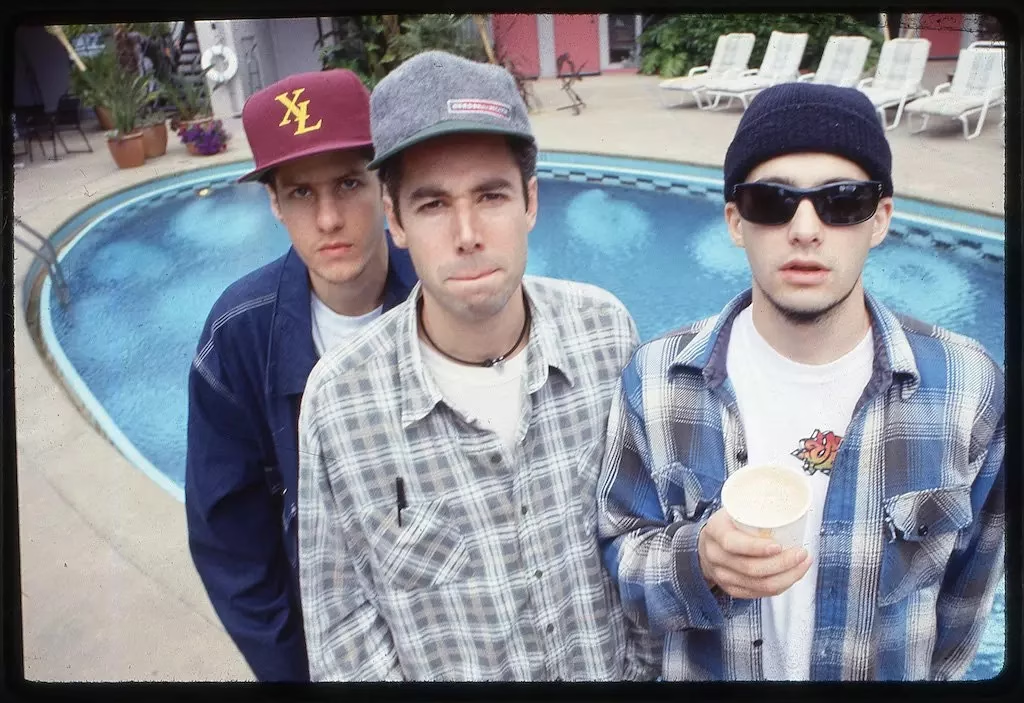
Promoting their new documentary, Beastie Boys Story, premiering today (April 24) on Apple TV+, the two surviving members of GRAMMY-winning hip-hop trio Beastie Boys, Adam "Ad-Rock" Horovitz and Michael "Mike D" Diamond, alongside the film's director and the group's longtime collaborator and friend, Spike Jonze, participated in a Zoom round-table video interview with select journalists earlier this week to talk about the project.
These pandemic times have affected every aspect of life as we know it, particularly when it comes to how we communicate with each other, and nowhere is this more evident than within the realms of entertainment and media. On TV, news anchors and talk show hosts broadcast from their kitchens and basements, reflecting many of our own work environments, while meetings of all kinds take place via video conferencing apps, providing a new semblance of personal exchange and connection. The Beastie Boys Zoom experience was no exception.
While the question-and-answer conversation was structured and moderated, it provided some loose moments, offering glimpses of each artist's homelife—Horovitz rested his head on a bed pillow for most of the interview—and exchanges of laughs and love.
The same could be said of the doc itself, which features Diamond and Horovitz live onstage during last year's theater book tour for their GRAMMY-nominated, career-chronicling 2018 tome, "Beastie Boys Book." It's been almost 35 years since the New York-bred band began making music. The new documentary shares their decades-long story in a scripted yet personal, TED-Talks-style presentation, backdropped by old photos and video footage taken throughout their career.
<style>.embed-container { position: relative; padding-bottom: 56.25%; height: 0; overflow: hidden; max-width: 100%; } .embed-container iframe, .embed-container object, .embed-container embed { position: absolute; top: 0; left: 0; width: 100%; height: 100%; }</style><div class='embed-container'><iframe src='https://www.youtube.com/embed//ZCyqR2RXoQU' frameborder='0' allowfullscreen></iframe></div>
Beastie Boys Story eschews the conventional talking-head documentary format and lets the guys share and reminisce in their own way about their development, crediting in large part producers Russell Simmons and Rick Rubin, their maturing perspectives and, most significantly, their late bandmate, Adam "MCA" Yauch, who died of cancer in 2012. The film offers an insightful and at times bittersweet look at how Yauch, who originally formed and named the group, used his artistic and activist vision to help transcend the group from its raucous rap and rock revelry of their youth to become sonic innovators and cultural icons.
The Recording Academy joined Diamond, Horovitz and Jonze, alongside a group of fellow writers and journalists, on a video conference call to discuss how Beastie Boys Story captures the group's growth and evolution—as a band, as friends and as men.
This interview includes questions and comments from writers and contributors not associated with the Recording Academy.
Journalist: It's interesting to see the two of you look back at your lives and admit your mistakes and have interaction with Spike Jonze. Who came up with the concept [for the film]?
Michael "Mike D" Diamond (founding member of Beastie Boys): It sort of evolved over time. We had the "Beastie Boys Book," and when that came out, we were faced with the idea [of], "What are we supposed to do now, go out and do some book readings and feel kinda lame?" So with [director] Spike [Jonze], [we came up] with this idea to do more of a performance. We were trying to tell our story, give a sense of the arc of time [in which] the story takes place. But it was tricky. The book is 500-something pages, and we didn't expect people to sit in their seats to deal with us for much more than two hours. Adam and I got together to write, and then Spike would be at the run-throughs and we'd rewrite things. We did those shows in New York, Brooklyn, Los Angeles, San Francisco, London, and toured it around a little bit. Of course, when we got to the end, we were like, "Hmm … we should've filmed that." So we took a little break, then we started to rewrite the show with the idea of filming it and getting more of the story down: How we as a band have always worked and how we've always worked with Spike, is just all of us getting together and a lot of ideas coming and sort of implementing them on the fly.
Spike Jonze (GRAMMY-winning director and filmmaker who directed Beastie Boys Story): It's like we threw as many different chairs and umbrellas and photos and records and doves up in the air, and then we just saw how many we could catch.
Journalist: One thing that struck me from the doc is the moment when Mike D says, "It could've been any three white guys from Def Jam's position." It struck me as odd. What would make you say that?
Mike D: In that moment, looking back at it, when Rick Rubin introduced us to Russell Simmons, Russell saw this thing in us that we didn't see in ourselves. He saw this ability … he was like, "These guys love rap music and they're going to make rap records and I can take that to an audience and I'm gonna get them on the covers of magazines." Honestly, at the time, it was a struggle for Russell, in terms of like rap being this very underground, alternative culture that he was trying to bust into the mainstream. I think he just saw us as an important part of that program. So to clarify, it could've been us or it could've been a couple other dudes. That's what Russell's mission was. And Rick's mission was he just wanted to make great records.
Adam "Ad-Rock" Horovitz (longtime member of Beastie Boys): Also, we were terrible. We were really bad when we were just starting out. So it's not like [Simmons] found this undiscovered gem, like these guys that could really rap or really play guitar or whatever the thing was. We were really bad.
Jonze: They're talking about when they started out, when they were 16-17 and doing Run-DMC rhymes together in their bedrooms, not so much when they were making their first record and finding their voice.
Adam Horovitz and Mike Diamond in Beastie Boys Story, on Apple TV+ | Courtesy Photo: Apple TV+
Journalist: When you go back and watch this film, were there things that surprised you that came up, or about the way that the audience responded?
Horovitz: There were definitely times seeing the pictures, even though we knew what was coming and what was going to be on the screen; it was really nice. It was surprising how I wanted to just pause on those moments and take the picture and the memory in.
Journalist: Did you ever believe that you were going to be one of the biggest rap acts [ever]?
Horovitz That wasn't anything that we thought about, really. We come from a punk rock background. It wasn't like, "We're going to make it one day." It was like, day to day, is it going to be fun? So it was wild when people started buying our first record and we started playing bigger shows. It wasn't part of our plan, but it was f*ckin' cool.
<style>.embed-container { position: relative; padding-bottom: 56.25%; height: 0; overflow: hidden; max-width: 100%; } .embed-container iframe, .embed-container object, .embed-container embed { position: absolute; top: 0; left: 0; width: 100%; height: 100%; }</style><div class='embed-container'><iframe src='https://www.youtube.com/embed//eBShN8qT4lk' frameborder='0' allowfullscreen></iframe></div>
Journalist: In the documentary, you talked about writing [the Beastie Boys' 1986 hit single] "Fight For Your Right" as a way to mock bro culture. But you confessed that, in a sense, you became those guys. How did you pull yourselves out of that?
Diamond: We were in my apartment in West Village in New York City, and we don't have any bro dudes in our circle, so it seemed like a really funny thing to make fun of. We didn't have this vision of, "We're gonna make it big." So we do this song that's kind of a goof. Then we go on tour and those dudes are in the front row, and you kind of go with it because you're getting applauded … Then after a bit, it's like, "Whoa, wait a second. The world we came from is so not that world." And we missed who we were in that world. Because we had a falling out with Def Jam, it brought us back to the three of us and we got to take a break and look at each other and be like, "OK, what do we want to do?"
Read: The Beastie Boys Provide A License To Party
Horovitz: It's like if you get the extra large bag of Frito chips and you start eating them and you're like, '"Whoa, these taste really good." Then you're like, "They're really salty and they're making me feel bad," but you keep eating them and eating them. Then when you're done with the bag, you're like, "Wow, I'm never gonna eat another f*cking Frito again."
Jonze: That's a poignant metaphor.
The Recording Academy: I love how the documentary showed the evolution of the band and how you tackled more politics and social ideas over the years. Obviously, Adam [Yauch] became very involved in activism, and the band reflected that. If the Beastie Boys were still making music now, how would they tackle the world and Donald Trump and today's issues?
Horovitz: Donald Trump is so awful I don't even want to give him space in my brain. He's awful … not even funny-awful.
Jonze: If you [search] YouTube [for] "MTV Awards Beastie Boys Woodstock," there's a clip of Adam—this is [in] 1999 or so, when it was extra-not-cool to be political—and they go onstage right after Woodstock happened.
Read: Why Can't Anyone Get Woodstock Right? 15 Of The Original Fest's Performers Weigh In
Adam Horowitz goes up and talks about how appalling what happened was: the lack of security, that bands need to step up and push to have better security and look out for women at these festivals and these shows. He's basically urging all the artists to take it seriously. There were no other artists talking about that at the time. I mean, it was really moving … I was just watching it at home and it was not popular.
<style>.embed-container { position: relative; padding-bottom: 56.25%; height: 0; overflow: hidden; max-width: 100%; } .embed-container iframe, .embed-container object, .embed-container embed { position: absolute; top: 0; left: 0; width: 100%; height: 100%; }</style><div class='embed-container'><iframe src='https://www.youtube.com/embed//wDw-pKCCs0o' frameborder='0' allowfullscreen></iframe></div>
Diamond: We weren't supported in the room. It wasn't like everyone was like, "Oh yes, finally someone's saying it!" It was basically us saying, "We all need to talk about this because it's happening." But it was this thing that nobody wanted to talk about because no one wanted to admit that it was happening.
The Recording Academy: Sounds like sort of a pre-#MeToo thing. You recognized that within concert culture, these things were happening. So you might have continued down that path, perhaps? Speaking out about these things?
Horovitz: Yeah, absolutely. Honestly, it was, for me at least, just being around Adam Yauch—him just saying the things that he did and taking stands that he did publicly. It was inspiring for me to be like, "Oh, you can make fart jokes and actually also care about people?" And respect your place in the public, that you have a platform to say things and people will listen—whether they give a sh*t or not, I don't know. He was always really inspiring, like, "Oh, wow. If Yauch can do it, I can do it."
Journalist: One of the things I loved about Yauch was the fact that he could look back at ways he behaved in the past and apologize for it and say, "I was wrong, I was stupid." How do you explain the [early] Licensed To Ill years to your kids?
Diamond: Being a father of teenagers, I don't know how I first explained it, but I was really happy that they got to travel with me a bunch while I was doing these shows, because this is going to happen to all of us. We are all going to have these actions that we're ultimately not proud of and we're all going to have situations in our lives that we could've handled better. We're so grateful. Here I am with my best friends, Adam and Spike, and we get to talk about that.
Journalist: What do you hope people watching [the documentary] take away or learn about you guys or your journey?
Jonze: I liked the idea of trying to represent everything I love about them and their band. And I love the idea of just the people that were in the car, on the road trip, telling the story. We don't have anyone else talking about the band from a cultural perspective. I wanted to really just capture the way they create and the spirit in which they're a band and their friendship. Not many bands that have been together that long are actually great friends through the whole thing; it feels like a lot of times when a band gets older, they're in a band together almost as a business. And I feel like nothing that these guys ever did was about that. It would be, first and foremost, about what the three of them wanted to do. So I hope [the film] just captures their love for each other [and] their friendship.