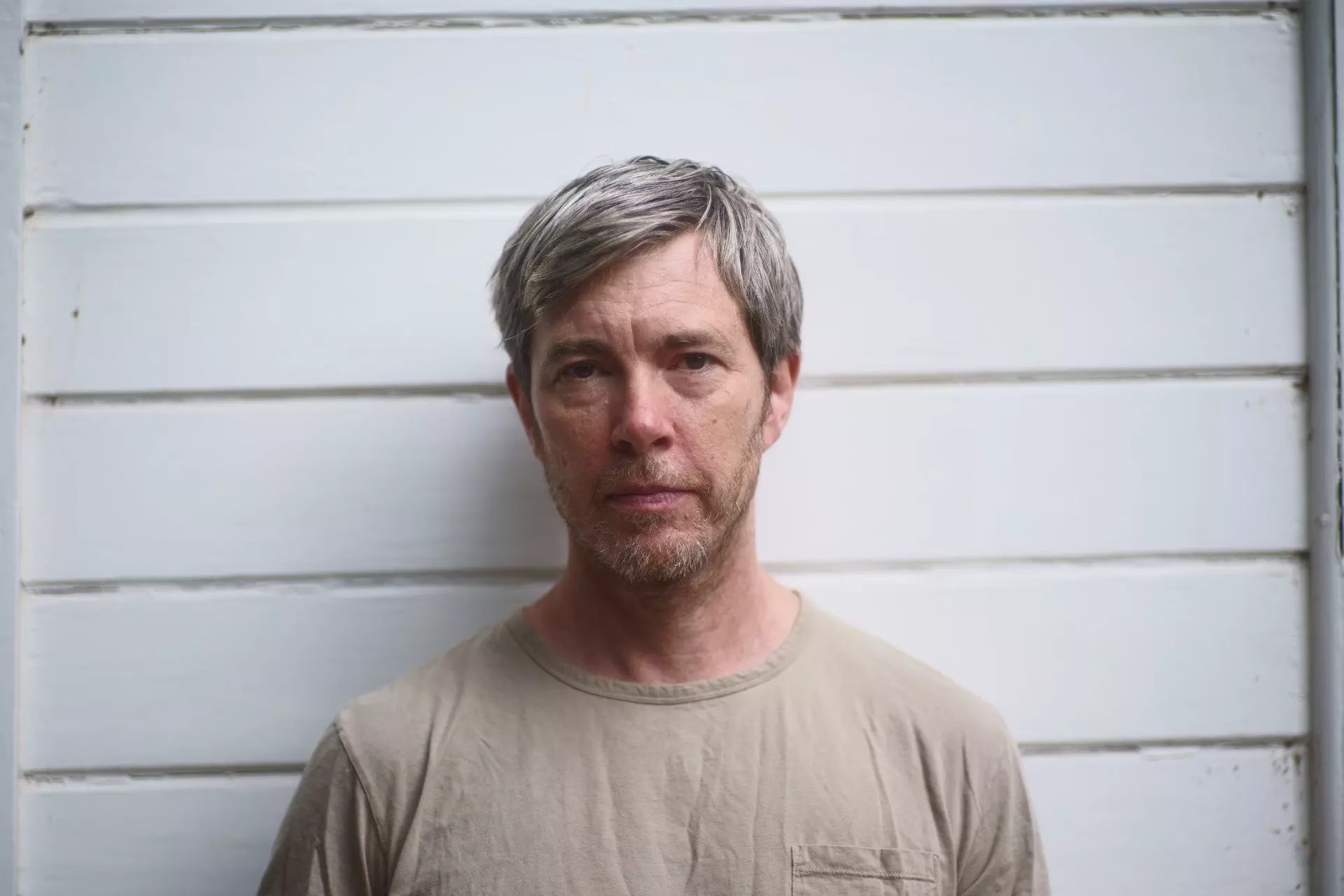
If the songwriter’s job is to explain life as he sees and feels it, then understanding, and making peace with death, is an essential part of that task. Bill Callahan, who’s been releasing music for 30 plus years—first under the moniker of Smog, then with his own name—has achieved just that. While his earlier work may have been death-driven, more prone to chaos than clarity, more tormented than tender, when he emerged after a rare five-year hiatus in 2019 with his 17th album Shepherd In A Sheepskin Vest, he returned with a passion for humanity. Following the death of his mother and the birth of his son, on Shepherd he not only managed to reconcile that new life with death, but he did what only the very best songwriters and sages can do: he made his listener thankful for life, while giving them a newfound appreciation for death. "When we let go," he sang, "Our arms are open, and our hearts are exposed."
Callahan, once the drunken uncle at the wedding, has now become the world's godfather. His voice, stolid and baritone, immediately puts you at ease. He counsels you like a patriarch. He tells jokes. He recites your anxieties back to you so that they don’t sound so bad anymore. When he picks up the phone to this call, the clucking of his teeth and tongue blends into the sound of the rattlesnakes in his backyard, while birds sing above, uneaten and free.
On his new album Gold Record, Bill’s world grows smaller and smaller. It’s filled with acts of daily trivialities and grievances—getting work done, not getting work done. Seeing eye to eye with others, not seeing eye to eye. Motiveless domesticity. Everything exactly how it is. The sound of a man settled down. The sound of a man who’s moved to the country.
GRAMMY.com spoke to him about his change in focus, viewing songs as living things—and Harry Styles.
<style>.embed-container { position: relative; padding-bottom: 56.25%; height: 0; overflow: hidden; max-width: 100%; } .embed-container iframe, .embed-container object, .embed-container embed { position: absolute; top: 0; left: 0; width: 100%; height: 100%; }</style><div class='embed-container'><iframe src='https://www.youtube.com/embed/Qad9R6-918c' frameborder='0' allowfullscreen></iframe></div>
What did you have for breakfast this morning?
I had some gluten-free toast with almond butter and raspberry jam.
Do you have the same thing every morning?
I guess I go through phases of fixating on one thing, but it’s actually pretty varied.
Is your general routine as varied?
No, I have a kid and that kind of regulates my world. He comes into the bed around 6:30 in the morning and then we get up and make his lunch and his breakfast, get him dressed. Feed ourselves, take him to this little camp he goes to. And then at 9 a.m. I’m free to do as I please.
Does that mean music or do you have a routine outside your kid and outside music?
Yeah, now that my time is limited I’m more kind of disciplined about when I work. Usually mornings are the most creative and energetic time for me so I usually either start playing guitar or start looking at notebooks of words.
You said you look at notebooks, what do you mean by that?
I just have a notebook with unfinished songs in it.
So do you write songs that might go onto a record from those unfinished songs?
Yeah.
Have you kept up to date with other music released this year?
Yeah a little bit.
Has there been anything you enjoyed or anything that’s annoyed you?
There's always stuff that annoys me but I try not to talk about it just ‘cause what does it matter? I liked the Harry Styles record a lot, I was surprised by how much I liked it.
What did you like about the Harry Styles album?
It’s just real, powerful and absorbing songs, surprising arrangements. Seems to be off on his own path. There’s kind of a trend in music now of disaffection and really it seems like depression and heartbreak and not in the traditional girl-breaks-your-heart [way], but like, life has broken a lot of people's hearts right now. And that’s valid but it’s not all there is. It’s a very uplifting thing to listen to I think.
What do you intend to give to the world as an artist?
I’m not really sure. I guess the thing I do is try to do my best and to really consider the listener, which I think maybe a lot of people don’t really do somehow. That’s kind of my pledge to anyone who wants to listen, is that I care. Some people will make music just because they can, they have the skill. I don’t really have the skill, but I care.
Did you consider the listener as much when you were starting out?
I don’t think I did, I think I came to value it maybe about 10 years ago, or maybe less than that. Especially when I put the Shepherd record out because it’d been five or six years since I’d done anything except tour. When people still cared, it just kind of warmed my heart. I was able to take five to six years off releasing anything and people were still anxious to listen and critics were still willing to write about it and talk to me. That was a good jolt for me.
When you start off playing music and no one knows who you are, especially back then in the early '90s, there would be at least four bands on every bill, sometimes five or six. If you wanted to play a show, you’d have to be first on a bill of five bands and no one’s heard of you, which is fine, but coping with the fact that no one gives a shit... So to not give a shit about the audience is kind of the only way you can make sense of what you’re doing. And then that became the way that I related to the audience because that’s how it was from the beginning. At some point I realized, well, these people, now they’re listening and now it’s changed my attitude because people are actually caring.
You said that change happened eight years ago. Why?
I was talking to this journalist who had interviewed me pretty early on a couple times and wrote some nice articles about me and then I didn’t hear for a while, and then they kinda popped back up on my radar and said she wanted to talk to me about whatever new record I had out at the time. She was remarking on how I'd played a show the night before that she was at, how different it was to how people were listening, and she started to cry, which really struck me that someone would be that moved by my success or whatever you want to call it. I was telling her how my attitude was changing just from taking a step back.
Sometimes you’re in a situation and you don’t really see where you are because you have tunnel vision, 'cause it helped you get things done by blocking certain things out. I think for whatever reason around that time I took a step back and realized that there wasn’t a reason to be angry at the audience, but I don’t really know what triggered that.
Is it because you sensed that the audience were finally listening?
I don’t know, I think I just started to feel kind of ridiculous.
When you re-recorded "Let’s Move To The Country" did it feel like you were in conversation with a past self?
I guess so, because it has some unfinished sentences in it. It’s kind of an unfinished song, which was the beauty of it at the time, but then I thought it would be a good idea to finish the song. I finished the part that was unfinished but then added more unfinished chapters to it.
<style>.embed-container { position: relative; padding-bottom: 56.25%; height: 0; overflow: hidden; max-width: 100%; } .embed-container iframe, .embed-container object, .embed-container embed { position: absolute; top: 0; left: 0; width: 100%; height: 100%; }</style><div class='embed-container'><iframe src='https://www.youtube.com/embed/Em6BszKzA9o' frameborder='0' allowfullscreen></iframe></div>
Do your other songs feel finished to you?
I think pretty much every song is either unfinished or proves to be inadequate or lacking in some way. And that’s the whole reason for me continuing to make music—because there’s always room for improvement. And then having a listener and/or critic really helps finish the song but they point out the holes that songs have on purpose. I think songs are probably supposed to be unfinished so that each listener can finish them in their own personal way and that’s why people are so passionate about the music that they like, 'cause something in their psyche has finished the song, so they feel like it’s a part of them.
How do you choose which moments to capture into song?
Anything that I hold in my mind, any exchange I had with a person or a physical space that I keep returning to in my head or a line I read in a book or a movie. I assume that everybody is like this but I have recurring things that keep coming back to me randomly—sometimes it’s just an intersection I was at on tour. Like, why have I been thinking about that time let alone a stop light in Ohio when nothing happened? Something important must’ve happened then. But that's kind of a more abstract… Anything that sticks in my head, I think it must have some significance even if I don’t know what it is until I start writing about it. Like with the song "The MacKenzies." I bought my first car from this couple, and they invited me in and gave me a cocktail and chatted for a while, but that was like 30 years ago. I’ve thought about them ever since. So I was like, let me try to turn them into a song. I think the moments choose me and they keep showing themselves in my consciousness.
<style>.embed-container { position: relative; padding-bottom: 56.25%; height: 0; overflow: hidden; max-width: 100%; } .embed-container iframe, .embed-container object, .embed-container embed { position: absolute; top: 0; left: 0; width: 100%; height: 100%; }</style><div class='embed-container'><iframe src='https://www.youtube.com/embed/bc5mU2-sKcU' frameborder='0' allowfullscreen></iframe></div>
Most of these memories and encounters on the album seem to take place on the road, in cars.
I love cars, I love driving. I think a lot of my songs are about movement. With cars, there’s an inverse feeling of potentiality, so that’s probably why they appear often.
As a songwriter, you seem to have developed a more superficial appreciation for these things, whereas before it felt more existential.
I think with Shepherd I tried to cover all bases like the tangible and intangible parts of life and the physical and immaterial parts. But I think with Gold Record I’m more rooted in the everyday interactions of life.
So are you trying to narrow your focus?
I think I was trying to because Shepherd was kind of all about me and I wanted to make a record that was more about other people and other lives. I haven’t really had any complaints about it but I do wonder with a record like Shepherd, like what if you’re not married or don’t have a kid, are you gonna give a shit about this? People not in that situation still seemed to get something out of it.
Has your perspective changed since making that album?
I always feel like I’m expanding as a human which could just be a psychological trick our brains play on us as we get out of bed in the morning. I do think being married and having a kid pushes me into all sorts of places that I would never have gone if I was single. And also watching a kid develop and seeing all the levels of how complex humans are because every couple of weeks there’s another layer of onion skin that my kid has on him that he seems like a complete human but then he develops some other trait that’s part of being human. So seeing that and just having to counsel him and guide him with his newfound complexity, that’s always a lesson for myself. But probably my general perspective is pretty much the same. And I think the Covid thing is really gonna change things for a lot of people. What can we really think in the face of this type of death that’s just sweeping across the world. We have to realize that there’s a natural thing that the biological world brings on us every 100 years or so.
Now that you have such an interest in humanity, I wonder how you look back on your younger self?
It depends how far back I’m looking but if I look all the way back, I mostly feel like shame. If I look at the time as a whole, I’m proud of the fact that I was so prolific and adventurous, I tried to change the sound of each record or just to make a different feeling thing for people to listen to. In some ways I feel like I’ve wasted a lot of my time back then but on a generous day, I just look at it as if I’m grateful I had that time to just make music without very many other concerns at all. I think I spent that time fairly productively. Now that I have more going on in my personal life I realize that you can do both, but you might have to relearn how to do music.
Why don't you see yourself in the books you read anymore?
That was just a feeling that overcame me a while back. I think when you’re in your late teens, early 20s and you discover the books that complete you or speak for you, say the things that you want to say but just can’t say it. That feeling when you’re reading a book like I could’ve written this, I should’ve written this but really you couldn’t have written it. Those books kind of become your skeleton to form the body that you present to the world. After 10 or 15 years of seeking out all the books I should read there was a point where I kinda felt like I’d read all the books that were gonna affect me. I guess having bad luck, a string of trying five or six different books and them not speaking to me, but I think that’s kind of a signal that you’re ready to start writing your own.
<style>.embed-container { position: relative; padding-bottom: 56.25%; height: 0; overflow: hidden; max-width: 100%; } .embed-container iframe, .embed-container object, .embed-container embed { position: absolute; top: 0; left: 0; width: 100%; height: 100%; }</style><div class='embed-container'><iframe src='https://www.youtube.com/embed/PSv60b7PWpU' frameborder='0' allowfullscreen></iframe></div>
Would you write another one?
Yeah… I love writing prose, I just need to get into some kind of groove with it, songwriting always kind of blows it away just because it’s something I know how to do a bit easier and quicker. I do wanna say that eventually I was able to find books again that are a very important thing to be reading, it just took a while.
I noticed there are fewer epiphanies and aphorisms on this album compared to your previous. When you do include them how do you know whether they’re "important advice or just preachy as hell?"
Yeah totally but usually if I’ve gotten to a point where I think that I have some advice that should go into a song, if I believe in it that strongly then I’m usually pretty confident that it might hold some value for somebody. At least for a year or two. I tend to revamp my world view every couple of years.
Have you always been that way?
I don’t think so, I don’t think I was that complex as a youth, as a 20-something, I didn’t have the complexity, the vision. You tend to be rather self-centered when you’re younger I think, maybe reactionary, you might see things with a very narrow vision. You see your parents from a childlike perspective only so when you grow up you can see things like your parents and other people from a more nuanced perspective.
Did you think about death from a young age?
I didn’t really get into reading novels until I was 17 or 18. I associate novels with thinking about death just because a book is like a little tomb, it’s got all these lives in there and they’re kind of trapped by a book or a story. Kind of like they’re dead but also like they have immortality at the same time. I’m not sure exactly when I started incorporating it, pretty early I guess in my songwriting.
And you view songs as living things?
I do, yeah. I mean you can listen to a song by anybody, someone dead, and the song is still alive.
Tame Impala Checks In From Hibernation