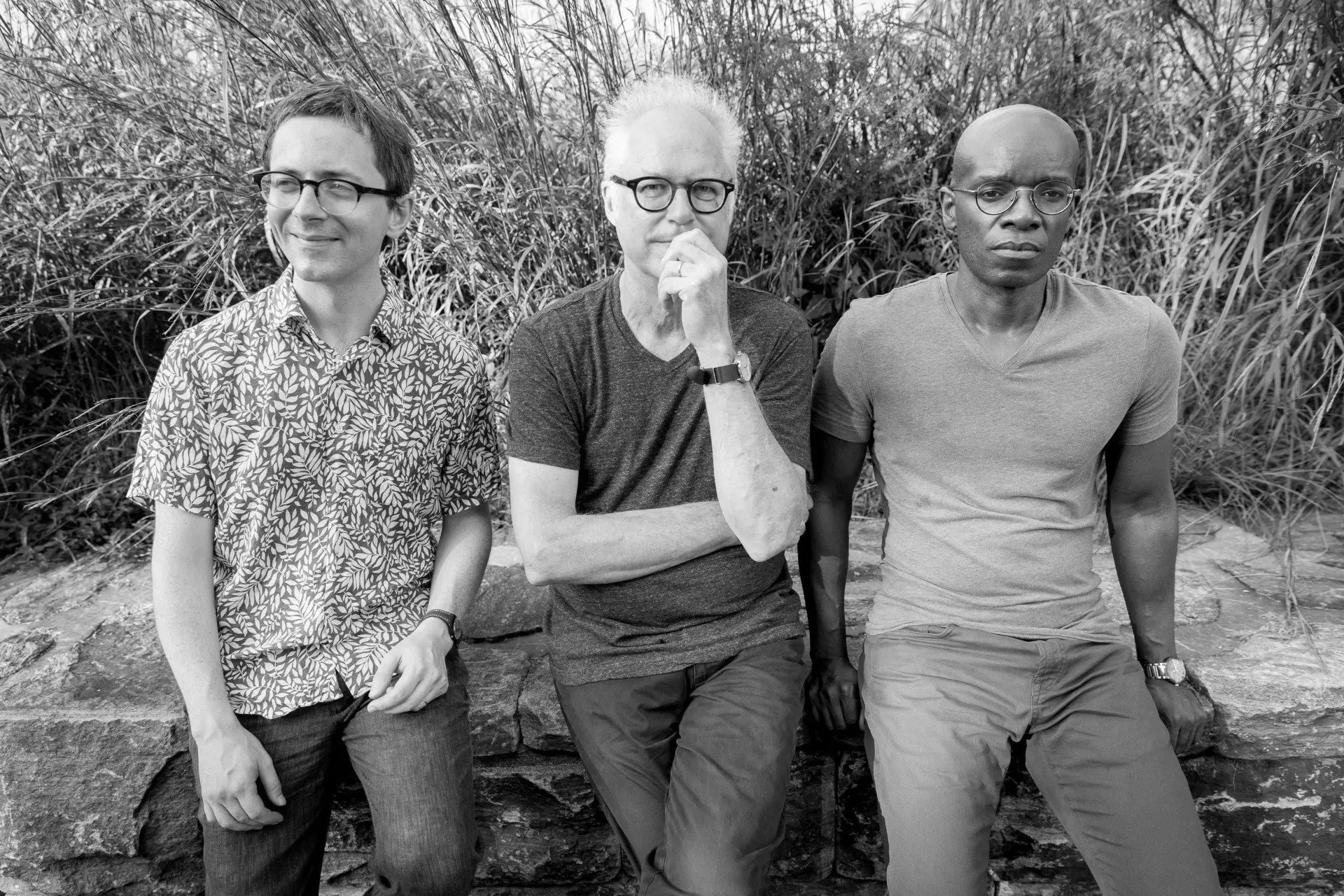
After months of zero live music, Bill Frisell, bassist Thomas Morgan and drummer Rudy Royston reunited in June — while socially distanced on a Kensington, Brooklyn, porch. (At least one Yo La Tengo member bore witness.) Being able to jam in public was a relief to the 69-year-old, who admits to being stuck in his own head during quarantine. But there was a slightly awkward moment when they put down their instruments.
"It was like, ‘'Shit! This is really weird. We're not supposed to touch each other?'" the guitarist tells GRAMMY.com from his home — not far from that makeshift stage — on a sticky late-July morning. "At every single gig we ever play, when we finish, it's a natural reaction that we hug each other. We grab each other. That was just one little strange moment, but basically, it felt so good to play."
Frisell is stumping for his new album Valentine, which arrives August 14. (It's something like his 40th release as a leader, depending on how you count.) The album captures his chemistry with Morgan and Royston, both of whom have been around for years — the former with greats like guitarist Jakob Bro, drummer Paul Motian and pianist Kenny Werner; the latter with altoist Jim Snidero, tenorist Fred Hess and trumpeter Ron Miles. Both have toured with Frisell over the past three.
"This album is all about Rudy and Thomas and the musical relationship I have with them," Frisell said in Valentine's press bio. "There was no evidence of it, so I really wanted to have a document of it, if only to show that it’s real and not this magical thing that I've imagined in my fantasies."
The trio mixes Frisell originals with covers from the Great American Songbook ("What the World Needs Now is Love") and the public domain ("Wagon Wheels"). Valentine concludes with a luminous version of the civil rights anthem "We Shall Overcome," which — in the wake of the police killings of George Floyd, Breonna Taylor and Elijah McClain — contains ever more gravity in 2020.
GRAMMY.com caught up with Frisell to discuss his emotional state in quarantine, working with Morgan and Royston, losing his friends Hal Willner and Lee Konitz to COVID-19 and how the socially distanced show came about.
<style>.embed-container { position: relative; padding-bottom: 56.25%; height: 0; overflow: hidden; max-width: 100%; } .embed-container iframe, .embed-container object, .embed-container embed { position: absolute; top: 0; left: 0; width: 100%; height: 100%; }</style><div class='embed-container'><iframe src='https://www.youtube.com/embed/C5Ipzu-Hcpc' frameborder='0' allowfullscreen></iframe></div>
This interview has been edited and condensed for clarity.
Are you quarantining in New York City?
Yeah, in Brooklyn. I don’t want to complain because I’m really lucky. We have a house pretty far out into Brooklyn where there's trees and space and stuff. I'm lucky to have this house with all my stuff in it. But this is a trip.
For as long as I can remember — I think even before I can remember, even thinking about my mother singing in the house when I was really small — there was some kind of way of interacting with music with other people.
Just about every single day of my life, that’s been the whole deal, up until March 8 — I guess that was when I came back from tour — and then, a couple of days later, everything just shut down. So it’s really strange to be in my own head all the time.
You, Thomas and Rudy have been around a long time. How did those guys come into your sphere?
Rudy's from Denver, where I grew up. I didn’t know him way back then. I'm not sure if you’re familiar with Ron Miles, the trumpet player? I have a long, long relationship with him. He’s also from Denver. The very first time I met Ron, I think it was 1993. I went to Denver and met [him] and did a gig and Rudy was the drummer. I was like, "Oh, man! This guy’s amazing."
That was the beginning of this incredible relationship with Ron, and that’s where I met Rudy. But at the time, Rudy was teaching public school and he really wasn’t into traveling or going out on the road and all that. We played a couple of times [then], but probably 10 or 15 years ago he moved to New York and really changed up his lifestyle. He really wanted to play and go out. So that’s when we really started playing a lot in lots of different circumstances.
Thomas I met in a sort of an on-and-off here-and-there [fashion] being in New York. My friend Joey Baron, the drummer, introduced us. I think he might have still been a student when we first met. We kept running into each other and I’d hear him play in different contexts. I really became a fan. Eventually, we did a rehearsal with Joey Baron, and then there was a session with Kenny Wollesen.
What really got it going strong was the last album I did with Paul Motian before he passed away. Thomas had been playing a lot with Paul and I had a 30-year relationship with Paul. Paul loved him and we did this album together with Petra Haden [2011’s The Windmills of Your Mind]. That was where it was like, "OK, now, this is it. He’s my brother for life."
Somewhere soon after that, Rudy came into the picture. With that, one thing led to another and here we are. We played in all kinds of different combinations and also as a trio a lot for the last few years, but we didn’t have an album. So it just seemed like time to get that [on record] — I wanted to have evidence of this special group.
Speaking of Motian, Valentine’s press bio cites Bill Evans Trio's Sunday at the Village Vanguard as a spiritual antecedent. What about that album speaks to you?
Oh, man. It’s huge. I can’t even imagine what it must have been like… you think of some music that you can almost start taking for granted, maybe. I’m not sure if that’s the right way to put it, but you hear it so much.
Like, think of Louis Armstrong. What if you had never heard that music before and it’s 1927, you walked into a club and heard that. I can't imagine what that would have done to your brain! I think the Bill Evans Trio had some of that. Of course, it’s coming from the whole history, but it made a new blueprint for what folks could do.
When I was in high school, one of the very first jazz — if you want to use that word — concerts I went to was Charles Lloyd. This is January of 1969. The band was Keith Jarrett on piano, Ron McClure on bass and Paul Motian was playing drums.
That right there was one of those moments for me. Hearing Paul for real, in real life, at that point in my life — I would have never imagined that some years later he'd be calling me up on the phone and that Charles Lloyd would be calling me up on the phone and I’d be actually playing with these people. Sometimes it feels like I'm dreaming or something.
You mentioned "the physical mathematics of a trio." "There's so much strength in it — it can lean to one side, but it will stay up," you said. But it's not like any three musicians sound great together, so how would a bad trio make this geometry fail?
[Laughs.] If something goes wrong, it's maybe because one of the pieces is not present. That's the whole thing: listening. If everyone is listening, I feel like nothing can really go wrong, whether it’s a duo or a trio or an orchestra. For me, it works best when my attention is away from myself and it’s focused on the whole picture, focused on the other guys in the band.
When there’s three guys and everyone is really focused on what the group is doing — not just their own self — it’s just the most amazing feeling. And then you have this trust when you take your mind off your own little world. That's what's weird about right now, right? Everyone's sitting at home by themselves in their own minds. That's what's making me a little nuts.
But what I'm saying is, where the music really takes off for me is when I don't need to think about what I’m doing. I just need to be in the space where the music is happening. Then you can really take risks. You know, I was just talking about dreaming. When you're dreaming that you can fly or you come to a big chasm in the earth and you want to jump in and find out what’s in there — in the music, you can do that if you're with folks you know will rescue you.
Bill Frisell in 1995
Photo by Bob Berg/Getty Images
On Harmony, you interpreted songs ranging from Pete Seeger to Lerner and Loewe. On Valentine, you draw from a similar well — there's a Hal David and Burt Bacharach song sharing space with a traditional hymn. To you, how does American folk music connect to the Great American Songbook?
I've always had a problem with how we put [them in separate categories]. I know we need words to describe things and we have to talk about the music, but when we put these labels and names on it it always has the effect of making it smaller than what it really is. To me, they're all part of one thing, whether it’s Beethoven or Monk or Robert Johnson or Jimi Hendrix or Morton Feldman. It's all music and it all fits together in my imagination.
I think as human beings, when you’re really immersed in the music, it takes you to a place where you’re not thinking about what it's called and all that stuff. For me, it’s a big ocean of melodies and it can all coexist.
You wrote "Hour Glass" for a performance of Allen Ginsberg's "Kaddish" staged by the late Hal Willner. Tell me about your relationship with Hal.
Boy, that was fairly early in this whole ordeal that we’re going through. He touched on so much. I met him soon after I moved to New York — I guess it was 1980. That’s a 40-year relationship. I've tried to make a list of all the things I've done with him and it’s dozens and dozens of albums and soundtracks and projects that we did together. It's really almost too much to [list]; we could go on for a few hours of that.
He was huge in my life as a friend and he had such an impact on my music. He gave me so many chances. That's what I’m talking about with a group — when you have trust where you can really take chances, that's where you learn. It seems like in just about everything I did with him, he would set me up in a situation where I wasn’t quite sure. It was always a little bit into the unknown. He had some kind of a trust in me that I didn't realize I had in myself.
He would give me an opportunity and I’m like, "Wow! I don't know if I could do that," but he would just sort of nudge me through the door and I'd deal with it and climb out having learned something new. It was like that for the whole of that 40-year period and it was still going on. I just talked to him a couple of weeks before he passed away and he had all kinds of ideas for the things we were going to be doing.
I keep having those moments: "Oh, I've got to call Hal and tell him about this or that," and I can’t do it now. So that's been really rough. It really made this situation real, just having it that close. Also, Lee Konitz I was close with. He was in his nineties, but still. People are dying from this stuff.
"Levees" and "Electricity" are tied to the director Bill Morrison — the former made it into 2014's The Great Flood and the other was cut from a different film. I’m not familiar with Morrison's films, but it looks like they dovetail with jazz and the avant-garde.
It goes back to the Village Vanguard again. Early in the time when I started to play there in the late 1980s, Bill Morrison was basically a dishwasher at the Village Vanguard. I knew him that way. At some point, he said, "You know, I make these films," and he wanted to use some of my music. That's how we connected.
He's deep in the music and that's how I knew him from the beginning, but I didn't even know he made films. One thing led to another and we’ve done quite a few things together at this point and planned more things in the future.
You should check out his stuff. What he does is really like nothing I've ever seen before. In all his films, music is a huge part of it. It’s hard sometimes to even separate. The music and the film become one thing in what he does.
<style>.embed-container { position: relative; padding-bottom: 56.25%; height: 0; overflow: hidden; max-width: 100%; } .embed-container iframe, .embed-container object, .embed-container embed { position: absolute; top: 0; left: 0; width: 100%; height: 100%; }</style><div class='embed-container'><iframe src='https://www.youtube.com/embed/TJxURT1NGro' frameborder='0' allowfullscreen></iframe></div>
About "We Shall Overcome," you said "I'm going to play it until there's no need anymore." Which is kind of beautiful since you play it instrumentally without words to convey the message. Is there righteous power in that song's melody and composition alone?
Oh, yeah, yeah. Definitely. When I'm playing that song or so many other songs, I might not even know all the words. I don't know all the words to all the songs that I play that have words. But the human voice has so much to do with how I play a melody. I'm hearing the sound of a voice in my head while I’m playing my guitar. Or, you know, I’m hearing the words in my head. So it gives you a lot to draw from when you’re playing the song.
I was quoted as saying "I'm going to play that song until it doesn't need to be played anymore," but I realized I’m afraid there may not be a time… I think that song is always going to be necessary. It’s just part of what we have to keep doing. It'd be great if we didn't need to say those things, but I think it's just part of the struggle [that] continues.
There are so many songs that are relevant every single day — "What the World Needs Now is Love," "We Shall Overcome," "A Change is Gonna Come," "The Times They Are A-Changin’," or "Masters of War," unfortunately. "Hard Times," which was written 150 years ago. All those songs are always relevant, so you have to just keep playing them.
Especially right now, as the George Floyd protests persist.
[Softly] Yeah. Yeah.
<style>.embed-container { position: relative; padding-bottom: 56.25%; height: 0; overflow: hidden; max-width: 100%; } .embed-container iframe, .embed-container object, .embed-container embed { position: absolute; top: 0; left: 0; width: 100%; height: 100%; }</style><div class='embed-container'><iframe src='https://www.youtube.com/embed/zU0HS4aMqBg' frameborder='0' allowfullscreen></iframe></div>
You, Thomas and Rudy recently played on a Brooklyn porch while socially distanced. What was that like?
That was incredible! That was the first so-called gig I've had in months and months. It was a relief to finally be with people, playing. Being with my friends.
A friend of ours, Derek Nievergelt, who lives not far from me, he's a bass player and he’ll just go out and start playing on his porch with guys. Thomas lives not far from where I do, too, in Brooklyn. It was just a chance to play. It was spur-of-the-moment. We didn't really know for sure if we were going to play until the night before, knowing that the weather was going to be OK.
But I hope we can do more of that. It’s still going to be a while before [shows can proceed normally]. Actually, in a couple of weeks, we’re going to play at the Village Vanguard, but not with an audience. You know, it’ll be streamed the week after next, I think. I’m looking forward to that.
It was lovely chatting with you, Bill.
I hope you’re staying safe and healthy and all that stuff we’ve been saying. I think we’re going to get through this. Not just the virus, but everything that’s going on. It’s a pretty intense time right now, but I still think we’re going to come out better in the end.
Read More: Gary Burton's Jazz Journey