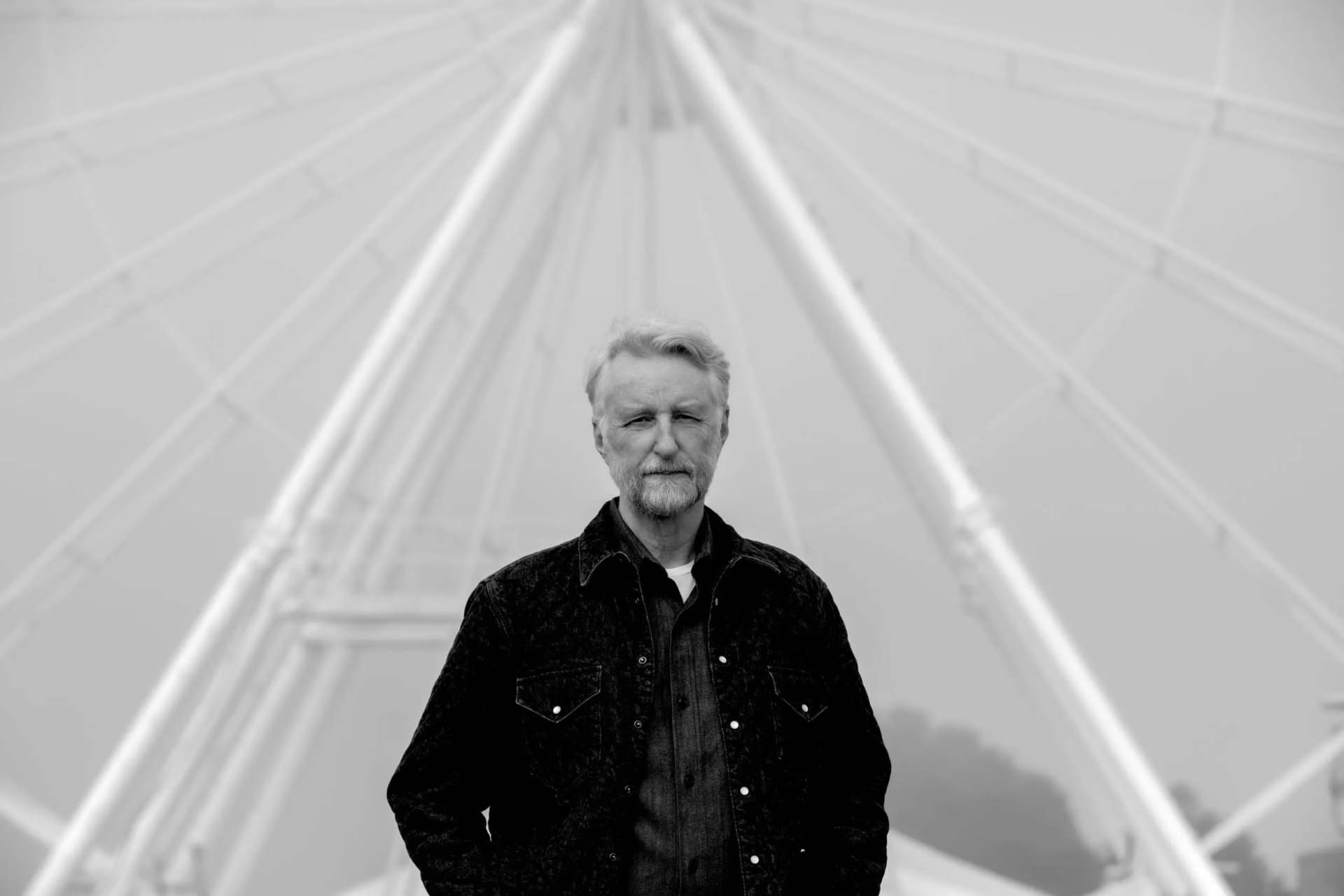
While swimming through the ambiguities and anxieties of the pre-vaccine pandemic — which involved "shielding" his partner while she underwent breast cancer treatment — Billy Bragg got into online ancestry. He soon learned he and his progenitors aren't so different.
"My ancestors seemed to be a bunch of nonconformists," the English singer/songwriter, who has been nominated for two GRAMMYs, tells GRAMMY.com. "They were Baptists, so they were refusing to sit in the church behind the squire. They were those kinds of people, preaching out in the fields in that kind of congregation. I feel that sort of connection with them."
No matter which way his candle is flickering religiously, Bragg feels akin to those evangelizers of yore because he values pure communication — a thought beamed from one's brain to another with minimal distortion. "I'm not really a musician; I'm a guitar player at best," he admits. "My bottom line is communicating, whether I'm writing a song or a book or an article or a long Sunday-afternoon post for social media."
<style>.embed-container { position: relative; padding-bottom: 56.25%; height: 0; overflow: hidden; max-width: 100%; } .embed-container iframe, .embed-container object, .embed-container embed { position: absolute; top: 0; left: 0; width: 100%; height: 100%; }</style><div class='embed-container'><iframe src='https://www.youtube.com/embed//yijRQSTANpg' frameborder='0' allowfullscreen></iframe></div>
Bragg's newest album, The Million Things That Never Happened, which will be released Oct. 29, does an awful lot of direct interfacing — about social movements, about the weirdness of lockdown, about staying afloat in a changing world, about why true liberty is impossible without accountability. (He also expresses himself through books like 2017's Roots, Radicals and Rockers – How Skiffle Changed the World and 2019's The Three Dimensions of Freedom.)
Tunes like "Good Days and Bad Days," "The Buck Doesn't Stop Here No More" and "Freedom Doesn't Come For Free" are direct, unvarnished representations of how he sees the world. This is true to his hero, Woody Guthrie, whose public perception Bragg did a lot to correct with Mermaid Avenue, an acclaimed pair of albums with Wilco that turned Guthrie's stray lyrics into songs.
<style>.embed-container { position: relative; padding-bottom: 56.25%; height: 0; overflow: hidden; max-width: 100%; } .embed-container iframe, .embed-container object, .embed-container embed { position: absolute; top: 0; left: 0; width: 100%; height: 100%; }</style><div class='embed-container'><iframe style='border: 0; width: 100%; height: 120px;' src='https://bandcamp.com/EmbeddedPlayer/album=3314629952/size=large/bgcol=ffffff/linkcol=63b2cc/tracklist=false/artwork=small/transparent=true/' seamless><a href='https://billybragg.bandcamp.com/album/the-million-things-that-never-happened'>The Million Things That Never Happened by Billy Bragg</a></iframe></div>
"It's always been true that if you've got an idea and you put a good beat on it or a great hook, people will listen," Bragg says — and that rings true when it comes to The Million Things That Never Happened. By interweaving new textures, like mellotron, and collaborating with his son Jack (who, he says, is miles more musically advanced than him), Bragg ensures his message will be received loud and clear.
Bragg sat down with GRAMMY.com to discuss the artistic essence of The Million Things That Never Happened, why the internet is a boon to an aging activist and why Guthrie would be "a devil on social media" today.
<style>.embed-container { position: relative; padding-bottom: 56.25%; height: 0; overflow: hidden; max-width: 100%; } .embed-container iframe, .embed-container object, .embed-container embed { position: absolute; top: 0; left: 0; width: 100%; height: 100%; }</style><div class='embed-container'><iframe src='https://www.youtube.com/embed//sOy8UuCu-MQ' frameborder='0' allowfullscreen></iframe></div>
This interview has been edited for clarity.
"Mid-Century Modern" is themed around feeling like a man out of time. How do you counteract that in daily life and align yourself with the now?
Well, the internet's a great mirror into other people's mindsets. If you go on a platform like Twitter and follow a younger activist in their thirties or twenties, you're able to look over their shoulder and get their perspective of the way the world is.
Things have moved on a long way since I learned my politics. We lived in a much more ideological political atmosphere here in Europe in the 1980s. In the 1990s, gay rights were in the front line. Now, it's trans rights. Politics doesn't have any ideology anymore, and the big challenge is how to deal with politicians who act with impunity.
How do we deal with the likes of Donald Trump and Viktor Orbán and Boris Johnson and Xi Jinping? The list goes on. It seems to me that the idea of the strongman with no responsibilities, no accountability, is the real challenge that we have to face in a democratic world.
So, I try to update my worldview as regularly as I can, while, at the same time, staying focused on the ideals I've always held. I talk about things like empathy and accountability, but they've always been at the core of my politics — whether you call them socialism or progressivism or whatever you want to call them.
The basic principles are the same, but the way I articulate them has had to change because the world changes. Margaret Thatcher's dead. There's no point in me talking in those terms anymore. I need to be able to talk in the way people are currently articulating their ideas. I try to do that. I do my best to live up to that.
Had you spent some time off from how young people are thinking politically?
I wouldn't say I've been on top of it the whole time, but obviously, with the things that have happened in the last few years — #MeToo, Black Lives Matter, Extinction Rebellion — these are all ostensibly single-issue movements.
What I've tried to find is, "What's the essence that links them together, and how do I feel about that?" My analysis is [that] what links them together is accountability.
There are people who define freedom as being purely about the right to express your opinion — that free speech is the definition of liberty. I don't agree with that. I think, while free speech is absolutely crucial to a free society — unless you also have equality, the right of everyone else to express their views, the most important [value] of all is accountability.
[Unless we have] the right to hold those in power — whether that's political power, economic power, social power — to account for the things they do that are wrong, then we're really not free. We're not free at all.
That's where my red line has come to: Accountability. Over the last few years, I've tried to apply that and look at the world in those terms. In the 20th century, we had an ideology that gave you parameters with which to engage in the world through discussion and reflection. You bring your ideology to bear on what's happening and see if you can make sense of it.
Well, we don't have that anymore, so we need other things. The framework I've constructed is liberty, equality and accountability, and I try to bring that to each issue and make a decision on it in those terms.
<style>.embed-container { position: relative; padding-bottom: 56.25%; height: 0; overflow: hidden; max-width: 100%; } .embed-container iframe, .embed-container object, .embed-container embed { position: absolute; top: 0; left: 0; width: 100%; height: 100%; }</style><div class='embed-container'><iframe src='https://www.youtube.com/embed//DL7bjuGcRFU' frameborder='0' allowfullscreen></iframe></div>
You mentioned #MeToo. That isn't just holding people upstairs accountable; it's eye-to-eye, social accountability.
That's the other side to liberty, equality and accountability: It also applies to our social media discourse. It's an absolutely essential part of how we debate with one another in the world.
First, to respect the other person's right to their opinion, and then to expect that to be reciprocated. And you, as an individual, to reciprocate yourself to other people's points of view, but fundamentally to be accountable for what you say — and to expect those you are talking to to equally be accountable.
Even just down to the point of answering the question rather than trying to come back with something that deflects away from the question. There's a hell of a lot of that kind of stuff out there.
All these terms that are bandied about, whether it's virtue-signaling or political correctness or wokeness, whatever that is — these are deflections in which people who are being held to account seek to turn themselves into the victim of some kind of conspiracy rather than, possibly, the perpetrator of bigotry, of divisiveness.
You've got to deal with these cultural spasms from time to time by holding on to some very firm ideas. And, as I say, my firm ideas are liberty, equality and — most importantly of all — accountability.
Some who are opposed to canceling might point to some extreme examples. A professor in Michigan was just fired for showing the film Othello.
Ultimately, students have to have some way of holding their professors to account. That's the best way to expect it of people nowadays. Because, really, it seems to me, cancel culture is just a form of accountability and the people who are calling it cancel culture just don't want to be held to account.
What was your aural vision for The Million Things That Never Happened? What did you want it to sound like?
Well, frankly, when I went to the studio to meet [producers] Dave Izumi and Romeo Stodart, they had just gotten an old-school, original mellotron. It's a 1960s thing which runs on tape loops and has this wonderful kind of woozy, dreamlike sound.
They put it on one of the first tracks because, unfortunately, I couldn't be there in the studio. We went back into lockdown after we set the date. We got to December, and I wasn't able to go. So I sent him my demos — which are very basic, guitar/vocal demos — and he came back with this mellotron sound.
To me, it spoke to the ambiguity of lockdown. The ambiguity of not knowing what the future holds — not knowing when we'll go back to what we used to refer to as "normal." So, I kind of liked that sound. I said to Dave, "We should use a little bit more of that to try and evoke that weird feeling, that space where we're not sure if we're going forward or backward."
I don't know where you are in this whole thing, but I have an Australian tour coming up — hopefully — in January. It's already been postponed twice, and there are so many ambiguities around it. In Australia, in the UK, and then in the g****mn flight! The flight changes every day!
I think this is a lot of people's experience — those people trying to work, trying to get back to school. Nobody's really sure where they are, and I wanted that ambiguity to run through the album. So, we added a little more mellotron than usual.
As a musician myself, I declare the mellotron to be the most underrated instrument.
We found, also, that the mellotron doesn't switch off. It kind of dies. It goes [Makes exhaling, deflating sound]. And I said, "Let's leave that in!" If you listen to the ends of some of the tracks, it's the same sort of exhausted kind of falling away that seemed to me [to mirror] the times we're in.
<style>.embed-container { position: relative; padding-bottom: 56.25%; height: 0; overflow: hidden; max-width: 100%; } .embed-container iframe, .embed-container object, .embed-container embed { position: absolute; top: 0; left: 0; width: 100%; height: 100%; }</style><div class='embed-container'><iframe src='https://www.youtube.com/embed//-n794uMfCJw' frameborder='0' allowfullscreen></iframe></div>
In the press release, you note that ancestry is the second-most-Googled term — the first being pornography. What's your relationship with your familial history?
Well, weirdly, I did a project at school when I was 12 or 13. It was actually calligraphy! I don't know what they were doing teaching 13-year-olds calligraphy at a state school in East London in the 1970s, but they taught us this lovely calligraphy.
My project was to draw a lovely family tree. So I asked everyone who was alive then — which was fortunate, because within five years, most of them had passed away — and got a basic idea of our family tree. I ended up being the only person who knows who anybody is in the photos anymore.
To pass it on, I put together — you know how, online, you can make a photobook of your kid's christening or engagement party or something, with lots of lovely, glossy photos? You can also put a lot of text in there as well.
So, I just wrote everything I knew — all the details — spun it into a narrative and came up with something I could pass along to my son and nephews who ask me about family history, because I'm kind of the oldest person in that branch of our family now, which is a very strange feeling.
Passing it on is a quite important thing to me. And during lockdown, I tried to do the same thing with my partner's family, which is so much more complicated than my family. I'm from Essex; my dad was from Essex; his dad was from Essex; his dad was from Essex. It's my mom's side that came in from Italy at the turn of the 19th and 20th century.
But my partner's family, they're all over the shop. They're very cosmopolitan. So, drawing that together during the lockdown, I kept talking to her siblings to get more information. And I kept saying the same thing: "I wish Mom knew this. We should have asked Mom this when she was alive." My mom had this information.
I started to think there's something really important about getting a sense, an idea of belonging. Where you fit into the world, what you learn from hearing family stories and stuff like that. It's quite an important thing.
I don't know much about my family a few generations back, but you never know what impact they had on those around them.
The interesting thing is that now, online, you can find out some aspects of those people's lives and join the dots a little bit — particularly, if they had experience in the armed forces during the First World War or Second World War. You can actually draw a lot of stuff from that.
I was fortunate in that my mother-in-law — whose photos I was working on, who has passed away — wrote a lot of autobiographical poetry. It's really interesting to glean stuff from reading reams of poetry that we inherited. We have the biggest house, so we got all their stuff.
Billy Bragg. Photo: Jill Furmanovsky
So, I got a real feel for that — how a poem or song can play a really important role in passing it on.
When studying your ancestors, did you find any common threads between your personality and values and theirs?
Yeah, some. Maybe you see it because you're looking for it. I always wondered about that. It wouldn't bother me if my ancestors were a bunch of Tories or anything.
But, certainly, my ancestors seemed to be a bunch of nonconformists in terms of their religious outlook. They were Baptists, so they were refusing to sit in the church behind the squire. They were those kinds of people, preaching out in the fields in that kind of congregation. I feel that sort of connection with them.
Tell me about working with your son on this album.
Yeah, that was nice. He's quite a songwriter himself. He's been writing songs for 10 years or more, and he had a band that went to South by Southwest a couple of years ago. They've broken up now and he's doing open-mic stuff around Brighton. But he's been playing these songs forever and we've never really collaborated.
He was here on Christmas and I was playing him the tracks and singing the lyrics so he could hear. He really liked this particular song, "Ten Mysterious Photos That Can't Be Explained." But he was adamant that what I was using as a B part on the verse should be the chorus.
So, he was trying to get me to take it apart and put it back together again in a different way, and I was like, "Ah, come on. Give me a break. What can we do with all these other lyrics? I've got some great lyrics that I love! I coined a new term — cyberchondriac! I'm not going to throw that away, am I?"
He said, "Well, write a middle eight." I was like, "Use the words, go and write a middle eight, and come back and play it to me if you reckon it's there, because I don't see it." So, he did. Half an hour later, he came back, and it was indeed there — and it did sound cool. I thought, "OK, that makes sense. I'll go with that."
So, that's how we recorded it. And where we recorded it was just up the road from Brighton, where he lives, so he came along and played on it. It was lovely. It was nice to collaborate with him. It's nice to have something in common with your kids that you can get into. He's never been interested in football, so it has to be that.
What do you appreciate about his musical thinking, or the way he bounces off your songwriting process?
I think he grasps the emotional side of it a bit better than me. He's a better musician than I am as well. He's more of a technical player. And he's out there beyond G minor, C and D, which is where I'm often found enjoying myself — running around those chords. I would probably have trouble keeping up with him on stage if we did a gig together.
Where do you stand with protest songs? On one hand, they're some of the most enduring works of art; on another, they can be instantly dated if you use too many proper nouns.
It's a strange one, isn't it? You say that, and then you listen to the stuff Woody Guthrie wrote in the 1930s, and it still resonates. If you're writing a song that tries to connect with people rather than an event, you have a better chance of having longevity in it.
I find myself, as I get older, talking about empathy — where empathy fits into what we do. Music can't actually change the world, per se. It has no agency, but it can change how you feel about the world. It can change how you perceive what's going on in the world.
That's always something worth trying to do — challenging people's perceptions and trying to use your music to make them feel some empathy for an individual or something they have no experience of. It's a form of allyship, I suppose would be a good way to explain it.
You can generate that through music, and then it comes down to the individual to make the change — not the artist. I think that's how it works. If it does work, that's likely how.
You've mentioned empathy several times. How do we restore it to online discourse, which has mostly degenerated to ad hominem slings?
It's more than a lack of empathy; it's almost like there's a war on empathy. Anybody who expresses any compassion for anyone outside of their perceived group immediately gets attacked and accused of virtue-signaling or all those other things.
There seems to be a sense that empathy is somehow feminine — somehow anti-American or anti-British. It's not just happening in your country; it's happening all around the world. And I think, ultimately, we have to rely on those people who are showing empathy.
I live in coastal Dorset. When I go to my local mega-supermarket, I would say 85% of the people in that supermarket are wearing masks. We've had no mask mandate since July. Those people in the supermarket are thinking of themselves, obviously, but they're thinking about other people as well. They're thinking, "I need to take responsibility for this situation we're in."
So, my faith in human nature is restored, in that sense. I've always been a person who believes in the notion of the common good. The idea that there are things you do that you might not want to do, but ultimately, are for the good of everybody.
It's as trivial as sorting out your garbage — putting your bottles here and your cardboard over there, putting your bins out. You don't get any benefit from it, but you know, long-term, that there will be.
Billy Bragg. Photo: Jill Furmanovsky
The people who are resisting efforts to get people to wear masks and get vaccinated, those people are relying on notions of individual liberty: We have to say to them, "Look, individual liberty is fine. We have plenty of license in that direction, generally, and I'm totally in favor of that. But there are times we have to lean more toward the common good, and these are those times.”
And it's only by doing that — by leaning toward the common good — that we're going to get out of this. It's only when we've got the high numbers vaccinated that we're able to live with the virus. I don't think we're going to totally eradicate it, but we can get back to not having to worry about these things.
Until we get there, we need to deal with this. I think we need to do it in a way that's not accusatory or necessarily belligerent, but it's also clear to me that reason alone isn't going to convince these people. They've taken almost an ideological view on wearing a mask, and that's a real problem.
Because if you can't reason with someone, you start to wonder how you'll be able to get through that divide. That's the real challenge in the years ahead: Will democracy survive? Will the people who come together to express an opinion be respected by other people?
A bunch of contemporary artists just did a tribute to Guthrie called Home in This World. Is that part of why his music endures — that it speaks to a universal human experience?
That has definitely been my experience working on the Mermaid Avenue project. He was writing about so many different things; there were so many lyrics in there that reflected where he was in the world and what he was thinking about.
I think he was a very forward-thinking guy as well. He would have been a devil on social media. He would have been the first one banned by Twitter, I think. He was so gregarious.
Bottom line is, he was a communicator. That's how I've always thought of myself, really. I'm not really a musician; I'm a guitar player at best. But really, my bottom line is communicating, whether I'm writing a song or a book or an article or a long Sunday-afternoon post for social media.
Read More: Woody Guthrie In The 21st Century: What Does The Folk Hero Mean To Contemporary Musicians?
It just so happened that when I was 19, the only medium available to me was to learn to play guitar, write songs and play gigs. That's different now. The younger generation now has a number of media through which they can express their views. Consequently, music no longer has that central place in political protest, because there are other ways to do it.
But there are still some people who are utilizing music — people who are marginalized in mainstream culture who are still using music to get their voice heard above the day-to-day clamor of social media. It's always been true that if you've got an idea and you put a good beat on it or a great hook, people will listen.
Billy Bragg in 2000. Photo: Michael Uhll/Redferns
You mentioned Mermaid Avenue. Can you share any memories of making those albums?
Going to the Woody Guthrie archive and being given the files, the boxes with the lyrics in there. I imagined there would be a box, and there were a dozen boxes.
At the end of the first day, having pulled out the songs I thought were good, I suddenly realized I had to go back, and that these actually weren't good songs compared to the rest of the stuff. They were just the first ones I'd seen. I thought there were even better ones and that I should put them back in the box, as I wouldn't need a hundred songs — I only needed 20 or 30.
The breadth of the material was just phenomenal as well. Obviously, there were Dust Bowl kinds of songs, but to discover that Woody Guthrie wrote songs about having sex with Ingrid Bergman on an Italian volcano, we're talking about another Woody Guthrie altogether.
That was really Nora Guthrie's [entreaty] to us: To expand the idea of who her father was. I think she felt he'd been captured by academics and was in danger of becoming a bit of a two-dimensional character in the Dust Bowl.
Whereas, so much of the material we were working from was written in New York City in the 1940s, when New York was perhaps the most exciting city in the world — where bebop was being invented, where what we know of as teen culture was emerging.
Woody was in that milieu. He was there. It's not right to just think of him in the Dust Bowl. He lived in Brooklyn for half his life.
That's what I feel Mermaid Avenue did: Open up the public's understanding of him so he wasn't just this polemical folk singer from the distant past. He's talking about disease and sex and baseball.
Flying saucers, yeah. He was on a pedestal, which was wrong, because if anything, he was an iconoclast. He was a knocker-down of statues: "Don't make a statue of me, for chrissakes."
Jay Farrar On Son Volt's New Album Electro Melodier & The Lifelong Draw Of Electric Guitars, Words & Melodies
