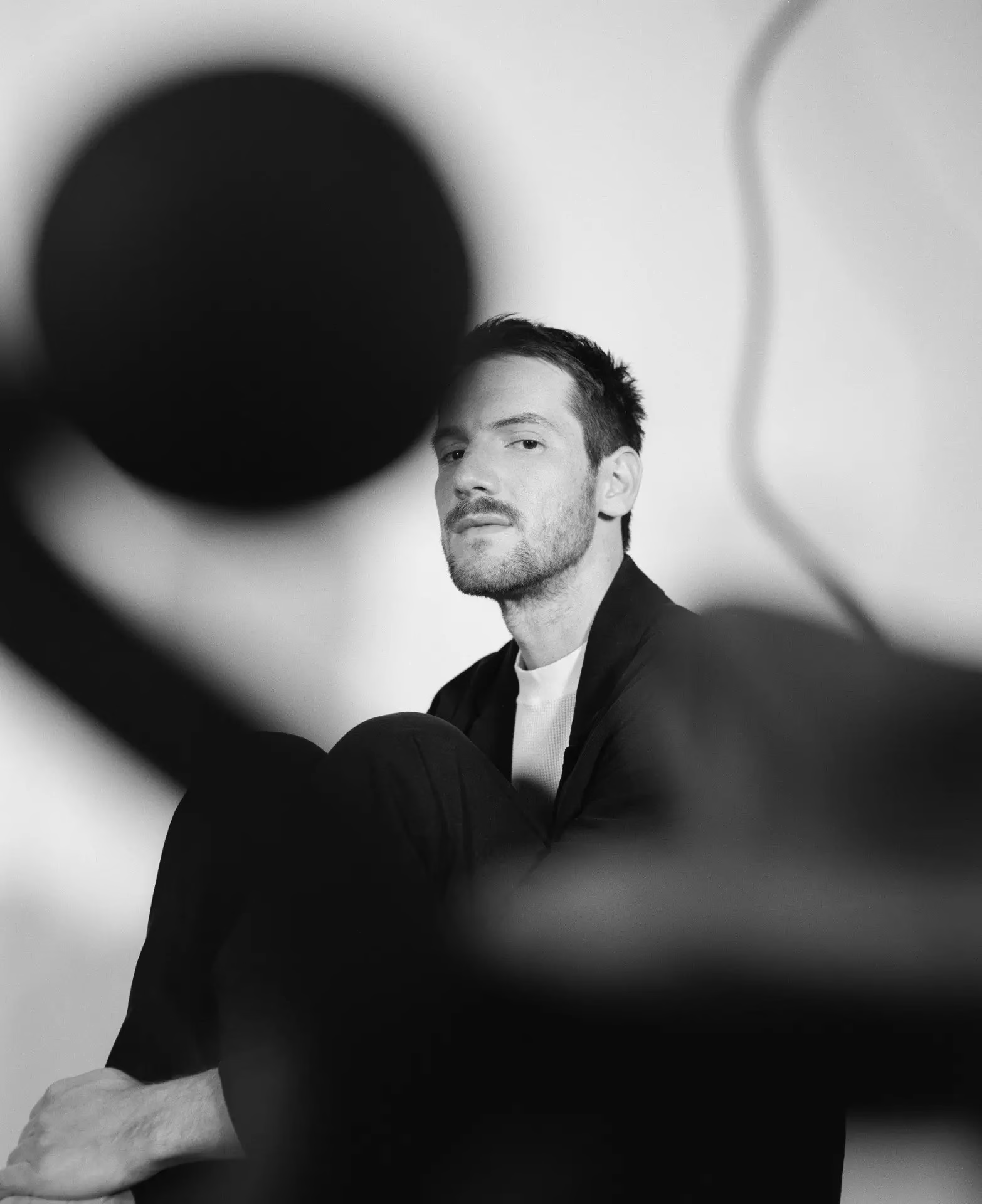
Over the course of a decade, Blake Mills has worked with everyone from JAY-Z to Fiona Apple. But live streaming, he says, has rendered him the most anxious he’s been since high school.
As musicians hunker down and switch on their webcams during the coronavirus pandemic, Mills has felt pressure to follow suit, but he hasn’t found it easy—which also goes for writing new material. "[It’s] like you’re sitting by a pond with a fishing pole and you see a fish in the water: "Oh, that’s interesting,'" he tells The Recording Academy, describing woodshedding at home while in isolation. "There’s no [immediate desire] to turn that into something."
The guitarist recorded his new album Mutable Set, which will be released May 8 on his label New Deal Records, well before COVID-19 bound much of us in our houses and apartments. Still, the intimate yet expansive vibe of songs like "Vanishing Twin," "Farsickness" and "A Window Facing A Window" feels germane to a moment in which, between four walls, the barriers between hours, days and weeks seem to have evaporated.
"This record deals with an awareness of two things—people and experiences in life that are precious, and whatever waits down the moat for something to drop," he said in a press release. ‘[The title] is a [theatrical] term that deals with anything that could change or be lost all together."
Mills has specific people and things in mind that are mutable sets, but he's not hungry to divulge the details. "I think there’s a reason it went from reality into a song," he explains. "To preserve that, you’ve just gotta let it now be a song rather than a person."
Read on for an interview with Mills about that person-to-song alchemy as well as creating while in quarantine, co-writing with Cass McCombs and achieving more with less while recording Mutable Set.
This interview has been edited and condensed for clarity.
<style>.embed-container { position: relative; padding-bottom: 56.25%; height: 0; overflow: hidden; max-width: 100%; } .embed-container iframe, .embed-container object, .embed-container embed { position: absolute; top: 0; left: 0; width: 100%; height: 100%; }</style><div class='embed-container'><iframe src='https://www.youtube.com/embed//1TkeETW9DVU' frameborder='0' allowfullscreen></iframe></div>
How are you holding up in Los Angeles?
It’s kind of peaceful and stressful at the same time. It’s definitely taking its toll psychically, from a creative standpoint of having all this time and wanting to do something useful or artful with it, to make some purpose out of it.
But [according to] everybody I’ve been talking to in the creative community, it’s not a hugely productive time by and large. I feel a little less guilty about not feeling super productive, but I’m trying and waiting for that to turn over.
There’s a lot of pressure on creative people to be perky and resourceful while in quarantine.
Everyone seems to land on live streaming. It does give you a quick reward of serotonin. It’s so different than performing for an audience or having people over or something like that.
But even just thinking about writing or trying to start a project, or if I’m playing guitar and there’s something interesting happening, there’s some part of my brain that’s like, "I should try to document this. I should try to record this or do something with this." Then the rest of my brain is like, "What is the point?"
Are you referring to the live streaming process or the demoing process?
More probably the demoing process. Or just the writing process. When you’re messing around and you stumble upon something musically that seems kind of interesting or at least better than what you’ve been playing for the rest of the day, in a normal creative environment, you’re like, "What does this mean? Should I do something with this?"
And in this environment, it seems a little more like "Oh, that’s nice." Like you’re sitting by a pond with a fishing pole and you see a fish in the water: "Oh, that’s interesting." There’s no [immediate desire] to turn that into something.
Something about a stranger’s kitchen jam session chirping through my phone speaker feels impersonal and disconnected.
Yeah, it is. There’s exceptions to that rule. There’s a label called Sahel Sounds that works with a lot of artists in Africa, like in Mauritania and in the Sahara Desert. A lot of those artists have never left the country; they’ve never gone on tour. So they’ll sometimes get recordings through WhatsApp or cell phone recordings of these guys playing at a wedding.
And it’s some of the best musicianship I’ve heard in a long time. There’s this guy who plays the [lute] ngoni named Jeich Ould Badou. This guy is unbelievable. Every month or something during the quarantine, the label would put up an EP [as part of the Music From Saharan WhatsApp project].
That degradation process that goes through that particular app, plus a cellphone and a copy of a copy of a copy… it gives it a certain kind of patina that is not dissimilar from when people try to make a record sound like it was done in the 1960s nowadays to give it a sense of authenticity or nostalgia or whatever.
I’m definitely bothered when I’m working on a project and I put time into getting it to sound a certain way and then the medium interferes with that and changes it—like most people probably would be. But I also think it’s kind of silly. Like, "You should have heard Frank Sinatra's voice when we tracked it that day!"
You can go into a lot of different rabbit holes about the nature of musical documentation. The Neil Young arguments, the David Byrne arguments…
Exactly. And they’re not wrong. They’re talking about something that does matter. But it’s like talking about a thing that you ate one time. You send somebody to a restaurant to eat it and they’re not going to have the exact same thing that you ate, you know?
<style>.embed-container { position: relative; padding-bottom: 56.25%; height: 0; overflow: hidden; max-width: 100%; } .embed-container iframe, .embed-container object, .embed-container embed { position: absolute; top: 0; left: 0; width: 100%; height: 100%; }</style><div class='embed-container'><iframe src='https://www.youtube.com/embed//_32FuDN2rmg' frameborder='0' allowfullscreen></iframe></div>
Mutable Set sounds like a continuation of your ambient 2018 album Look, but with vocals. What compels you to remove borders and edges from your music?
I think at the time Heigh Ho came out [in 2014], it seemed really disconnected from my first record [2010’s Break Mirrors]. And when Look came out, it seemed really disconnected, obviously, from both of those.
I tend to take a lot of time between records primarily because I write slowly. But also because I often don’t feel like there’s a real reason to make a record until it feels like it stands apart in some way. Or at least until a general atmosphere around what a record might sound like or how I would want to record it… those kinds of things have to emerge before it feels like it’s time to make another record.
It’s a lot easier to articulate what you don’t want something to sound like than being able to decide what you do want it to be. If there’s a lack of borders or anything on this record, it’s probably a result of the process of this one being different from previous ones.
I’m not somebody who’s beholden to analog tape being the prime sonic medium for recorded music like a lot of people I know are. But I do think it does lend a lot of character. The sound of a record made on tape is due not only to the fact that you’re listening to analog tape, but the decision-making process that goes into working on tape—the speed to which you’re forced to work.
Going back to degradation for a second, tape compression works in such a way where the more you add to it, the more compressed and sort of muddy things can quickly sound. A lot of time on this one was just spent more on getting a performance vocally and instrumentally from myself at the onset to where there was enough information in that performance that I didn’t spend too much time trying to create the record with overdubs on top of it.
So you tried to focus more on the core performance?
Yeah. More of the core performance. If that was just a solo performance from me or if it was a trio, depending on what went down on this sort of base layer, most of the overdubs and layers on top of that were going to be pretty minimal because, again, with tape, it felt more profound the more sparse they were.
And you start to listen to the lyrics, the performance, the quality of the voice or the playing, more when you’re not given other things like guitar coming in here or percussion coming in there. You [wait] for those things to happen, but when they don’t, it forces you to digest it differently.
It seems like you’re using silence as an instrument like never before.
Yeah, I guess so. The lack of "more."
And you used a much more traditional process than I presumed you did.
I would say it was pretty traditional. This record is [my first where] I’ve done this much collaborating on during the writing. It’s something that’s familiar to me when I’m producing or [being] approached by artists to co-write, but it felt very different doing it for my own music. I felt a little lost so I tried it with a few friends and different people, and I really found a stride with Cass McCombs, who I’ve known and worked with for maybe seven or eight years.
I’d say about half of the songs on the record ("Never Forever," "May Later," "Summer All Over," "Vanishing Twin" and "My Dear One") came about from me showing him something that I had. Maybe a version of the lyrics that felt like, ‘I’ve got this verse and I kind of like the way this one is fitting, but the second verse doesn’t mean anything to me and I don’t feel like it belongs in the song. But when I tear it up and throw it out, I can’t see anything else there because it’s been there for so long.’
A lot of music hangs out in the attic for a long time and it takes a while for me to be able to know if it’s a good idea or not and I kind of have to keep coming back to it.
It seems like a new development to have an outside party put a fresh set of ears on your songs.
Most of the time, I’m sitting on various elements of songs and I’m not sure if they fit together. Certainly [there are] ideas that feel like they have some good parts and the rest of it, I wouldn’t need it. But somebody else coming in with a fresh perspective is usually more on the instrumental side of when I’m making one of my own records, in terms of how the music comes across and, therefore, how the song comes across.
But to bring somebody in on the writing side, I think what happened in this case is that a lot of the decision-making is maybe a little more in the foundation of the song. The performance and presentation can be stripped back and just be more minimal and allow for some of those decisions to have a pathway to come through. The singer can communicate things that are not necessarily being said.
So what were those decisions? What did Cass bring to the songs specifically?
He has an innate style as a lyricist. He has a respect for the economy of a phrase and using fewer words and experimenting with what happens if you take this out, you take this out, you take this out. To have as little as possible in there and still have it be evocative. We both love music that does that.
In this case, what was great beyond just the obvious suggestion of ‘What about this here?’ was to have somebody whose tastes are so aligned working on an idea. It’s really hard to put a value on that and to say exactly what they did.
When somebody walks into your house or your studio, it allows you to recognize where you are in a way you couldn’t before. Like, when the plumber shows up, you realize, "Oh my god, my house is a mess." Once you find a rhythm with somebody on something, it allows you to take stock of where you are in a way that you couldn’t really see beforehand.
Would it be accurate to say that you felt lost in the weeds with the material and he helped you shape it up?
Yeah, definitely. He came in, he got where I was coming from, and I would play him an idea. I’d have this one line and I’d record it on my phone and then he would go on about his day and start sending variations on ways to sing that line. That would inspire a new section for me. Then I would send that to him and he’d come back and have variated lyrics for half of that section.
And that’s just the process of one song. It happened very naturally and then never happened like that again on any other one. So it’s a very fluid collaboration.
How did you choose who would accompany you on the record?
I would say most of the people that are on the record [saxophonist Sam Gendel, string arranger Rob Moose, pianist Gabriel Kahane, bassists David Boucher and Pino Palladino, drummer Abe Rounds] are people I’ve just worked with a lot in the past. The exception being [keyboardist] Aaron Embry, who is someone I’ve been a fan of for many years but had never crossed paths with.
I just thought this would be a good excuse to reach out and make that call. I love his songwriting and I know that his approach to this music would come from the standpoint of listening to what’s happening in the song, not necessarily from the frame of mind of ‘We’re here making a record.’
Everybody who played on the record are people who think outside the box without having me tell them to do so.
You've said that the title of Mutable Set implies the temporary nature of everyone and everything. Any particular people, places, or things that you’ve lost — or fear to lose — come to mind?
Every one of these songs is about something or someone to me. And I know who those people are and what those things are. I think it’s important that those things and those people are not publicly attached to the songs. As a general statement, for art in general, I think it’s important to preserve the anonymity in songs so that people can hear the way the story is being told through the song rather than trying to put it together like some sort of police report.
I like that kind of aspect of when people are putting real experiences into an abstract medium. I think there’s a reason it went from reality into a song. To preserve that, you’ve just gotta let it now be a song rather than a person.
You’re left feeling the essence of loss without specifics.
Maybe those details are important for certain people, certain songs, or certain stories. Not for these songs. But that’s just for this record. That all could change on another group of songs for sure.
Tori Amos On Maintaining Faith, Vision & Conviction In Troubled Times