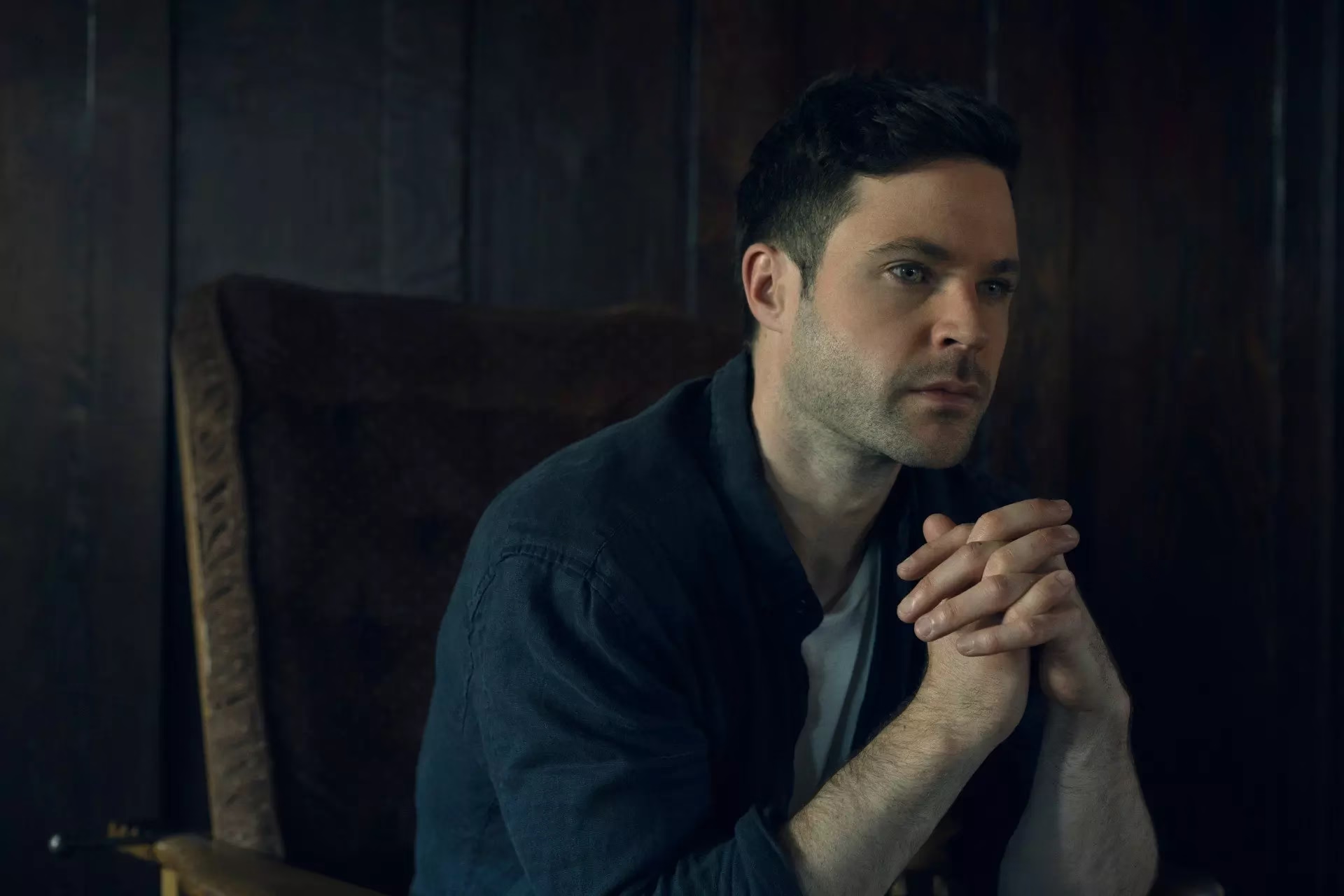
"You can hide your scars, ignore your pain / But it all comes out in other ways," weeps Brandon Stansell. An openly gay country star, the Tennessee native first came out when he was 22, and the fallout within his very strict, Southern Baptist family sent him on a path many queer individuals know all too well. While he had already been living on his own at the time, studying at Belmont University, he quickly realized that family is often not defined by blood alone.
With "Hurt People," the title cut to his new EP, Stansell invites the listener to hear his story and fully understand the scope of brokenness out of which he still climbs. "I knew they wouldn't understand, but I told them anyway / And 10 years later, I'm still waiting for time to heal this pain," he sings. "My daddy said I want you to know that we're not proud of you / So, I left home all on my own just like hurt people do."
Stansell draws from a very deep well of pain. Across his four-song Hurt People EP, he wrestles with an upbringing rooted in faith, longing for what could have been ("Like Us"), and finding his own kind of light. Accompanying the project, Stansell, in partnership with OUTtv, returned to his hometown to play his first-ever show there and film a documentary. Three Chords And A Lie features commentary and insight from CMT’s Cody Alan, songwriter Jeffrey James, performer Shelly Fairchild, and various young people from Nashville’s Launch Pad, an initiative to assist homeless youth in the community, particularly LGBTQ+.
"It feels crazy to finally have it out into the world. It was almost a year-ago since we shot the documentary," Stansell recently told GRAMMY.com. "I guess because the world has felt stagnant, it feels like we just did it."
The documentary, filmed in October 2019, doesn’t sugarcoat the truth about coming out in many parts of America ─ depicting some truly heart-wrenching moments in his story. Stansell never shies away from discussing his family, their reactions to his coming out, and the ongoing struggle for self-worth. What is also truly admirable is his willingness to be open and honest on-camera, even leaving in an emotional breakdown while rehearsing with his acoustic guitar.
Below, Brandon Stansell spoke with us about his journey, the new documentary (which premiered Sunday, August 23 at Out Fest), conversion therapy, representation and what's next.
<style>.embed-container { position: relative; padding-bottom: 56.25%; height: 0; overflow: hidden; max-width: 100%; } .embed-container iframe, .embed-container object, .embed-container embed { position: absolute; top: 0; left: 0; width: 100%; height: 100%; }</style><div class='embed-container'><iframe src='https://www.youtube.com/embed/Hj8D-OLMVcw' frameborder='0' allowfullscreen></iframe></div>
When did you get the idea to film a documentary about your story?
I started writing the EP last May. I had ideas for the project, and I vacillated between doing what I considered a more traditional route where you would pepper songs like "Hurt People" and "People Like Us" across multiple projects so it doesn’t feel like the hammer is falling when you listen to them all in a row. Once I had everything written, OutTV approached me about doing this documentary, and it wasn’t anything I ever thought I would do. With the music I was writing, and the timing of everything, it felt like I was writing this music for a purpose. And it was this purpose. It all felt right to put into one EP. It’s better that way. I have a real passion for talking and writing about queer stories in country music, and you really get that sense when you hear these songs back to back. It doesn’t just feel like a little piece of you. These things have fundamentally changed my life and shaped me into the person I am.
What did you ultimately learn through this documentary process?
I was going through this process of being very hesitant to put this music and documentary out and then just being really ready to go. I obviously shied away from it because it was very personal for me. It’s my life. It’s not a persona or a mask. It’s my world and relationships, and it’s hard for me to allow everyone to have a window into that world. I didn’t really know how else to engender that conversation without talking very specifically and personally about my own experiences. The responses I’ve gotten so far have been ─ I guess I didn’t know what to expect ─ on the positive side of what I hoped for, and that was people feeling like they finally had a voice from someone who had gone through experiences they’d gone through. And they were okay. It didn’t kill them or ruin their lives. We can have these shared experiences, as hard as they are, and still be okay, and better than okay. We can do great things in the world, pursue our dreams, and do all the things we ever wanted to.
"Ever since I came out, I decided that I was going to go and try to pave a path for people like me and use my experiences to make that an easier path to take."
For a lot of queer people, and specifically for me, I always wanted to be a singer and songwriter. I didn’t think these would be the things I would write about. I don’t think anyone hoped for that, but when I came out, I had an experience that fundamentally changed me. It’s just part of my story now and because I see it reflected in kids across the country, I thought it was important for me to share in an effort to help people feel not so alone and to help families with people like me know what this process is like. It can be good or it can be bad, depending on how you react. That’s my hope for the project.
You've said you didn’t want to sugarcoat the truth about your experiences. In one particularly moving moment, you break down while playing guitar. Did you have any reservations about showing such raw vulnerability and pain?
I think anyone that is putting themselves into a public view wants to portray themselves in the very best way they can. You don’t take an ugly picture of yourself and go, "Oh, I can’t wait for the world to see!" [Laughs.] It’s just not the natural thing to do. But I realized that there’s more important things going on than how I am personally perceived. That is the thread that runs through this entire documentary. There are so many people in this world that have these shared common experiences but for one reason or another, we get shamed into not telling our experiences, and we can’t ever grow from that. We can’t ever be better if we don’t talk about the things that have happened. At some point, I had to look at scenes like that breakdown and realize that I don’t look great, no, and makes me look like a complete mess, yes ─ but can it/could it help someone, yes! I think it could. So, it’s worth it. That’s what I had to lean into.
<style>.embed-container { position: relative; padding-bottom: 56.25%; height: 0; overflow: hidden; max-width: 100%; } .embed-container iframe, .embed-container object, .embed-container embed { position: absolute; top: 0; left: 0; width: 100%; height: 100%; }</style><div class='embed-container'><iframe src='https://www.youtube.com/embed/PGXhi1L1ok4' frameborder='0' allowfullscreen></iframe></div>
In the documentary, you also mention conversion therapy and how "they think they’re doing the right thing." From your perspective, how has such religious beliefs led to such extreme ways of thinking?
Thankfully, specific states in this country are coming to their senses in that conversaion therapy is nothing more than child abuse. It is emotional abuse. Just plain and simple. No matter which way you cut it or what techniques you use, you’re trying to convince a person that what they are is wrong and bad and needs to be fixed. That is emotionally scarring to anyone who goes through such "therapy." When I was coming out, the people in my world wanted me to do that. There were a few Christian conversion therapy camps, including the Exodus Ministry and Love Wins Out, and thankfully at that point in my life, I had the foresight to know it was only going to make things worse for me. My only reason for wanting to do anything like that was not so I would not be gay anymore but so I could stay connected to my family.
Now, looking back, we're 10 years past that and a lot of these places have closed down. Some states have banned this kind of therapy. It’s part of my story, so I talk about it. It still exists in places, and some people still consider it to be a legitimate thing. And it’s not and shouldn’t be.
You and your mother share an embrace at the very end. Have you found this documentary to be an important step forward for your relationship?
My goal was that this would facilitate healing. It has been a conversation I don’t think we could have otherwise had. It’s done good in my space. I have stepped back and said, "There’s nothing I can do to change the minds of people I love. I can’t do that. I can only control and me and my world." Ever since I came out, I decided that I was going to go and try to pave a path for people like me and use my experiences to make that an easier path to take. If any of them want to come along for the ride at some point, I’m open arms. That’s kind of where I’ve always been and where I am now.
Nearly two years following the groundbreaking CMT premiere for your "Hometown" video, has there been a weight of responsibility for you as you've moved forward?
I don’t feel a weight on me. I have only felt that my only responsibility is to be authentic to who I am and share my story as honestly as I can. I feel like I’ve done those things. I don’t know what people expect of me, but I think that what I can say is that I’m going to continue doing the things I’ve always done, which is make music I think people will want to listen to and is reflective of me and proud of. That’s been my road from the beginning and where I see myself continuing to go.
You've also spoken on the importance of representation, noting you didn't have that growing up watching CMT music videos. What's it been like for people to reach out to you now with the understanding you’re giving them that bridge?
You know, it’s been different over the years. When that video came out, the one story that’s stuck in my head is I had a guy message me, saying, “I saw your video and sent it to my mother. She called me, and I got the apology I never thought I could ever get from her.” It was such a weird, full-circle moment because I wrote that song out of a pretty deep, personal place and shelved it for a long time. I didn’t think anyone would be able to find themselves in it. When I finally put it out, I realized that not only did so many other people find themselves in the lyrics, but it was something that was being used as a tool to start bridging the gap. It made me proud of the work and wanting to do more.
<style>.embed-container { position: relative; padding-bottom: 56.25%; height: 0; overflow: hidden; max-width: 100%; } .embed-container iframe, .embed-container object, .embed-container embed { position: absolute; top: 0; left: 0; width: 100%; height: 100%; }</style><div class='embed-container'><iframe src='https://www.youtube.com/embed/qwQEuV5aqzM' frameborder='0' allowfullscreen></iframe></div>
Do you think mainstream country music will ever see an out gay superstar?
Yes, I do. I've said for years that people are more open than we give them credit. We just have to give them the chance to show us. Ever since I started making music, I have had nothing but good things said about me and to me. I think with the work that we’re doing ─ queer people, women, and people of color ─ in country music, we’re setting the stage for anyone who has a dream of being a superstar in this genre will be able to with no inhibitions. They will be able to see themselves, from the time they’re little kids to making moves. And that’s exciting. I grew up watching and loving CMT. I would dance around in the basement to Jamie O'Neal's "When I Think About Angels." I love that station, but I also knew I was gay when I was six. So, I lived in this split world where I wanted to so much be a part of this country world, but somewhere in me I didn’t know if that would be able to happen. I think it’ll happen, as soon as people start feeling like they’re represented in the genre.
Have you already been writing for the next project?
It’s pretty much written. I’m excited about the new project, because it’s upbeat and fun. So… it’s different. [Laughs.] It’s going to be another EP. We’re currently vacillating between a five- or six-song EP, but we’ve already started working on it. I’ve been recording through quarantine and doing scratch vocals on an iPhone. It’s been an experience. I’ve been doing some writing by myself and then some Skype writing, which I had done before since I’ve been living on the West Coast for six-plus years now. I would Skype write with people in Nashville all the time. It didn’t really feel like anything too new to me.
Brandon Stansell Takes Us To His "Hometown" In Special Pride Month Edition Of Press Play