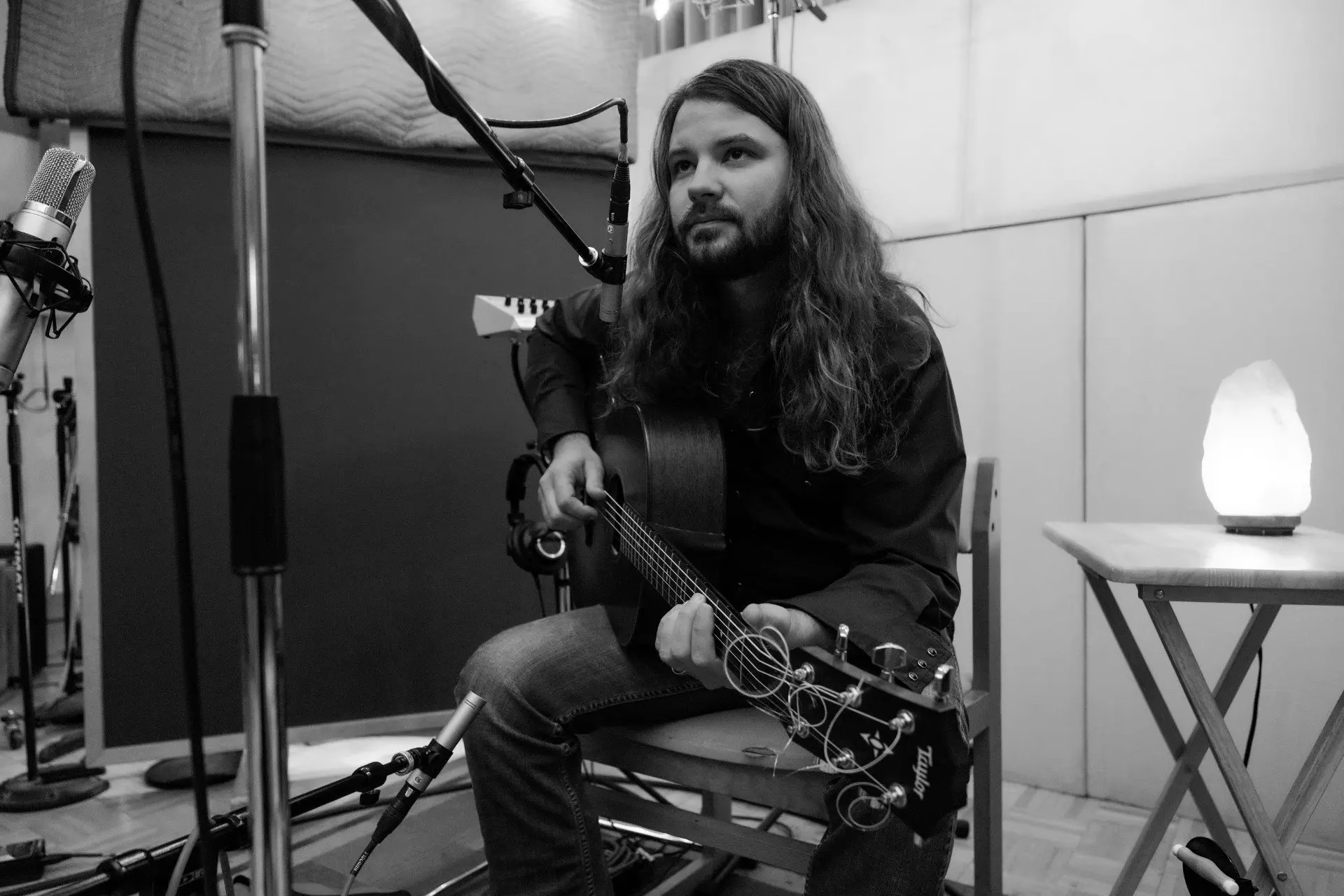
Brent Cobb grew up in a musical family, even if he didn’t know it. Around the age of 17, the now-34-year-old born and raised in Ellaville, Georgia, discovered the music of Shooter Jennings. Jennings, in his words, “...represented a cool side of country music. I just knew it was cooler than anything I was hearing on the radio." The producer of Jennings’ 2005 Put the "O" Back in Country? None other than legendary Nashville producer, Dave Cobb, who funnily enough shared a last name with Brent. That’s because the two are cousins, and Brent didn’t discover this until after he had already become obsessed with Shooter and Dave’s stellar country album.
Before you go searching for nepotism, Brent Cobb’s already admitted to thinking as much: "Dave gets irritated with me. He thinks that I think the reason why we work together is because I'm his little cousin. I don't think that," he explained to GRAMMY.com with a chuckle. "He would go, ‘Well, it's because of your great songwriting. It ain't because we're cousins, you dumbass.' Even if we didn't exist as a family, just to be associated with all of this feels like I'm living a little piece of history," he added. Brent’s "Down Home" is featured on a compilation record made by Dave in 2016, and the songwriter’s realistic, humorous, lyric-driven songwriting is apparent on the track, as it is on his new LP, Keep ‘Em On They Toes (out on Oct. 2 via Cobb's own Ol' Buddy Records via Thirty Tigers).
For Toes, Cobb enlisted the help of another star producer, Brad Cook, who has helmed albums for Bon Iver and Waxahatchee, among others. On songs like "Dust Under My Rug," you can almost hear the psychic powers between Cobb and Cook. Brent was insistent on highlighting his lyrics by stripping the instruments back to bare essentials, and Cook’s keen ear for subtle details highlights Cobb's tales of individualism and honesty with peerless precision. Though Cobb’s connections in the music industry run deep, his work on Music Row in Nashville and GRAMMY nominations have earned him respect outside of his familial ties. Brent Cobb knew he wanted to be a musician from his teenage years, and he’s followed that guiding light, discovering a few friends and family members along the way.
<style>.embed-container { position: relative; padding-bottom: 56.25%; height: 0; overflow: hidden; max-width: 100%; } .embed-container iframe, .embed-container object, .embed-container embed { position: absolute; top: 0; left: 0; width: 100%; height: 100%; }</style><div class='embed-container'><iframe src='https://www.youtube.com/embed/XK5qaRdBvhQ' frameborder='0' allowfullscreen></iframe></div>
When did you begin writing this album and conceiving the direction you wanted to head in?
I think the first song that I wrote for it was "This Side of the River." That one set up the rest of the foundation for the themes and direction for the rest of the album. Then the second one was “Keep ‘Em On They Toes.” Up until that point, I had written a lot about missing home and describing Georgia and that sort of thing. We moved back to Georgia a couple years ago and I wasn't missing it anymore. So the songs I started writing began to focus on the world we live in.
When you wrote the title track with your wife, had your son been born yet?
He had just been born and that night I had started that song here in the backyard and was just thinking about my legacy. After I had kids, each album I write is approached from the mindset of, "If I died the day after this album came out, what would I leave behind for my kids to get to know me?" This song was no different. The initial thought was, "How would I want my son to grow up? What lesson would I want to leave behind?" Then my wife and I finished it during the first weekend we had away where the grandparents took both kids for the weekend. We just hung out and wrote that song. That's how we spent our first night of freedom since the second one had been born.
What were some things that you wanted to do differently on this record versus earlier releases?
I don't know that I wanted to do anything different per se. I wanted to make sure the lyrics were the focus of the album. I wanted that to be the focal point. Maybe that would be the only thing that was intentionally done differently.
Does that come from working with Brad Cook? How did that collaboration come about?
Well, I don't know how familiar you are with a lot of his work, but he's great at that, specifically. On the albums he produces that I gravitate towards, the small amount of instrumentation used is used well and it covers a lot of ground. The lyrics are always the focal point of the albums that I've been into that he's worked on. Dave and I couldn't get our schedules on the right track. Anytime I was free, he was busy and then when he was free, I was on the road. I was itching to make the album. This was last December. I had all the songs written for it, but I knew I wanted Brad to hop on board.
<style>.embed-container { position: relative; padding-bottom: 56.25%; height: 0; overflow: hidden; max-width: 100%; } .embed-container iframe, .embed-container object, .embed-container embed { position: absolute; top: 0; left: 0; width: 100%; height: 100%; }</style><div class='embed-container'><iframe src='https://www.youtube.com/embed/3DHTm_v1pTU' frameborder='0' allowfullscreen></iframe></div>
You do a lot of songwriting with friends, family members and collaborators. What is it about inviting people into your world that you get so much satisfaction from?
Well, I spent 10 years in Nashville writing on Music Row. Every day you go in and you collaborate with another person. That's the name of the game for the publishing world on Music Row in Nashville. So I love that process of collaborating with someone. Once we moved back to Georgia, I still enjoyed that process. It just so happens that the people here were my wife and my dad and those were the people that I collaborated with. I just enjoy it. I just enjoy getting on a song with somebody else.
Did working on Music Row writing for other people inform the way that you write your songs as a solo artist?
The only thing I've ever been good at in life is writing songs. Even as a kid. That's the only thing that just kind of sort of came natural to me. But being in Nashville surely refined that natural ability.
Can you talk a little bit about your relationship with your cousin, Dave, and how he helped inform the style that you have now, if he did?
Well, he absolutely did. He would say he didn't, but I was a kid. I was 16 or 17 when I first heard that Shooter Jennings album Put The “O” Back In Country. I had no idea Dave even existed. We didn't know each other, but I was a huge fan of the album. We met after I was already a fan of that album. Then when I went to L.A., I was exposed to that freedom of creating "country music" in a way that I may not have been exposed had I gone to Nashville first.
It was all Dave. It was Dave and Shooter. It was them just being completely free in the studio and it felt like the way you would imagine making an album should feel. It didn't feel sterile at all. It didn't feel like you'd walked into a doctor's office like sometimes it can feel in other places. The way he operated gave me the confidence to continue to be free in my creativity and my song writing.
Do you think about your own legacy in that way?
I try to. None of us are going to be around forever and we're only spinning around for a little while. I absolutely try to think about what I would leave behind. Whether it's to my kids or whether it's to this world, I try to constantly think about that. It's all fleeting.
But you can take the positive aspects of that without dwelling too much on the finality of it?
What are we going to do? What are we going to do about it? When you're in a bad situation and you could freak out and go, "Holy shit. This sucks," but it's just going to make the bad situation worse. I don't know that life is a bad situation. It's kind of a beautiful situation. Part of the reason why it's so beautiful is that it isn't forever. I always think about that.
Are you always writing or do you sit down and get to work when it’s time to make a new album?
It's both. I will say it is harder for me to write when I'm not trying to write for a project. That doesn't mean I'm not writing decent songs. The inspiration is much more robust when I have a project that I'm working on.
<style>.embed-container { position: relative; padding-bottom: 56.25%; height: 0; overflow: hidden; max-width: 100%; } .embed-container iframe, .embed-container object, .embed-container embed { position: absolute; top: 0; left: 0; width: 100%; height: 100%; }</style><div class='embed-container'><iframe src='https://www.youtube.com/embed/U0awI-uvJik' frameborder='0' allowfullscreen></iframe></div>
How does your lyrical process generally begin?
I've always thought that most songwriters write about what their heart desires and for me, when I was writing for Shine On Rainy Day, I was focused on down-home Georgia life that I missed and had been removed from for so long. It generally just begins with the question, "What am I thinking about right now?"
It’s fairly clear then that you don't miss your days in L.A. and Nashville as much as you did miss being back home in Georgia when you weren't there.
Not yet, but it took me a while to understand the longing for Georgia. Maybe in a couple of years I'll really be able to decipher those emotions and what was really going on. Maybe I will miss it. It's hard to tell, I don't know if I'll miss it. Perhaps.
Do you sort of use songwriting as a way of reckoning with your thoughts? Is it only through songwriting that they come to your head?
There's so much other stuff going on that's directly in front of me, like raising two kids and being a good husband and a good father and what the next lesson is for homeschool. There's a lot of stuff going on. It's hard to take a minute and think about the deeper thoughts and emotions. When I sit down with a guitar and I try to make the music happen, that's when the stuff comes out clearer.
What's something you hope a listener takes away after hearing this record?
I would hope people realize they’re not alone in thinking that it's okay to do what you feel in your heart. If you have a good heart and you're not harming anybody, then do what's right and live your life and don't f**king worry about what anybody else is doing. I hope I sound like an old friend. I'm here to talk to you and I'm here to listen, too. I just hope people find comfort in knowing that it's okay to live your life the way you see fit.
Rising Singer/Songwriter S.G. Goodman Talks Debut 'Old Time Feeling' & Growing Up In The Rural South