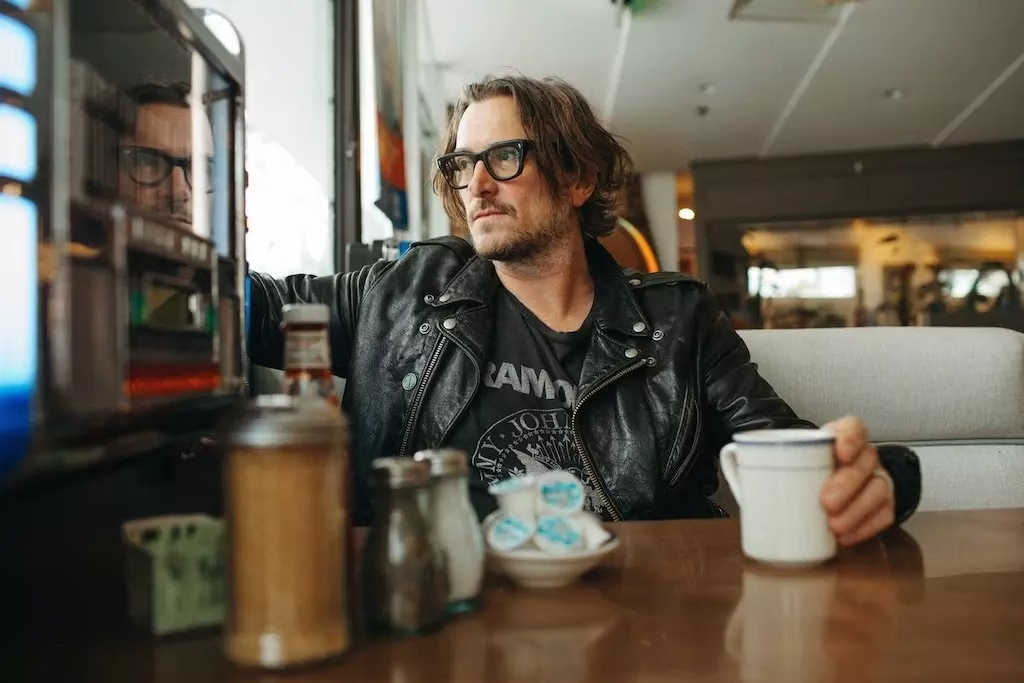
As Butch Walker watched the tragedies and violence spewing out of the Charlottesville protests in 2017, it reminded him of the time when the Ku Klux Klan was asking for money in his hometown in Northwest Georgia. So he made a rock opera about it.
When the singer-songwriter and superproducer watched the footage of the Unite The Right rally, the white nationalist protest that resulted in the murder of civil rights activist Heather Heyer and the injury of several dozen counterprotesters, it didn't strike him as a new phenomenon. Growing up in the small town of Cartersville, Ga., he had regularly seen such virulent hate on full display—even at an everyday red light.
"It was just normal," Walker says incredulously from his Santa Monica studio. "You actually saw people putting money in the f**king bucket, just like a firemens' donation."
From there, he says, "I just started writing in a pattern after Charlottesville happened, and all these things started coming back into light." It returned him to a time when, as a young man, he witnessed animosity against people who weren't straight, white and Christian. While he didn't perpetrate these acts, he admits he was "complicit" in them.
<style>.embed-container { position: relative; padding-bottom: 56.25%; height: 0; overflow: hidden; max-width: 100%; } .embed-container iframe, .embed-container object, .embed-container embed { position: absolute; top: 0; left: 0; width: 100%; height: 100%; }</style><div class='embed-container'><iframe src='https://www.youtube.com/embed//1rz-OvZ8rnw' frameborder='0' allowfullscreen></iframe></div>
Three decades after the events of his "complicit" youth, Walker is now shining a harsh light on bigotry through his songwriting. His new album, American Love Story, out this week (May 8) on his label, Ruby Red Records, is a largely self-performed concept album. The storyline follows a character named Bo, the child of a discriminatory Southern family, who bullies a gay classmate who, in a twist of fate, saves his life. The transformative moment causes Bo to rethink the prejudices ingrained in him by his upbringing.
Even before the album's release, its controversial song titles alone—"Divided States Of America," "Torn In The USA," "Blinded By The White"—are already ruffling feathers online. Walker doesn't care.
"Oh, I don't like it when my favorite artist gets serious or talks social or political or whatever!'" he mock-complains as an offended fan in a bellyaching voice. "Well, f**k you, because guess what? I pay taxes and I've lived a long life and seen a lot, and I'm not going to just write another breakup song for people or a party anthem."
The new album's political and social slant may come as a surprise to fans who have been following Walker for years. A singer-songwriter who released his debut album Left Of Self-Centered in 2002 and has made records ever since, he's become widely known in recent years for producing summer-ready albums by Rob Thomas (2019's Chip Tooth Smile), Green Day (2020's Father Of All Motherf**kers) and Adam Lambert (2020's Velvet). Whether or not your politics align with his, Walker's commitment to self-examination on American Love Story is without question.
The Recording Academy caught up with Butch Walker to chat about the inspiration behind American Love Story, his misspent youth in a Southern small town and his choice to make amends for his upbringing through a rock opera.
This interview has been edited and condensed for clarity.
<style>.embed-container { position: relative; padding-bottom: 56.25%; height: 0; overflow: hidden; max-width: 100%; } .embed-container iframe, .embed-container object, .embed-container embed { position: absolute; top: 0; left: 0; width: 100%; height: 100%; }</style><div class='embed-container'><iframe src='https://www.youtube.com/embed/nad4bNOCacA' frameborder='0' allowfullscreen></iframe></div>
Walk me through what you were like as a young man—your attitudes and your actions.
I can't say that I was ever like the main character in the rock opera. I had a very loving family, albeit it came with some dated philosophies as it does growing up in a small town. But my parents were from a small town, and I wasn't really having a scope outside of that and what was on TV and the radio. That was all you really got back then. It was hard to be "woke," so to speak.
But I was more complicit, I think. I was more passive about things, maybe. But I was definitely OK with how normalized that behavior was toward minorities and [people with] different religions and different sexual preferences. All those things were considered so taboo because, quite honestly, it's fear. It's being afraid of the unknown. Unfortunately, a lot of people were instilled with that from a young age. Sometimes it's inherent and sometimes it's not inherent.
I think that's how I walked through life until I moved to California with my band when I was 18. I kind of had my eyes opened in a very big way. Not just because of Los Angeles or [it being] a big city, but because it was a melting pot of cultures and religions and sexual preferences and things like that. And then I toured forever after that, and by doing a lot of touring I felt like I grew as a person and as a mind.
What small town did you grow up in?
It's called Cartersville, Ga. At the time, coming up in the '70s and '80s, it was a lot smaller than it is now. It went from being a pretty small rural town to, at this point, almost being a suburb of Atlanta.
Do you want to go into any detail about the discriminatory behavior you were surrounded by?
Like I said, my immediate family was pretty tame and I'm super glad about that. My mom, she's a super-progressive country woman, which is a rarity. My dad grew up not so much, but by the time he died, he was very progressive-minded. I think it sadly came with the times and the location that you heard a lot of derogatory words thrown around about people. Most of it [came from] relatives, maybe some friends or friends' parents.
I took a lot of that and put it into the record. It's a factual tale of fictional characters based on people I know or even myself, loosely. I've got to say, coming from a small town [made me] have certain scruples and things that are lost on someone in a big city. Some of my favorite people are from these small towns. They'll give you the shirts off their backs.
I was trying to be careful how I did the record so it didn't sound like I was judging. It really isn't. It's like a movie with characters. It's a story based on things that happened in my youth. It's also stereotyping stereotypes in a lot of ways.
Read: Jimmy Eat World Are 'Surviving': "At The End Of The Day, We're Fighting For The Same Thing"
In the story, "Bo" experiences an attitude adjustment regarding a gay schoolmate. Tell me a little about that.
I absolutely knew and was friends with some gay kids at my school. But at the time, obviously, that was forbidden to be out of the closet in small towns. I think a lot of people just sadly kept it shrouded and kept from the public. But people knew and sadly, I followed this behavior toward them by some mean-ass motherf**kers at my school.
Having that happen in the rock opera, there's a [kernel] of truth, obviously, but it was more like a "What if this happened to you?" scenario. I'm sure this has happened where a racist or a bigot or something has had their life saved by the one [type of person] that they had been raised and taught to hate. What does that do to your mind after you realize you'd be dead without the help of somebody who didn't judge you, but you spent your whole life judging?
And you realize they're just people. That there are good and bad people in all walks of life. So I think that's why this character has this comeuppance and this crazy epiphany about what his life actually means and has meant all this time because he had blinders on.
<style>.embed-container { position: relative; padding-bottom: 56.25%; height: 0; overflow: hidden; max-width: 100%; } .embed-container iframe, .embed-container object, .embed-container embed { position: absolute; top: 0; left: 0; width: 100%; height: 100%; }</style><div class='embed-container'><iframe src='https://www.youtube.com/embed/gp9zI8AY648' frameborder='0' allowfullscreen></iframe></div>
Did anything like that happen to you?
No. That part of the story is fictional, but I wanted to make it something that could easily happen. Not to say that I didn't see that happen growing up. I [also] saw instances where people were compassionate to people who didn't deserve it because of their actions toward them.
Let's fast-forward to 2020. What made you want to tell this story in a format as outsized as a rock opera?
I'd say it was more like 2017. I wrote and recorded it a couple of years back. When I finally finished it, I just sat on it and didn't think I wanted to do anything with it. I was like, "Nobody needs a f**king rock opera." And certainly, it's touchy subject matter. I didn't set out to make a rock opera, a concept record, whatever people want to call it. I just started writing in a pattern after Charlottesville happened and all these things started coming back into light.
I started flashing back to my childhood where I can remember what it was like seeing Klansmen in full costume on the side of the road, walking up to red lights wanting donations and s**t like that. And it was just normal. And you actually see people putting money in the f**king bucket just like a firemens' donation. Or worse, going over to a kid's house and seeing racist s**t everywhere and [knowing their parents were] probably a member of some sort of organization. So it was wild to see that the sleeping giant never died. It was just always around.
I certainly don't want to politicize this because it's beyond being a political record by a mile, in my mind. It's more that in the last four years, there's been an inherent spike in hate and division and racial crimes and bigotry. When I started writing songs about it, it was just a theme—I don't know why. Then I sent some demos to my manager and he was like, "It sounds like you're making a rock opera." I was like, "I guess you're right." And here we are.
Then the pandemic of 2020 set in and I said, "You know, this is going to be a really tough record to market and tour on anyway without playing the whole thing from beginning to end. It seems like it'd be weird to just pepper a couple of songs into a set of 30 years' worth of albums that have a first-person narrative from a bigoted racist. It'd be strange to hear in a show! So when [the lockdown] happened, I said, "You know, I've got to put this out."
As a classic rock fan, I appreciate that you went full Tommy or The Wall with it.
Absolutely. I grew up on that music. I'm a big fan of when a band or an artist wants to get out there and jump into the deep end. Even if it's something spacey like Tommy, which is a strange, convoluted story. It was more like a surreal situation rather than a strict storyline. And it didn't matter because that's what made those records so much more intriguing and fun to listen to.
We're still a long way from the finish line on the current lockdown, but we could be nearing the end of the Trump era. What are your sociopolitical feelings at this stage in world history?
Well, I've got to be careful there. I've already got a record here that a lot of people are judging based on the titles and lashing out at me about online, thinking I'm some sort of pious, judgemental Hollywood liberal elitist. Which is funny because I f**king hate Hollywood. I don't live in Hollywood. I live half the time in the South where I love it the most. I made that record because I wanted to poke fun at all types of stereotypes of all people.
Where we are right now, in my 50 years, I may care more now than I did naturally when I was younger because I know most people in my 20s didn't care about politics. Maybe they do now. But I know when I was growing up, most people just cared about them-f**ing-selves. They didn't pay attention to the world. But we've unleashed a massive amount of hate and vitriol into America with this presidency.
At the risk of this making me sound soft, I miss having someone who has just an ounce of empathy and compassion. I would love to see that exist again. Whether it be in him or in someone completely different. I just want that back. I want that tone to be set for the rest of the country, because when you have somebody angry and tensed up and yelling and f**ing screaming at everyone all the time in America and lashing out daily and nightly on Twitter, all you're doing is making everyone else feel that way.
I just think we're not going to get anything done and we're not a strong nation when we're divided. Obviously, people in politics are going to have differences until the end of days with their right-wing and left-wing agenda, but there used to be more civility between the two. Now it's just bad. I would like to see a shift back. I don't care who it is. I could care less. It has nothing to do with right or left—it's right and wrong.
Do you hope this record can help well-intentioned folks to reexamine possibly unsavory attitudes?
Man, I hope so. I'm not Post Malone, so I'm not going to have millions of people be aware of who I am or my record, so it is what it is. I'm limited on who I can reach. But do I want it to? Yes. Because I know there are people who come to my concerts who are like that, and I have friends that are like that. I've had conversations with some of these people even recently, which is what I want.
You can't have a conversation in a comments section on a f**ing Instagram post. That's not a place to have it. It's more about trying to establish some sort of talking point in a civil manner. And that's few and far between, but I've definitely had people, including myself, believe in wrong things growing up and grow over the years.
My dad was one of those people! By the time he was on his deathbed, for the last 25 years of his life, he was helping out black people, white people … he totally had as many gay friends as I did! And that's something that just didn't exist. It's sad to say that, like it's some sort of accomplishment or something to be stoked about. But it is, sadly. For a lot of people, it's just not going to be their reality.
Nobody's going on tour, obviously, and I think we've reached the saturation point for livestreaming. What are your immediate plans to promote the record?
[Sarcastically] I've got an idea! Livestream! I mean, I get asked daily to do someone's livestream. I'm so thrilled and honored that people want me to do them. But I can't keep up. I'm trying to finish the records that are here right now, and it's hard to take the time out to do them all. It's really awesome that people want me to do them. But it's the only form of digital expression of songs that we have right now. And right now, with this record, I think I got a little divine intervention because I was thinking to myself, "How am I going to do this live?"
Sorry if I'm repeating myself from earlier, but I didn't know how I was going to do this record anyway because peppering in a couple of songs from it didn't make sense. It needed to be played all the way through in its entirety. That's a tall order to ask your fans that have come to see you play and they're pretty die-hard. They love old and new material, but the last thing I want to do is say, "Hey guys, chill for an hour! I'm going to play a whole album you don't know that well yet!"
But it does sound like a great idea. To me, anyway. So in that respect, it's the perfect time for me to film it and show it. Whether that be a livestreamed concert where I do a storytelling, one-man-band version of the record or … what? I don't know. But I know that I've got that option that I've been playing with, trying to make it come to fruition.