
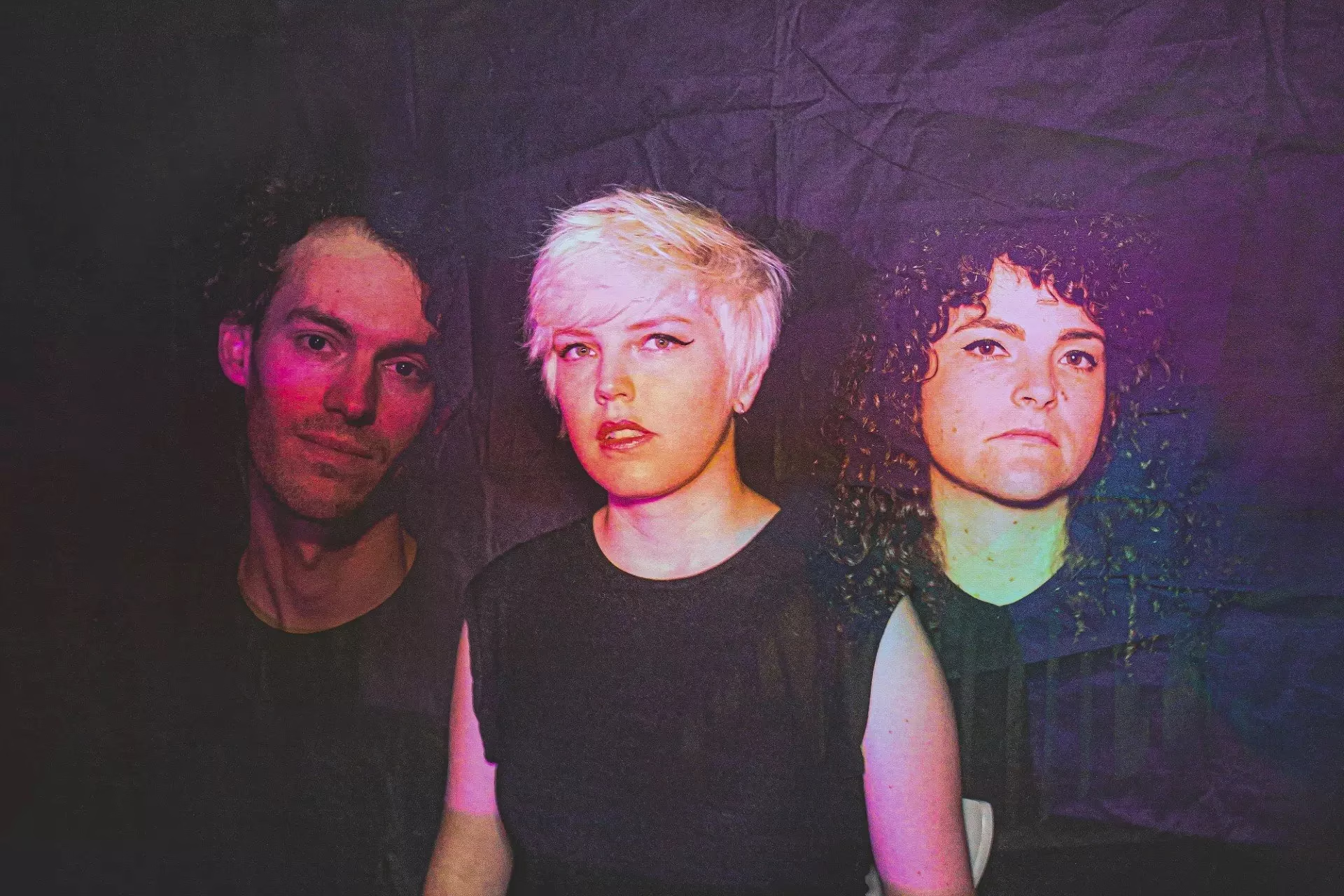
"Everything feels pretty chaotic at the moment," Jenny McKechnie says. "We're just hoping that people are still listening." And while it’s true the world has been upended by recent news, the guitarist-vocalist for Australian punk band Cable Ties isn’t exactly unfamiliar with chaos. The trio of McKechnie, bassist Nick Brown and drummer Shauna Boyle built a following on explosive live shows and scorched, thunderous punk. Their new album Far Enough—their first with legendary indie label Merge Records and first to be released outside of Australia—proves that there's intensity in Cable Ties' tenderness as much as their fierce determination to fight back against oppression.
"Writing this album, I was experiencing a lot of anxiety and depression, and figuring out ways to work myself through that," McKechnie says. "I was doing a lot more self-reflection about how I fit into the world and how I participate in and am affected by the systems of oppression that I talk about in my songs." Far Enough is a record built to bring the world together, flaws and all, to raise up something better.
The band’s roots in Melbourne’s D.I.Y. punk scene are palpable musically—and socially. The scene is powered by collaboration and cross-pollination, diversity and inclusion, care and support; before forming Cable Ties, McKechnie herself helped organize Wetfest, a backyard festival that highlighted women-led and gender-nonconforming bands. Community powers Cable Ties, so a catastrophic moment that has driven isolation and social distance seems particularly trying. "It’s hard not to think that this thing I’ve been working on my whole life is just going to be lost," McKechnie says. But if any punk album can inspire hope for change and the strength of unity, it’s Far Enough.
<style>.embed-container { position: relative; padding-bottom: 56.25%; height: 0; overflow: hidden; max-width: 100%; } .embed-container iframe, .embed-container object, .embed-container embed { position: absolute; top: 0; left: 0; width: 100%; height: 100%; }</style><div class='embed-container'><iframe src='https://www.youtube.com/embed/YHEfSKcZ_0o' frameborder='0' allowfullscreen></iframe></div>
From the concussive "Sandcastles" to the expansive, aching opener "Hope," Cable Ties' shout-along choruses and smoldering mechanics fraying like lightning at the edges. Fusing proto-punk rhythms, whip-tight harmonies, and hard rock grandiosity, Far Enough is an exploration of how to turn passion, belief, protest and a refusal to succumb to patterns of societal abuse into action and forward motion.
McKechnie spoke with the Recording Academy about being fueled by Melbourne’s D.I.Y. scene, fusing punk energy with experimental song structures, the importance of recording live and the anticipation and anxiety of releasing music in the face of a pandemic.
With everything being shut down for the foreseeable future, how far ahead have you canceled your tours?
At this stage, we've just canceled the one that we're supposed to be on right now in the U.S., but we're supposed to be going back to Europe in July to play some festivals. We don't know, but I’m not very confident. We just don't know what it means for the release of the album, whether it's just going to get buried under all this craziness.
Having it coincide with all of this must feel frustrating, but how did it feel to make the jump and move to Merge Records for this album?
We've been making music for about five years, but we haven't ever released anything outside of Australia. We've done a couple of tours in the U.K. and Europe before this album, but we're trying to get it going internationally. But we couldn't be happier with Merge. We sent them the album and after a few months, they replied and said that they'd kept listening to it and it got under their skin.
<style>.embed-container { position: relative; padding-bottom: 56.25%; height: 0; overflow: hidden; max-width: 100%; } .embed-container iframe, .embed-container object, .embed-container embed { position: absolute; top: 0; left: 0; width: 100%; height: 100%; }</style><div class='embed-container'><iframe src='https://www.youtube.com/embed/npVtivmmgmw' frameborder='0' allowfullscreen></iframe></div>
You've built your sound in what seems to be a really tight-knit community in Melbourne. What has the last five years as a band looked like for you?
We are in the punk and D.I.Y. community in Melbourne, which is a really great, flourishing, supportive community. I moved to Melbourne when I was 20 and have played in bands here since then. We started Cable Ties just so we could play shows with the other people in the community at local places like The Tote and The Old Bar, and in people's backyards. And then when we released our first album, it got quite a lot of play on the national broadcast called Triple J. That meant that we were then able to do a lot of touring interstate, which was really awesome. We've just kept asking ourselves what we can do next.
One thing that's really important in Melbourne is our community radio stations—Triple R and PBS. They have a really wide listenership across Melbourne of people who are into interesting music that doesn't get played on mainstream radio. Those stations are run mostly by volunteers who will either do a show on a very specific genre of music that they're into or shows playing bands from the local scene.
It's also partially about venues and licensing laws. Melbourne is really great because there are venues that anyone can play at. The Old Bar has live music on every day of the week, sometimes two shows a day. So if you're in a punk band that's just started up and hasn't done much or is doing some weird thing that is challenging to people, you can go and jump on a lineup there and just go do it.
Is it different in Sydney or Perth, or the other big hubs?
Yeah. In Sydney, they do have more licensing restrictions. They had a big fight over lockout laws there, which meant that people were locked out of venues after 1 a.m. in some areas. And that just had huge effects on live music venues because if they have to lock people out, they can't afford to take the risk of having bands play. Melbourne recently had the 10-year anniversary of the Save Live Australian Music (SLAM) rally, which was when the government tried to bring in laws that meant that venues would have to do a few things like put on more security staff. It would have meant that venues like The Tote, which is a really iconic Melbourne venue, would be unable to afford to operate. People fought really hard and protested until they reversed those laws, and that's part of the reason that we have what we have in Melbourne today.
<style>.embed-container { position: relative; padding-bottom: 56.25%; height: 0; overflow: hidden; max-width: 100%; } .embed-container iframe, .embed-container object, .embed-container embed { position: absolute; top: 0; left: 0; width: 100%; height: 100%; }</style><div class='embed-container'><iframe src='https://www.youtube.com/embed/CdPU_VnC6UI' frameborder='0' allowfullscreen></iframe></div>
What are some of the misconceptions about the D.I.Y., punk scene?
Punk music in Melbourne is just whatever weird thing that you want to do—just being able to have free expression and not feel like you're constrained by what's going to get played on mainstream radio. It's not a specific sound, it's just an unfettered expression.
And your first gig I believe was at Wetfest, which was a festival you helped organize for female-led and gender-nonconforming bands, which fits that feeling.
That's right. Wetfest was a festival that my first punk band in Melbourne, Wet Lips, organized in our backyard. That band was a feminist queer band, and when we put on events like that, we put on a whole bunch of women and gender diverse and queer acts because they were the people in our community and also because we strongly believed in promoting their voices and giving those bands a platform. We did that for four years. That band finished a couple of years ago after seven years of playing, and that's where Cable Ties started as well.
That festival isn't happening anymore, but when we put on our own events, we have the same values. For us, it's not only about making sure that people are heard and that their contribution is valued, but it's also just about making sure that your lineup is interesting. If you're booking people who just sound and look like you, it's pretty boring and it doesn't benefit you, the bands, or your music community as a whole. Things tend to stagnate when you just book the same old thing.
"We as a band have strong collective values and every decision that we make is based on whether or not it aligns with the core values that we had at the start."
How do you ensure that the community offers that same potential for the next generation?
It's still definitely a huge part of our life. It's our whole social group and it's what we love doing. Every member of Cable Ties lives to go out to shows. There are so many new bands coming up in Melbourne. Every time I go out, I'm amazed to see a new punk band with a whole bunch of people who are 18 or 19. And there are other little scenes and communities cropping up outside of the community that we're a part of.
As you get bigger and gain a wider audience, what is it like transitioning out of being solely embedded in your scene and then now stepping out into a more industry environment? Obviously it's difficult because now the tour was canceled, but mentally and emotionally, you're all prepping for a newer audience.
It’s an interesting feeling. It's not something that we planned for at the outset of the band. Every time we do something new, we take a step more outside of our comfort zone of that music community. Sometimes I find certain aspects of the music industry challenging, but that's because it exists within the capitalist society like any other industry. We as a band have strong collective values and every decision that we make is based on whether or not it aligns with the core values that we had at the start.
It’s about having people around me that I trust to give me good advice to make a good decision. It's really about listening to your gut reaction and then checking it with other people.
Not many bands in the punk realm are bold enough to open an album with a six-and-a-half-minute track, let alone one that starts out as tender as "Hope." What was the importance of starting Far Enough with that track?
That track is a mission statement for the rest of the album. I really wanted the album to start from this vulnerable, tender place. From our last album, people know we can go to these in-your-face punk moments. But the writing process for this album was really different. I was experiencing a lot of anxiety and depression and figuring out ways to work myself through that. I was doing a lot more self-reflection about how I fit into the world and how I participate in and am affected by the systems of oppression that I talk about in my songs. I really wanted the opening track to be vulnerable and speak to the more complicated, self-reflective nature of this album in contrast to the other one.
Read More: Courtney Barnett Talks Life, Music And (Almost) Everything
When you're going through all of that, the last thing you want is to scream at somebody else. You don't want to transfer that energy. And that trend runs through the album. You take punk and heavy rock touchstones but explore experimental approaches. How did you balance wanting to control that vulnerable state with opening up for experimentation?
The great thing about Cable Ties is that the writing process is super collaborative. Most of the time we'll just play a riff for half an hour or more and see how it feels and where it goes. What's the emotion? For the track "Lani," which is one of the longer ones, I remember Nick [Brown, bassist] saying that the last bit needed to sound like it had turned a corner. It needed to sound like someone that wasn’t necessarily feeling completely different, like they'd completely overcome everything, but like something had changed. That collaborative process stops me from getting way too bogged down in trying to control things and making them be exactly so. "Hope" and "Pillow" were the only two songs off the album that I wrote more on my own in my bedroom, which is kind of rare for us. But I think it meant that those two songs had a certain color to them, which worked well at the start and the end of the album.
You can tell this album was recorded live in a room. You can feel it.
We love Paul Maybury, who recorded the album and our last one as well. His process is really essential to us. I just can't imagine us being able to pull it off any other way. It would draw all the blood out of the bag. Paul sets us up pretty tight in a big warehouse and there's a lot of bleed into the microphones. The visceral feeling of playing is so important, and I can't even imagine what it would sound like if we were unable to have that.
Do you seek out music to listen to that gives you the same feeling when you're making it?
If I find something that just hits some emotional spot, I will get addicted and listen to it over and over and over again. A band for me that does that, and one that is a big influence on this album is a Melbourne band called The Dacios. They're so criminally underrated.
<style>.embed-container { position: relative; padding-bottom: 56.25%; height: 0; overflow: hidden; max-width: 100%; } .embed-container iframe, .embed-container object, .embed-container embed { position: absolute; top: 0; left: 0; width: 100%; height: 100%; }</style><div class='embed-container'><iframe src='https://www.youtube.com/embed/sMDxK_Su_n4' frameborder='0' allowfullscreen></iframe></div>
Right, and you feel it in the atmosphere to "Anger is Not Enough"; it's like being lost at sea. How do you make sure that you each control what you're there for and not get overwhelmed?
It's a delicate process. We sometimes struggle with that, and I think a lot of the struggle comes from getting yourself in a rut with being really anxious and focused on not fucking up a take and letting down the rest of the band. That's the worst thing in this kind of recording context. It generally starts to go off the rails when you get in your own head. For our process, mistakes don't actually matter that much unless they're absolutely huge and noticeable. Little mistakes are all over the record and that's fine. It's about relaxing, taking a deep breath, and just making sure that the track has the right feel to it, even if it's not perfect.
What did you do in the downtime to make sure that you weren't feeling overwhelmed or kept feeling inspired?
I think we've previously made the mistake of sitting in the control room too much. On this album, whenever Paul started doing rough mixes on anything, we'd get out of the room and read the newspaper or a book. Paul's studio is full of weird and wonderful instruments, so everyone just wandered around looking at his amps and guitars. There was one period with "Hope" where I completely lost the plot. I had to be sent to a different studio to sit on my own. [Laughs.] We were listening back to the chorus and I was like, "I'm really sorry everyone, but I wrote the wrong notes. I wrote the wrong notes in the chorus. We have to write the song again. It's just wrong." And everyone's like, "We think that we're not going to listen to you right now. Have a little walk."
I've yet to see you live myself, but a friend said that your live show is the ideal way to hear your music. With everything going on and touring up in the air, what's the ideal way that someone can hear this record right now and still feel that power?
I would definitely say put it on really loud, lie on the floor, close your eyes, and try and find a way to feel it in your body. It's not a record to be put on in the background. I hope that people will put it on and just be enveloped in it.
