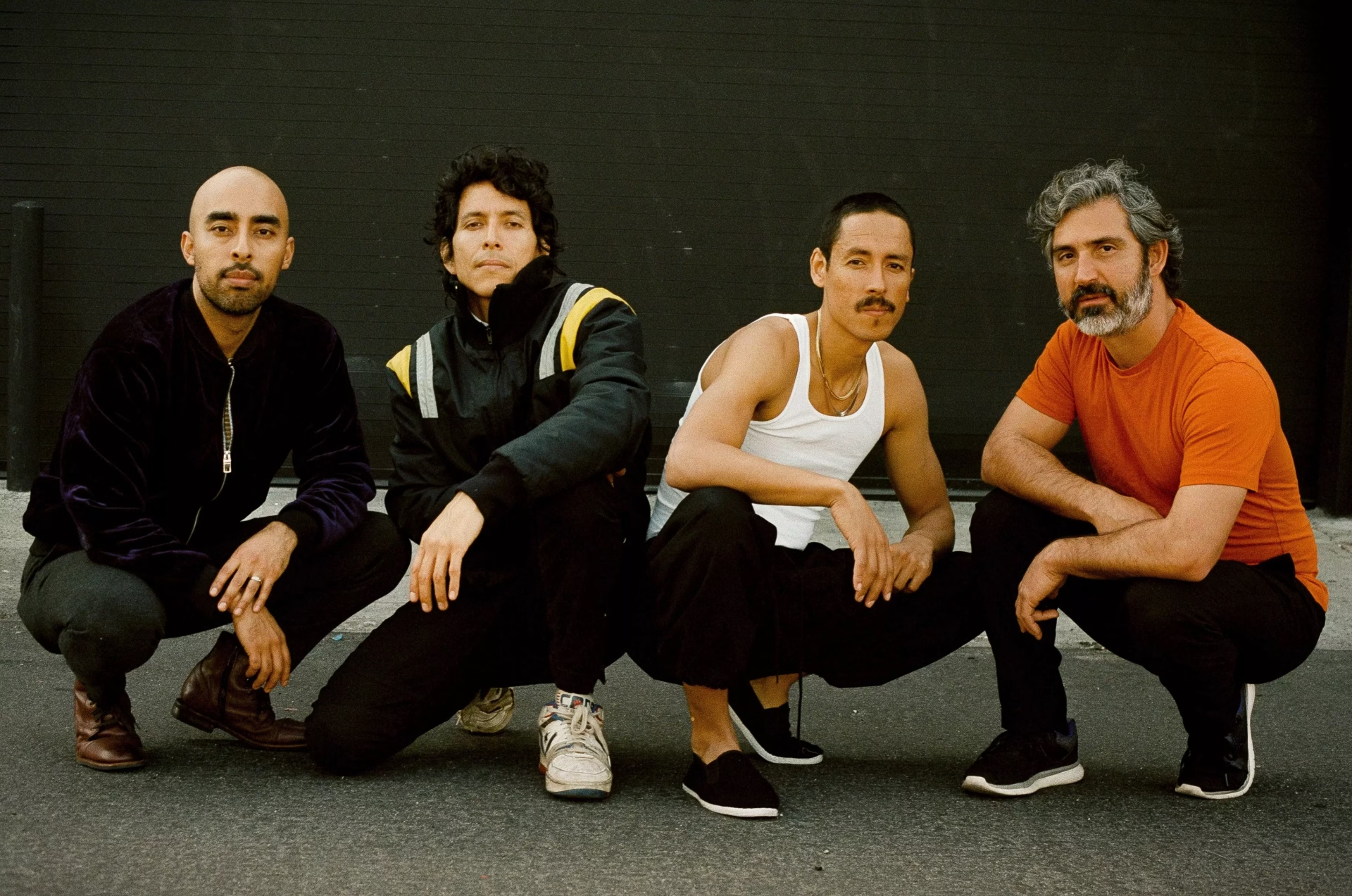
There is real power in music that gets you dancing, feeling joy and thinking about critical human issues. That is exactly what Chicano Batman's music does—drawing you in with their groovy bass lines, warm and soulful vocals and all-around funky, sun-soaked instrumentation and aesthetic. With their fourth studio album, Invisible People, released May 1 on ATO Reords, they double-down on the funkiness and deliver their most powerful, rhythmic project yet.
Founded in 2008 in Los Angeles, the four-piece embodies the true beauty, creativity and diversity of the city they call home. Since the release of their self-titled debut album in 2010, the band has brought their infectious energy and vibrancy to countless shows and festivals through Southern California, the U.S. and abroad, with a (typically) active tour schedule.
With their 2020 tour with Le Butcherettes put on hold until 2021, the group has stayed busy with virtual appearances on "The Late Show With Stephen Colbert," NPR's Tiny Desk, KEXP and more. They've also stayed engaged with their community despite quarantine, offering youth music workshop livestreams with the Young Musicians Foundation and a delicious fundraising taco at L.A.'s HomeState.
In conversation with GRAMMY.com, Bardo Martinez (lead vocals, keyboard and guitar), Carlos Arévalo (guitar), Gabriel Villa (drums) and Eduardo Arenas (bass) dive deep into the creative process and meaning behind their latest album. They get real about identity, racism and representation, and the marinization they have experienced as Latinos in the indie-rock space.
You guys dropped the fourth Chicano Batman album, Invisible People, just back in May. What was the creative process like on this album? How long were you guys working on it?
Villa: A few years?
Arévalo: [Laughs.] A few years. Yes. That's it.
Villa: A few years. Next question. [Everyone laughs.]
Arévalo: Maybe 14 months.
Villa: We had to go on tour, so, we had to stop a little bit. We had writing sessions, but we basically started in 2018.
Arenas: In 2018, we talked about different ideas we wanted to introduce to the new record, and we did a lot of demos. At the end we chose 12 songs. Everybody kicked in on this one and helped develop it, where in the past the Bardo wrote the majority of the songs. This time Carlos was kicking in stuff, Bardo was kicking in stuff. I would join up forces with them and throw in stuff. There were all these different combinations of things that happened that we had not explored in the past.
Martinez: Recording was a big part of it, us using our home studios to record stuff and vibe that way.
Villa: Carlos, talk a little bit about that moment where you came into rehearsal and you were like, "Guys, I know we have to do this album, but wait listen!" [Everyone laughs.]
Arévalo: I had my own little idea of what I thought the record should be in terms of a theme or a direction. That's something I would keep to myself on the past records and then just have my own personal goals for my instrumentation. But this time I shared it aloud to the group. That's choppy waters you can get into because you're asking a drummer to play drums a certain way or a singer to sing a certain way. Well, it's more recommending or showing examples of like, "Hey, could we try it this way this time and see how that goes?" That was a vulnerable place to be. But I've known these guys for so many years, it was time for me to be real with them and hope for the best.
They were receptive, everybody needed a little bit of time at first to just take it in. Once we started trying out these ideas, everybody else started bringing in other stuff they'd been wanting to try before, but maybe never thought this was the project to do that. So, I got the juices flowing creatively for everyone. It was cool.
Martinez: Yeah, this record was a lot of push and pull, as it's always been with our music. It's four dudes in a band, so everybody's pushing for whatever ideas they had in their head. I mean, Carlos was pretty straight forward. He was like, "Well, we should make something we could dance to, danceable music." It was a great idea. It brought us into the late '70s and '80s in terms of aesthetics, in terms of sound—it was new territory for me. It was a lot of fun. It's a dope realm that we eventually got to.
Villa: It was definitely fun to create. The whole process was just fun, fun, fun, and a lot of communication. We learned a lot. We're always inspired and happy to be working with the team so it really, really paid off. You can hear it in the music. If you compare the Chicano Batman discography, you really hear that this album is so different from the rest. It definitely has that element of dancing—for the first time we're doing a lot of 16-notes. [Mimics fast drum beat.]
Listen Up: Record Store Recs: Chulita Vinyl Club On The Best Music Stores In L.A., Oakland, Austin & Beyond
Carlos, that idea you came in with, was it "dancing" music or something else?
Arévalo: I had started a little DJ night as an excuse to play records that I was collecting on the road with being on tour—you hit up shops in Michigan and you find amazing 45s that are just so overpriced in L.A. or that you can't even find them. I was playing once a month at bars and exploring what music has that universal appeal to people, that makes them want to get up and move or sing along. It's a cool way to experience music when you have the sound system at your behest. I was controlling the PA and it's bumping, I could control the bass. I could see what was going on from the mixer. That inspired me.
There's so many 45s that I love. I would play stuff like Talking Heads' "Naive Melody," Tom Tom Club. I'd play Prince's "Erotic City," that '80s music that had amazing songwriting appeal, but simultaneously were hit records. I feel that doesn't go hand-in-hand all the time anymore. Now, you have writers that get together to make a song sound exactly like this other song so it can be a hit and make money. It's about capitalism and it's about getting that publishing. Back then, it was more so you can make an art piece that was also danceable. It was really appealing and inspirational to me.
The Purple One: From Foo Fighters To H.E.R., Chris Martin To Mavis Staples, Here's Who Rocked The GRAMMY Prince Tribute
When did you finish the album? Since you were working on it on and off, was there a period of time where you huddled up and finished all of it?
Arévalo: Yeah, so we started writing the record, like they said, in January 2018. And then we demoed it when we could and we started amassing demos amongst all of us. We had little sessions in between touring and we finally started recording the album in February 2019 at Barefoot Recording, which used to be called Crystal Industries. It's where Stevie Wonder recorded one of his epic '70s trilogy albums, Songs in the Key of Life, those amazing records where he found his synthesizer voice. So many hit records were made there. Sly Stone worked out of there and George Clinton. So, we made Invisible People there for two weeks and then Bardo flew to New York for another two weeks to do vocals and some overdubs. Then we had to wait a year to put it out.
Martinez: Well, it got mixed and we put all the music together. Leon Michels produced it. He definitely put his hand in the sound of it. He's an amazing producer [he's also worked with Lee Fields, Aloe Blacc, The Carters and others] and has an amazing hip-hop sensibility. He knows how to make everything knock. He definitely added some amazing vibes, and then he passed it over to [five-time GRAMMY winner] Shawn Everett who mixed it. So, that was the whole next process of, "okay, well he got the music" and we were in the dark for a week or month or so.
Once we received it, I'm telling you, for me, the summer of 2019 was lit, 'cause it was just blazing, f****ing listening, bumping that in my car. I had just moved into this house that I live in now. It was amazing. Imagine, you move into a new house and you're playing a new record. I had my friends over and it was amazing. It was perfect.
Read: Aluna On New Album 'Renaissance' & Making Dance Music Inclusive Again
The title track, "Invisible People" is really powerful and very pertinent to this moment we're in right now—calling out racism. Can you speak to the message behind this song and how you feel that it informs the rest of the album?
Marinez: We came up with a thesis statement, which was the title itself. Carlos was like, "How about we write a song about how the marginalization of Latinos?" "Invisible People"—for example, not being noticed in the indie music world or being on tour and feeling marginalized just entering spaces like the liquor store in Tennessee. That was one piece of it.
I started tackling different pieces in different verses, and I only have three verses. I wanted to make sure that whatever I was saying was going to be very strong and very poignant, straight to the point. I didn't have time to cut corners, so I was going to be direct with it. I wanted it to be as strong as possible because the music was set up that like that. We went into the studio and that song was [originally] a little bit faster and Leon suggested we slow it down. The instrumentation is super sparse. The beat is heavy, the bass drops on the kick in the perfect place. The music is there for the vocal to just shoot out.
I approached every verse as a different thing. My first line is, "Invisible people, we're tired of living in the dark. Everyone is trying to tear us apart." So, it's obviously pointing at some type of marginalization. It's not necessarily specific. The second line—"smoke a spliff so I could feel now"— I don't even smoke spliffs by the way, I like joints, but it was a homage to maybe Bob Marley or something I knew a lot of people were going to relate to. Something edgy, something cool. The next verse is about race, "The truth is we're all the same. The concept of race was implanted in your brain." I definitely wanted to call that out, race as a construct pretty much.
Also, just to challenge all of that because as a band, as, we're Chicano Batman. We decided to use this name, which has its own meanings as a Chicano, as an identity. I don't know if that's problematic, but it's going to challenge norms within our own community, and also in the superstructure status quo. That's the more obvious knot.
Also, anybody could be invisible in society. It wasn't "Just Latinos are invisible or just people of color." The privilege that White people have in this country is not good for them. When they walk onto the street, into the supermarket, there's a lot of psychological weight to all that history, to alter that reality which is based upon history, decades and centuries of oppression, that White people really have to deal with as well. Everybody, regardless of who you are, if you're living in a city, if you're living in society, you're a part of it. You're complicit in it. You're subjugated by it. People don't necessarily talk about it like that on Instagram. People on Instagram are just pointing fingers at each other. So, that's really not the goal of it. The goal is to be like, "Yo, the truth is we're all in this together." It's not some "We Are The World" shit. It's also, "This record is fire, we're spinning the world around you. We got this record, we're ready to tour and do it big." It's all those things wrapped into one.
Arenas: Piggybacking off what Bardo said about Instagram, they're probably not saying that on Instagram because White cops are too busy killing Black people and shooting them in the back. That's a reality that White privilege has led to, it's not only capitalism, but genocide. That's also what we have to live with today. Not only with religion, but with the way communities are divided, with the way we think, with our mental health as a people, with our communities and the disinvestment in them and the lack of education and resources. This is all very implicit and designed to be this way, to lack people of color of the resources while the few good resources go to the top. That's the system that we've been living under here in the United States for a very, very, very long time.
I think for me, "Invisible People" has a very open open-ended meaning, it's a very big concept, and I think it can definitely be understood differently in 10 years, in 30 more years, et cetera. But right now, to me, it speaks so much about the murder of innocent people, invisible people, who are our family members, our voices, our activists. They're actors of change in our society, the heroes. So, to me, we need to put some extra highlight on that at this moment right now.
Arévalo: For me, the idea for the song was explicitly about people of color and the struggle we've endured. I don't know how many bands GRAMMY.com has interviewed where they get pulled over by border patrol in Florida for driving in a tour van, but that's our experience. I don't know how many indie rock bands have gone through that. Dealing with stuff like that was in my mind when bringing up the idea of the song, and the lack of representation we see of Latinos in the media, you don't see us with parts of substance in movies or TV shows. It's always cliched, and it makes me sick, because we're multi-dimensional. We are more than caricatures.
So, that was part of the idea. Also, just tongue-in-cheek like, "Do you see us now? Here we are, this is our record. Will you acknowledge us yet?" Because there has been a hump of, people keep saying, "Chicano Batman is breaking through with this record, this rising band." And every time we put out a record, we're always this new band that's coming out of nowhere. So, it's a critique on that and how the status quo in the media views us.
You've said "Color my life," which opens the album, is about experiencing nature versus being stuck in the city. Was there a specific experience, feeling or place that inspired this song?
Martinez: That's the first time somebody asked me where, what's the location. I appreciate the question. Honestly, it's Oakland. I lived in Oakland for a year and a half. That was the first thought, literally what I was thinking about when I was writing those verses. I had some lyrics that were taken out too. During the chorus, "You've got to color my life..." I had something about birds. Anyways, Oakland was definitely the place.
Do you feel now when you perform "Color my life" now, especially in a virtual setting like on the NPR's Tiny Desk, do you feel it has taken on new meaning?
Martinez: I'll be honest, it's hard for me to connect with the virtual stuff. It's difficult. I'm a little numbed by the whole virtual reality experience. But what's the new meaning? I just went to the forest recently, to Mammoth for four days with my family. I needed to do that. Honestly, it's been a long time since I've actually gone camping or anything that because of doing the music thing and touring. This pandemic has given me the opportunity to do some of that. I want to do it more often because it's the most freeing thing, just to be out in nature, it's fantastic.
<style>.embed-container { position: relative; padding-bottom: 56.25%; height: 0; overflow: hidden; max-width: 100%; } .embed-container iframe, .embed-container object, .embed-container embed { position: absolute; top: 0; left: 0; width: 100%; height: 100%; }</style><div class='embed-container'><iframe src='https://www.youtube.com/embed//hARU2pnprX4' frameborder='0' allowfullscreen></iframe></div>
"L.A. is what I carry with me all the time... It's what I try to represent in my music, at least respective to the instrument that I play and the swagger I input and the way I want people to move. We want them to feel that this is the way L.A. moves you, when we're in Germany, Brazil or France. It doesn't matter where, it's rooted in L.A. and L.A. is international because our roots are deep." -Eduardo Arenas
As a Los Angeles band, what does the city mean to all of you?
Arévalo: It's a forever home for me. My dad immigrated from El Salvador and lived in an apartment complex in Hollywood and went to Hollywood High, which I can't even imagine—what a dichotomy that must have been. My mom is third generation Mexican-American, so her family's been here since the '20s and they all have roots and stories that come from L.A. It's always been a big part of who I am and where I come from. I still have family that lives out there and also family that lives in L.A. It's an important part of my identity.
Villa: For me, L.A. feels like home. I come from very far away. I was born and raised in Colombia and I've traveled around the world. I had the opportunity and was so lucky to able to go to Europe and live there before coming to the United States. I lived over there for many years. Coming to L.A. straight from Toulouse, France was a big cultural shock for me, learning all these new set of laws and lifestyles. And there's a lot of things I probably will never understand, like the freeway, but L.A. is special, it has so much, it's a place for everyone. I feel it's a big blender and that's something that I like about this city. When I was in France and went to Paris and rode the Metro and saw all these different cultures together, I was like, "This is good. I want to live in a city this."
And I ended up living in L.A., and you have the same feeling just like riding on a Metro in Paris. It's like a dream and every day I'm learning something new. There's a lot going on here in terms of opportunities and work, especially music and media. It's crazy. I'm super glad and lucky to have found my brothers here. The band has embraced me as a Chicano, as a brother, and that's the world for me. Yes, I feel home.
Arenas: I'm born and raised in L.A., I'm from the generation of kids that used to walk to the market and get a gallon of milk and a pack of tortillas. That's how I grew up. I used to sell flowers in the street on Mother's Day and Valentine's Day. We used to sell fruit and vegetables that we'd get, extras from the produce market in downtown L.A. and resell them on the streets. L.A. is me.
I grew up with Hollywood movies and TV shows, all this '80s and '90s action stuff—the vanity that comes with that. And the vision of wanting to be something else that also comes with that. Like Carlos was saying, there's no representation of Latinos on TV, especially when you're growing up in the '80s and '90s, only dumbasses or a donkey mother****ers. Or some, "arriba, arriba" type shit, which we tossed around as culture when we were kids because we don't know better. But, in a lot of places in the country, they still perceive it like that.
L.A. is what I carry with me all the time, even when I lived in Brazil and Panama. It's what I try to represent in my music, at least respective to the instrument that I play and the swagger I input and the way I want people to move. We want them to feel that this is the way L.A. moves you, when we're in Germany, Brazil or France. It doesn't matter where, it's rooted in L.A. and L.A. is international because our roots are deep. Our roots go way back, they're not just bounded to the streets and these grids and these traffic lights, they go down really deep to communities in Mexico, at least for me. I think that's what I can offer.
Martinez: I grew up in La Mirada, Calif., it's a suburb [in L.A. County]. My dad came to Santa Ana, Calif. with his grandma in the late '60s. My mom came to Orange County in the early '80s from Cartagena, Colombia. They established the family. I was the first one to come out and there's only two of us. We moved to La Mirada and lived in some apartments over there for a while, and then they bought a house. Parks and beaches were part of my family's recreational activities. I look at L.A. as a massive region as a county, not just a city.
And to be honest, I'm infatuated by its natural beauty, these hills, the mountains, the wildlife, the ocean. I think of things like, "Wow, I can see the sunset over the oceans horizon because I'm facing directly west" in Redondo Beach. And conversely, the sun sets over the mountains when I'm in Long Beach because I'm facing south. After so many years I can visualize the panorama from various points in relation to the map. Although I navigate L.A.s streets and highways, I'd rather be on a bike, traveling at the speed of my own will, heading in whatever direction without so much regard to traffic or signals. I guess I try to feel the region I live in, as opposed to think of it in the confines of the names and boundaries, that actually don't exist.
What key things do you think are necessary for L.A. to become a place where all of its residents are celebrated and able to thrive?
Martinez: I think it's necessary for people to open their minds, drop the judgement. I feel like traveling definitely helped me see and feel things differently.
"For me, I'd say that following your heart can work!... I'm still marching to the beat of my own drum, because that's what I know how to do, and that's what makes whatever I do unique." -Bardo Martinez
It's been a decade since the band's debut—what have you learned about yourself as artists and as humans since then?
Martinez: For me, I'd say that following your heart can work! I've pursued music for aesthetic reasons, never really thinking about the markers of success, not to say those aren't necessary.
And I'm still marching to the beat of my own drum, because that's what I know how to do, and that's what makes whatever I do unique.