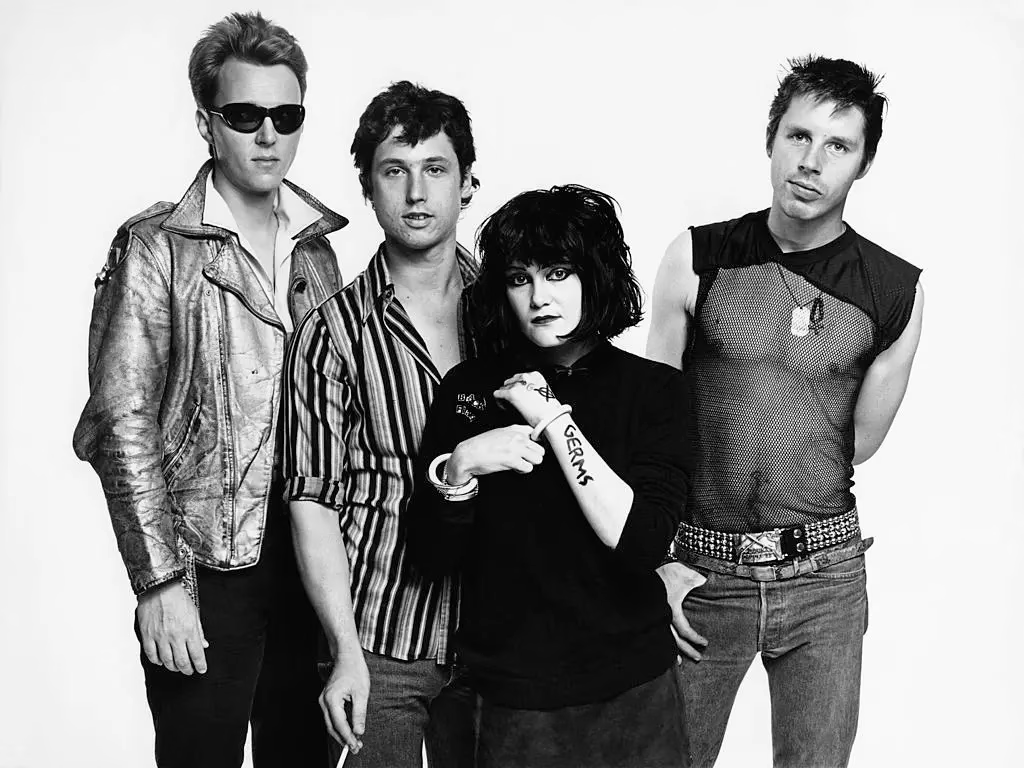
Many misconstrue punk rock as a simple, bare sound: three guitar chords, screamed vocals, straightforward basslines and thrashing drums, all jumbled together and played at breakneck speeds across short, two-minute songs. Indeed, punk's DIY ethos did open a threshold for an everyman and everywoman musician to participate, and in many instances, succeed. But the impact of the sound and scene spans far beyond all those preconceived restraints. With Los Angeles, their 1980 debut album, punk icons X pushed the genre's boundaries while defying them all at once.
X, the legendary Los Angeles quartet, are considered by many music and rock historians as the band that put L.A.'s punk subculture on the map. While the punk scene in New York City had already gained major momentum by the time they formed in 1977, X quickly became the West Coast's answer to pioneering acts like Television, the Ramones and Patti Smith, establishing Los Angeles on equal footing as its East Coast counterpart. Once X released Los Angeles, there were no questions asked about the validity of their hometown's punk presence.
<style>.embed-container { position: relative; padding-bottom: 56.25%; height: 0; overflow: hidden; max-width: 100%; } .embed-container iframe, .embed-container object, .embed-container embed { position: absolute; top: 0; left: 0; width: 100%; height: 100%; }</style><div class='embed-container'><iframe src='https://www.youtube.com/embed//-ey5agy1blc' frameborder='0' allowfullscreen></iframe></div>
On Los Angeles, X combine a hodgepodge of elements and sounds rarely heard or seen in punk. Founding member and guitarist Billy Zoom brought his background in rockabilly, blues and R&B into play, while D.J. Bonebrake added crushing drum patterns. (The album, produced by original The Doors keyboardist Ray Manzarek, feature lots of psychedelic organs, too.) The true magic of Los Angeles, and of X in general, lives within the male-female dynamic of bassist/vocalist John Doe and punk-poet Exene Cervenka, who together wrote the majority of the band's songs and lyrics.
Like the burning X-shaped figure on the album's cover, Los Angeles depicted the eponymous city and society on fire. X, whose members were all non-native Angelenos, except for Bonebrake, encapsulated the underbelly of Los Angeles. Album standout "Sex And Dying In High Society" talks of the city's upper-class indecency, while the title track highlights the city's racism and homophobia.
"[The album is] the uneasy soundtrack of Los Angeles, with its songs about dashed dreams amid the palm trees and mountains," Mitch Schneider, founder and partner at music and lifestyle publicity firm, SRO PR, who worked with X in the '90s, told the Recording Academy.
Released 40 years ago today (April 26), Los Angeles has since been recognized as one of punk's best albums and immortalized as one of Rolling Stone's greatest albums of all time—in any genre.
As for X, the band continues to pummel through the noise: This week (April 22), they surprise-released Alphabetland, their eighth studio album and their first full-length in 27 years.
To celebrate the 40th anniversary of Los Angeles, the Recording Academy chatted with the journalists and creatives who were on the scene when the album first hit and talked to the new wave of artists who have since been inspired by the iconic release.
The quotes and comments used in this feature were edited for clarity and brevity.
<style>.embed-container { position: relative; padding-bottom: 56.25%; height: 0; overflow: hidden; max-width: 100%; } .embed-container iframe, .embed-container object, .embed-container embed { position: absolute; top: 0; left: 0; width: 100%; height: 100%; }</style><div class='embed-container'><iframe src='https://www.youtube.com/embed//nBcSynjBASg' frameborder='0' allowfullscreen></iframe></div>
What was your first memory of X and Los Angeles?
Mitch Schneider (founder/partner at music and lifestyle publicity firm, SRO PR; his previous company, MSO PR, represented X for the band's 1995 live album, Unclogged): Having first seen X at the NYC club Hurrah in November 1978 and then countless times after that after I moved to Los Angeles in January 1979, it was absolutely exhilarating to hear that they got it right with their debut album. I just played it over and over again in my apartment on Norton Avenue in West Hollywood. I still believe it's one of the top 10 debut albums in rock history, a list that also includes the debut album by The Velvet Underground. It's the uneasy soundtrack of Los Angeles, with its songs about dashed dreams amid the palm trees and mountains. I am still haunted by the characters in "Johny Hit And Run Paulene" and "Sex And Dying In High Society."
Robert Christgau (a rock critic since 1967, Christgau writes weekly or more for his own part-subscription, part-free newsletter And It Don't Stop at Substack; he originally reviewed Los Angeles in early 1981; in the year it was released, the album ranked in Pazz & Jop, the annual music poll he created during his tenure as chief music critic and senior editor for New York City alt-weekly, The Village Voice): My brief as a Village Voice critic-editor who started pumping punk in 1975 and published a monthly Consumer Guide of 20 letter-graded album reviews was to home in on any major American punk LP. But for most of 1980, I was on leave, immersed 16-18 hours a day in finalizing my first Consumer Guide collection. So while I must have played it a little, I don't recall it the way I do, for instance, checking out Grandmaster Flash's "The Birthday Party."
But in early '81, when I annotated the Voice's Pazz & Jop Critics' Poll with capsule reviews of my favorite albums of 1980, I began thusly: "From poet-turned-chanteuse Exene to junk-guitar journeyman Billy Zoom, these aren't mohawked NME-reading truants who think Darby Crash is God or the Antichrist. They're sexy thrift-shopping bohos who think Charles Bukowski is Norman Mailer or Henry Miller."
Mike Berault (keyboardist for Southern California ska/pop/punk band Bite Me Bambi and co-host of Mixtape Mixtape Podcast; his previous band, LP3 & The Tragedy, toured with X on the group's 40th anniversary tour in 2017): I remember I watched The Decline Of Western Civilization [1981 documentary about the Los Angeles punk scene], and I saw John Doe giving tattoos in the dressing room before their gig with a needle; this was during the AIDS scare when I saw it. I thought to myself, "These guys are so fucking punk!"
Drea Doll (guitarist/vocalist for all-female punk rock trio The Venomous Pinks): I was first introduced to Los Angeles and X through The Decline Of Western Civilization music documentary. I was 17 at the time, and I found myself at a party with a bunch of punk rockers. The song "Nausea" blasted through the opening scene. I was completely mesmerized by Billy Zoom's guitar riff and the dueling vocals. The unique sound shook my core and woke me as a young musician.
Read: Meet Armageddon Records, The Record Store-Turned-Label For Punks And Metalheads
What is it about Los Angeles that's allowed it to cross so many generations throughout the decades?
Mitch Schneider (SRO PR): I think music fans are still amazed by how the band synthesized their influences into a completely unique sound. There are the breakneck tempos of the Ramones, the virtuosic rockabilly riffs, the off-kilter male-female vocal sound that's rooted in Jefferson Airplane and the Beat-Generation-inspired lyrics. It's an unbeatable and mind-blowing combination of sound and vision.
Mike Berault (Bite Me Bambi/Mixtape Mixtape Podcast): The songs are as fresh and relevant today as they were when they were released. X proved that punk rock could have a relevancy as a genre on its own, like rock or jazz. Until this point, if you thought of punk rock, you probably thought of the [Sex] Pistols, the Ramones or any number of [L.A.] bands: Germs, Black Flag, Circle Jerks, FEAR, Middle Class, etc. X took a step away from what we were coming to know as a "punk" band. They taught us that the songs could be longer than a minute-and-a-half, could have meaningful lyrics [and be] dynamic, with different parts and tempos. X is real, not that the others weren't. They didn't necessarily have an axe to grind. They were describing their real lives, and that kind of honesty is timeless.
Drea Doll (The Venomous Pinks): The diverse approach with their songwriting is what really makes this album so genuine. It's punk, but it also has rockabilly, early country and Americana nuances. There is truly something on this album for everyone. [The title track] "Los Angeles" is an original punk reflection of what was going on in the world in 1980 that still holds truth today. At the time, so many L.A. bands were staying with the same approach by playing straight-up thrash punk rock. Contrastingly, X stood out by unapologetically incorporating different genres. In between experimenting with various musical elements, they still maintained just as much passion and aggression as the run-of-the-mill "hardcore" band.
<style>.embed-container { position: relative; padding-bottom: 56.25%; height: 0; overflow: hidden; max-width: 100%; } .embed-container iframe, .embed-container object, .embed-container embed { position: absolute; top: 0; left: 0; width: 100%; height: 100%; }</style><div class='embed-container'><iframe src='https://www.youtube.com/embed//pfyCUWezVxA' frameborder='0' allowfullscreen></iframe></div>
While X were considered punk pioneers, they also flirted with diverse sonic elements like rockabilly and country. In what ways did Los Angeles define and defy what punk was "supposed" to sound like?
Robert Christgau: Like The Blasters, who nobody mistook for a punk band, and Gun Club, who some did, X went against the grain of the D.C./Minor Threat-inspired avant-anarchistic notions of L.A. punk typified by Black Flag and Germs. Their taste for the roots genres both John and Exene spent their rather different individual careers pursuing began with their 1985 hookup with The Blasters' rhythm section to form the less-than-memorable Knitters. But in X's great period, which I don't think survived John and Exene's 1985 divorce, it was their transmuted fondness for folkish forms that made their songwriting stand out.
Mike Berault (Bite Me Bambi/Mixtape Mixtape Podcast): Los Angeles put it out there that punk can be anything—it was an art form unto itself. It was OK to have organ/keys on the record. It was OK to have rockabilly guitar licks. It was OK to have pop hooks and poetic lyrics and the harmonies-melodic with a street punk sensibility.
X rose from the Los Angeles underground punk subculture yet they are considered one of the city's quintessential bands, regardless of genre. In what ways are X and Los Angeles representative of their hometown?
Robert Christgau: I wouldn't say X are seen as quintessentially L.A. the way The Beach Boys or the Eagles are, because they made no attempt to be smooth or escapist. Theirs is the L.A. of noir novelists like Chandler and Mosley—an L.A. where getting high isn't always a trip, where the rich tell ugly lies of their own as they make the most of capitalism's ugliest secret: the myth of trouble-free material comfort for everyone.
Mitch Schneider (SRO PR): The music is an honest depiction of Los Angeles. Alongside the physical beauty and wealth of the city, there's an underbelly of financial desperation and dreams that went awry. Don't be fooled by the blue ocean, the palm trees and the hills—there's a lot of desperation in L.A.
Mike Berault (Bite Me Bambi/Mixtape Mixtape Podcast): Opposite from the city itself, which reveals a grit with anything beyond a surface or tertiary glance, X gives you the grit first and then hits you with the beauty after and then judges you for not seeing it sooner. In many respects, that is very L.A.
Read: From Punk Rocker To Motivational Speaker: The Surprising Evolution Of Angst
X were leaders in the first wave of the Los Angeles punk scene. What impact did X and Los Angeles leave on the city's punk scene and its overall music and artist community?
Drea Doll (The Venomous Pinks): X implemented their own attitude that screamed, "Take risks and do what you want". Punk rock is not about conforming to anyone's rules or standards, and this album demanded individualism. X defies what we think "punk" should sound like, and that is what truly makes them "punk". The early scene was communally collaborative. These early punk rock ethics laid down the foundation of today's scene.
Kelsey Goelz (Associate Curator at GRAMMY Museum in Los Angeles; in 2017, she helped curate X: 40 Years Of Punk In Los Angeles, an exhibit celebrating the 40th anniversary of X): One of my favorite moments during the installation process [of the X exhibit] was following John Doe as he paced along a row of framed photographs in our gallery. While I took furious notes, he rattled off stories from the band's late-'70s/early-'80s beginnings. I was astonished at the level of detail he recalled so easily: identifying the exact L.A. street corner he stood on when a photo was taken or naming a now-closed concert venue from just a quick glance at its interior walls. These stories became the captions that accompanied each of those framed photos.
During the run of the exhibit, Exene and DJ participated in an education program for a visiting school group in the Museum's Clive Davis Theater. They spoke to the importance of having a supportive musical community, citing their early years among L.A.'s budding punk scene, and offered tips on songwriting and collaborating. It was amazing to watch a new generation interacting with, and becoming inspired by, these L.A. legends.
X were widely known for their literate songs and poetic lyrics, with punk-poets Exene Cervenka and John Doe heralded as some of the best lyricists and songwriters in the punk genre. Los Angeles, for example, lyrically paints a vivid snapshot of the city—scars, scabs, warts and all. What did Los Angeles say about the state of the city itself and the wider American society at the time of its release in April 1980?
Robert Christgau:"Scars, scabs and warts" are their specialty, and good for them. Los Angeles is darker, thematically, than anything to emerge from NYC punk—Ramones, Voidoids, Heartbreakers, whatever. Sure, I prefer John Prine, who's funnier and more measured. But there ought to be brutally frightening songs about rape like "Johny Hit And Run Paulene," even if the slam dancers don't know it. "Sex And Dying In High Society" is about what it says, and so is "Nausea." Not an upful song on the entire album.
<style>.embed-container { position: relative; padding-bottom: 56.25%; height: 0; overflow: hidden; max-width: 100%; } .embed-container iframe, .embed-container object, .embed-container embed { position: absolute; top: 0; left: 0; width: 100%; height: 100%; }</style><div class='embed-container'><iframe src='https://www.youtube.com/embed//QUeKoz4A3dQ' frameborder='0' allowfullscreen></iframe></div>
How has Los Angeles influenced your own music and art?
Mike Berault (Bite Me Bambi/Mixtape Mixtape Podcast): X gave me permission to create: Just create, and something will come out of it. You don't need to know how you are going to get there or where you are going—just stay on the path of creating and you will get something of value out of it.
How would you explain the importance and legacy of Los Angeles to someone who's never heard it before?
Mitch Schneider (SRO PR): It's real, it's fearless, it's visceral, it's cerebral. It's original and utterly timeless. Art triumphs over commerciality in the end.
Read: The Ramones' Pioneering Punk Rock
Los Angeles celebrates its 40th anniversary this month. In your opinion, what will be the album's lasting legacy?
Robert Christgau: To my ears, Los Angeles' lasting legacy is 1981's titanic masterpiece, Wild Gift, and 1983's excellent More Fun In The New World. Many believe that John and Exene then spent a lifetime making meaningful music separately, not counting reunion tours. But I say they were never better than when turning their painful frictions into noise and song.
Mike Berault (Bite Me Bambi/Mixtape Mixtape Podcast): After 40 years, I would say their lasting legacy has already been proven. Before X, punk bands, in my opinion, were considered disposable and adolescent—no pun intended. After X, the genre was one that demanded to be taken seriously and had artistic value beyond the fashion or politics of being punk. That kind of artistry doesn't come along often, where the culture, the fans and even the music business all have to respect that artist. That is why they are still celebrated today.