Two decades ago this summer, the metal community got its own touring festival: Ozzfest.
Ozzy Osbourne, with the help of his wife and manager Sharon, launched the concept in 1996 with just two dates in Phoenix and San Bernardino, Calif. Then, in the summer of 1997, Osbourne and his traveling dark circus traipsed across the country with 14 bands in tow to offer fans the chance to see a full day of the heaviest bands around on two stages.
Of course, Ozzfest went on to more than 10 years of successful tours that showcased more commercially successful bands, and the festival landscape in general would grow to the juggernaut it is today, but there was something special about the early years of Ozzfest.
Arguably the most influential band to any one genre, Black Sabbath are to heavy music what Newton is to physics. The early lineups at Ozzfest read like a lineage of Sabbath's family tree. It's worth remembering that the landscape of mainstream radio changed in the summer of 1999 when Kid Rock and Limp Bizkit started getting airplay alongside Britney Spears and Christina Aguilera, opening the door for heavier sounds on radio.
In the years that followed, more accessible Ozzfest bands such as Disturbed, Godsmack, and larger-than-life shock rockers Marilyn Manson and Rob Zombie would burst through that door and onto the airwaves.
But just prior to that shift, metal fans in the mid-'90s were used to being ignored by the radio. The chance to see their hero Osbourne, both as a solo act and fronting a reunited Sabbath, shoulder-to-shoulder with anti-radio thrash monsters Slayer and Pantera, flanked by an army of the most brutal young bands on Earth such as Neurosis, Machine Head and Fear Factory was, well, a real f***ing treat.
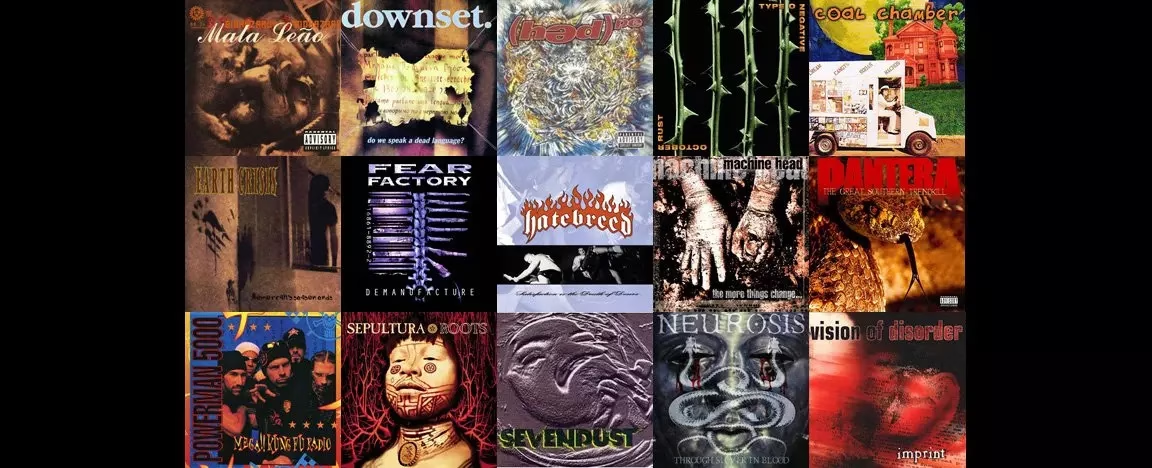
As we look back on the genesis of Ozzfest and the role it played in the proliferation of heavy music, here are 15 metal albums from 1995 to 1998 that still have our ears ringing.
<iframe src="https://open.spotify.com/embed/user/grammy.com/playlist/0EjBg31YF70akZhgSKnWEd" width="300" height="380" frameborder="0" allowtransparency="true"></iframe>
Fear Factory, Demanufacture (1995)
On their second album, Demanufacture, Fear Factory's sound exploded from its death metal roots into an industrial roar that shook Ozzfest's main stage during their early afternoon sets from 1996 to 1997. The Los Angeles band continued to evolve over the course of their tumultuous career, developing dystopian themes and experimenting with instrumentation, but Demanufacture remained many fans' favorite balance of concept, construction and intensity. Years later, Fear Factory frontman Burton C. Bell received a GRAMMY nod for his work with Ministry.
Machine Head, The More Things Change … (1997)
Bay Area bashers pinpointed power on The More Things Changed . … Less technical than their debut, Machine Head brought a raw aggression to the Ozzfest main stage in 1997. While only on the tour for one year, their influence in the genre never slowed. A decade later, the band was nominated for a Best Metal Performance GRAMMY for "Aesthetics Of Hate" from 2007's The Blackening.
Coal Chamber, Coal Chamber (1997)
An instant groove-oriented L.A. shock-rock classic, this debut album stuck to the ribs much better than most of the so-called nu metal spawned during this timeframe, largely due to the musical makeup of the band: Miguel "Meegs" Rascón's uber-creative guitar work, Rayna Foss' signature bass grooves and frontman Dez Fafara's unhinged vocals. Coal Chamber were a pillar of Ozzfest's second stage from '96–'98, and their debut album packaged the demented frenzy of their sound accurately.
Vision Of Disorder, Imprint (1998)
Few albums of this or any era are as relentless as Imprint. Produced by rock mainstay Dave Sardy (Incubus, Marilyn Manson, Nine Inch Nails) and heavily endorsed by Pantera's Phil Anselmo, who makes an appearance on "By The River," VOD vaulted from Long Island, N.Y., to Ozzfest's second stage in 1997. Imprint is pure, unadulterated aggression, punching out of the speakers like a heavy concentrate of undiluted force that still sounds grating, pained and eviscerating nearly 20 years later.
Neurosis, Through Silver In Blood (1996)
Neurosis found their true, monolithic sound on 1998's Times of Grace, but it was Through Silver In Blood guitarist/vocalist Steve Von Till described as "a f***ing railroad through hell," to Rolling Stone in a 30-year retrospective piece. Especially in the mid-'90s, Neurosis were arguably the heaviest band on any bill, both conceptually and sonically. Ozzfest '96 and '97 marked the first times the band braved the sunlight to deliver their crushing, dynamic and brilliant live set.
Powerman 5000, Mega!! Kung Fu Radio (1997)
Early comers to Ozzfest '97 had the privilege of catching this quirky comic book metal outfit fronted by Zombie's younger brother, Spider One. PM5K was more than a novelty, and Mega!! Kung Fu Radio journeyed through funk, rap, rock, and psychedelia. The band went on to find more widespread success with soundtrack placements and even chart success, but as a nascent band with the opening main stage slot, they had something to prove about removing boundaries of creativity in heavy music, and they did.
Type O Negative, October Rust (1996)
Ethereal, dark and haunting, October Rust showed what an indie Goth band with a sense of humor is capable of. Massive, sludgy riffs under a canopy of church synths with the late Peter Steele's baritone calmly cutting through the gut, Type O Negative never sounded more at home in their own style than on October Rust. The band might have been too dreary for some Ozzfest goers, but their inclusion in the festival demonstrated the wide breadth that heavy music encompassed by the time they were slotted in on the main stage just before Pantera in 1997.
Earth Crisis, Gomorrah's Season Ends (1996)
Built on the foundation of hardcore edge, metal arrangements and environmentally conscious lyrics, this New York quintet's second album offered a surplus of discordant guitar melodies and ax-ground vocals, all delivered with devastating force. Earth Crisis would outdo themselves in 1998 album with Breed the Killers, but it was the raw edge of Gomorrah's Season Ends that shot them out of a cannon and onto the Ozzfest second stage in '96.
Hatebreed, Satisfaction Is The Death Of Desire (1997)
Another east coast hardcore band to make it to the Ozzfest stage, Hatebreed were instrumental in blurring the lines between metal and hardcore punk. In true punk-rock form, Satisfaction … has 14 songs, all of them ballistic, and clocks in at just over 26 minutes. Their debut album put Hatebreed on a path that would lead to a long and influential career, including a GRAMMY nomination for Best Metal Performance for 2004 for their song "Live For This."
Sepultura, Roots (1996)
Roots marked a turning point, not only for Sepultura, but for the controversial shift in metal the album represented to some critics. The dense, claustrophobic rhythms of thrash metal inherited the rhythmic space created by early Sabbath without losing any intensity. But by 1996, the influence of new bands such as Korn, and later, Deftones, found its way into many traditional metal bands' sounds. For Sepultura, a Brazilian band led by brothers Max and Igor Cavalera, the difference was the other influences that informed their sound. As a result, Roots blended equal influence from the evolving pulse of metal with their death metal origins and native Brazilian tribal culture.
(HED) p.e., (hed) p.e. (1997)
While most of the rap-rock of this era would be short-lived and formulaic, (HED) p.e.'s self-titled debut was arguably more aggressive and inventive than many of their contemporaries. The Southern California group joined Ozzfest's second stage in '99, eventually helming the main stage for the U.K. run in 2001.
Sevendust, Sevendust (1997)
The Atlanta newcomers joined Ozzfest in '98 on the strength of their self-titled debut that wielded heavy groove riffs underneath frontman Lajon Witherspoon's effortless vocal ability to growl and soar. The fresh brand of heavy Sevendust brought to the table in the late '90s transcended rap-rock stereotypes to give way to a more electronic and melodic sound the band perfected on subsequent albums. Sevendust showed the promise and originality of the band that would go on to be nominated for a GRAMMY for Best Metal Performance for "Thank You" from 2015's Kill The Flaw.
Watch Sevendust's Lajon Witherspoon discuss their first career GRAMMY nomination
Downset., Do We Speak A Dead Language? (1996)
Formed in 1986, Downset. put in their share of time on the L.A. metal scene ahead of landing the headlining spot on the second stage of Ozzfest '97. Lyrical positivity and musical experimentation, mixed with a blend of blending hardcore and hip-hop elements, boldly underlined Downset. as a band with something to say. This urgency is especially palpable on Do We Speak A Dead Language?, which marked a high point in the band's career.
Biohazard, Mata Leão (1996)
Brooklyn, N.Y., hardcore pioneers were also nearly 10 years into their career when they landed on the Ozzfest main stage in '96 on the heels of Mata Leão, their fourth album. Biohazard looked and sounded like a no-nonsense hardcore band, but they were also ahead of the curve with infusing hip-hop into a raw, street metal aesthetic that achieved new peaks of grinding musical gears and in-your-face vocals.
Pantera, The Great Southern Trendkill (1996)
Simply put, Pantera were the kings of this scene. The now-legendary quartet took their fitting throne as the penultimate act on the Ozzfest stage before the host himself appeared. By the time … Trendkill was released in 1996, word had gotten out about Pantera's unmatched live show, led by late guitar virtuoso Dimebag Darrell's riff arsenal. Pantera earned four GRAMMY nominations in their career, but perhaps more importantly, they also embodied Ozzfest's underground movement in the early years, proving a band could succeed without support of mainstream radio and only marginal exposure on MTV. For many fans, Pantera was the band that drew them to Ozzfest in the first place in '97 and again in 2000, opening doors for other bands on mainstream's fringe to find an audience.
