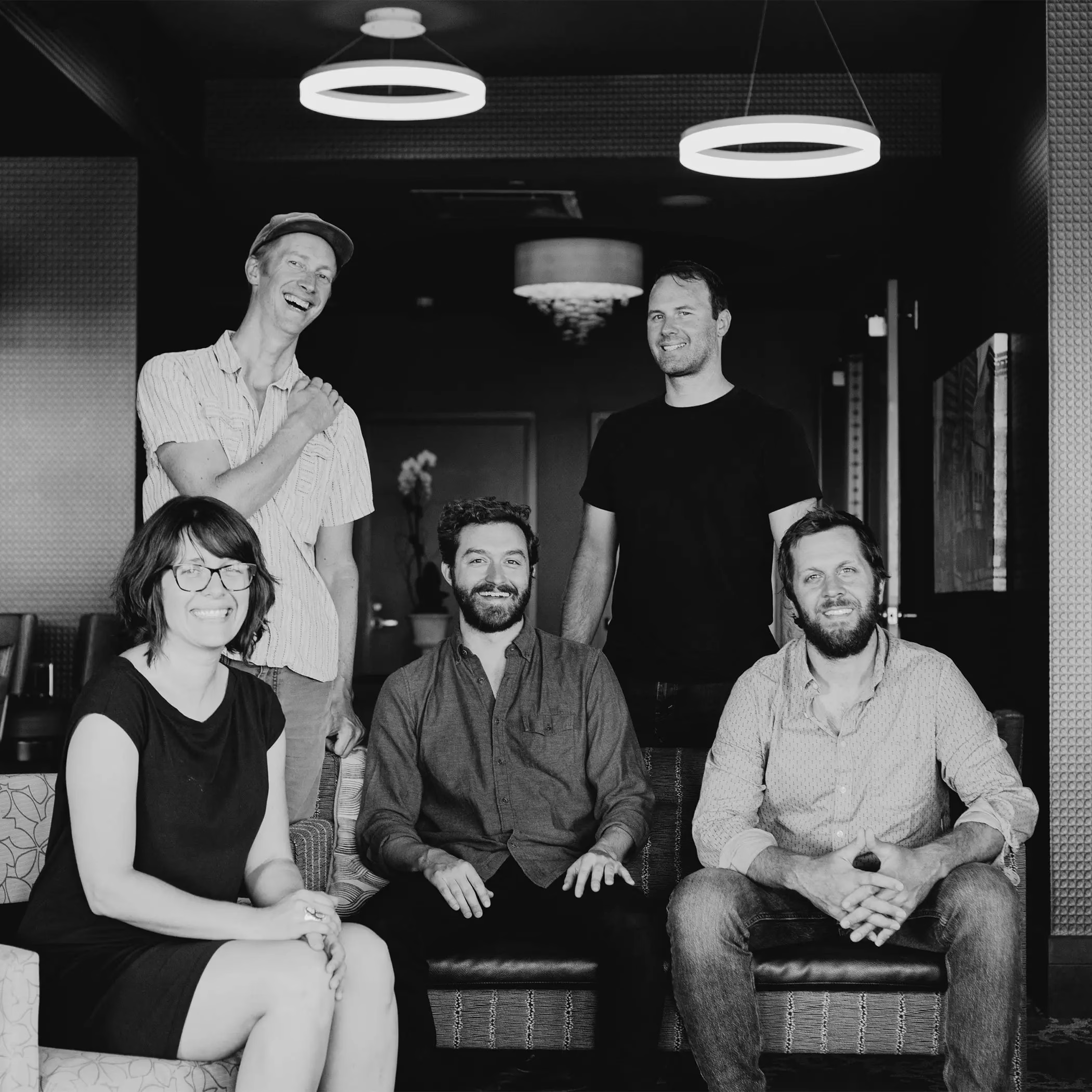
Colorado and the majestic Rocky Mountains have produced many successful bluegrass and newgrass bands over the years. From Yonder Mountain String Band and Leftover Salmon to the legendary GRAMMY-nominated group Hot Rize; the Centennial State has brought a different perspective to the bluegrass genre time and time again. Enter the band Trout Steak Revival, who is following in the same footsteps as the acclaimed groups mentioned above.
Like so many of the Colorado groups, their music tends to be more wide open, heavily influenced by the relaxed lifestyle of Colorado and by nature itself, as in the mountains, the canyons and the high desert.
What is fascinating about the Colorado music scene and many of its most successful bands, including Trout Steak Revival, is that the musicians are mostly non-natives. The groups are almost routinely made up of folks who grew up elsewhere then moved to Colorado and the Rocky Mountains seeking adventure and cameraderie, and that spirit is found in the sounds they create together.
<blockquote class="twitter-tweet"><p lang="en" dir="ltr">Thursday at <a href="https://twitter.com/IntlBluegrass?ref_src=twsrc%5Etfw">@IntlBluegrass</a> <br>4:20PM: Convention Center Workshop Stage<br>11:00pm: <a href="https://twitter.com/DaddarioandCo?ref_src=twsrc%5Etfw">@DaddarioandCo</a> Marriot Suite 1727 <a href="https://t.co/a6l1RXXAIz">pic.twitter.com/a6l1RXXAIz</a></p>— Trout Steak Revival (@troutsteak) <a href="https://twitter.com/troutsteak/status/1177254907130388480?ref_src=twsrc%5Etfw">September 26, 2019</a></blockquote> <script async src="https://platform.twitter.com/widgets.js" charset="utf-8"></script>
Hot Rize, for instance, the great band from Colorado that won the first-ever International Bluegrass Music Association (IBMA) Entertainer of the Year award in 1990, was filled with migrants. Original member Pete Wernick was from New York City, Tim O’Brien was from West Virginia, Nick Forster ventured west from the Hudson River Valley of New York, and Charles Sawtelle came north from Texas. After Sawtelle’s untimely death, Bryan Sutton stepped in to fill the guitar chair as a native of Asheville, NC.
This weekend, as the Recording Academy hit the road to cover the IBMA's Wide Open Bluegrass Festival in Raleigh, NC, we found the members of Trout Steak Revival relaxing at the 10th and Terrace Rooftop Bar at the Residence Inn overlooking downtown and the State Capitol.
It is Saturday of the festival, and in a few hours Trout Steak Revival will be performing on the Capital Stage, one of the nearly dozen official and unofficial stages that can be found on the blocked off streets during the Wide Open Bluegrass festival. There are literally over 100,000 people in town for the event, and the band members are all looking forward to performing for a large and enthusiastic audience.
Based in Denver and various other mountain towns in Colorado, Trout Steak Revival has been together for about ten years now and include Bevin Foley on fiddle, Casey Houlihan on bass, Steve Foltz on mandolin and guitar, Will Koster on Dobro and guitar and Travis McNamara on banjo. One of their big breaks came when they won the band contest in 2014 at the Telluride Bluegrass Festival. Since then, they have risen up the festival poster with their name written in bigger and bigger fonts as their popularity has increased. The group also won an Emmy Award for their original music used in the highly praised PBS documentary called Rocky Mountains.
<iframe width="620" height="349" src="https://www.youtube.com/embed/oD06EsOypJM" frameborder="0" allow="accelerometer; autoplay; encrypted-media; gyroscope; picture-in-picture" allowfullscreen></iframe>
Foley is the only band member of Trout Steak Revival who grew up in Colorado. The rest of the group grew up in either Wisconsin and Michigan. Houlihan was one of the first to venture west having grown up in Kenosha, Wisconsin.
“I went to school at the University of Minnesota, where I met Steve, and while I was in college I was a camp counselor in Michigan, which is where I met Will and Travis,” said Houlihan. “After graduation, I got a job at a camp in Conifer, Colorado, located a half hour west of Denver. It is still considered in the Front Range, although it is in the mountains. The Rocky Mountains are a huge playground, but it is also very humbling. If you want to hike to the top of one, you better be ready because they will kick your butt. When I first moved there, I was in man-versus-mountain mode, but I have curbed that back a little bit as I’m no longer in my 20s.”
Koster is from Casnovia, Mich., which is just north of Grand Rapids. He told us a bit about the band's formation, playing shows at small Colorado bars.
“Casey, our bass player, got a job in Colorado working in the mental health field and I was working at a summer camp in Michigan living in a tent,” said Koster. “One day, Casey said, ‘Hey, I have this job out in Colorado working with kids and they have an opening.’ So, I took the job and I moved out there and I got to stay in this cabin on 150 acres for free while working at this school. It was a pretty cool way to start living in Colorado. We would work for two days and then have four days off, so we started playing music together. It wasn’t really bluegrass picking then, but we began to learn tunes. We lived in Conifer, Colorado, and there was this bar called the Buck Snort Saloon there near Pine Junction that was so tiny, you felt like if there were 100 people in the place it would fall off the cliff. We started playing there doing cover tunes and some originals.”
Koster did not initially play bluegrass music, but was later introduced to it due to an unexpected road trip.
“One year, I went to the IBMA Convention when it was in Louisville with a friend and I walked in and saw all of the jamming going on,” said Koster. “I thought it was cool, and I liked to jam, but all I played at the time was the blues and not bluegrass. I found myself in a jam with these gals playing ‘Salt Creek’ or some other traditional tune and they ended up rolling on the floor laughing at me. I was bending strings and didn’t have a clue. Then one of the girls said, ‘If you like to bend notes, why don’t you get a Dobro or something?’ And, I did.”
<iframe width="620" height="349" src="https://www.youtube.com/embed/EHWsxxwsl6I" frameborder="0" allow="accelerometer; autoplay; encrypted-media; gyroscope; picture-in-picture" allowfullscreen></iframe>
“I followed Will and Casey out to Colorado after Will ran this PR campaign on me because he wanted to get me out there,” added McNamara, who is from Grand Rapids, Mich. “Whenever it was rainy and grey, which was nearly all of the time in Michigan, he would call me up and leave messages on my phone saying, ‘Hey Trav, this is your friend Will. Did you know that Denver, Colorado, experiences 300 days of sunshine every year? That is more than in Tampa, Florida, my friend. Give me a call back.’”
Foltz, oringinally from Rhinelander, Wis., near the incredibly beautiful Upper Peninsula region of Michigan and Lake Superior, talked about joining the band after his burning desire to get back into music steered him toward the group.
“I graduated with an Architecture Degree at the University of Minnesota and moved out to Vail, Colorado, for my first architecture job and worked in that field for about five years,” said Foltz. “Slowly, our band started to grow while I also got my Masters in Architecture in Denver, but then came the economic crash of 2008 and there were no jobs whatsoever. I did some accident reconstruction work for a couple of years, but what I really wanted to do was play music. That experience taught me that you got to do what you love in life because there are no guarantees about any career path. So, I took a chance on Trout Steak Revival.”
Foley, who began playing the violin as a kid, mostly performing with the school orchestra, concentrated on classical music throughout her college years. Later, she began to notice the sound of the fiddle on jazz records and Stuart Duncan’s fiddle work on some Garth Brooks albums. She eventually joined a folk group and took Texas fiddling lessons to expand her musical horizons. Eventually, Foley went to her first small bluegrass festival.
Photo: Paul R. Giunta/Getty Images
“Then, I started listening to the Yonder Mountain String Band, who in Colorado were a gateway group for people who didn’t know what bluegrass or newgrass was, and Hot Rize as well,” said Foley. “Yonder put out those live Mountain Tracks albums and I had a friend who gave me three of those CDs. She just wrote the words, ‘Bluegrass good,’ on them. They were the first group that I listened to that made me think, ‘Wow, this is awesome. Maybe I could play this music.’”
After the four men met Bevin and eventually talked her into joining Trout Steak Revival, the musical journey has been hard yet magical and upwards in trajectory. Now, they tour the country from Atlanta to New Mexico, from Montana to here in Raleigh, North Carolina. They have a new album in the works, which will further showcase their fun and original music inspired by Rocky Mountains of Colorado.
“The view of those mountains does not get old,” said Foltz. “To go into the mountains with just a backpack and some food, being in the wilderness with no city sounds or lights but just stars; it is beautiful. Natural experiences have changed my life. And, it affects our music a lot.”
Sierra Hull Takes Her Place In Bluegrass History, Talks Legacy & New Music At Wide Open Bluegrass
