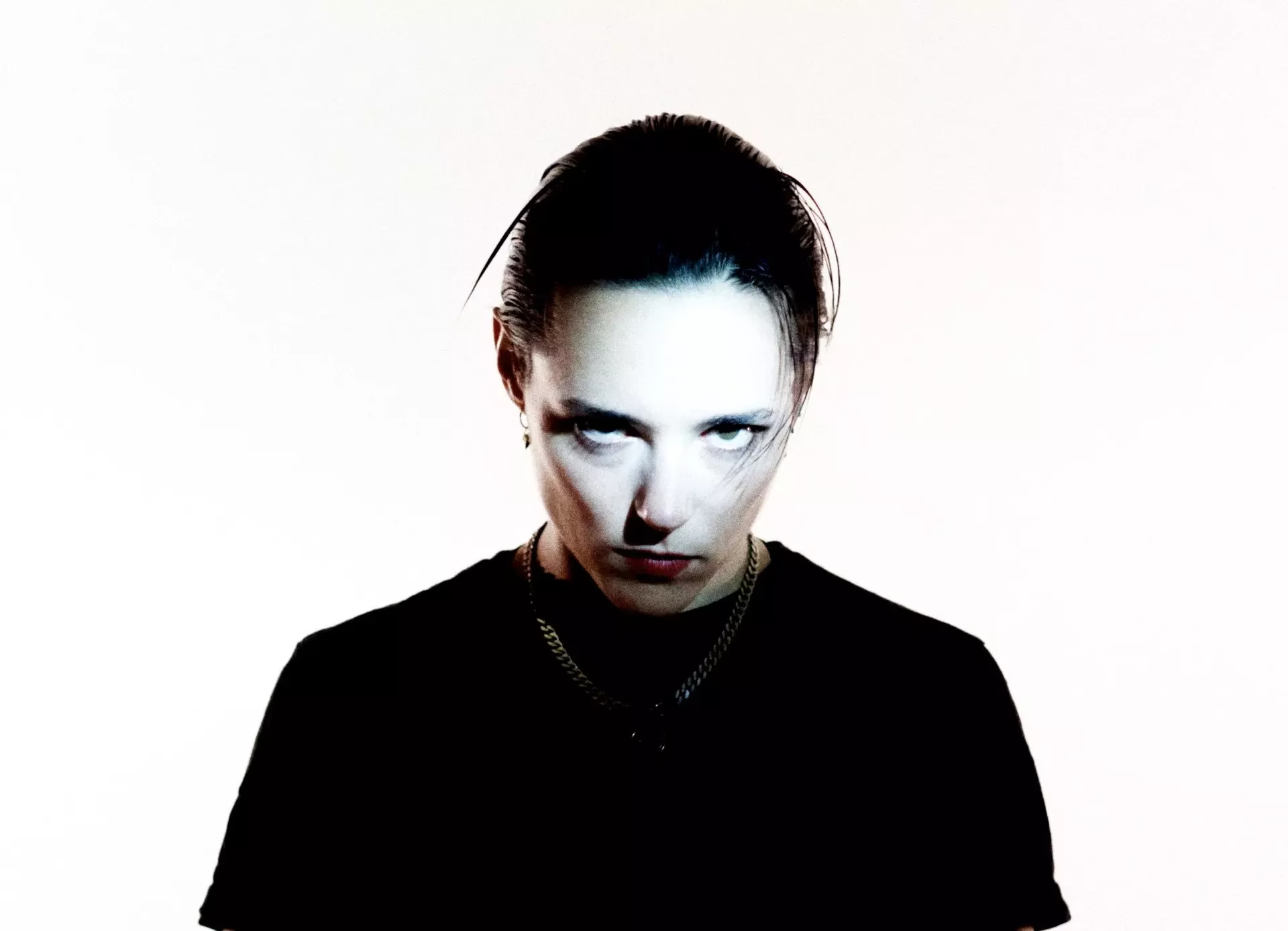
Jehnny Beth’s newest work, To Love Is To Live, opens with the spoken-word declaration "I am naked all the time/I am burning inside." It’s an aggressive statement, one delivered in an androgynous, robotic voice. But for fans of the musician (née Camille Berthomier), it’s not an outside-of-the-box ask. Through her work as front person of the Mercury Prize-nominated band Savages, and as her work as an actor, writer and poet, Beth has asked fans to explore the dark and so-called taboo corners of human existence.
But on her solo debut, Beth pushed out the boundaries of her creative impulses. Crafted with assists from Gorillaz, PJ Harvey, Anna Calvi and Julian Casablancas, To Love Is to Live is an expansive album, filled with cacophonous industrial noise and cinematic interludes. Each shift directly reflects who Beth is as both an artist and person—a fact she acknowledges with a nervous laugh. Her move back to her native France, anger at life in modern society and desire for transcendence—all of these are not only represented, but fully explored.
Ahead of the release of her album (out now via Pop Noire), Beth spoke with the Recording Academy about how she’s driven by a fear of death, looking for herself in pop culture and learning to accept a universe of identities.
<style>.embed-container { position: relative; padding-bottom: 56.25%; height: 0; overflow: hidden; max-width: 100%; } .embed-container iframe, .embed-container object, .embed-container embed { position: absolute; top: 0; left: 0; width: 100%; height: 100%; }</style><div class='embed-container'><iframe src='https://www.youtube.com/embed/F8WMhLzBU94' frameborder='0' allowfullscreen></iframe></div>
Given that you have so many different projects and get across so many different skill sets, is there a better question to start with than "what do you do?"
"How are you" is a better question than "what do you do?" I think actually "What do you do?" is quite an American question. It's something I'm asked a lot when I go to America more than Europe, I've noticed. But you are what you do, probably. But with my friends I prefer "How are you?" But what we do is very important as well, you know, it's central to who we are as well. Part of it, anyway. The choices we make.
Given that, do you see yourself directly reflected in the music you make?
Yeah. Which is sometimes quite disturbing. And sometimes I'm afraid that people would see me as well, but, but it's part of the game. It's part of the exposure. I wanted to go in those areas where I didn't feel that comfortable. Because I didn't want to repeat myself. If I heard musical sounds that I felt I knew what it was, I want to keep it for the record. The whole purpose of this record was to trying to do something new. There's a lot of fear that comes with not knowing, but it's a lot of excitement.
Was there any hesitation or fear of presenting this under your own name, as opposed to as part of a band?
No, there was never hesitation in that way. It's more like in the writing process. Sometimes you censor yourself. And that was well surrounded with people. It is quite a collaborative record, people helping to keep me on track, and not to hide.
Where was the point in your life when you started wanting to say something outside of Savages?
I always had something to say outside of Savages. I always expressed myself as an individual, I never really expressed myself as a group. I always thought of myself as an individual as an artist in my own setting on my own two feet. And I rarely asked for permission to say things I want to say. So there's not really much difference.
I read this beautiful statement where you said that you were working on To Love is to Live like you were going to die and this could be your final statement.
I know, heavy, right? I just was so afraid to die before making this record. Maybe it happens on every record, but the first time he happened to me so vividly. I was certainly very aware of my own mortality, the fact that life also short and I really wanted to do this. I think I can die now. But I felt that, the sense of the connection between life and death is it gives value to life, I think it brings a certain density to it. And I think, through the making of this record, I wanted to keep that feeling alive. When you're in close contact or in close exposure to death, I think we are generous, you know, towards ourselves and towards others and we're more maybe we're better. We give the best of ourselves, and sometimes sadly we wait the end of our lives to do that. I wanted to try to keep that feeling for the record and so that not in a serious way, but it would bring more weight to the words into the work itself because I constantly reminded myself that it would out live me.
When you frame it like that, the idea that we're not kind to ourselves or give our best until you're near death becomes one of the great tragedies of life.
It is. But at the same time, living is about forgetting that we're going to die, otherwise we wouldn't be able to live. We have to forget.
<style>.embed-container { position: relative; padding-bottom: 56.25%; height: 0; overflow: hidden; max-width: 100%; } .embed-container iframe, .embed-container object, .embed-container embed { position: absolute; top: 0; left: 0; width: 100%; height: 100%; }</style><div class='embed-container'><iframe src='https://www.youtube.com/embed/QYcVIPQiOpU' frameborder='0' allowfullscreen></iframe></div>
Do you have a personal concept of the afterlife?
I started to be really interested in astronomy a few years ago. And this is gonna sound very strange. But up until maybe four or five years ago, I didn't know there was a universe. I wasn't really conscious that we're living on earth, on the planet in the middle of nowhere. I was sort of mad as well because I was like, nobody really explained that to me in a way that Neil deGrasse Tyson has explained it to me. And so I became quite obsessed with knowing more about the stars and the planets in the universe and it became not a religion, but it brought meaning into my life in the sense of knowing simple facts about the creation of life, how we are made of stardust, and when we die, we become stardust again, and, and those things are very simple, but actually quite complicated. But they're simple to understand, but they also kind of mind-blowing. And I like the shift of perspective it brings to life.
How has your definition of love changed as you've gotten older?
It has changed a lot. It keeps changing. Something that hasn't changed though: I've always struggled with codes of romanticism imposed on relationships. And I joke to say that I actually more into post-romantic love in the sense that I think the codes of romanticism are quite ancestral and the problem I have with romanticism is that it generates so much frustration because we are disappointed to see all reality disagree with the idea of love is being made to accept as the only alternative. And we think we know what the relationship requires what makes them valuable, but we don't imagine that love is something we can learn.
<style>.embed-container { position: relative; padding-bottom: 56.25%; height: 0; overflow: hidden; max-width: 100%; } .embed-container iframe, .embed-container object, .embed-container embed { position: absolute; top: 0; left: 0; width: 100%; height: 100%; }</style><div class='embed-container'><iframe src='https://www.youtube.com/embed/sUQCBCJkG5Y' frameborder='0' allowfullscreen></iframe></div>
So, we fall in love and we're unhappy and we don't know why. And I think what I've been looking for in art, film, and records and that's why I struggled so much with pop culture. Sometimes I'm looking for alternatives. What are the alternatives? What is the way I can shape a relationship—love in general—that suits me, and doesn't necessarily follow the rules of loving that are imposed by society? And I mean, family and monogamy, some people feel very content with it, and there's no judgement in that. I think that's wonderful, but there are some people who don't, and maybe in a moment in your life, you will feel that it doesn't fit anymore. So it's just I think trying to question that ideas, those ideas and and find them if we can.
It is interesting how it seems like we all want to see ourselves in some way reflected in pop culture.
Yeah. And that's why sometimes I struggle. Like the '50s pop culture with Phil Spector and all these amazing songs, I never was able to cover any of them because I can't sing them with these with enough belief, I can't. Because they describe a certain kind of love that for me seems to not exist. Or not the kind that I believe in. And maybe they also tend to draw a line between good and bad. I feel that I like to cross those lines just for fun, artistically anyway.
Is that where a song like "Flower" comes in?
"Flower" is in the contiguity of songs ever written about women in the past, Even in Savages. It comes from my fascination for women and since a very young age, and fascination that I was unable to express as much as I wanted to, which caused a lot of anxiety for me and a lot of issues when I was younger. Now I'm fine, but I mean, there's still this trace of fascination and also this excitement coming from the distance, the idea that distance is sexier than the touch and this power that the woman has over me. It's quite an exciting feeling, but it's scary as well.
<style>.embed-container { position: relative; padding-bottom: 56.25%; height: 0; overflow: hidden; max-width: 100%; } .embed-container iframe, .embed-container object, .embed-container embed { position: absolute; top: 0; left: 0; width: 100%; height: 100%; }</style><div class='embed-container'><iframe src='https://www.youtube.com/embed/XwOjI60EsTw' frameborder='0' allowfullscreen></iframe></div>
It's an interesting thematic niche you've created for yourself. I know the song "Heroine." Do you see yourself as a role model?
No, I struggle a lot with that. It's not my instinct to think of my role model. I have role models and I think role models are important. I just think that it's not something I have to think about. Role models for me were men and women who were free, who didn't really wait on anybody. They were not afraid to speak up and to express themselves. So I think it just comes down to that. But if you start to think of the impact you have, it can be a bit daunting. "Heroine" the song was indeed a journey, lyrically to try to come with that line, which seems very simple: "All I want, all I need is to be a heroine." And although it talks about my journey, it's also about everybody's journey in the sense of coming to realize that you are the heroine and you can be in control of your narrative. It's like a declaration of independence, in a way. Which I needed in the record because, if you mix it with [the song] "I'm the Man" it's another transformation. Transcending all your fears, that's what a hero is, right?
It seems like the song "Innocence" in all its glorious chaos was hitting on a different part of the emotional spectrum.
In the song, the ideas and feelings expressed are anger from a place of loneliness. It's a song about isolation and which is a feeling that is often created by living in big cities. It's so populated you start to gets a bit sick of humanity, that feeling of sickness. I was really ashamed of that feeling. Even putting it onto a song felt like blasphemy. So if I feel that way, maybe someone else does. The whole record was about sharing not just the good side of me. If I'm going to do personal record, I'm going to share the things that I'm a bit feeling a bit shitty about.
<style>.embed-container { position: relative; padding-bottom: 56.25%; height: 0; overflow: hidden; max-width: 100%; } .embed-container iframe, .embed-container object, .embed-container embed { position: absolute; top: 0; left: 0; width: 100%; height: 100%; }</style><div class='embed-container'><iframe src='https://www.youtube.com/embed/-heQqKo-Dh4' frameborder='0' allowfullscreen></iframe></div>
After creating this album, do you feel more at peace with the sides of you that you said aren't particularly positive or those things that society tells us we're not allowed to feel?
I don't think you can always be at ease. But I think definitely the idea of having different name, to be called "Jehnny Beth" means you can say whatever you want. It empowers you. I can say things I wouldn't be able to say as Camille; I don't know why I do it. Creating or making music or writing is a way to understand more about yourself, isn't it? And when you read someone else's work, or listen to someone else's music, it's a constant back and forth with the work and that you sends you back something that you haven't thought of. It's constant dialogue and that's why it's interesting. I think I'm interested in dialogue, in making the evil man talk with the heroine and having this cross between all the universe of identities that are inside of us.
