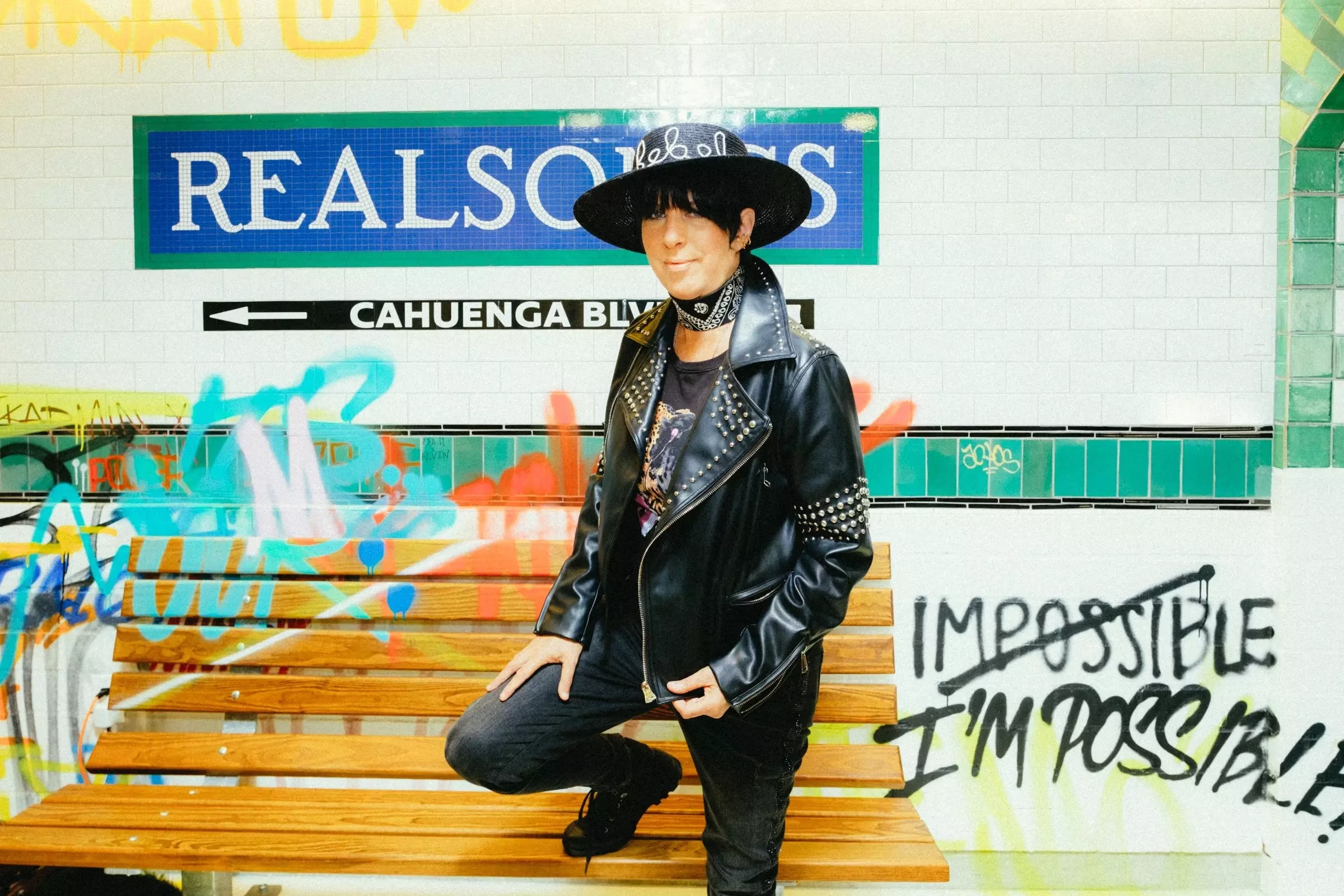
Like a bird simply being a bird or a tree being a tree, Diane Warren has an unshakeable understanding of herself—both what she is and isn't. She's not a singer. She doesn't perform live. Rather, Warren writes songs—some of the most successful songs of all time, for artists like Lady Gaga, Aerosmith, and Cher. She harbors no illusions about doing anything else. Nor does she play up the persona of the arteest, getting precious in interviews about "the craft."
That said, what prompted this non-performer to release her first-ever studio album, The Cave Sessions, Vol. 1, with a litany of famous collaborators—ranging from Carlos Santana to John Legend to Ty Dolla $ign? While considering the pantheon of DJs in the music world, the GRAMMY winner and 15-time nominee had a lightbulb moment. "I thought, 'You know what? I'll be DJ Diane and I'll do the songwriter version of that,'" Warren tells GRAMMY.com. As such, she took a crack at a "curated body of work" of self-written songs.
<style>.embed-container { position: relative; padding-bottom: 56.25%; height: 0; overflow: hidden; max-width: 100%; } .embed-container iframe, .embed-container object, .embed-container embed { position: absolute; top: 0; left: 0; width: 100%; height: 100%; }</style><div class='embed-container'><iframe src='https://www.youtube.com/embed//6uKO4zvnND4' frameborder='0' allowfullscreen></iframe></div>
DJ Diane's gambit paid off on the first volume of The Cave Sessions, which was released August 27. (In fact, she's already pondering a Vol. 2.) The wildly diverse and genre-shifting album gets sultry ("She's Fire," with Santana and G-Eazy), ebullient ("Seaside," with Rita Ora, Sofia Reyes, and Reik), and cathartic ("Where Is Your Heart," with John Legend) in equal measure. What ties it all together is Warren's unmistakable songwriting voice—economical, universal, leading with emotion.
As for Santana, it was no problem jumping on "She's Fire" on short notice—despite not previously knowing Warren, not to mention the unconventionality of working with a rapper. To explain this, he evokes the landscapers on riding mowers in his Maui neighborhood. "Behind them, there are 12 to 20 white storks, and they look like angels following them," he tells GRAMMY.com. "I feel like that. I feel like I can mow anybody's lawn—or be in anybody's song—and just show up, and the angels will show up with me."
Ultimately, that's what The Cave Sessions, Vol. 1 sounds like: A master stepping out from behind the curtain with earned confidence—and a battalion of powerful guardians cheering her on. Read on for an in-depth interview with Diane Warren about The Cave Sessions, looking back on her decades-long career, and the one thing she'd change about the music industry.
<style>.embed-container { position: relative; padding-bottom: 56.25%; height: 0; overflow: hidden; max-width: 100%; } .embed-container iframe, .embed-container object, .embed-container embed { position: absolute; top: 0; left: 0; width: 100%; height: 100%; }</style><div class='embed-container'><iframe src='https://www.youtube.com/embed//fOoBZMOUQwU' frameborder='0' allowfullscreen></iframe></div>
This interview has been lightly edited for clarity.
Can you lay out the foundation of how The Cave Sessions came to be?
The Cave is my writing room, and it's really disgusting. I haven't cleaned it in quite a long time. The idea of doing this record was that I saw so many DJs—Mark Ronson, DJ Khaled, David Guetta—all these guys that do that. I thought, "You know what? I'll be DJ Diane and I'll do the songwriter version of that."
Most songwriters are in one genre; I'm all over the place—I wanted my album to reflect that. I'm still going to do the same thing I normally do where the artist does all the work, but it's a curated body of work. That's what's different.
You've never recorded an album under your name before. Why is that?
I'm a behind-the-scenes person, basically. I'm cool just writing songs for people. That's still what I'm doing on this record. The artists and producers are doing all the work; I happened to write the songs. I just thought it was a cool thing to do to show the diversity in styles in what I do and tie it all together—hopefully with great songs.
It was almost like a microcosm of my career in the various styles I work in—whether it's Latin, whether it's country, whether it's rock, whether it's hip-hop or R&B. I'm everywhere, so I wanted my record to be like that.
What was it about your early development that made you want to remain behind the curtain?
I always just wanted to be a songwriter. I wasn't one of those people where it didn't work out being an artist, or being in a band. I never was an artist, and I never was in a band.
There was no question about what you wanted to do, then.
Yeah, it was never a question of what I wanted to do. I knew from when I was a kid that this is what I aspired to be and wanted to do. I've known it for a while. It's what I do.
Tell me about your collaborators on The Cave Sessions. How did they arrive in your orbit?
We'll start with John Legend and "Where Is Your Heart." I just kept getting frustrated that he kept not using the song. It was such a great song and performance. I kept giving it to other artists and he wanted it back and then wouldn't use it and I'd get it back from him.
Truth be told, nobody sounded as great as John Legend on that song. A couple of other people worked it up, but I was like, "This song needs to get heard. I'm not giving up on it." Anybody who knows me knows that's how I am. I'm a pain in the ass until something's a hit, and then they're like, [Gushing voice] "We love your passion!" But this song, I just felt determined to get it heard.
<style>.embed-container { position: relative; padding-bottom: 56.25%; height: 0; overflow: hidden; max-width: 100%; } .embed-container iframe, .embed-container object, .embed-container embed { position: absolute; top: 0; left: 0; width: 100%; height: 100%; }</style><div class='embed-container'><iframe src='https://www.youtube.com/embed//s8rnRRjiH7M' frameborder='0' allowfullscreen></iframe></div>
What do you appreciate about John Legend's musicality at its core?
He's a real artist. He's a great musician. He's a great singer. I had a meeting with him seven or eight years ago. I played him a couple of things that he wasn't that into, and I went, "I wrote this song, and I don't know if it's right for you." That was "Where Is Your Heart," and he literally recorded it the next day. I remember being in the room and being like, "F***, man. This is one of the best things I've ever heard." It was just him and a piano.
That's the thing: When a song's great, you don't need a lot more. It's just his emotion and what he put into that song. So it was frustrating when he kept not using it, but you know what? Now the world gets to hear it.
How did The Cave Sessions continue to grow from there?
When I was thinking about doing this project, I was like, "That song has to be on this!" And then there were a couple of other ones, and it went on and on, and it kept changing. I'm always writing new songs, so I was frustrating my team because I was like, "No, I want this one! But wait, that one's great! We'll do a Vol. II!". I kept doing songs when the album was almost turned in.
That's why I did the last song, "Sweet," with Jon Batiste and Pentatonix. The album was done, but I loved the song and thought it was an important song for the album. I loved the message of it, as the world was starting to open up. It's such a positive message, so I put that on the album.
Read More: Jon Batiste Talks New Album 'We Are,' His Brain-Breaking Itinerary & Achieving "Freedom" From Genre
A lot of these artists I didn't know. Like, I didn't know Santana, but I knew I wanted him on "She's Fire." I came up with that guitar riff—I usually don't write a guitar riff in a song—but I wrote that little thing at the end of the chorus. I kept hearing Carlos Santana in my head, playing it. I didn't know him, but I sent him the song and he loved it.
And then it was like, "Oh, well, someone's got to sing it!" A friend of mine said, "You've got to work with G-Eazy. He'd be so f***ing perfect for this song. He's known as a rapper, but I bet he could sing this. I bet he'd put some swag on it." You don't have to be a virtuoso singer to sing it; you just have to be vibey. It turned out great. He loved the song. He kind of said "yes" before he even heard it, and then when he heard it, he was really excited.
What's your background with Santana's music? To me, his guitar is a sound you hear very early on as a music fan.
Yeah! I mean, I grew up being a huge Santana fan. All his records were so great. I'm from L.A. and we love Santana here. But, again, I didn't know him. I actually reached out to Narada Michael Walden, who's a friend of mine. He gave me Carlos' manager's number, and I reached out and sent the song to Carlos. He sent me a giant thing of flowers. It was really nice.
I still haven't met him! We've only met on Zoom and text and talking on the phone. It's so funny because, with the pandemic, when everything was under lockdown, my friend Peter Stengaard—who co-produced "She's Fire" with Ish Cano—actually had a place next door to Carlos on Kauai. When I was trying to get him involved with the production, Peter goes "He's my next-door neighbor." Oh my god. How perfect is that? So he literally went next door and did the guitar part.
And then with G-Eazy, these are two totally different artists. And the fun, for me, was putting these two worlds together—that you wouldn't think would be together—and they create a different world. Like this magical combination, you know? I love the two of them on there.
Songs aside, what are your favorite moments on The Cave Sessions?
I have a lot of favorites. I'll tell you one that just blows me away every time I hear it: "Not Prepared For You" by Lauren Jauregui. That performance is spectacular. Something my songs do for people over the years is take them to the next level.
Lauren's from Fifth Harmony, where Camila Cabello and Normani are from. And Ally Brooke, who's also great. With "Not Prepared For You," I wanted it for Lauren. I was in the studio when she did that and I was like, "F***. She's so f***ing good on this song. This song will take her to the next level."
I love everything on the record, or it wouldn't be on the record, to be honest. With each song, there's a moment.
<style>.embed-container { position: relative; padding-bottom: 56.25%; height: 0; overflow: hidden; max-width: 100%; } .embed-container iframe, .embed-container object, .embed-container embed { position: absolute; top: 0; left: 0; width: 100%; height: 100%; }</style><div class='embed-container'><iframe src='https://www.youtube.com/embed//Jp_LXH5xPJM' frameborder='0' allowfullscreen></iframe></div>
Tell me about the information embedded in these tunes—what you were trying to say that you haven't said in songs in the past.
Well, it wasn't like I was trying to say anything in particular, to be honest. I just wanted to put together an album of great songs with great artists, like Celine [Dion]. I gave Celine something so different than normally I would give her. It wasn't the big ballad. [It was] something more soulful.
And for me, it was a chance to work with someone like Ty Dolla $ign. I worked with Luis Fonsi a long time ago, and it was great to work with him again. I've worked with Rita Ora before. I was nominated for an Oscar with a song called "Grateful" I did for her. But we hadn't done anything since then, and it was kind of fun putting together Rita, Sofia [Reyes], and Reik, who's a Latin group.
I appreciate your intense focus on what you wish to accomplish in life and art. What about your early life made you you, demeanor-wise?
I have no idea. I've just been doing this forever. I love writing songs. It's my life. It's been my life since I was about 11, and I'm older than that now. Now I'm 29—I'm just kidding. This is just what I love and what I do. I'm happy that what I do is what I love.
Every time I write a song, I'm learning something. I just wrote a song that I finished yesterday, actually, in a style I've never written in before. So, that was really fun. I'm always learning.
From your perspective, how has the music industry landscape changed in the decades you've been in this business?
I mean, I'll tell you what's consistent: It's all about the song. I think there are a lot more writers on songs now. The writing-by-committee thing—I'm so not a committee person. I think it's always the power of one person that changes the world. I don't know what 10 people do on a song, to be honest. I know what one person does on my songs, you know?
It's changed a bit, with streaming and all that. But what it all comes down to—it doesn't matter what it is—is either the song's compelling and people want it, or it's not.
Are the pressures different for you today versus when the industry was in a different place?
No. I still put myself under a lot of pressure. I can only speak from my point of view, really. The only pressure for me is pressure to better myself.
What about on the licensing and publishing side? What have you learned over the years that you can share?
I mean, I own my own publishing, which is great. If you can do that, that's always good to do it. Not everybody can, and it takes time to get to that place.
To build up your autonomy?
Yeah. It just worked for me because I'm a self-starter and a go-getter. It's not like I've ever needed a publisher to do what I do. I can't give big life lessons about that. I just know what works for me.
Diane Warren. Photo: Mekael Dawson
When you look back on your entire songbook, what stands out in your mind? Are there any tunes you're particularly proud of?
You know, I'm proud of a lot of them. "'Til It Happens For You," the song I wrote for Gaga. I'm proud of "Because You Loved Me," the one Celine did. I'm proud of all my songs. I'm proud of songs you haven't heard yet. I'm proud of "I Was Here," the song I did with Beyoncé. They're all deep songs.
But then, I love "Seaside," from my album. I'm proud of that. It's like a shot of positivity right now.
It seems like you're not jaded about the process at all.
No! But I don't let it f*** with my process at all because this is what I do and this is what I love.
What are you jaded about?
Well, I'll tell you one thing: Everything's so data-driven. That's frustrating. Because, to me, the data that matters is: Does it make your heart stop? Does it make the hairs on your arms stand up? Does it make you say, "What the f*** was that?" Does it make you sit there and say, [Breathless voice] "What?" That's the data that matters to me. But what are you going to do? That's the world that we live in.
Do you mean streaming numbers, specifically?
I'll give you an example: There's an unnamed artist and his manager works for a major record company. He did an independent release, right? I said, "Why? Your manager works for that major label." He said, "My TikTok numbers aren't high enough." That... just… f***. Because this guy's really talented and his records are really good. Yeah, that kind of s*** is frustrating.
If the Beatles or Prince came out and their TikTok numbers weren't high enough—you know what I mean? It's a strange world with all that. I don't understand that, to be honest. My brain isn't a data brain. I just try to write songs that make you feel something.
Well, you're plucking something from the ether that's spiritual and immaterial. It seems unfair to assign a cold numerical value to it.
I mean, it is a business. I get it. It's the music business.
If you could change one thing about the mechanisms of the music industry, what would it be?
I would make it less about that stuff and more about playing something because you love it. Not putting something on the radio because it has enough TikTok numbers, but because it's a great song and a great artist.