
For years, there was little mistaking what a Patterson Hood song was about.
While his partner in Drive-By Truckers, Mike Cooley, spun riddles even at his most polemical, Hood increasingly poured straight from the bottle. "Baggage" was about his lifelong battle with depression. "Thoughts and Prayers" skewered politicians' empty sentiments in the wake of mass shootings. "What It Means" opened with the extrajudicial slaying of Michael Brown. Whether dealing in the political, personal or both, Hood got franker and franker and franker.
But when Hood wrote "Shake and Pine," he didn't know what it meant at all.
"So you've gone astray in a New York minute/ Nothing left to say, or ways to spin it/ You've just gone too far, unsafe within it/ All spun out and swept away." Hood wrote in a burst of inspiration — he estimates it took only 15 or 20 minutes. When he played it for his wife, Rebecca, she hoped it wasn't about her. (He assured her it wasn't — but that was all he knew.)
Seven months later, Hood was performing "Shake and Pine" solo in Asheville, North Carolina. Right then, he had a lightbulb moment. "I had a friend pass away suddenly around the first week of November in 2020," he tells GRAMMY.com. "I realized: Wow, this is about my friend Jimmy. It's all here. All these different lines are codes for various things about him and our friendship and my sense of loss with him dying and our last conversation.
"It was all written on such a subconscious level," Hood continues. "Which of course, is my favorite aspect of being a writer — whenever it happens." And on Drive-By Truckers' refreshed and reinvigorated new album, Welcome 2 Club XIII, it happens all the time.
On their preceding trifecta of very political albums — 2016's American Band, and 2020's The Unraveling and The New OK — the Truckers dealt in carefully worded statements of purpose. Even comedic moments, like Cooley's "Sarah's Flame" (as in Palin), served to articulate their specific political perspective.
For all those albums' merits, it's a relief to hear them so introspective, so internal-facing on this one, out June 3 — which, naturally, contains "Shake and Pine."
In ominous opener "The Driver," Hood is a shiftless young man, clearing his heavy psychological weather by "f***ing around and wasting gas." The title track is an ironic ode to the dismal Muscle Shoals honky tonk where their pre-DBT band, Adam's House Cat, performed for indifferent or hostile audiences. "Forged in Hell and Heaven Sent," "Billy Ringo in the Dark" and "Wilder Days" swirl with memory, loss and regret.
But even when Hood and Cooley evoke concrete images — Klansmen scattering "like rats" away from a flaming dumpster, the "penny beer and cheap cocaine" in the title track — these songs remain impressionistic, their colors smeared in half-remembrances. And the shot-from-the-hip vibe of the songs applies to the one-and-done production; the Truckers tracked Welcome 2 Club XIII in three and a half days, added some overdubs and called it a record.
In an in-depth interview with GRAMMY.com, Patterson Hood discusses the inspiration behind the album, his 37-year partnership with Cooley and why he feels Welcome 2 Club XIII is their most personal record since 2003’s revered Decoration Day.
This interview has been edited and condensed for clarity.
One connection I made while enjoying Welcome 2 Club XIII was the recent resurgence of Adam's House Cat. How did it feel to reunite with those guys with decades of experience under your belts?
God, it was crazy. The original bass player has passed away, and the guy who replaced him in the band passed away. So, it was just Cooley and I and the drummer, Chuck [Tremblay]. He was older than the rest of us and kind of raised us. He kind of taught Cooley and I how to do this thing. He's an amazing drummer, so playing with him all these years later was really special. Plus, we just love the guy.
Finally putting that record out [2018's Town Burned Down] — hell, it was lost for almost 20 years. We thought the tapes had been destroyed; the mixtapes got destroyed in a tornado, of all things. But we were able to find the 24-track multitracks and mix it from that. I was really happy to finally put that out.
So, Chuck was the Ringo of the band — not just because he was the drummer, but because he was older. By the time the Beatles found Ringo, he was already a seasoned pro.
We thought he was ancient. He was, like, 35. Cooley and I were barely in our twenties; Cooley was a teenager when we started Adam's House Cat. We thought [Chuck] was this old guy! He had spent years and years playing in bands on the road and we were green as s***.
I don't know how he didn't kill us, because we were fighting all the time, drunk a**holes. He was really great with us and taught us how to be a band.
The title track reminds me of Richard and Linda Thompson's "I Want to See the Bright Lights Tonight," in the sense that it's longing for a night out that doesn't seem very fun — in fact, it sounds miserable. Was that the comedic crux of it?
[Laughs.] Yeah, that was pretty much it! It was the only club in town, so it was the only place to play. And it wasn't suited for what we did at all. They let us open for some hair metal cover band, and we were doing our post-punk, Replacements-y kind of thing. None of them liked us there! The place had disco lights and industrial carpet and the stage was [Gestures a shallow level] this high off the ground.
But it was all we had, so it was something! It's kind of the anti-glory-days song.
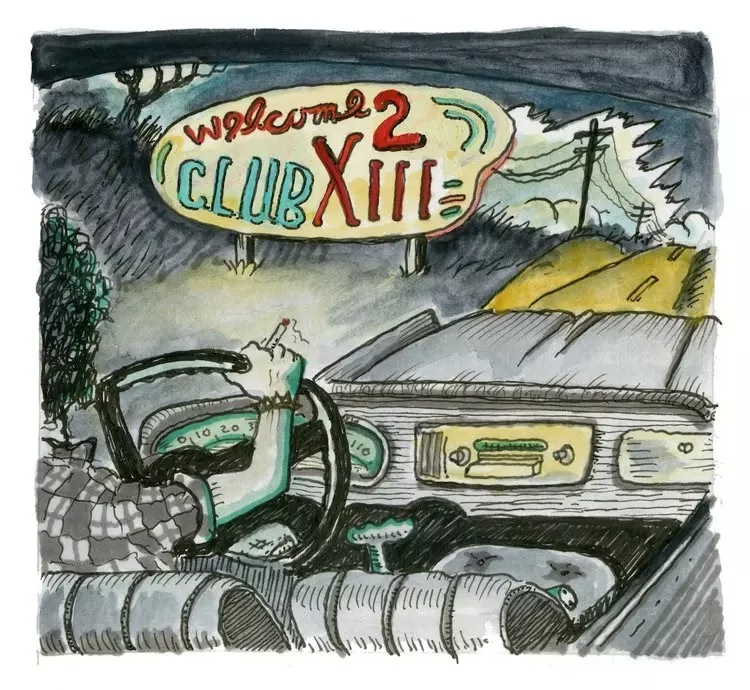
As you've noted, every Drive-By Truckers album is political to some degree. But after three straight albums of 90 percent political material, it seems like it was time to get 90 percent personal again.
I think that's pretty accurate. We didn't know we were going to do a trilogy of that. We did American Band as kind of a standalone thing, but then everything went from bad to worse.
And the next thing you know, The Unraveling was inspired by so many conversations I had with my kids about all the bulls*** going on during the early days of the Trump era. Which, unfortunately, isn't over, because we're still seeing it. It's still going on. What happened in Buffalo has roots with all of that. It's so far from over.
But at the same time, this record is probably the most personal we've made since Decoration Day, because so much of it was written during the lockdown. We were dealing with a lot of loss, a lot of stuff.
I've always heard that Decoration Day was borne of touring constantly while relationships were falling apart back home. Is that accurate?
Very much so. Fortunately, that's not happening on this one! Home's OK, as far as that goes.
But, yeah, everyone in the band was either going through a divorce or on the verge of one when we made Decoration Day. That was about the time we hit the tipping point of being in the road 200-plus days a year, and no one making any money and everyone's wives saying, "F*** this." Except for Cooley's wife! She's still here. But we're all in a better place as far as that goes. That's not part of this record, thankfully.
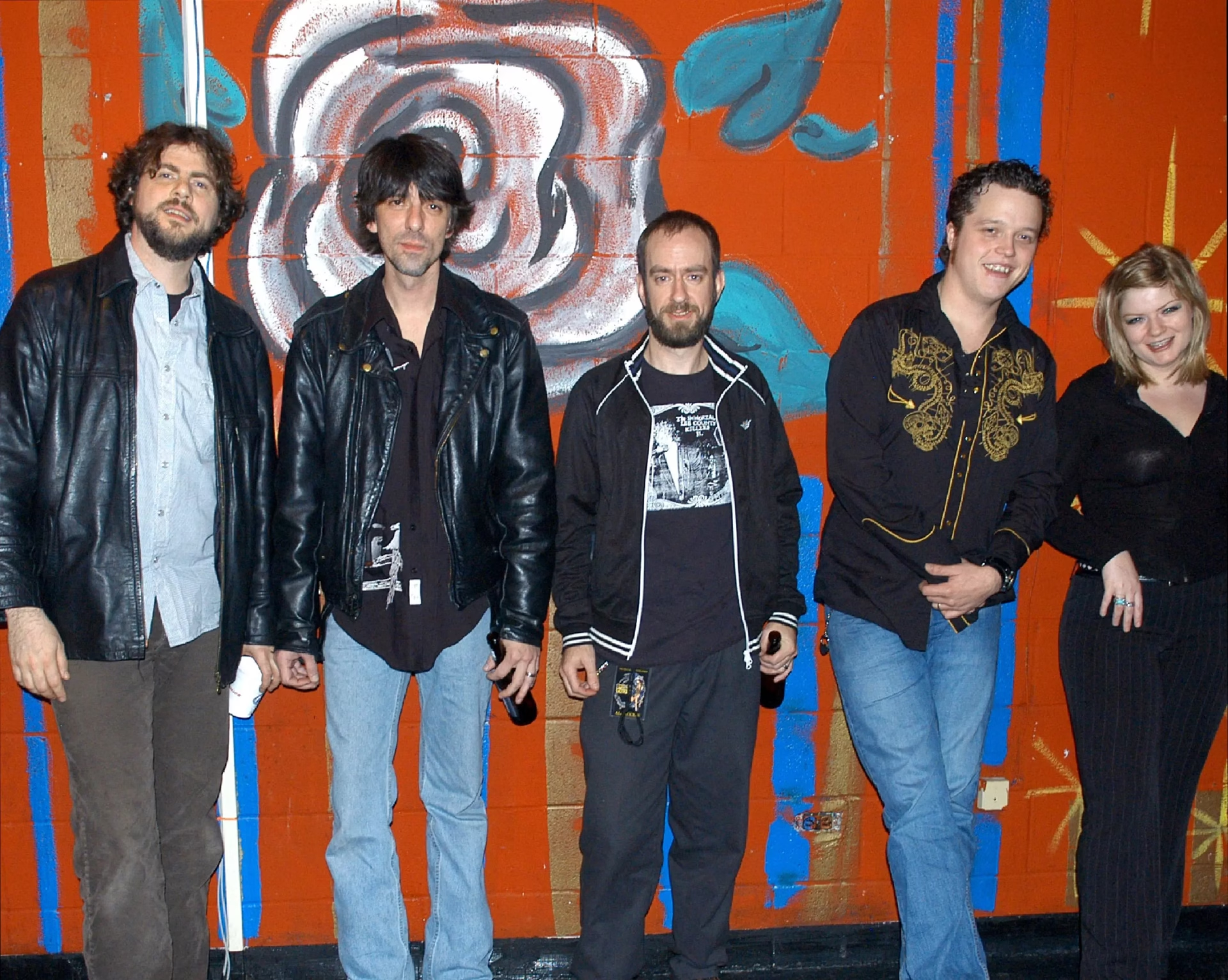
*Drive-By Truckers in 2004. (L-R) Patterson Hood, Mike Cooley, Brad Morgan, Jason Isbell, Shonna Tucker. Photo: Chris McKay/WireImage via Getty Images*
When things were deteriorating in your personal lives back then, what kept you guys going? Why didn't you turn the van around?
I've been trying to do this thing we're doing since I was 8 years old. I started writing songs when I was 8. By the time we started Drive-By Truckers, it was my and Cooley's fourth band together. So by the time we started this band, he and I had been playing for 11 years already in three failed bands. Adam's House Cat breaking up damn near killed us.
When we started this band, we knew it was our last chance to do this thing we wanted to do. As hard as the early days were, it was still better than it had ever been. We were playing dive bars, but we were pulling people into dive bars. We were sleeping on floors and touring in a van, but we were touring. We were getting shows and selling merch and we could see it growing.
And we were stubborn. A lot of it was stubbornness. We believed in this thing we were doing. It was like, "I'm not quitting now! We've got a possible shot at getting to do this thing!"
It all worked out, but it was brutal at the time. I don't know how we didn't kill each other. Because after all the marriages imploded and we were trying to put out Southern Rock Opera and nobody wanted to put it out, we tried to raise the money to put it out ourselves, we weren't even speaking to each other.
We were literally mixing that record, having to talk through [producer] David Barbe. We would tell him and he would tell us. But, somehow, we got through it. I give Barbe a lot of credit for that. He definitely helped save the band because we were all too close to it to see things that were right in front of us. But we all trusted him. He could sit us down and go, "Look, guys. I know this sucks. But you're so close. At least see this through, and then if you want to break up, break up."
By then, we'd seen it through and were like "We're not breaking up now! We're getting some momentum!" That all led to Decoration Day, which was definitely an important record for our band.
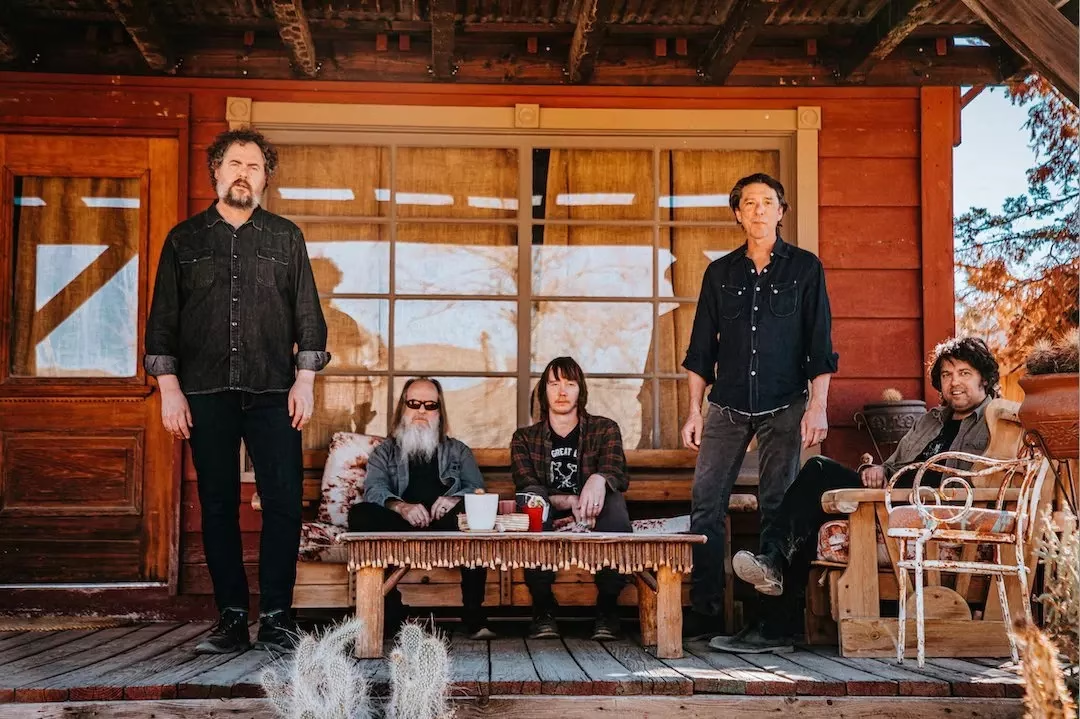
*Drive-By Truckers in 2022. (L-R) Patterson Hood, Brad Morgan, Matt Patton, Mike Cooley, Jay Gonzalez. Photo: Brantley Guitierrez*
There has always seemed to be one dark cloud or another following the band. I know depression over the state of the world has been a struggle for you. How are you doing lately?
I started writing as a kid, basically, to deal with my depression. I was a misfit, kind of lonely kid. I grew up in Alabama; I didn't play sports; I was bullied. My way of dealing with it was to write; that was always my go-to way of dealing with whatever my problems were.
In 2020, when everything shut down, I got really, really super-depressed and I couldn't write much. I did a little bit; I wrote a couple of songs for The New OK that were directly about the federal occupation of our town, when Trump sent the troops in and all that bulls***.
But I wasn't really able to write about personal stuff for a bit, until the clouds started lifting at the end of it all — after the election and the vaccine got approved and it looked like we were about to start living our lives. And then the floodgates opened, and I wrote the majority of my songs on the record around that time.
And then, of course, when we got together and recorded Welcome 2 Club XIII last summer, we hadn't seen each other in a year and a half. Instead of rehearsing before our first shows, we just decided to go into the studio and demo our new songs. We went in for three days to demo and see what we had, and at the end, we said, "I think this is our album." We didn't feel any pressure to make a record; we just went in to get to know each other again and play and show each other our new songs. It was magical!
I was so happy with the performances for the new songs. You could tell that even though the songs were, at times, really dark, there was a joy in the playing that I felt lifted the whole thing up. I think we all instinctually felt that.
You and Cooley have watched each other develop for 37 years. To you, is his writing getting deeper and deeper?
"Every Single Storied Flameout" might be my favorite Drive-By Truckers song of all time.
Really!
I think it's just a monumental song. I'm kind of used to him having my favorite song on any given record, because he usually does. But I don't know if he's ever written a better song than that one. I generally don't like talking too much about his songs, because he doesn't say a lot about them himself. I feel like whenever I talk about his songs, he reads it and growls [Laughs.]
But, my take on it — and he might totally disagree — is: There's that guy in "Zip City" 25 years later, raising a family, watching his kids live through the same things he lived through and trying to figure out his place in that. It's like, "OK, I created this thing. What the f*** do I do now?" And I'm a parent, too! So, I'm dealing with my own version of those things.
He absolutely nailed that thing I feel 99 percent of the time as a parent. I think it's such an amazing song.
I love how he never explains his songs. My favorite Cooley song of all time is "A Ghost to Most." I read that you asked him what it meant and he replied "It's hard to find a suit that fits me right."
[Laughs.] When I first met Cooley, he worked in a men's shop fitting suits! Cooley can look at you and fit you. Whenever someone gives us clothes on the road, we always have Cooley write down our sizes. He can still look at you and fit your suit!
I feel like Welcome 2 Club XIII is impressively cohesive — no wasted moments. Would you agree?
I do. I feel really strongly about this record. I'm like a parent: I love all my kids, even the one who had to go to jail for a while. All the different records are all closely related to me for sure. But there's something about this one.
Especially the way it was recorded. More or less, all our records are mostly live in the studio. But for this one, there was no rehearsal. There was no prep. It's like "OK, I've got this song!" And I'd play it for them and we'd cut it. There was no time to think about it. It was everyone's first, primal take on it.
Every Moment Flame On: A Guide To The Expanded Universe Of Robert Pollard & Guided By Voices
