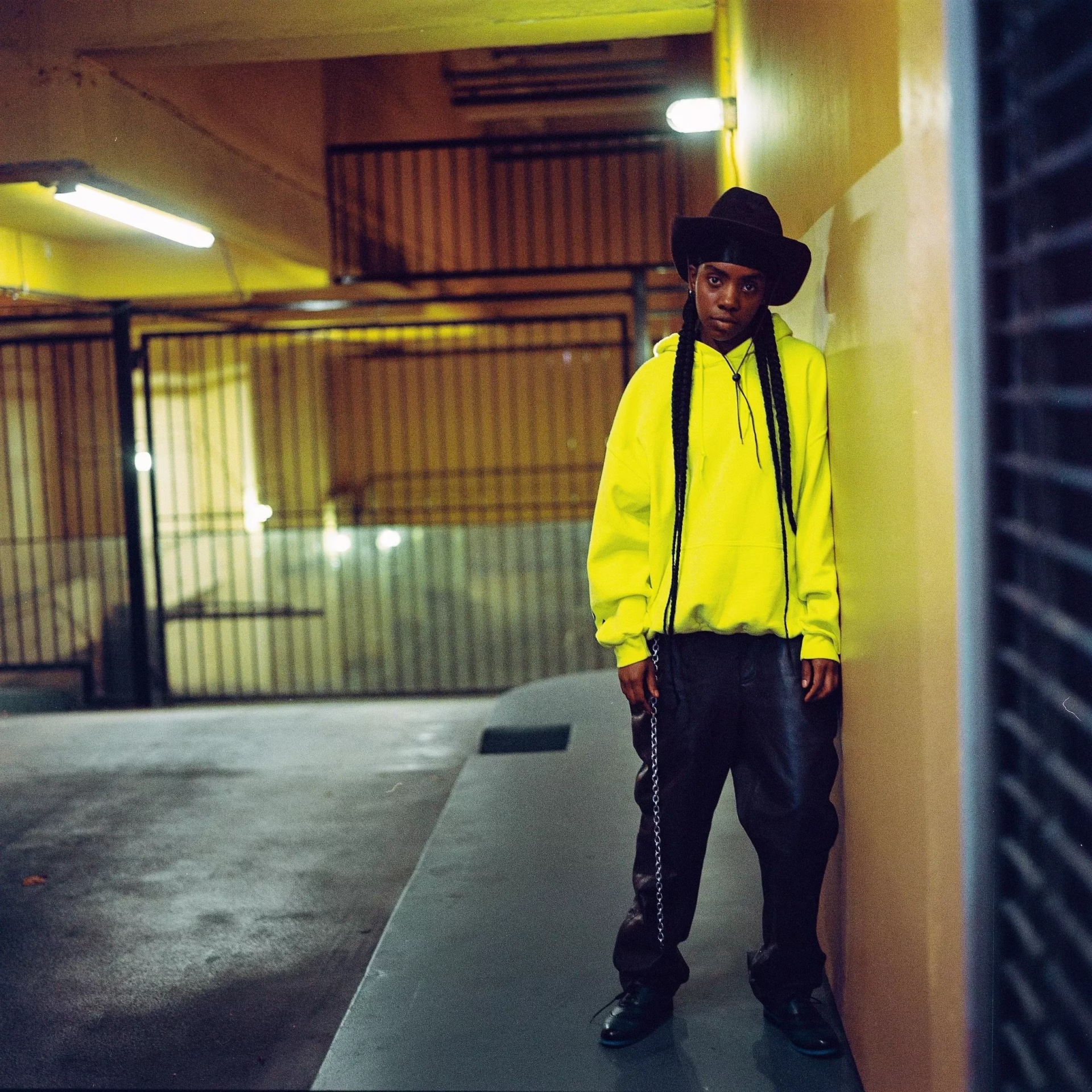
Meet Dua Saleh. They are a non-binary artist born in Sudan and based in Minneapolis, creating haunting alt-pop from another dimension. Their second EP, ROSETTA, whose name was inspired by rock and roll pioneer Sister Rosetta Tharpe, just came out on June 12 on indie label Against Giants. On the expansive six-track project Dua explores facets of their identity, using the power of their vocals with an effortless fluidity, enhanced by beats from producer Psymun.
In response to the killing of George Floyd at the hands of Minneapolis police, Saleh released "body cast" on May 31, a powerful song condemning police brutality, created with Psymun in 2019, originally set for a future project. They donated 100% of proceeds to Women for Political Change, a local nonprofit actively investing "in the leadership and political power of young women and trans and non-binary folks."
We recently caught up with Saleh and Psymun (born Simon Christensen), calling in from Minneapolis over Zoom to learn more about ROSETTA, the current situation in Minneapolis, supporting Black and Queer artists, and more.
Psymun | Photo: Zoe Pizarro
I want to start by checking in and see how you're feeling right now, and how you've been coping with these difficult times.
Saleh: I'm feeling pretty anxious. Anxiety and fear have been the streamline that's been running through my system. But I've also been feeling activated and feeling ready to put in as many resources and as much love and care into my community as possible, because everybody's dealing with a lot, both from the uprising and from the COVID-19 shut down and financial ruin. And just a lot of personal things that are happening to people within the Black trans community, and just across all communities that I've been attached to personally.
Christensen: I've been also pretty anxious, but overall fine. I haven't really been making music much; it's just hard to focus, I guess. Have you been feeling that, Dua?
Saleh: Yeah. I feel like I've also been sick for a long time and, even now, I'm anxious about interviews that I'm doing. So I haven't been able to even focus on music because my voice is not capable of even talking for long periods of time. I don't know if that's because that anxiety is also adding to that, but I think that's just been on my mind.
I felt like I was having a lot of the same symptoms that were COVID-related for a lot of people. A lot of chest pains, I couldn't breathe during times. I had to intake a lot of vitamin C, otherwise, I would literally be gasping for air and my heart would be palpitating immensely. Also, my voice hurt for a long time. I couldn't speak for like two weeks, legitimately.
Christensen: Did you get tested?
Saleh: Yeah, I tested negative, but I didn't get my antibodies tested, which I should check that out.
Christensen: I think the antibody test is expensive. I got tested [for COVID-19] and it came back negative. I'm getting tested again today because it's free, just to make sure.
Coping For The Best: How To Manage Mental Health During Social Unrest & A Global Pandemic
I want to get your pulse on how things are feeling right now in Minnesota. How would you describe the current situation we're in here in the U.S., through the lens of the activism and uprising in Minneapolis?
Christensen: Well, the feeling of it, it's a lot. It's really beautiful for a lot of reasons, but it's also really, really tense for a lot of reasons. Currently, things haven't stopped. There's still plenty of protesting, but from what I've noticed, rioting and stuff has slowed down. I think people can literally only handle so much. And also I think it came to a point where a lot of people [and] protesters were afraid for their lives.
It's not like things have stopped and I don't think they're going to. I hope not. But there is a weird part that feels like things have almost gone back to normal in the city. I think the media doesn't cover a lot of what's still going on, so it's hard. It does feel like things are back to normal in a way, but they're not actually.
Saleh: I feel like for me, I've been seeing a lot of community care infrastructure being put in place by community members, like mutual aid efforts and sanctuaries. People have been signing up to be security and medics at the sanctuaries and offering food and medical supplies for people, tents for displacement and homelessness. And people being there for GoFundMe efforts for people who have been harmed or their businesses and their homes have been completely destroyed by non-local agitators, as well as some local agitators.
I've just been seeing a lot of community efforts of love and care. And I feel like that energy is what makes people feel like things are going back to normal, because it's not really about the urgency of immediate fear of death and pain because there aren't weapons with live ammunition being pointed in the faces of people, but they are still afraid of being harmed by police officers.
One of the sanctuaries that was set in place by community members had to move a few times because police officers were called and they literally displaced all these people. So in my mind, I feel like the urgency is still there, just the narrative around it has shifted and people aren't as interested or intrigued by talking about sanctuaries or mutual aid because it's not as tantalizing as, I guess in a pornographic way, as protests and as tear gas grenades and other things that are thrown at people. It's more about institutional violence and ways to help people who are in urgent need in that way.
It's so inspiring to see the outpouring of support for different orgs, like the Minnesota Freedom Fund that got so many donations they asked people to choose other local institutions to help. It just shows how, like you said, people have to bring the attention in all the right places, because I think many people want to help and offer what they can.
Saleh: Definitely. And there are a lot of different organizations and arts-based orgs that are doing healing programming for people to try to figure things out that way and also need immediate funding. Like Mercado Colegio, who are working with Latinx community members, or Free Black Dirt is helping with healing efforts and food redistribution, and also Women for Political Change, which me and Psymun are donating all of our proceeds from "body cast" to directly. They've been doing a lot of immediate on-the-ground work with medics, medical aid and security. As well as with redistributing funds to Black youth, specifically Black women and Black trans and non-binary people who are in immediate need, especially after all the events that occurred with the uprising and with COVID-19. People are very vulnerable and need support, so organizations like those are very helpful.
I would love to talk a bit more about "body cast." At what point did you feel called to release the song early?
Saleh: Psymun, do you remember—I feel like I've just been talking out my ass for most of these interviews, because I don't really remember how the songwriting process started. I know I had some random lyrics written down in my Notes app and I think you sent me some chords or something and the title of it was called body cast, and that spiraled me into something. Or were we in the studio?
Christensen: I was in L.A. when I sent it to you. It was when I sent you that grip of ideas and that one actually wasn't just chords, that was like one of the two that I sent with drums. It was called body cast, I just named it something random.
One thing I really like about working with Dua is, a lot of the time, whenever I send them anything, it's just named something random and they typically write a song based off of what I titled it. Which is really funny, because most people don't do that.
Saleh: I don't know. I get lazy with titles. So I'm like, yes. Also, it's really good inspiration. I appreciate your titles. Actually, "windhymn" which is on the EP, was called yah originally. I miss that name, to be honest.
Christensen: [Laughs.] Also, "bankrupt" was called bankrupt when I sent it to you and then same with "cat scratch." [For "body cast"] I remember you sent me two videos; you specifically wanted a sample of Black women telling off cops. You sent me, the one we sampled, was from Angela Whitehead. You also sent the Sandra Bland one, which I think, I don't know if it was just me, so I'm not trying to speak for you, but I remember feeling like, man, this is really sad.
Saleh: Yeah. Triggering, probably. I'm glad that you chose the other one. I think the first one I sent was the Angela Whitehead one, because I think in myself, I was like maybe the Sandra Bland one is intense. I've been very cognizant of the way that auto-played videos of Black people in distress have been triggering Black people who follow me on social media. So I haven't re-posted any of those videos.
I think back then, I wasn't thinking about that. It was a year ago. And I didn't even think that we were going to release the song now, I thought it was going to be in a future project. But I definitely now, upon reflection, appreciate the fact that the Angela Whitehead video was chosen, because that video is such an energizing and activating video because people see it as reasserting their right to be aggressive and loud and to live in the comfort of her home without fear of invasion.
Read: Rapper Niko Brim And Activist Opal Lee On The Importance Of Juneteenth: "It Represents Freedom"
And once you released "body cast," what did it feel like to share that message, standing up to police brutality, at this time? It is really powerful and I saw it get covered in quite a few places.
Saleh: I feel like people resonated with it. I've been getting a lot of DMs and messages and just a lot of articles being published about it from GRAMMYs, Hypebeast, Rolling Stone, other publications that I was not expecting and didn't solicit. They just either posted on their own or they reached out to us directly.
It's been invigorating specifically because we've been trying to build narrative about giving back to community through the song. Seeing Minnesota Women for Political Change being tagged on different articles and seeing people being linked to their work and having people accredit them for the very essential movement-building that they've been doing, that has been very fulfilling for me personally.
And in what other ways have you been advocating for justice and engaging with everything right now?
Saleh: Well, I've been helping with a Twitter page that's specific to Minneapolis, just re-posting different things that I've been talking about. So, mutual aid efforts, GoFundMes for people who have been displaced, people's medical transition needs, people's immediate donation needs at sites and sanctuaries. And that's been the way that I've been trying to help navigate this, especially because I've been careful about organizing spaces, considering my personal triggers. With previously being in organizing, I have some concerns about safety for myself and younger Black people, Black youth and Black trans people, and how they're not always held by larger orgs in the ways that they need to be held. So, I've been trying to navigate space in that way, and also trying to help with arts initiatives and healing initiatives.
I also got trained to be a medic, but I still haven't utilized it because I was so sick for so long, and I didn't get my COVID-19 test back until near the end of the uprising pretty much. So I was only out there once and I didn't need to do anything or apply anything to anybody medically. But yeah, those are the small ways that I've been contributing.
Explore: Beyoncé Celebrates Juneteenth With "BLACK PARADE" & Epic Black-Owned Businesses Directory
It sounds like a lot.
Saleh: Psymun's been doing a lot. Mutual aid efforts, I think. Right?
Christensen: I have a car, which is helpful too for a lot of people right now, so I've been helping with transportation. North Minneapolis got hit really bad when there was those weird specific few days of attacks from white supremacist groups and stuff. So I've been letting a couple stay at my studio in Northeast Minneapolis because they were being terrorized where they live. I guess I've doing a lot of food and medicine supplies delivery. I was at some of the protests.
I'm not trying to sound like I've done a ton or anything because I haven't done as much as I could, I'm sure. I guess my point is that having a car has been a way for me to be helpful because transportation is huge and being able to deliver stuff to people is really huge.
Saleh: I think it might encourage other people to do it or to help people who need emergency safety stuff like that couple does. Everything's so heightened and everybody's tensions and personal entrenched violence has been lifted to the top, everything's lifting up, so I think community being there for each other and being able to have spaces for people to be safe are vital. To have spaces and resources for people to sit and rest or to get rides, all of those are very essential and seeing one person do it will motivate another person to do it.
Christensen: Yeah, I feel that. And yeah, that's a huge part of, when you were talking earlier Dua, about how it almost feels like things have gone back to normal but are still so different. Because I feel like the community has come together in so many different places that it really never existed before and among different people. It's definitely interesting and great to see the community almost just running things and it feels like people aren't relying on authority. Especially law enforcement, obviously, but any higher ups—it feels like less people are relying on or trusting those systems and we are looking to each other more now because of the uprising. And I imagine it's like that elsewhere, not just here in Minneapolis.
I want to make sure that we talk about ROSETTA. Dua, how did it feel to release your second project out into the world? And I'm also curious of what inspiration Sister Rosetta Tharpe had with it, based on the title.
Saleh: It feels—I don't know. I feel like there's a huge amalgamation of feelings that I'm experiencing just because I released it at such a sensitive time. Usually there's time for everybody who works on the project—I guess I've only released two EPs now—but usually there's time for us to talk about it, celebrate together. Because of the urgency of the times COVID-19 safety measures, there have only been group chat celebrations. I haven't seen Psymun in a long time and I haven't seen Alec [Ness], who mixed and mastered the project, in a long time.
It's felt odd, but it feels good to have it out now because I feel like people needed a reminder to re-center, and a reminder to sit with art and to let that flow through their body. Especially with all of the death and turmoil that's surrounding us, with George Floyd's murder specifically in Minneapolis, but also the many other murders of people, like Tony McDade, and Riah Milton and Dominique Fells, who were two trans women murdered within their communities.
Read: The Curious Career Of The Legendary Sister Rosetta Tharpe
But there's just been so much death and turmoil that I think people needed a source of healing. Sister Rosetta Tharpe is a huge source of healing for me personally—the person that music historians' credit as the inventor of rock and roll is a Black queer woman. Finding her music was a huge source of my personal healing in my journey towards lifting the burdens of life off of my own shoulders. And I wanted to use the narrative of her legacy to entrench into this project.
It happened naturally though. I wasn't thinking about Sister Rosetta Tharpe when I made all of this music, but obviously all music that is rock inspired or that's indie-inspired has a root. And for us, I think the root is Sister Rosetta Tharpe and rock and the origins of rock and roll music.
I agree that music and art, and this project specifically, is definitely something that is needed right now. The whole EP has a lot of interesting sonic elements, so I'd love to look at the different elements of "smut," which I was really drawn to, and you sing in Arabic on it.
Saleh: The song was produced by Psymun and Sir Dylan. I wrote the song acapella and then they put production over it, and then we added Velvet Negroni's vocals on it and Psymun manipulated that. The song was primarily written in English, about sexual escapades, primarily about my ex, but there's a portion of the song inspired by the Sudani Revolution that happened. I use the term Kundaka, which was inspired by Kandake which means queen in Nubian text, but I queered it to mean gender nonspecific royalty.
The song is one of my favorite songs off the project as well. Psymun, you can talk about the sonic elements of the production, if you want to.
Christensen: Yeah, that song, me and Dylan, I remember we were making a lot of the percussion out of crazy noise samples that we both had. It was really fun. I remember Jeremy, Velvet Negroni, came back to record his part another day and his throat was all f**ked up. But he was so in love with the song that he still pushed through for it.
How can the music community at large better support Black and queer artists?
Dua: The best way to support Black and queer artists is by offering them direct financial support and listening to their concerns. I've curated a Spotify playlist called DO IT LIKE DUA featuring mostly Black trans and queer artists [the playlist includes Mykki Blanco, Noname, booboo, Kehlani, Frank Ocean and others]. Please listen to these talented artists and donate directly via Spotify's COVID-19 Relief fund on their profiles or find them on Bandcamp.
Also, consider following them on social media. The artists I've highlighted are very knowledgeable about ways to give back to the community. In addition, they all have very humorous, engaging and critical content! Please show them love.
How Black Trans Artists Are Fighting To Achieve Racial Justice & Amplify Queer Voices