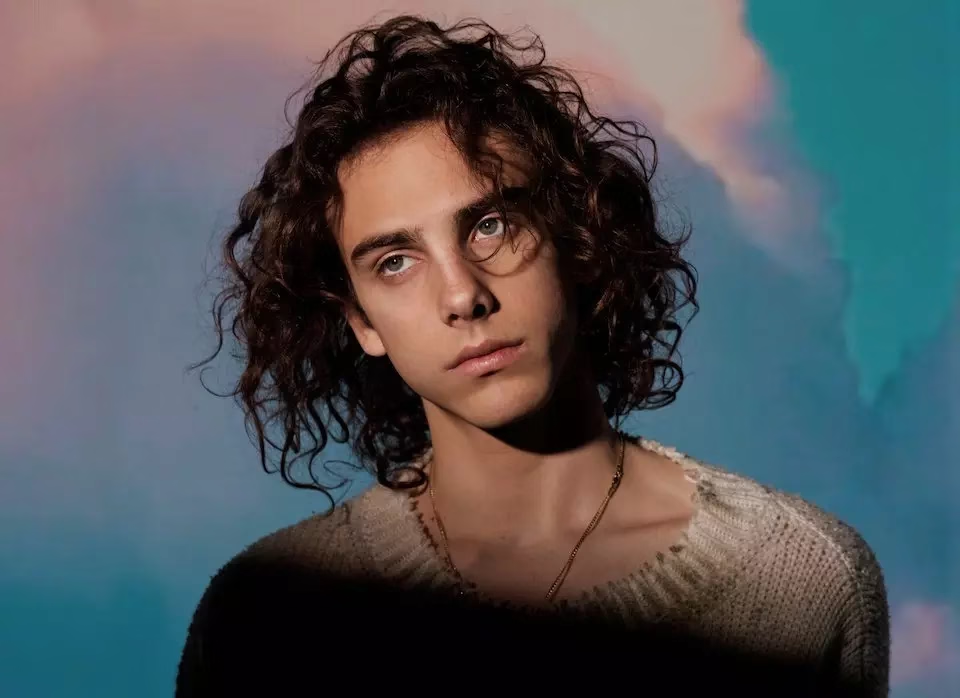
Not every artist can say they've been on a sold-out arena tour before their debut album has even been released. But Eddie Benjamin can.
The 20-year-old Australian singer/songwriter is currently opening for Justin Bieber on the first North American leg of the Justice World Tour — a slot he earned all on his own.
First gaining attention in a rock group called Haze Trio — which won several talent competitions in Benjamin's native Bondi Beach when he was a teen — the singer relocated to Los Angeles in 2020. His talent was quickly recognized there, too, as he found a mentor in fellow Australian Sia — and, not long after, Bieber.
The two met through mutual friends in 2020, and Bieber has dubbed Benjamin "the next generation." The pop star may just be right: Benjamin has already written and produced for the likes of Shawn Mendes, Cordae, Meghan Trainor and Earth Wind & Fire. And now, he has a viral hit of his own.
Benjamin's piano-backed track "Weatherman" was recently one of the most-used songs on TikTok, with nearly 20k videos featuring the tune. (Since he joined the platform in February, Benjamin’s TikTok videos have garnered more than 30 million total views.) His first single since his 2021 debut EP, Emotional, "Weatherman" expands on the vulnerability Benjamin has unabashedly showcased so far — and serves as a teaser of what's to come on his debut album, due later this year.
The LP will blend his affinity for jazz (he's a classically trained bassist!), retro sounds and hyper-modern sonic techniques. As Benjamin teases, he's ready to overhaul the sound and production of today's popular music. "This album is moreso my foresight [on] where sonic structure should go," he says.
Ahead of his debut LP's release, Benjamin spoke with GRAMMY.com about how Bieber has helped him, his struggles with anxiety, and his plans to shake up the music industry.
So, how did you end up opening for Justin Bieber?
When I first moved to LA, he reached out and was making sure I was okay, showing his support. He became a good friend and a mentor. And I remember I released my first EP and he actually asked me at dinner [at the release party].
Has he passed along any advice that's stuck with you?
I definitely have called him in a time of need. Keeping your body healthy is one of the main things. You're stumbling around up there doing a lot. His set is also really long. The main thing was talking about just staying healthy over the course of the tour, because it's months.
Growing up in Australia, how did you get into the arts scene?
My parents were artists. My dad was a session drummer and touring musician, and my mom was a choreographer and dancer. So I was around creativity since I was really young. They would have Stevie Wonder, Prince, Bach, Mozart records on — an array of different styles of music.
I was never pushed into it, but I had listened to so much music by the time I was 11, and that's when I asked for my first bass guitar. But it was definitely a creative environment where I grew up.
You also grew up in jazz trios playing with musicians older than you. How did that affect the way you approach being an artist?
I came from a jazz and classical background. I think that really structured the way I think about music, and what I have to offer as a songwriter, because I really know how to express myself in many styles of music. Being in those rooms, learning how to be a musician, messing up in front of teachers, messing up in front of people, really having to work hard to be a good player before singing in front of a bunch of people — I think it really, really helped me.
You're a big Prince fan. How did seeing him in concert growing up transform your music career?
I think it started it. I hadn't played an instrument before I'd seen him live. I saw him slapping a bass on stage so confidently — that was one of the first moments that put a battery in my back to go, "Wow, I really want to do that."
You relocated to LA right when the pandemic started? What was that experience like for you?
That was definitely an interesting time, because I got thrown into a lot of rooms. I was working a lot. I was in the studio meeting a lot of people, and then it kind of shut down. I kept working. I was in the studio the entire pandemic. But it was definitely a bit of a shock moving countries and then having the whole world shut down.
Sia took you under her wing a bit, right?
Sia is a mentor of mine. She has a studio, and when she has her collaborators over, like Labrinth and Diplo, I've been over there working on music.
How have you been able to write with such prominent artists so early on in your career?
These people, honestly, are my friends. It happened very naturally. I wasn't ever really trying to go in as a songwriter or a producer. These things happened, and I don't necessarily go into rooms writing songs for other people. I love writing for other people when it just happens, and the connection is real.
Who do you dream of collaborating with?
A lot of them have passed away — I have so many composers I would want to work with. But my dream person to sing a song with would be Stevie Wonder.
Which artists do you feel influenced your debut album?
I don't think that's just one artist.I'm very inspired by an array of artists and their recording techniques. I'm super obsessed with 1960, 1970s and 1980s analog recording techniques and mixing that in with the modern textures and ways of recording. Working with Mike Dean, Kid Culture and Alex Salibia has been amazing for that. We've been able to really hone in on that sound.
In terms of what the album's about, is there a specific theme that encompasses it?
It is a concept album, but it's a hidden concept album where the songs together portray the entire story. The best way I can describe what the album means to me is [that] they're all extreme and pivotal moments in my life in song form. So, the storyline is just extreme experiences that have shaped my life. The album just represents kind of an extremity of those emotions being expressed.
I wanted this kind of idea that everyone has of themselves to be represented in the album. The songs represent an extreme time to me. It's more the idea of getting through these hard times and being the person you want to be.
Can you tell me about your lead single "Weatherman?" Why did you choose to lead with that?
"Weatherman" was created in Malibu with my collaborator, Kid Culture. We were sitting there looking at the ocean, and I remember it was a bit of a breakthrough moment — musically, conceptually and sonically all at once. We knew we wanted to have theatrical, upbeat energy, because I was feeling very pushed around by these outer thoughts, these outer layers we have as people. I was a little frustrated. I really didn't want to feel yesterday's pain, and those lyrics made their way in the song. Then we spent the next three days just crafting the entire arrangement before we had written any of the verses or any of the rest of the structure.
We were just really honing in on a lot of sound design to make it feel exactly how we wanted it to be. We just knew it was the start of that sound. That was actually the first song we made on the album. I didn't overthink it.
Kid Culture co-produced the track. How did you get involved with him?
Funny enough, Kid Culture DM'd me on Instagram, "Let's cook" with a cook emoji. It actually took a while for us to meet up, but when we met up it just absolutely clicked.
He just spent months of his time talking to me and being with me. I think what's really important as a producer is spending a lot of time with the artists, and he did that. I feel like you can hear that in the music. The music is very vulnerable and very real. I think that's because we spent a lot of time together just talking.
It seems like anxiety may resonate throughout the project.
There are a few songs that tilt their hat to anxiety. Honestly, I suffer from extreme anxiety — life-stopping anxiety, can't get out of bed, brain completely frozen. One of those days I got up, went to the studio and made a song feeling like that — that's one of those songs on the album.
I'm still learning how to deal with all those things. I'm not gonna pretend like I have it all figured out. But music is definitely a way to express those hard times.
What do you want fans to get out of your first album?
I think we have a whole new generation of artists who are going to change the wave of music, and this is one of the first albums really pushing that. I have my heart really wide open, and it's a really vulnerable piece of art.
I'm just excited for people to finally see a little bit into my brain. It's not too many songs, it's only seven. I'm already working on my next album. But I'm really excited for people to hear the sonics and hear what we've been working on.
What do you think your next album will look like?
I'm just really focused on pushing the sonics into a new modern place where it hasn't been. I think music has been at a standstill sonically, and a lot of things have started to sound the same.
I don't want to do that. I want to stand out. I don't want to fit in remotely, and I just want to deliver consistently high-level music for a long, long time.
