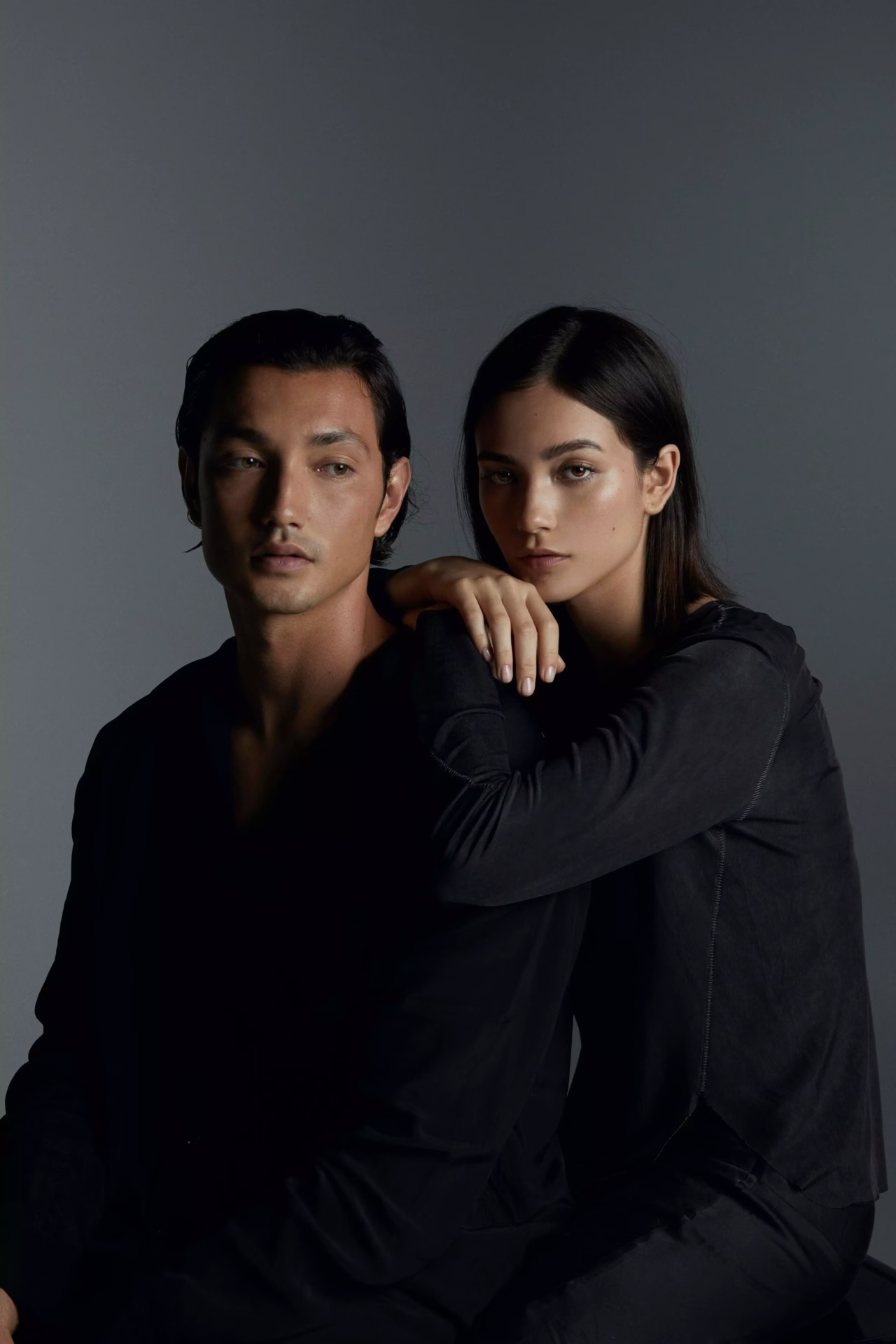
Lastlings, made up of Josh and Amy Dowdle, create moody, synth-filled music inspired by sci-fi soundtracks and other dimensions. The Japanese-Australian brother-sister duo, on production duties and vocals/lyrics respectively, began dropping tracks in 2015 when they were still teenagers.
Since then, they've toured with fellow synth-loving Aussies RÜFÜS DU SOL, remixed for them and are signed to their Rose Avenue imprint, fostering a mentorship that has grown into a true friendship (meme sharing included.) That relationship has been major in growing their recognition and fanbases in Australia, the U.S. and beyond.
Lastlings released their emotive debut album, First Contact, in November 2020 on Rose Avenue and Astralwerks, which has spawned remixes from LP Giobbi, CRi, Tim Englehardt and others. Their trippy, otherworldly visuals and their name came from an essay Josh wrote in high school about the last humans on earth.
GRAMMY.com caught up with Amy and Josh over Zoom to learn more about getting back on stage in Australia recently, the vision and process for creating First Contact, working together as siblings, their friendship with RÜFÜS DU SOL, and more.
You wrapped up a real life, in-person Australia tour in May. What did it feel like to get back on stage after everything that was last year?
Amy: It felt really good. We missed playing shows so much. I think our first show of the tour was the first one we've played in about a year and a half. It was really awesome to be back on stage and to see people coming to our shows again.
The first few shows of the tour were actually seated and then I think the second half of the tour was standing, which was really cool. We're so lucky here in Australia that we get to actually play shows.
I was watching a Boiler Room or something for a real festival in Australia and people just looked so happy. It's nice to see people being happy and dancing together safely.
Josh: Yeah, especially where we're from, on the Gold Coast, it didn't really feel like there was much of an effect there. We had a little bit of a lockdown, but we were really lucky that we could still leave the house and go to the beach and all that kind of stuff. People in Melbourne had it way tougher, they went into lockdown a few times, [where] they couldn't leave the house or the five-kilometer radius.
And I think once it started to open up in Melbourne, that's when all the bigger events started happening down here and everyone was just like gearing to go out and have fun. And I've actually moved down to Melbourne from the Gold Coast and Amy's almost here, she's going to move to Melbourne as well. We're really excited for this next chapter.
I want to talk about your album that came out last year. What was the vision for First Contact? What was the timeline for its release?
Amy: It's about all the moments you experienced in life for the first time and how they shape us as people. When we first started writing it, I think we wrote this one song that never actually made it onto the album and it was called "First Contact" at the time. We were like, "Oh, actually that'd be cool as an album name."
Josh: But yes, since then that song went to the back of the line and I still haven't finished it yet. And it's since changed names, but hopefully, it might make its way onto the second album. We didn't start writing First Contact as a like, "Oh we're going to write this album now." We started writing singles, and I think the first song that we finished was "Deja Vu" and that was ages ago, has to be two or three years ago.
That was the first one that we finished together, and then all the other ones we demoed out and then we went to America and we finished it. We stayed at the Rose Avenue house where RÜFÜS DU SOL was finishing their album [Solace] and we've worked a lot with Cassian, who's worked a lot with RUFUS. We were just really lucky to pair up with those guys and they helped us a lot with getting songs to another level. We learned a lot and they were really, really helpful with the album.
Cassian Talks Debut LP 'Laps,' Attending His First GRAMMYs & Staying Calm In Quarantine
So did you finish it before the pandemic?
Josh: Yeah, we finished it right before the pandemic, and we actually went to Japan to film our album teaser content and all of our press and promo stuff. We wanted to go out with a bang with this album, and Japan is such a beautiful place. We went over there literally right before COVID, it was right before Christmas actually.
And then COVID hit, so we couldn't really tour the album or didn't know what to do, so we had all this content backed up. So we just drip fed it all throughout 2020. We were lucky we could make that trip before COVID hit.
I was reading another interview, did you record some of the album or work on it in Japan?
Amy: Oh no, a lot of the lyrics were written in Japan. After I finished high school, I went to Japan with my mom. I used to sit up in my grandparents' top bedroom and it looked out onto all the other buildings with snow on them. It was a really good place to write, so I wrote a few of the songs there. Then, when Josh was 18—Do you want to tell the story, Josh?
Josh: I was 21. I went [to Japan] for four or five months and during that time I downloaded my first music software and was learning while I was traveling. And I know it sounds like a made-up story, but I was sitting on the bullet train one day and I open the software for the first time and literally I was going past Mount Fuji. It was a really beautiful, picturesque moment. The town that I was going to stay in got snowed in, so instead I stayed in a little hostel, just myself and the caretaker.
I just had nothing to do other than learn how to use the software, or read or walk out and go eat this special noodle there. It was just a really cool little town and I had to spend two or three weeks there snowed in because I couldn't leave. I couldn't go back to Tokyo, so I had no choice but to learn some music production.
That's so cool. Did being in Japan and the atmosphere there give birth to some of the songs?
Josh: Yeah, it's just a very inspiring place. And all the architecture, just the purposefulness of Japan and how much care they put into everything is very inspiring too.
Do you feel like the creative energy when you were working or writing in Japan felt different than when you're writing in Australia, than when you're writing in L.A.?
Amy: We [were] inspired by [the] snow [in Japan] a lot because we just don't have that here in Australia. It's just dry. We have a lot of other beautiful things.
Also, Blade Runner inspired this album a lot, it's one of our favorite movies. There's this scene where he's walking in the snow and it reminded us of Japan a lot. And we just don't have that in Australia, we don't have snow here. We do in one city but it's like the only place where you can go to here that actually has snow.
Josh: There are heaps of places that snow in Australia.
Amy: Really? Not like in Japan.
Josh: Yeah, not in the main towns, but yeah like it snows in Canberra, Melbourne and Sydney.
Amy: Yeah, but not like as much as Japan does, it snows everywhere in Japan.
Can you talk a little bit about the meaning and inspiration for the "Out Of Touch" music video?
Josh: [Chuckles.] So, we were meant to film it as like a three-part music video with "Out Of Touch," "No Time" and the interlude. We filmed it in South Australia because it was the only place we could travel to, there was like a travel bubble I guess you'd call it between South Australia and Queensland, two States in Australia. We found a Screen South Australia photo gallery, where you can see where lots of different film sets and locations [were shot].
We went there without really scoping them out and it kind of backfired on us a little bit because we got there—it was just the weather. I think because they had the most rain they've had in like 40 years. So a lot of the places that we wanted to film at, like the salt flats—there's really beautiful salt flats that are really reflective—they were just completely muddy and gross. And we went to two of those, they were both just completely ruined. Then we went to the sand dunes to film and it was like 60 kilometer winds and the whole trip we were just getting absolutely ruined by the weather.
But it was like one of the most fun trips ever because we normally shoot with our friend Dylan Duclos and our close friend Rico Zhang was over from China, where he's a director. So we all collaborated on the idea together and went over and shot it together. We didn't get as much as we wanted out of it, but it turned out great in the end.
Amy: We pretty much just got one video out of what was meant to be three videos.
Josh: Yeah, we had to come back and reshoot a lot of the stuff in Queensland to actually finish the "Out Of Touch" video. And all the set builds, like the big monolith and the stuff we stand on, my dad and I had to rebuild them when we came back to Queensland and we had to get a truck and lug them around. There was so much that went it, it was a very D.I.Y. shoot, so we were cutting off on the corners and building a lot of this stuff ourselves and pulling in a lot of favors, basically.
What was the initial inspiration for the visuals—when I'm watching it, I feel like there's imagery and stuff that probably means something, like the burning tree?
Josh: It ended up becoming more of an arty conceptual piece more than something that had a clear narrative. Because when we had it in the three-act form, it was the Lastlings—which are us—we go and collect our army from this kind of research facility, then we take them back because that world is going to explode or deteriorate. That was the first act and then the second one was a limbo of the Lastlings walking through a dream-esque land. And then the third act was the resolve, when Amy collects everyone and takes them back because the world is going to explode.
Amy: And there are all just these different Amys. It's like "Rick and Morty." [Laughs.]
Josh: It became a really ambitious thing with time constraints and the weather and everything just kind of fell to bits at the end, but we managed to get enough footage for "Out
Of Touch" and make it a really nice, interesting piece.
You know when you watch something and you're like, "Is there something more? What does this mean?" I'm glad I wasn't really missing things, but it's super cool and it feels cinematic.
Josh: Yeah. There wasn't too much symbolism and stuff, like you said with the fire, and all the portals and stuff. But I think the moments in themselves are really cool because we got to explore some VFX stuff and really just flex on a lot of our own movie inspos that we love; there was a lot of Blade Runner references.
Even random movies like Prometheus, with the color grading and all that kind of stuff as well. It was almost like a homage to all of our favorite sci-fi films. Even the big planet in it kind of looks like the Death Star from Star Wars. And the monolith, it was like the ones in Space Odyssey.
What's it like making music together as siblings?
Amy: Sometimes we do fight but then we can be really honest with each other [about] what we like and don't like, too. And every time we're on tour and stuff, we're always so comfortable because we always know that we have a good friend there with us. Some people tour by themselves—I've asked people this as well, and they've said that sometimes they get a bit lonely or they wish they had someone close with them. So it's nice to have a brother there with you when you're on tour and stuff.
Josh: Yeah, for the music-making part, we're both very different. Amy does the lyrics and the singing and I do most of the production. So, we work kind of separately most of the time, like I'll do an instrumental or a bit of piano or just an idea, and then Amy generally writes some lyrics over that. And at the moment, it's kind of hard because we're not living in the same city, so we kind of have to send stuff back and forth and record it in our own time.
What was your workflow on the album?
Josh: I think Amy wrote most of her lyrics when she was in Japan and then I did a lot of the instrumental stuff. I made a lot of instrumental demos with ideas on them and then I kind of gave them to Amy and then she could recycle lyrics from her Japan trip or write new ones. It's a very collaborative process when most of the time it doesn't really start with us [together], but usually, it starts with me with an instrumental, then Amy writes on it.
What kind of music did you guys grow up listening to? Was it like a musical house and everything?
Amy: Yeah. I grew up listening to a lot of classical music and mom used to listen to a lot of J-Pop and so I listened to that too. And a lot of indie rock music when I was in my teens and then I started listening to electronic music when I was 18 or 17. I listened to a bunch of different stuff.
Josh: Yeah, we both started playing classical music when we were younger and then I quit. And it wasn't for a few years until I got into rock music, like Led Zeppelin and the Chili Peppers and all that kind of stuff. I think I did like one classical guitar lesson, and I hated that and quit. I taught myself electric guitar, then played in a band with a few friends. I think all my music interests were kind of around the music I was playing at the time. So like I said, Led Zeppelin, Red Hot Chili Peppers, is kind of the music we were playing in our band and Arctic Monkeys. Then I kind of moved on to more synthy stuff, more electronic stuff.
I think DJ Koze was my first introduction to electronic music. I think the DJ Koze remix of "Bad Kingdom" by Moderat was one of the first songs that I heard out in the club randomly one time that I'd actually really liked. Because the rest of them—it was just a kick drum really. That song really stuck out [to] me. I really loved electronic music from then.
I love that track. I think it was summer 2014? I just remember having it on repeat, and every time a DJ would play it, I was just like, "You're my favorite DJ."
Josh: Yeah, it was so good. And then like everyone started to rinse it; it just got so overplayed, but it's still such a good song. There were just a few DJs on the Gold Coast that would kind of ruin it; they'd play it too fast or just play it at the wrong time.
It was one that my friends and I would always play when we were DJing together. That's right, I started DJing before I started making music. My friends and I got one of those little [DJ] controllers when we were like 18, teaching each other how to DJ, it was so cute.
Do you remember your first electronic song or producer that you liked, Amy?
Amy: I actually think it was RÜFÜS. I would have been 15 when they put out "Take Me." I didn't even know that song was them when we were touring with them. I went back and found it and I was like, "I really liked that song when I was really young. My friends and I used to always play it," which is funny. I think that song and then also probably Flume when I was really young, he was probably one of the first electronic artists I started listening to.
And then it just started to evolve and then I went to a festival in Melbourne with Josh and a bunch of friends and I watched Fatima Yamaha and that was like the reason why I wanted to start listening to more electronic music.
Must Watch: RÜFÜS DU SOL's Epic Joshua Tree Concert For No One
And what does your relationship with RÜFÜS feel like for you guys?
Josh: It's really good. They're like really chill and really, really nice guys. So, it was really easy to get along with them when we were touring together. And even when they were giving us feedback for some of our songs as well, they're really great guys to work with. So we've become friends as well, it's really cool, we send each other memes and stuff. It's great.
That's awesome. Yeah, they're so nice. They seem like brothers—once you tour in a van around America together, you become brothers.
Josh: Totally, totally. Yeah we were lucky to go and stay on their tour bus as well when we were doing some of the American shows, which [was a] really cool experience. It's such a weird concept to do a tour bus because in Australia we kind of fly everywhere because the cities aren't close enough together.
Amy: So fun! [The buses] are so small, like little capsules. It's like staying in hotels in Japan, but on a bus.
You recently put out the Bob Moses remix. How do you usually approach a Lastlings remix?
Josh: I usually start with the vocals and with some chords and tend to stay in the same key as the remix. With that song, I wanted to preserve the vocals as much and not drop the pitch down and stuff because he has a really, really nice voice. There's a Four Tet remix, of Eric Prydz's "Opus"—I don't know why that was the inspo for it, I think because it has a really massive build. But yeah I just wanted to make a nice long, slow-burning remix that had a bit of a nice build-up in the second part.
But yeah, I don't know. I just kind of use my Prophet-6 [analog synth] to get a bunch of nice atmospheric sounds and then just start building around that. And then, I normally do all the melodies and all the chords and stuff first before I do the drums. I know a lot of other producers start with drums, but I do it the other way around.
That's cool. I really liked that remix, it's nice.
Josh: Yeah, that was fun to make. I actually did another version of it first—I made four or five different remixes, but that was the one that I ended on.
Are you a perfectionist?
Josh: Oh, very.
Where did the name Lastlings come from?
Josh: Lastlings was a short story I wrote in high school about the last beings on earth. It was a dystopian story. All the trees and nature had grown over the cities and stuff. Have you seen "Love, Death & Robots" on Netflix? It's really good. In the new season, there was a city and I was like, "Oh my God, that's exactly the city that I had in mind when I was writing the story."
You guys are sci-fi nerds, I take it?
Josh: I like sci-fi. I always get asked that, but I guess I've seen a lot of them. I do love it. I just love really fantastical worlds and stuff that probably will never exist. The more we get into the future, I'm like, "Wow, maybe some of this stuff is actually real."
Amy: Yeah, every story I read in high school was fantasy or sci-fi.
Okay, broad question but I always like to end on a positive note. What's your biggest hope for the future?
Amy: I have so many wishes, I just want the world to be less f***ed up.
Josh: Pretty much. I really want Coronavirus to f*** off.
Amy: That's a lot of F words. I would like future generations are more open-minded—I think there's time [for all of us] to be more open-minded as well.
Josh: Yeah, I wish we had a more unified world and everyone was on the same wavelength.
Amy: Hopefully it's like that in the future.
For The Record: Explore The Colorful, Inclusive World Of Sylvester's 'Step II'
