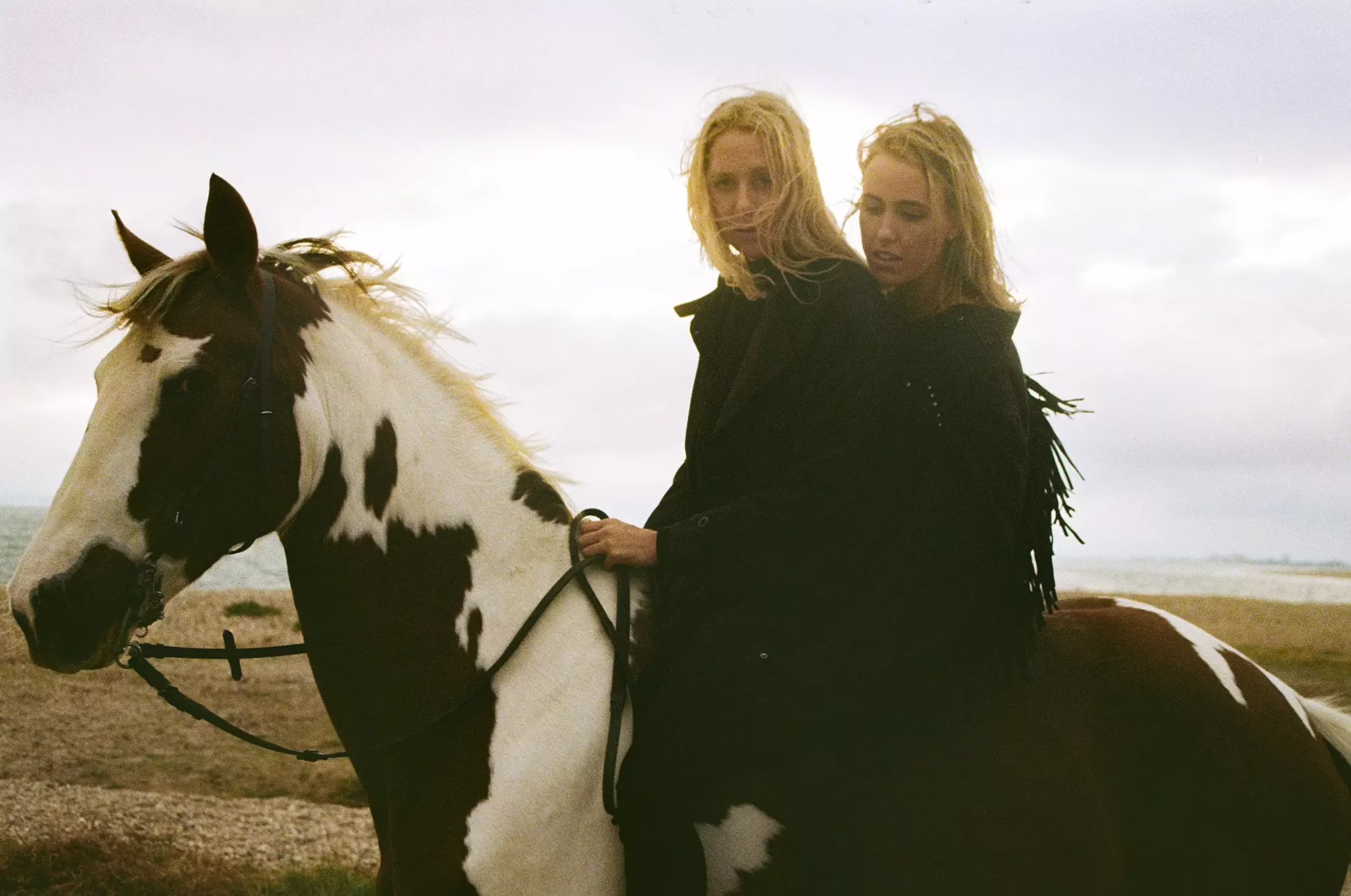
To better understand British duo Eli & Fur's debut album, Found In The Wild, it might help to watch Into the Wild. The film adaptation of Jon Krakauer's 1996 non-fiction book tells the story of Christopher McCandless, a then-recent college graduate who rejected modern society by adventuring solo across North America into the Alaskan wilderness, supposedly in search of enlightenment. Before his death in approximately August 1992, McCandless sought shelter from the snowy elements in an abandoned bus, documenting his life through self-portraits and journaling.
Into the Wild, Eliza Noble, a.k.a. Eli, tells GRAMMY.com over Zoom, is one of her favorite movies. (She also loves its Eddie Vedder-composed soundtrack.) "I definitely relate to that, wanting to escape," she muses. At the moment, she and partner Jennifer Skillman, a.k.a. Fur, are holed up in their own creative refuge on the other side of the world, in Sussex, South East London, in a giant wooden shed turned studio which to them feels more like a sauna on one of the hottest days in recent memory. The studio, non-weatherproof as it may be, has served as its own frontier, a lawless land where genres, deadlines and plans don't exist, and where creativity has free rein. It's no Alaska, but perhaps it's helped Eli & Fur answer some questions of their own: Who are we? Where do we fit?
They've pondered over that last one, especially, for nearly all the nine years that Eli & Fur the project have existed. Before then, they were "proper cheese pop" songwriters and vocalists, as Fur calls it, who after spending countless nights in the club evolved into DJs and producers of their own, culminating in their 2013 debut, "You're So High." Since then, the duo's profile has increased with releases on dance labels including Defected, Spinnin' Deep, Anjunadeep and their own NYX Music. Still, as they shared in a statement, doubters thought their combination of pop-structured vocals and club tracks wouldn't work.
Split into a dual showcase—Found represents their songwriting roots, while In the Wild shows off their club side—Found In The Wild is the musical whole of Eli & Fur, proving that both can co-exist to beautiful, emotional results. With all tracks either created or finished during lockdown, a dark, moody energy surges throughout its rolling melodies, emphasized by lyrics that reflect the sadness ("Come Back Around"), uncertainty ("Broken Parts") and existentialism ("Are We Even Human") of having everything you know and love turned upside down. By stepping back and trusting their instincts, Eli & Fur were able to recenter themselves and move forward. As Eli sums it up: "You have to get lost to be found."
Ahead of the album's release this Friday, June 25 on Anjunadeep, Eli & Fur chart their path to Found In The Wild.
This interview has been edited and condensed for clarity.
How has being home for the last 16 months affected your relationship with music?
Fur: When Coronavirus happened I came back from L.A. to be with my family, and I've literally been in this shed for the last year making music everyday. It's been incredible because I haven't had this [much] time before to fully be creative and not have all these crazy deadlines and touring. We've also been making music that we wouldn't usually because of what's been going on in the world. Being able to come in here and make different genres with no planned outcome or release or whatever—just purely create—I love that.
Eli: That's so true. When you're at home and you know you're going to DJ on the weekends, you often have it in your mind that you're going to test this track out. You're thinking from that club perspective, because that's where you're spending a lot of your time. At the beginning of the pandemic we were in separate places and we had to make music remotely, so we'd sent stuff back and forth and—
Fur: It was a new way of working for us.
Eli: Yeah, it was a crazy experience… Even though we're dying to get back to touring now, the silver lining in this has been being able to get ahead of ourselves.
Did you experience any existential anxiety? The idea of, "I'm a DJ/producer, but who am I while none of that's happening?"
Eli: We both struggled through the whole thing. It's been difficult, especially as our income comes from touring, but it was scary because for the first three months, it felt like a real loss of identity. What am I without this? It was weird. When everything gets stripped away from you and you don't know when you're going to work again, you essentially don't have a job and no idea of what the future holds… That was really stressful, but it's been amazing that the two of us have supported each other. I have no idea what I would've done had I been on my own.
Fur: I don't think I could do it.
You two were separated for what, seven months?
Fur: Yeah. I think it was the longest time we hadn't seen each other in ten years.
Yet somehow you managed to make an album!
Eli: We went through the tracks, and 50 percent were created from scratch in lockdown; the other 50 percent, there was some stuff there but we finished in lockdown. We had a lot of stuff lying around that we just hadn't had the chance to finish… We were just discussing this the other day: We were like, did we make [the album] because we weren't together and were just so focused on getting it done? We weren't just sitting in the studio getting distracted.
As it turns out, we made so much music that we've almost got another album's worth. It worked out for the best, I think, because now we finally have an album which we've wanted for so long.
You've mentioned in interviews that you were just waiting for the right time. When did it finally feel like that time?
Eli: I think when we had enough to work with. We knew before coronavirus happened that we had a certain amount of tracks and sketches of tracks that we knew would be good enough for an album. We'd definitely put it off and been very selective—Fur's probably the biggest perfectionist you will ever meet—so we've never rushed anything… So while we had the tracks to make an album, coronavirus accelerated it and actually gave us the concept of the two sides of the album, Found and In the Wild, because we were like, we're not touring right now, we're not playing stuff out in clubs, so let's have the club tracks that we really like and try some of our natural roots.
When you put those two sides together, you have Found In The Wild. What exactly is being found in the wild?
Eli: I guess the best way to describe it would be: You have to get lost to be found. In some ways that sounds a little obscure, but it's been a long journey for us. The Found side represents our songwriting roots, and In the Wild represents the club side of things, and we went from one to the other. In those club capacities and electronic music and that real feeling of deep, incredible music that makes you want to dance… We sort of found ourselves in that wilderness, those nights out on the dancefloor. After being two 16-year-olds who like guitar music, we had to go through those changes, experience the industry and get passionate about electronic music to really come together and create an album which we really feel represents us.
Fur: I feel in some ways at the beginning we held back... When you're starting out you have someone, like a manager, who asks you: Where do you fit? That's always been a bit of an issue for us because everyone asks us: Where do you fit? It's been nice to express the two sides of us and not have limits. We went with our gut feeling.
Fur: So we worked at this music production company as a day job, just writing pop songs and putting ourselves out there creatively. We'd be given a theme for a song, and then we'd write lyrics—you almost have to be someone else to write that kind of song. We were getting into the industry at quite a young age doing these writing camps and working everyday with engineers and recording vocals. At the same time, we were going out at night and seeing DJs. We'd DJed a few times at friends' parties purely for fun, but we felt like we wanted to combine that melody with what we enjoyed going out to. So we'd write proper cheese pop during the day and then at night we'd stay up really late, jam and figure out what kind of sound would also work in the club.
Eli: We learned so much from that. We can sit down and come up with a chord sequence and write a song—verse, bridge, chorus; traditional song structure—but the way they did it at the pop factory where we worked, you'd write so many melodies and then you'd condense them into your favorite verses, bridges and choruses. It was in some way clinical, but incredibly original and exciting because you'd write so many melodies on one piece of music and you'd whittle it down to your favorite ones. At the end of it, you'd have this beautiful song.
It was interesting to use that way of writing on a club track, because with a club track you don't necessarily have a verse, bridge and chorus; it's mostly just a repetitive hook. It's all about hooks, which is definitely what pop music is about, so it was natural for us.
You've been told that meshing your songwriting and club-minded sides wouldn't work, but in the last few years especially, vocal melodic tracks have been thriving in the dance music space. What do you think connects with audiences?
Eli: The emotion on the dancefloor. You can have rolling, amazing tracks that are great to dance to, but the ones that you remember, in our opinion, are the ones that make you stop and listen to lyrics that you relate to… It's certainly a style that not everybody loves, but as you said, it's growing.
Anjunadeep is a perfect example. They're a great label to be on because when you go to an Anjunadeep show or listen to an Anjunadeep artist you're going to get these emotive, beautiful, interesting layered pieces of music which have a lot of meaning. I think that's what people are connecting with.
Tell me about the emotional headspace on this album, because some of these songs like "Broken Parts" and "Come Back Around" touch on loss, paralysis and the desire to run away from yourself. Then you have "Are We Even Human," which sounds so existential.
Eli: Because there's two of us, we've got twice the stories and the emotions. I personally write better when I write about sadness, so we often come up with a theme based upon the experiences that we've had. "Broken Parts," for example, is about wanting to get out and leave things behind. We filmed a music video to go with the single which is COVID-related. Being at home and trapped in your house and mind, it's not going to be a summer jam. That definitely shows across the album.
Then there's the non-vocal stuff like "Light Up Your Eyes" and "Big Tiger," which is just what comes out from whatever instrument we're playing… that's a more obscure emotion, and I think that's interesting as well, not having vocals and it just being there.
While we're on wanting to leave things behind, have you heard of Into the Wild?
Eli: It's one of my favorite movies.
Okay, that might explain why it's the first thing I thought of when I saw your album title.
Eli: Not only is the story amazing, the soundtrack is amazing and the book is amazing. But I definitely relate to that, wanting to escape, and that's what music is to a lot of people.
With a happier ending, though.
Eli: Definitely.
When was a time that the club most felt like being in the wild?
Eli: My favorite moments are in a dark, more intimate space where the crowd is just right there, vibing with you, and you completely lose yourself. I think a track that really represents that is "Light Up Your Eyes" because… it really communicates that moment. Those moments are really inspiring, when you're all on the same wavelength. The best part about going out is losing yourself and escaping and being somewhere dark where you're not staring at someone in a bright light. It's shadowy and mysterious; you can be whoever you want to be. No one has to know who you are.
Whenever we go out, we're usually going out to DJ. Our concept of a night out is playing music and seeing people's reactions. It's incredible to look at different faces in the crowd and kind of think about who they are, where they come from, what's going on in their minds—
Fur: You're not even having a conversation; it's just a feeling.