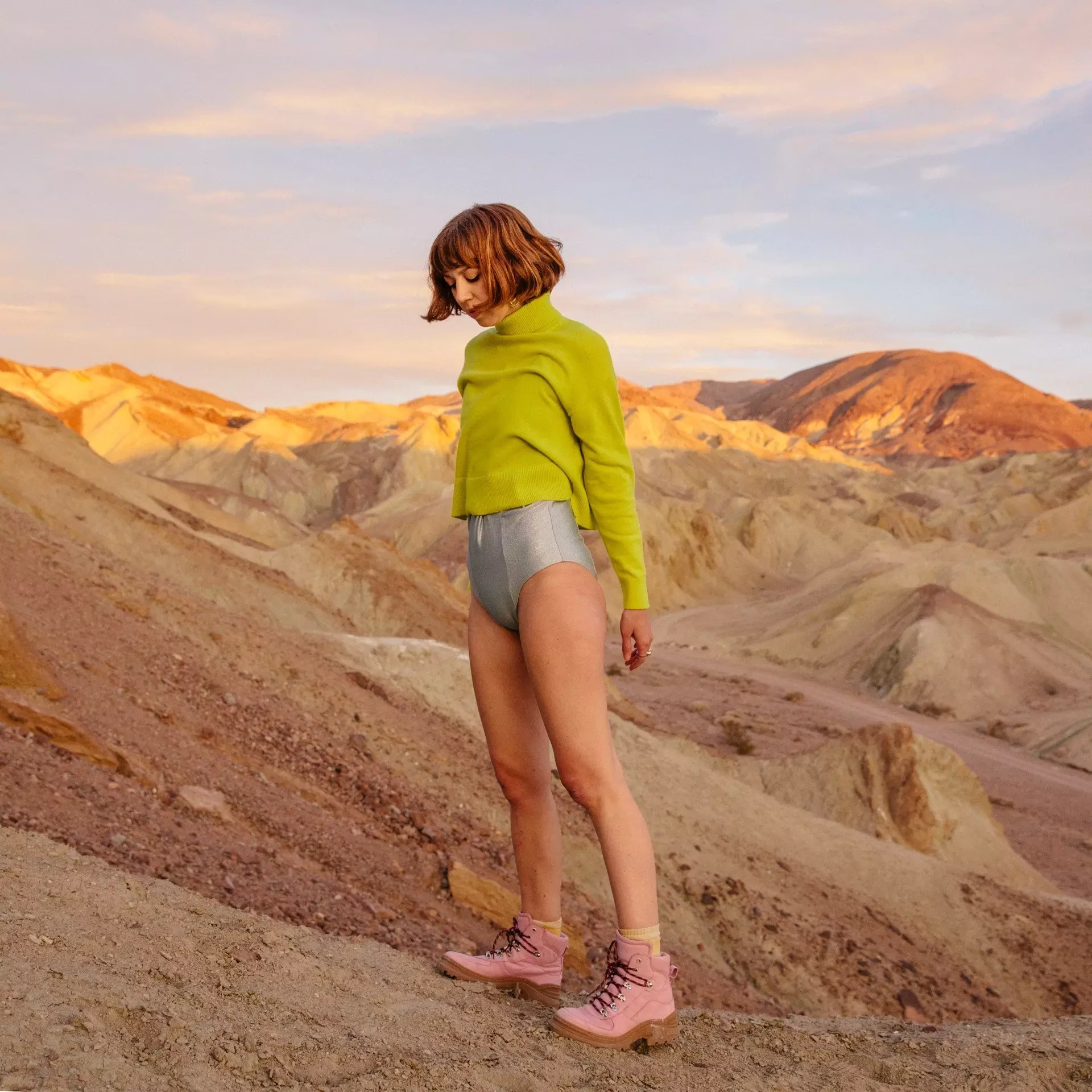
The Los Angeles-based pop singer Ella Vos hasn’t yet found the words to describe her latest album—"I always write a little album statement and I am yet to write this one because it feels so daunting," she says. Why then, on the occasion of her birthday, and in the middle of a cross-country road trip through Grand Canyon, Arches and Rocky Mountain National Parks in a recently refurbished trailer that she and her new fiance have nicknamed Tammy, did she want to talk about it for the first time?
Simple: "It seemed like a fun birthday present," she says from a pit stop to visit her soon-to-be in-laws in Illinois.
Titled Turbulence (out on July 31), the album is decidedly upbeat for an artist who draws inspiration from the chaos around her. Before writing the album Vos was diagnosed with cancer, suffered a severe bout of depression, and got divorced from her first husband. But Vos is no stranger to turning turbulent subject matter into soothing, cathartic pop songs. In fact, the word turbulence would be a suitable title for a future greatest hits collection. She has previously written about suffering postpartum depression on her 2017 debut album Words I Never Said, and of undergoing cancer treatment on 2019’s Watch & Wait EP, which was written between waiting rooms and hospital beds.
But where those previous works featured sweeping synth lines, moody guitar riffs and contemplative piano parts—introspective arrangements that complemented the self reflective subject matter—Turbulence is infused with reggaeton beats and sprite pop hooks that highlight the more hopeful message that Vos wants to relay with this collection. "I really wanted to make an album I could dance to," she says, emphasizing that these songs were written to remind herself that sometimes you have to walk through fire in order to thrive. "Every single song has some kind of lesson in it that I still need to learn. I am the recipient of these messages, for sure," she says without hesitation. Vos even took inspiration from Swedish pop-singer Robyn and created her own "Dancing On My Own" moment—check out the aspirational pop banger "Dancing Under Water."
Perhaps this explains why Vos wanted to talk to us on her birthday: to affirm that although Turbulence was written immediately following her divorce, it's not about confrontation or reevaluating the past, but rather about building character and embracing change. "It’s not that it’s not about the divorce, it’s just more focused on the idea that things get better." she emphasizes. "[Compared] to a classic divorce album like Tom Petty’s Wildflowers, where there is a little more sadness in it, I don’t think I have that same perspective. Mine is that this is a necessary life change and things are going to be better."
Read more of Ella Vos' conversation with GRAMMY.com, where she discusses growing up near wildfires in California, the Supreme Court's recent decision to allow nonprofit religiously affiliated businesses to opt out of providing birth control and why she delayed releasing her most recent music video.
<style>.embed-container { position: relative; padding-bottom: 56.25%; height: 0; overflow: hidden; max-width: 100%; } .embed-container iframe, .embed-container object, .embed-container embed { position: absolute; top: 0; left: 0; width: 100%; height: 100%; }</style><div class='embed-container'><iframe src='https://www.youtube.com/embed/rVnV7ALz0l8' frameborder='0' allowfullscreen></iframe></div>
Turbulence contains very personal subject matter, but it’s subject matter that a lot of people may be able to relate to. Are you able to talk about the circumstances that led to the creation of this album?
Leading up to writing the album I was in the beginning stages of a divorce, I had just recovered from a year of non-stop infections, and I was also waiting to be in remission from lymphoma. My doctors had also diagnosed me with severe chronic depression. Those were the circumstances, and on top of that, this was the first time I wrote music with other people. Throughout the process I shared so much about myself, and I didn’t realize how draining that would be to deal with day after day. It kind of got to a point where I was like, how do I go and write a song that is really personal without sharing too much and me ending up drained and exhausted? The entire eight months I was writing this album I was just in emotional, invisible turmoil. But it’s strange, because all the songs turned out so positive, so I think that was me trying to lift myself up.
You have described it as an enthusiastic album.
It’s a bit aspirational. Thematically, it’s where I want to be.
How much of this album is about reconciling with the past, and how much is about personal growth?
It’s a lot of personal growth—I'd say like 80% of it—but it’s also reflective. "Turbulence" feels very in the moment and personal. "Mistakes, they catch up" is the same. "Carousel" feels very me, like where I’m at now. But "Burning Bridges" and "Dancing Under Water," I want to be that resilient and good at setting boundaries and thriving in the chaos.
You have described yourself as an introvert, and as someone who likes to keep secrets. Does writing confessional songs come naturally to you, or do you have to really dig deep to extract those emotions?
I feel like it’s easy at first and then I do get a little insecure about it. I start to feel like I’m revealing too much in the music, or even just with the people who I’m recording and writing with. A lot of times when I find myself being really personal, my first thought is that this probably isn’t relatable, and that’s what I get scared of. But I have definitely learned that you are never alone in anything, so anything I experience is always relatable in some way.
<style>.embed-container { position: relative; padding-bottom: 56.25%; height: 0; overflow: hidden; max-width: 100%; } .embed-container iframe, .embed-container object, .embed-container embed { position: absolute; top: 0; left: 0; width: 100%; height: 100%; }</style><div class='embed-container'><iframe src='https://www.youtube.com/embed/G9ArwO0ubII' frameborder='0' allowfullscreen></iframe></div>
Did you set boundaries for yourself that you didn’t want to cross?
The first chunk of last summer I was sharing a lot about my divorce, and we ended up writing a lot of songs about it, but it just didn’t sit right with me. So after the summer I decided that it wasn’t going to be the focus anymore—I didn’t want the album to be about that. But it took three months to figure out that it isn't working for me. I think the album is more about thriving, finding yourself and coming out better on the other side.
A bit like a coming-of-age album.
Yeah, it really is. You have to go through the fire; you have to go through the hard stuff and start over in order to transform. For me, that’s what the album is about.
In the song "Mistakes, they catch up," you compare a wildfire raging through the forest to humans having the ability to transform and rebuild themselves. Can you explain why you decided to make that comparison?
I grew up in California where there have always been wildfires that just destroy everything, and anytime there would be a fire, I would always feel pain. I’m an empath, so I’m super sensitive, and I would feel physical pain. So I started to think—there are definitely fires in California that are really bad—but a fire is really good for the forest, and that helped me feel so much better about some of the fires. Driving up to my parents house I always pass some burned hillside that has some new growth on it, and then after a while it looks beautiful. And it’s like, yeah, we have to start over, it’s just part of life. I just loved the image.
You released an EP in 2019 following your diagnosis with cancer. Are you able to talk about where you are at with that, in terms of treatment and recovery?
On Christmas Eve my oncologist said, "Your cancer is coming back so we’re probably going to have to start treatment again soon," and I was like, why did you bring me in on Christmas Eve to tell me this? But it turned out to be a bloop in the blood work. I went into remission in February. So, so far so good, but it is the type of cancer that I'm told will come back, so there's always a lot of checking and waiting for results. My health overall has been good. In 2018 I only had to have one round of treatment which was great. The year of infections right after that was not so great, so that was a very difficult EP to write.
As someone with an underlying health condition, how have you been navigating the COVID-19 pandemic?
It was definitely scary in the beginning, but now we’ve got to the point where it’s not scary to tell people: "six feet please." Social distancing is an awkward thing to do. I’m a person who has trouble saying what I need, or telling anybody no, so sometimes when people get too close it’s really hard because I don’t want to make them uncomfortable. But it’s very black and white, we have to be as careful as possible. Besides that, I have my son, and me and my ex have been trading off keeping him for a month at a time, which has been a challenge.
<style>.embed-container { position: relative; padding-bottom: 56.25%; height: 0; overflow: hidden; max-width: 100%; } .embed-container iframe, .embed-container object, .embed-container embed { position: absolute; top: 0; left: 0; width: 100%; height: 100%; }</style><div class='embed-container'><iframe src='https://www.youtube.com/embed/7-PsYCfAEK0' frameborder='0' allowfullscreen></iframe></div>
In 2017 you wrote a song called "You Don’t Know About Me," which, among other things, is about how elderly male legislators use their privilege to regulate women's bodies. I wanted to ask about it because the Supreme Court just upheld a rule that allows nonprofit religiously affiliated businesses to opt out of providing health care plans that include birth control. What was your reaction to hearing that judgement in 2020?
It’s just not surprising. It's sad to say, but we're way past the point of being shocked, and it’s just one of the many problems we have. It's infuriating. The only thing I can say is that we need to vote Trump out. We need to show up.
We have an election in November. What should be looking out for when assessing a candidate's credentials for office?
It does feel like right now, anyone is better. It’s hard to think beyond that. Joe Biden is not my favorite, but he is a better option. It sucks to say it, but I kind of fell like that's where we are at. We have to take baby steps to get out of this shit show. Maybe that’s not the best advice, but I feel like it's maybe a small sacrifice to make to hopefully get moving in a better direction. Key is just not to get overwhelmed and to remember that voting does make a difference, showing up does make a difference. Like we've seen with the signing of petitions against police brutality, if the voice is loud enough, it does make a difference.
You decided to delay your most recent music video to allow space for artists of color to remain in the spotlight while there are ongoing protests against police brutality. Do you have any advice to give to other musicians who are still wondering how they can be a better ally?
That music video, the song that I didn’t put out, it just didn’t feel appropriate at such an important time. It really was bad timing. I have had a couple of artists friends ask me, how should I balance promoting myself? Should I just stop promoting myself through all this? I think that no, you shouldn’t, because this should be a part of your daily life. It should just be natural for you to promote yourself and highlight this other stuff. Make a plan, you can’t just shut down, because that is not sustainable. I found an action plan where you have 60 days, and you take 20 minutes each day to read this essay, or watch a documentary, or read these chapters in a book, and you slowly make a change over time. It’s doing small things over time that really shift you. And I use this other example, which is slightly different, but when I first started my solo career I realized that I didn’t listen to any female artists. All of my big inspirations were male artists and I was kind of overwhelmed, I thought, how can I expect anyone to listen to me when I don’t listen to anyone who looks like me. So I started a playlist to get myself used to seeking out other female artists, and now it’s 90% of the music I listen to. I don’t have to think about it, it’s just part of my life. So I think that’s the best advice, take these small steps and make it something that you can focus on that works for you.