
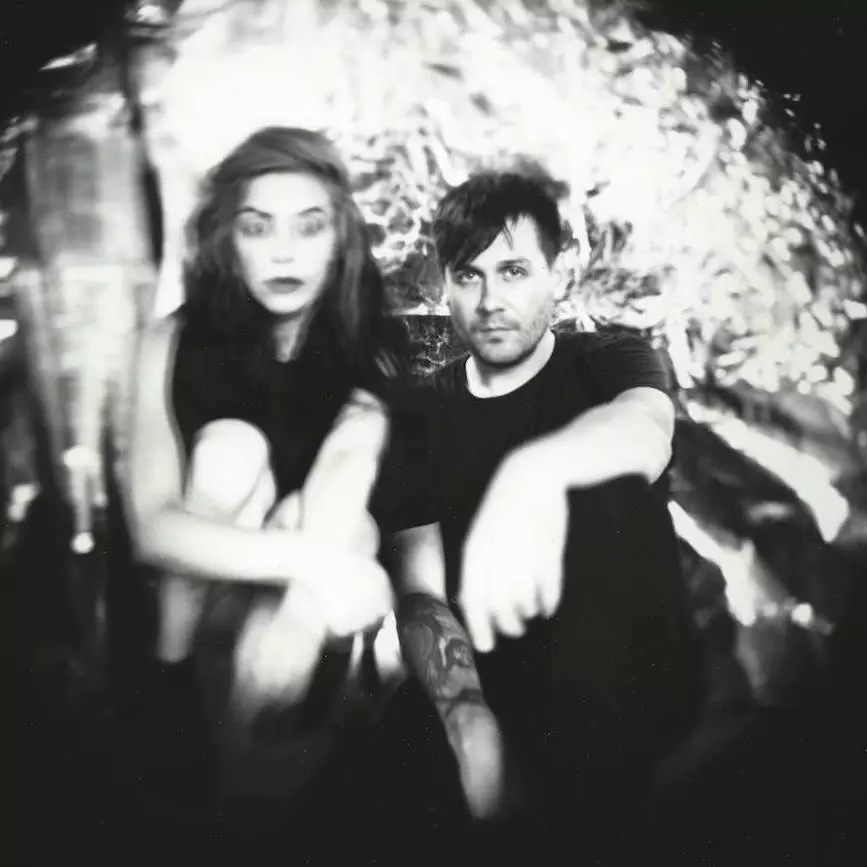
For Brooklyn's Azar Swan, getting spooky has never been an issue. From their debut album, Dance Before the War, in 2013, to their sophomore album, And Blow Us a Kiss, in 2015, the fun, dance-friendly synth-pop duo of Zohra Atash and Josh Strawn have embraced the darker side of life, touching on themes of war and death all within the constructs of traditional pop music.
<iframe width="620" height="349" src="https://www.youtube.com/embed/VGS4E7fyCik" frameborder="0" allow="accelerometer; autoplay; encrypted-media; gyroscope; picture-in-picture" allowfullscreen></iframe>
But on their latest album, The Hissing of a Paper Crane, Atash and Strawn relinquish tight orchestration and melody for a looser, more collaborative songwriting approach. Deconstructing their previous work down to its very essence, as they did on their subsequent album, Savage Exile, they create a sonic landscape this time around that is a freewheeling journey both beautiful and terrifying. The title song, which clocks in at nearly eight minutes, is an industrial meld of experimental noise. "I am the beggar of the world," Atash croons. "A wounded animal on the river of memory." It's a far departure from Azar Swan's previous albums, but collaboration with musicians like Paige A. Flash from Cult of Youth, and Thomas Boettner of Straight Panic, and the improvisational nature of the writing process was a healing act for the band.
"Our first record took four years from start to finish," Atash recently told the Recording Academy over the phone. "To widdle this approach down to just doing the music was cathartic. We're having a much better time with this music, and there's a beauty in it. I used to try and make things pretty to offset what I was feeling, but this creates a joy within myself that maybe sounds darker."
On the heel of their release party at Trans-Pecos in Queens, N.Y., which benefited migrant organizations, El Comedor and Contra Viento y Marea, Azar Swan spoke with the Recording Academy about the process of collaboration, the effects of climate change and healing during difficult times.
How was the release party?
Zohra: We had a great time. We saw old faces, new folks. We hadn't played here in a year or so. New York is where we play our community shows for the most part, so it felt like coming home even though it is my home. When Josh isn't here I don't play live without him anymore.
<blockquote class="twitter-tweet"><p lang="en" dir="ltr">OUT NOW ON DIGITAL AND CASSETTE. THE HISSING OF A PAPER CRANE. <a href="https://t.co/HmhTZTGbcR">https://t.co/HmhTZTGbcR</a></p>— Azar Swan (@AzarSwan) <a href="https://twitter.com/AzarSwan/status/1187766623077191680?ref_src=twsrc%5Etfw">October 25, 2019</a></blockquote> <script async src="https://platform.twitter.com/widgets.js" charset="utf-8"></script>
Josh, being that you live in New Orleans, are you constantly travelling back and forth to New York?
Josh: I've actually been here a lot in the last couple of months. My band, Blacklist, reunited for the first time in almost 10 years and we did a show in late August. Then I did a show with an industrial side-project of mine in late September, and then we had this show, so I've been up here a lot. But prior to that, for the earlier part of this year, especially in the winter and spring, Zohra was actually in New Orleans a lot. We've been working on stuff together, but I've been in New York more in the last couple of months.
Does living in different places as a band make it difficult to make music? Are you constantly emailing each other music?
Zohra: Not really. That stopped working for us, to be honest. I don't spend a lot of time online at all. I just showed Josh how many unread emails I have. It's up to 71,000. But band-wise, I would say I'm not the best person to be in a band in terms of the logistic stuff, but the writing and the music part I love. It felt like it would be more industrious if I spent more time in New Orleans because we have a makeshift studio there.
Josh: Our process has changed a lot, too. We used to do a lot of composing on a computer. As we started to use more hardware, and as we started to get more into the process and experimentation of governing sounds, the writing process became a different thing for us.
Zohra: In our first band, Religious to Damn, I used to write on a piano or on my Telecaster. But then as we transitioned into Azar Swan, I wrote a lot of the demos and Josh would help me with production right within Logic and GarageBand in 2012. That's when I started playing around with more electronic music. As we progressed, our writing process changed to where, with Savage Exile, I would send him the beginnings of the stuff I was writing and it was the first time he felt the writing was in a particular space that didn't need his output as much. With Azar Swan, it really is about our collaborative energy together. Josh had his own music, and I would contribute a bit to that, and I wanted him to sing on my parts, so Savage Exile became the first intersection of his output and mine in a band.
And then the next step for us was to be more present within the writing process and jam together. With this new record, I wanted to do this crazy drone and cacophonous, extended vocal technique, and then Josh spearheaded bringing some more musicians together from different camps from New Orleans and New York…
Josh: ...Chicago, Baltimore, all over the place.
Zohra: It was almost a surrealist approach of not over-composing and getting to know the music as it was being finalized. I would put some things down and then it would go into someone else's hands and then come back. The thing about The Hissing of a Paper Crane is that the chaos that we were shipping within Savage Exile, and the stuff in between what will be in the next record and the solo stuff we plan on releasing, is a marriage of all of these ideas, but we finally have more outlets for it.
Josh: With the way we've been working and creating so much stuff, that's kind of why The Hissing of a Paper Crane came about. We had all of this material; some of it being really hooky and dance-y and groovy, like (the 2019 Adult Swim single) "Empire Grave," and some of it being really crazy and experimental. We can put this out now and then we can work on tailoring these other projects. I'm excited about the idea of going into the music this time with more of a live energy.
<iframe width="620" height="349" src="https://www.youtube.com/embed/ucVLAxls-Yg" frameborder="0" allow="accelerometer; autoplay; encrypted-media; gyroscope; picture-in-picture" allowfullscreen></iframe>
The new album reminds me a lot of (Japanese experimental noise band) Boris. I saw them live a few years ago and they played for two or three hours. Similar to The Hissing of a Paper Crane, they really take you on this sonic journey. It felt like experimental theater almost.
Zohra: With The Hissing of a Paper Crane, the way that the first couple of verses were delivered in the title track, we were calling it nightmarish ASMR (Autonomous Sensory Meridian Response). I've been an ASMR aficionado since it started because I'm an anxious sleeper. I needed to find something online that would be healthy to fall asleep to and I found this community of people with the same issues who talked about ASMR and different noises, or "hissing." With The Hissing of a Paper Crane, the lyrics were written years ago but we didn't have any output within the constructs of a pop song to put some of those words and sounds in. It's a strange intersection of white noise, chaos and cacophony and it also feels very hypnotic; like you're slipping into a different realm.
Josh: People make the joke about noise music sounding like a washing machine or a vacuum cleaner. And then there's also the joke that you have kids and the kids end up falling asleep to the vacuum cleaner. These sounds that we think of, they should be loud and obtrusive. There's ways of contextualizing them and complicating that simplicity.
Zohra: The ASMR community, and people who listen to noise machines, has really grown. You'd think that a lot of these noises would be intense and that you'd need earplugs, but it's more trance without the techno beat. Trance is definitely what I feel when I listen to these types of frequencies. I went deep into that world and listened to the types of sounds and words you could get.
<iframe width="620" height="349" src="https://www.youtube.com/embed/t248_CcKb1M" frameborder="0" allow="accelerometer; autoplay; encrypted-media; gyroscope; picture-in-picture" allowfullscreen></iframe>
What hand did improvisation play on the album?
Zohra: It was almost entirely improvisation.
Josh: Except for the first half. A lot of it grew out of the fact that our friend in the Berlin techno scene was putting together a record where he was going to take a vocalist and use their voice to build these dance tracks. He invited Zohra to participate in that. I thought she was going to sing a couple of hooks, but she played me what she was going to send him and it was this massive orchestration that reminded me of everything from Diamanda Galas to the Suspiria soundtrack.
Zohra: Michael Wollenhaupt of Ancient Methods invited a few vocalists to basically do what I call an alientoric approach to music. Whatever I decided to give him he would compose around that. I thought it would be easy just to give him something, but it took me like three or four months to come up with material. I wanted to collaborate with him, it was an honor to be asked, but I could not take heed of what I could give him. I wanted to soundtrack a moment through voice by using an extended vocal technique. I've always been big into horror---we're both huge film fans---so soundtracking a moment that was a bit terrifying using breath and sounds was really interesting. The only words I gave him were "swallow the screw." He took it and he made this wonderful track and he told me he could have made a whole record out of everything I sent him.
Josh: I thought people should hear this. It was so intensely orchestrated already. You could just add some drums and drones to certain sections to make it even more interesting. And then we almost started reversing the process where I reached out to friends who were really talented who sent us textures and drones and then we would build off of that. We would go and make whatever noise over it with either our own voice or synthesizers. It was fun to change up the process that way and to focus on the process. Aside from the first track, which Zohra composed, it's not a meticulous composition album. It's very expressive.
Zohra: There was an improvisational aspect of not knowing where the next person was going to take it. I'm used to knowing the structure of a song. We used a lot of this drum machine that a friend of mine put me onto called the Lyra, which has its own unique story, and we used that to compose the bedrock of the album.
Josh: We also have to give credit where credit's due to our mixed engineer, Kris Lapke. I gave him a rough mix of where I thought things could drop out and come back in. We love what he does as a musician, so if he needed to add or change anything, he got that producer license. He had a big hand in arranging the music.
Zohra: It's a small team and Kris has been a huge part of the last three or four years of our lives as a band. He's been really valuable and we can't thank him enough.
Did you both go into this project wanting to collaborate with other musicians?
Josh: It really snowballed. I think the first person I asked was Mark Solotroff in Chicago who does the projects, Bloodyminded and Anatomy of a Habit. We wanted to work with Mark for a long time. We've been friends for a while but most of the music I've done has been in the realm of more traditional song structure, melodies and vocals. This was the first time where I thought Mark's sensibility would contribute a lot to what's going on. I know that this isn't my fortay. I'm not hugely experienced with speaking in these textural terms. One thing would come back and it would be so good and then I would get an idea to ask somebody else.
Zohra: We have a rotating cast of people we love collaborating with, especially people who really know their instruments. I only wanted to ask musicians to be a part of something so that that energy was there. I wanted this built on creating music and having it not take as long.
Josh: With collaboration, there's this omen of security. You don't have to feel like, ‘Oh, I did everything.' You have a lot of talented people around you that it would be really great to bring those talents together. There's been a huge sense of camaraderie and joy in creating something that we deeply care about.
<iframe width="620" height="349" src="https://www.youtube.com/embed/KtuJT4K93HQ" frameborder="0" allow="accelerometer; autoplay; encrypted-media; gyroscope; picture-in-picture" allowfullscreen></iframe>
You mentioned in the description of the album that it touches upon "explorations of a scorched earth." Immediately my mind went to climate change. Is that what you meant?
Josh: When you're making records and the Mississippi River is literally yards away from your house, it's impossible not to have that on your mind to some extent when that's your environment. Oftentimes, with noise records, or songs with fewer vocals, the song titles are kind of an interesting way to add context to the song. I've been reading Dark Ecology by Timothy Morton and The Uninhabitable Earth by David Wallace-Wells, so that's where my headspace is in. But we didn't sit down and say, ‘We're going to make a record about climate change.' When Doug (Moore, of Pyrrhon) passed over his vocals and lyrics for 'The Vengeful Sun,' we were like, ‘OK, let's roll with this.'
Zohra: What he gave us was just a shoe in for what was already happening with the direction of the album. But the thing about New Orleans is that it's one of those cities where it may not exist in 100 years. It might be under water. Living close to the river here in New York, for me, it's hard not to think of surges happening. It's a strange thing to wrap your mind around the fact that the ocean might eat up where you're currently living and breathing. It's hard to think about on top of all the other chaos going on, but it's scary, especially with all the fires in California right now.
Josh: It was definitely on our minds, even to the point where the beginning of ‘Accelerant' actually has this drone introduction that uses a sample of this family who were driving out of the Paradise fires in California last year. This guy is reassuring his kids the whole time that everything is going to be okay and you can tell that he's saying it because that's what he has to say, but you don't know if he believes it. You're watching this video and you're like, ‘I don't know how these people got out alive.' Also, when you're making records that are inspired by current events, you have to be careful about being too on the nose.
Zohra: We're very careful about the energy that goes into the stuff we make. I one hundred percent believe that the place you're in has to be from a place where you want to give something positive. Even if the subject matter is verboten, it should still lead to something that pushes for change. No one makes art that's worth anything without coming from that place, in my opinion. The goal for us is to always leave people with something positive.
I think especially now with everything that's going on politically, environmentally, an album like this is nice to get lost in. So, where do yourselves going at this point, as a band and individually?
Josh: 'Empire Grave' would be the best indication of where our music is going to go. It's groovy, it's aggro, but we're also doing this weird thing where it's kind of a dance-y song, but it also has elements of prog-pop where for like seven minutes you're getting a new hook and a new verse. It's almost like the attention span of dance music but trying to draw that out to make it work the way that pop music works.
Zohra: It has a lot of techno aspects, but there's proggish elements as well. In terms of the solo stuff I'm doing, it's an in-between. I didn't want to do something completely on my own until I felt like it was ready and it was something I was really proud of. We're on an upswing, creatively, so we're definitely really psyched on what the next record is going to be. It will be finished and come out sometime next year. We had a lull for a little while just because of what was going on politically. It was difficult to finish making music.
Josh: It was hard to finish and process stuff. It was more intense.
Zohra: I wasn't really inspired to put anything out. I was in more of a misanthropic mindset than I've ever been in my life and I didn't want to share anything. I've always been terminally optimistic, just hoping that things would get better. I believe that being creative and putting art out there can change people's mindsets. It certainly has for me.
But at that time between 2015 in 2017, it was like, 'let it all burn, f**k it, I don't care.' When Betsy Devos became the Secretary of Education, I just lost it. I didn't have any hope left and I thought it was all going to s**t. Josh really helped in nursing my wounds at that point. Going online into ASMR communities was helpful, too. It's been such a positive thing in my life for healing. How can the world not be a beautiful place? These are perfect strangers and they're helping me heal. It's a beautiful thing. And if we can soundtrack the way people are feeling and give them some amount of feeling like their barometer is at normal, that's all I can hope for.
