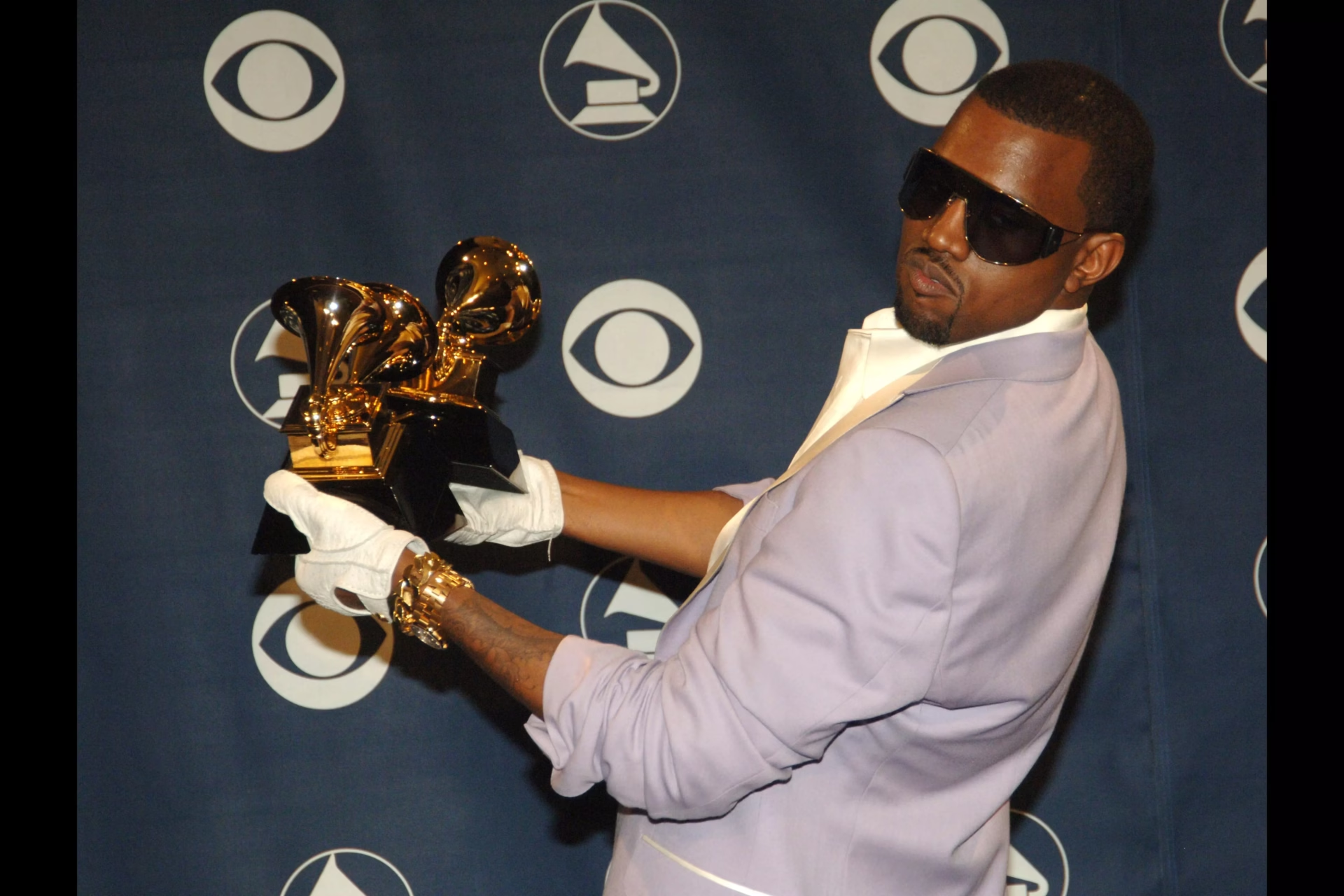
As the echo from resounding applause faded in Staples Center, Kanye West scanned the well-dressed attendees at the 47th GRAMMY Awards, gold gramophone in hand.
He took a deep breath and then embarked on a lengthy but heartfelt acceptance speech.
"If you have the opportunity to play this game of life, you need to appreciate every moment," he said. "I plan to celebrate and scream and pop champagne every chance I get, 'cause I'm at the GRAMMYs, baby!"
He triumphantly raised the award — one of three GRAMMYs he took home that night — above his head. West, then 27, had waited his entire life to receive the coveted honor. But in that moment, his victories over critics, adversaries and even death meant more than any tangible award.
Just two-plus years earlier, a severe car accident left West lying in a hospital bed. His cheeks were swollen from reconstructive surgery, and his dreams of becoming a rapper were nearly shattered. Still, not even a near-fatal collision held back the Atlanta-born native and Chicago transplant from pursuing greatness.
While recovering, West wrote and recorded "Through The Wire," a soulful anthem from his 2004 debut album, The College Dropout, that he performed with his jaw still wired shut. "They can't stop me from rapping, can they?" he said in the song's intro.
Dating back to the late '90s, West emerged as a sought-after collaborator by Jay Z and the Roc-A-Fella clique for his "chipmunk soul" beats, a style of production in which R&B songs are sampled, pitch-shifted, sped-up, and anchored by drum patterns to create a harmonious marriage.
Though West's name was thrown around as an in-demand producer, he envisioned his own lyrics flowing atop the soulful instrumentals he created. All he needed was an opportunity.
With The College Dropout, he seized that opportunity. The album went triple platinum stateside, peaking at No. 2 on the Billboard 200 and spawning a No. 1 single with Twista's "Slow Jamz," featuring West and Jamie Foxx. Though Foxx was an accomplished comedian at the time, he often credits West and the success of their collaboration as the inception of his own career as a singer.
West and Foxx's chart-topping chemistry trickled into "Gold Digger," the second single off West's sophomore album, Late Registration. The single went quintuple platinum, and took home the GRAMMY for Best Rap Solo Performance at the 48th GRAMMY Awards in 2006. West also won Best Rap Album that year.
Accolades aside, West's debut and sophomore efforts made hip-hop relatable to a broader audience. Songs such as "Jesus Walks," a track where he openly raps about his Christian faith, challenged the myriad of content focused on illicit activity. He preferred colorful button-ups and tailored blazers over baggy shorts and do-rags, foreshadowing his foray into fashion with his Yeezy clothing and shoe line.
Most of all, he wasn't afraid to smile. His light-hearted image later paved the way for other artists, such as Lupe Fiasco, Drake, and Chance The Rapper, to flourish as introspective creatives who purposefully scale back on hard-nosed street bravado.
West's influence and confidence led him to take on gangsta rap's spokesman head on. In 2007 he moved up the release date of his third album, Graduation, to challenge 50 Cent's Curtis to a friendly joust to see whose album would garner more first-week sales.
Graduation earned the No. 1 spot by a considerable margin, selling more than 950,000 copies in its first week, compared to Curtis' 691,000. After outselling one of rap's Goliaths with ease, the message was clear: It was West's world now. Graduation also earned West another GRAMMY for Best Rap Album for 2007, and a total of eight nominations, including Album Of The Year.
Nearly a year to the date following his mom's untimely passing in 2007, West released 808s And Heartbreak. The album debuted at No. 1 and sold more than 450,000 units its first week, but the album's artistic significance outshined its commercial performance. Enveloping West's confessional lyrics, the minor chord progressions intertwined with the thick Roland TR-808 drum machine patterns and Auto-Tuned vocals painted slate landscapes that couldn't be relegated to a single genre.
Fans were concerned their beloved rapper was departing from his affable persona. In actuality, he was paving a way for future generations of artists, such as Kid Cudi and The Weeknd, to boldly take melancholy to the mainstream.
Nearly everything he touched that year turned into GRAMMY gold. At the 51st GRAMMY Awards in 2009, he received six nods and took home awards for his vocal performance on T.I.'s "Swagga Like Us" (with Jay Z and Lil Wayne) and Estelle's "American Boy."
To locate West later in 2009, one had to travel across the Pacific Ocean to Honolulu. It was there West got some much-needed clarity on life. Sequestered in the tranquil, soundproof control rooms at Avex Recording Studio, West began work on his fifth album, My Beautiful Dark Twisted Fantasy. Black suits and ties were worn at all times by all personnel. This was business.
West spared no resource in chiseling his masterpiece. He recruited Jay Z, Nicki Minaj, Rick Ross, Pusha T, and Chris Rock to assist in the assembly of a record that unapologetically explored themes of devilish lust and ambivalent romance from the viewpoint of an African-American male striving to live the American Dream.
Receiving the rare five-star review from Rolling Stone, My Beautiful Dark Twisted Fantasy didn't take long after its release to join West's preceding albums at the top of the Billboard charts. The formalization of the production process and investment in resources paid off for West in the form of seven GRAMMY nominations and four wins for 2011, including Best Rap Album.
Ever the skillful collaborator, in 2011 he and Jay Z graced the world with massive singles such as "Otis" and "N****s in Paris" from their collaboration album Watch The Throne (also nominated for Best Rap Album the same year West won for My Beautiful Dark Twisted Fantasy). The two then embarked on what was, at the time, the second highest-grossing hip hop tour in history, bringing in $75 million domestically and internationally.
With all that cash, it'd be reasonable to assume West would spare no expense in the promotion of his next project, 2013's Yeezus. Given his past releases, it was apparent that West invested in copious hours of research to locate the proper creatives to execute his album artwork and visual content.
This time around, however, West opted for no cover art and a blank disc to represent his sixth album. It was a marketing ploy that was as raw, straightforward and experimental as the songs within. Some tracks that were deemed "too melodic" were actually removed from the album.
In spite of West's decision to intentionally disregard the traditional formula for terrestrial radio play, Yeezus still debuted at No. 1 on Billboard's charts. At the 56th GRAMMY Awards in 2014, the album received a nod for Best Rap Album; "New Slaves" earned the GRAMMY for Best Rap Song. Later that year, in May 2014, West wed Kim Kardashian, instantly transforming them into arguably the most powerful couple in show business.
West's most recent offering, 2016's The Life Of Pablo, is likely far from being the final installment in his discography, if his recent mountain hibernation is any indication. It was the first album in history to go platinum solely off of streams, racking up more than 1.5 billion listens to date. His name was also in the 59th GRAMMY ballot box eight times, including multiple nominations for "Famous" and "Ultralight Beam."
To date, West has been nominated for 68 GRAMMYs, winning 21 of them, which puts him in a tie with Jay Z as the winningest hip hop artist in GRAMMY history. Six of his seven solo albums reached No. 1 on Billboard's charts, and altogether he has sold more than 21 million albums worldwide.
Despite the investments in his own music, West still wasn't too busy to open the doors to G.O.O.D. Music (short for Getting Out Our Dreams) in 2004. The record label has since allowed artists such as John Legend, Big Sean, Pusha T, Kid Cudi, and a host of others to pursue their dreams without limits.
While moving forward, West has found other ways to give back. In honor of his late mother, Donda West, he co-founded Donda's House in 2013 to provide art and music program for at-risk students in Chicago.
If 40 really is the new 20, it's fun to imagine where West's genius will take him next. After all, as the GRAMMY winner once said: "My greatest award is what I'm about to do. I'm always thinking about the future."
Want more Kanye West? Revisit his GRAMMY highlights from over the years
(Ogden Payne documents the careers of up-and-coming hip hop and R&B artists for Forbes’ media and entertainment column. He has collaborated on articles with GRAMMY winners such as Chance The Rapper and Wyclef Jean, as well as nominees Tory Lanez, PartyNextDoor and D.R.A.M.)