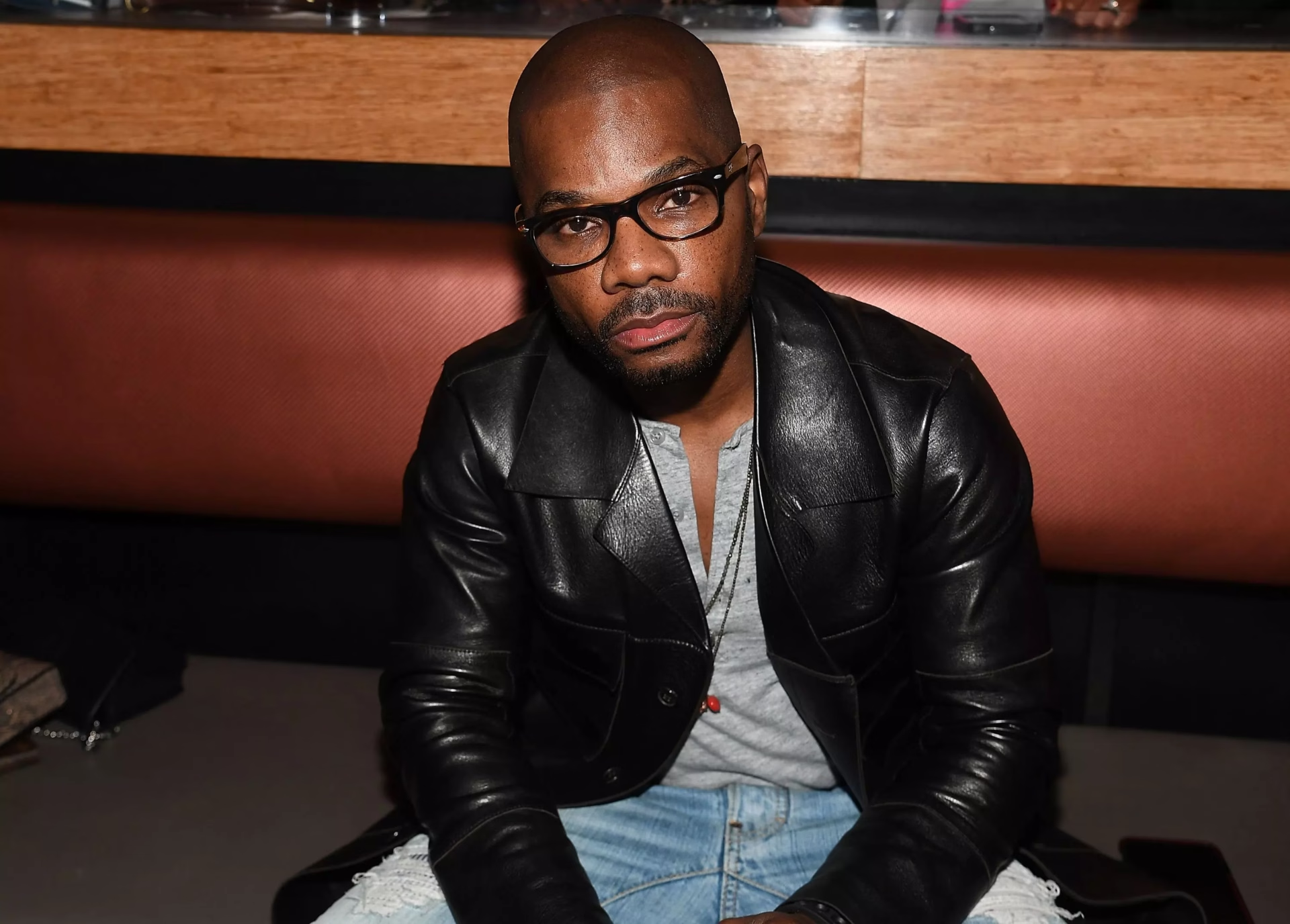
With hits like "Looking For You" and "Declaration (This Is It)," Kirk Franklin has made a career out of skillfully combining contemporary R&B and hip-hop with gospel. From the very start, Franklin has often collaborated with secular artists to drive his uplifting messages home.
Case in point: "Why," Franklin's catchy gem of a collaboration with Stevie Wonder, presents a social critique that fuses soul with a traditional fire-and-brimstone preaching style that zeroes in on modern-day ills such as materialism and terror in a way that remains particularly relevant today, especially given the work of acolytes such as Chance The Rapper and Kanye West.
"Why" is the 14th track on Franklin's 2005 release, Hero, which earned a GRAMMY for Best Contemporary R&B Gospel Album and was very much a concept album about a world still reeling from the Sept. 11, 2001, attacks on the World Trade Center, beginning with the opener "Intro — America The Beautiful."
And while "Why" represented one of several collaborations on the album, which also featured Yolanda Adams, Marvin Winans, P.O.D.'s Sonny Sandoval, and TobyMac, its place in history is secure mostly due to hits such as "Looking For You," which went to No. 1 on Billboard's Hot Gospel Songs chart, and "Imagine Me," which earned a GRAMMY for Best Gospel Song at the 49th GRAMMY Awards.
<iframe width="560" height="315" src="https://www.youtube.com/embed/jKaSmqce7_g" frameborder="0" allowfullscreen></iframe>
All the same, Franklin acknowledges the timeliness of "Why" considering today's current events.
"What we're going through now as a culture is something we've been going through for a long time," says Franklin. "That song was written just a few years after 9/11. It deals with the ups and downs of society, the rich getting richer and the poor getting poorer. That's kind of a narrative of the times, whether this century or last. It's just a dilemma we continue to wrestle with."
As with all his songs, Franklin credits God with giving him the inspiration for "Why."
"I really believe it spoke to what we were and can still speak to what we still are," he says. "Those things have a hard time changing until the people in control have more compassion for those that don't have. That's why the song is timeless. And as much as that's a compliment, it is also a disappointment that those issues are still here."
In terms of his songwriting, Franklin has no blueprint as to whether melody or lyrics come first, preferring to "just roll with it. … This one was definitely written with Stevie Wonder in mind, [and it was] inspired by his entire body of work.
Kirk Franklin, Andra Day To Perform On "GRAMMY Salute To Music Legends" On Oct. 13
"I approached him and said I have a song for the album I wanted him to do with me. I sent it to him, he heard it and really, really loved it. You don't even need to hear any of his songs, in particular, to be influenced by him [or] to enable you to pull from a certain vibe or feel that makes you want to go in that direction. I had the idea for him to play harmonica at the end."
Like the rest of Hero, which included samples from Patrice Rushen ("Haven't You Heard" is sampled in "Looking For You") and Tears For Fears ("Shout" in "Let It Go"), "Why" sports a sample of Deniese Williams' "Free," a track from her 1976 album, This Is Niecey.
"Samples occur very naturally and organically for me," says Franklin. "When done the right way, it can be a tip of the hat, a celebration of the person's artistry, a compliment to them."
As for the lyrics, Franklin very much assumes the persona of a minister in terms of delivering his message, raising the fervor with his litany of a society teetering on the edge of collapse.
"['Why' is] meant to be a sermon," he says. "I'm just trying to find creative, new ways of communicating. Just because you're a Christian, that doesn't mean you can't deal in social issues. We have a responsibility, as Christians, to talk about the things going on around us, and to try to resolve them."
And while he considers the deep track "Why" to be a strong highlight from Hero, Franklin admits he lets others make the decision when it comes to picking singles.
"I've never really been good at knowing what makes one and what doesn't," he says. "It's important for the artist to just create the music, then allow it to go where it's supposed to. When you start to think about what goes on the radio, the music can come across contrived. I just want to be able to do music that speaks to the souls of people, and to be real in that process."
As for his own choice of a favorite sleeper deep track, Franklin's go-to song comes from the catalog of the late gospel artist Thomas Whitfield, who specialized in merging jazz and classical into traditional gospel roots.
<iframe width="560" height="315" src="https://www.youtube.com/embed/hgyxKgeA-c8" frameborder="0" allowfullscreen></iframe>
"The song is 'In Case You've Forgotten' [from 1991's My Faith]," says Franklin. "It's a powerful, reflective song. When I'm getting ready to go onstage or to undertake a life-changing event, I'll listen to it in my headphones because it helps me focus, and reminds me of what it is I do and why I do it."
(Roy Trakin is a veteran music journalist whose work appears in Variety and Freedom Leaf, and still holds out hope for Suicide's induction into the Rock and Roll Hall of Fame.)
More Songwriting: Moby Reflects On 'Last Night' & "Everyday It's 1989"